
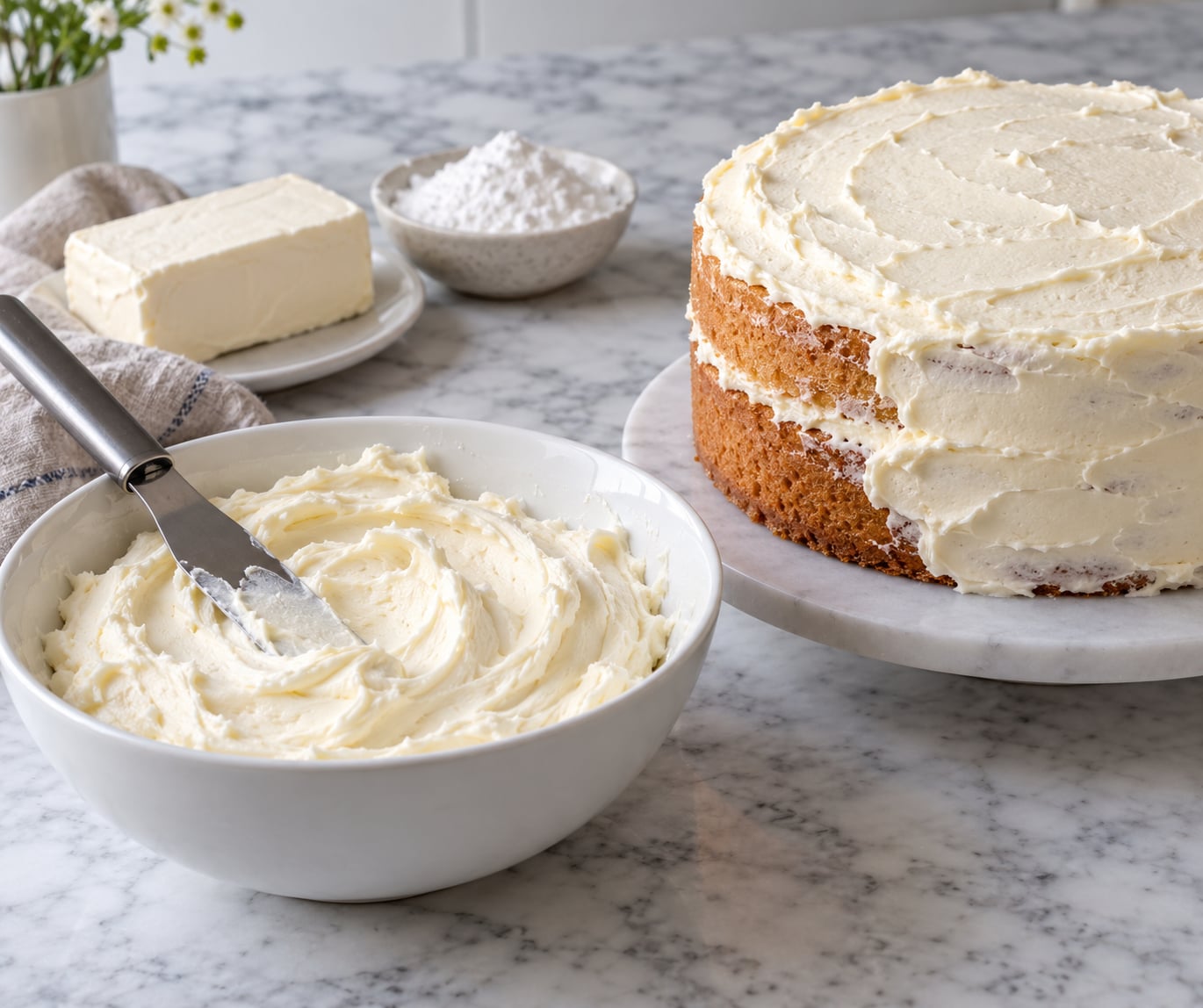
To make cream cheese frosting that is not runny, beat cold full-fat block cream cheese until smooth, add measured powdered sugar a spoonful at a time, and judge the texture before you add any liquid at all. The whole job takes about 10 minutes and needs no more skill than beating butter.
Most of the time the frosting is not wrong, it is just warm and under-fat. Chill the bowl for 15 to 20 minutes, beat it again, and it firms up. That is the first thing to try, and it works often enough that you should try it before anything else.
Table of Contents
- What You Need
- Step-by-Step: How to Make Cream Cheese Frosting That Is Not Runny
- Common Mistakes
- Frequently Asked Questions
- How do I thicken cream cheese frosting that is already runny?
- Can cream cheese frosting be piped, and how do I stop it melting in the bag?
- Why does my cream cheese frosting taste sour or look curdled?
- How long can cream cheese frosting be stored, and can I freeze it?
- How much frosting do I need for cupcakes, a layer cake, and a 9×13 sheet cake?
- Conclusion
What You Need
The ingredient list is short, but two choices decide whether the batch holds its shape: the cream cheese and the sugar.
- Full-fat block cream cheese, 8 ounces (225 g). Sold as a wrapped brick in the dairy case, not the whipped tub. Low-fat and triple-cream versions carry more water, and that water is exactly what you are trying to avoid.
- Powdered sugar, 2 to 3 cups (240 to 360 g). Measure it by weight if you can. Sifting breaks up the lumps that a measuring cup leaves behind.
- Unsalted butter, 4 tablespoons (60 g). Optional, but it gives you something to add when a batch is thin, and it builds structure you can pipe with.
- Vanilla extract, 1 to 2 teaspoons. Pure extract, not imitation, and measure it with a teaspoon rather than a glug.
- A pinch of salt to sharpen the tang.
- An electric mixer, stand or hand. A sturdy whisk and a lot of arm work will do it, but a mixer is the difference between smooth and grainy.
- A spatula, a bowl, and something to frost. A cold bowl helps more than most bakers expect.
Tools matter less than temperature. A glass or metal bowl that has been sitting in a warm kitchen is working against you, so chill the bowl for 10 minutes while the cream cheese softens.
Step-by-Step: How to Make Cream Cheese Frosting That Is Not Runny
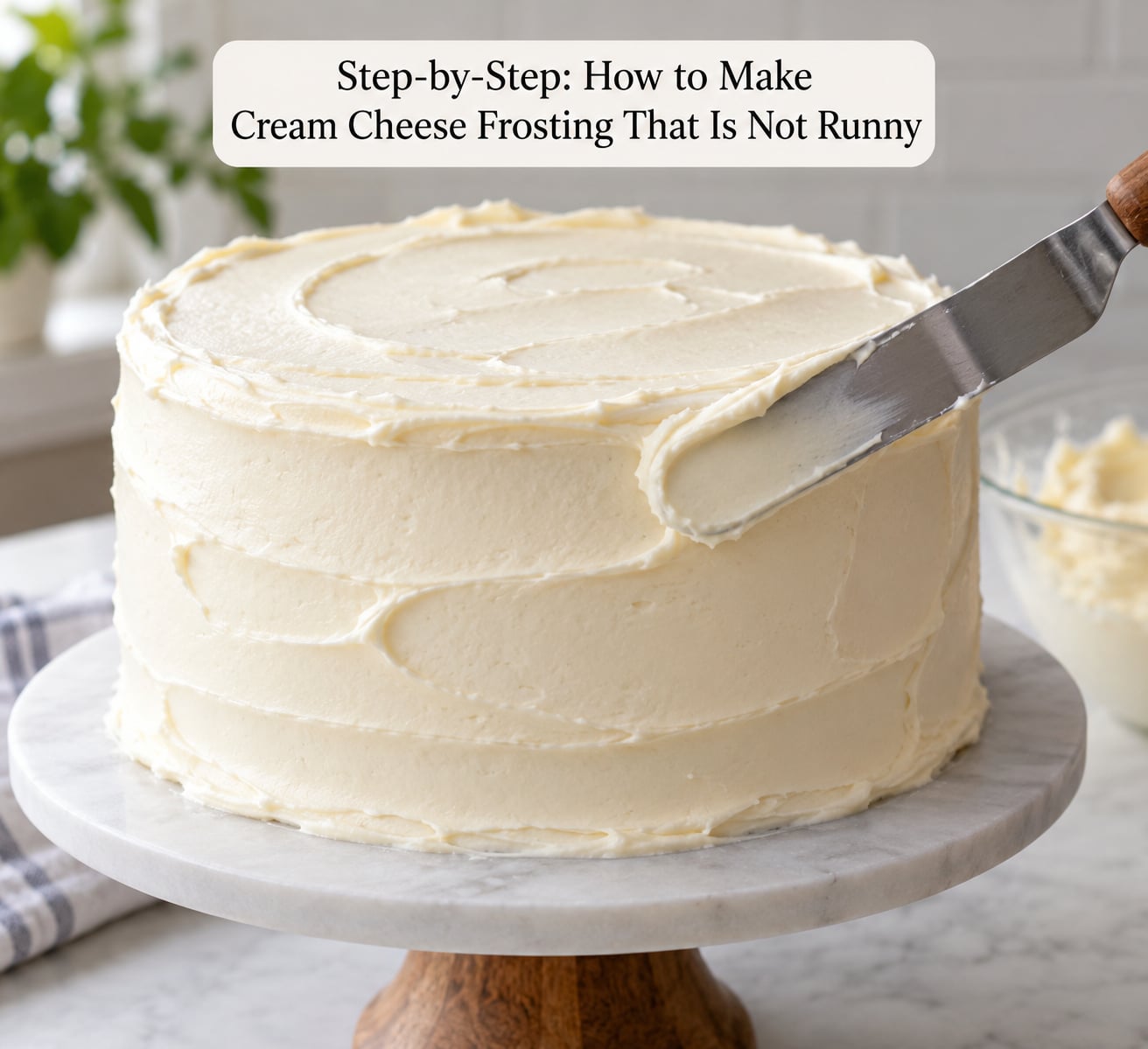
Step 1: Use Cold, Full-Fat Cream Cheese
Cold block cream cheese is firmer than room temperature cream cheese, and that extra structure is what holds everything else in place. Take the brick out of the fridge and let it sit for 15 to 20 minutes, just long enough to lose the knife-edge hardness.
Cut the brick in half and leave one half in the fridge. You will use the softened half now and can rescue a second, thinner batch later if you over-softened. Beat the softened portion on medium speed for 2 to 3 minutes until it is completely smooth with no lumps, scraping the bowl twice.
Do not add milk, cream, or juice at this stage. Once the cream cheese is smooth, the batch is done as far as the water is concerned.
Step 2: Add Powdered Sugar Gradually
Sift the powdered sugar if it has any hardened bits, then add it in 4 or 5 additions rather than all at once. On low speed, let each addition disappear into the cream cheese before the next one goes in, then bump to medium for the final addition and about 30 seconds of beating.
Powdered sugar contains a small amount of cornstarch, which is why it thickens more than table sugar would. That is a bonus, not a rescue plan, and it is worth knowing why this is the last step you should reach for.
Here is the part that trips up most people: if the frosting is already watery, more sugar usually makes it worse. Sugar dissolves into the free water in the bowl, and dissolving pulls still more moisture out of the cream cheese. The frosting gets glossier and looser while you look at it hopefully. Bakers on baking forums describe exactly this, adding sugar spoonful by spoonful with no change at all.
Step 3: Check That Your Cream Cheese Frosting Is Not Runny Before You Spread
There is one test that beats guessing. Lift the spatula, turn it sideways, and hold it above the bowl for five seconds. A frosting that is not runny keeps the ridge and the peak you left behind, and it does not slide off the end of the blade. If a thin ribbon drips off the edge, keep working on it.
Too loose? Add 1 to 2 tablespoons of additional softened butter or another 2 ounces of cold block cream cheese, and beat another minute. Too stiff? Add milk or heavy cream one teaspoon at a time, never a splash, and stop the moment the spatula holds its mark.
Give the bowl a final test at room temperature rather than straight from the fridge. Cold frosting always looks perfect and then slumps the moment it warms against the cake, so let the bowl sit out 10 minutes before you commit it to a crumb coat. If your layers are doming in the oven, how to make a layer cake that does not dome is worth a read before you start stacking.
Common Mistakes
Almost every runny batch traces back to one of six things. Here is what went wrong and what to change.
- Soupy, dripping off the spatula. Warm ingredients, a warm kitchen, or the frosting sat out. Chill the bowl for 15 to 20 minutes and re-whip on medium.
- Thin no matter how much sugar. Tub-style, whipped, or low-fat cream cheese. Stir in 2 ounces more full-fat block cream cheese, or start over with a brick.
- Holds a peak but slides off the cake. The layers were warm or the frosting went on warm. Chill the layers 20 minutes, crumb coat, chill again, then do the final coat.
- Oily with a watery layer on top. Over-whipped, usually at high speed for several minutes. Chill hard, then beat briefly on low. Often only partly recoverable.
- Lumpy and curdled but tastes fine. Cold cream cheese beaten too hard, or sugar dumped in at once. Let the bowl warm a few minutes, then beat on low until smooth.
- Grainy or gritty. The sugar did not dissolve, often because of undiluted food coloring. Pass the bowl through a sieve, or add a tablespoon of warm water and re-whip.
A note on language, because two of these get confused. Curdled means the mixture looks broken but the fat is still in the bowl; chilling and slow beating usually brings it back. Separated means the water has left the fat entirely and sits in a layer underneath, which happens after a real emulsion break. Freeze-dried fruit powder, cocoa, and citrus zest thicken the frosting. Fresh berries, pineapple, juice, and gel or liquid food coloring all thin it, and gel coloring is a frequent culprit in a frosting nobody can explain.
Two mistakes you cannot undo: over-whipping, and a frosting that has already broken and separated. Everything else on that list is recoverable with patience and a fridge. If you are working through a full cake, our tips for stuffing that stays crisp instead of soggy apply the same way of thinking: control moisture early rather than patching it at the end.
Frequently Asked Questions
How do I thicken cream cheese frosting that is already runny?
Chill the bowl for 15 to 20 minutes in the fridge, then beat again on medium for a full minute. Cold firms the fat back up. If it is still loose, beat in 1 to 2 tablespoons of softened butter or 2 ounces more cold block cream cheese. Cornstarch or meringue powder work too, one tablespoon at a time. Skip extra powdered sugar, which usually dissolves and thins the batch further.
Can cream cheese frosting be piped, and how do I stop it melting in the bag?
Yes, once it passes the spatula hold test. A frosting that keeps its ridge when you turn the spatula five seconds will hold a star tip. Fill the bag no more than two-thirds full, squeeze out the air, twist the top, and chill the bag for 15 minutes if your hands warm it. Warm hands and a warm kitchen are the reason piping bags fail in summer.
Why does my cream cheese frosting taste sour or look curdled?
A sour taste is normal and comes from the cultured cream cheese, so reduce the cream cheese or add powdered sugar rather than expecting sweetness to come from somewhere else. A curdled look is usually just cold cream cheese that was beaten too hard. Let the bowl stand at room temperature for 10 minutes and beat on low until it smooths out. It is still safe to eat.
How long can cream cheese frosting be stored, and can I freeze it?
Keep it in an airtight container in the fridge for up to 5 days, and let it come to room temperature for 20 minutes before spreading. It can be frozen in a sealed container for up to 2 months. Thaw it in the fridge, not on the counter, then beat briefly on low to bring the texture back. Because it is perishable, do not leave a frosted cake out longer than 2 hours.
How much frosting do I need for cupcakes, a layer cake, and a 9×13 sheet cake?
Plan on roughly 2 tablespoons per cupcake, 3 to 4 cups for a frosted two-layer cake, and about 4 to 5 cups for a 9×13 sheet cake. Make a small test batch first if this is your first time, because the yield depends more on how stiff your frosting is than on the recipe. A firmer frosting spreads further and covers more.
Conclusion
Start with cold, full-fat block cream cheese, add the powdered sugar in measured increments, and test the texture with the spatula before you add anything liquid. If a batch is already loose, the fridge and the mixer do most of the work in 20 minutes.
Then chill the layers before you frost and the frosting before you spread it. A cake decorated this month with the same frosting that slopped in June usually only needed a cold bowl and one more minute of beating. If you are serving it alongside a summer table, our guide to fruit salad that does not brown solves the same kind of timing problem in a bowl.