
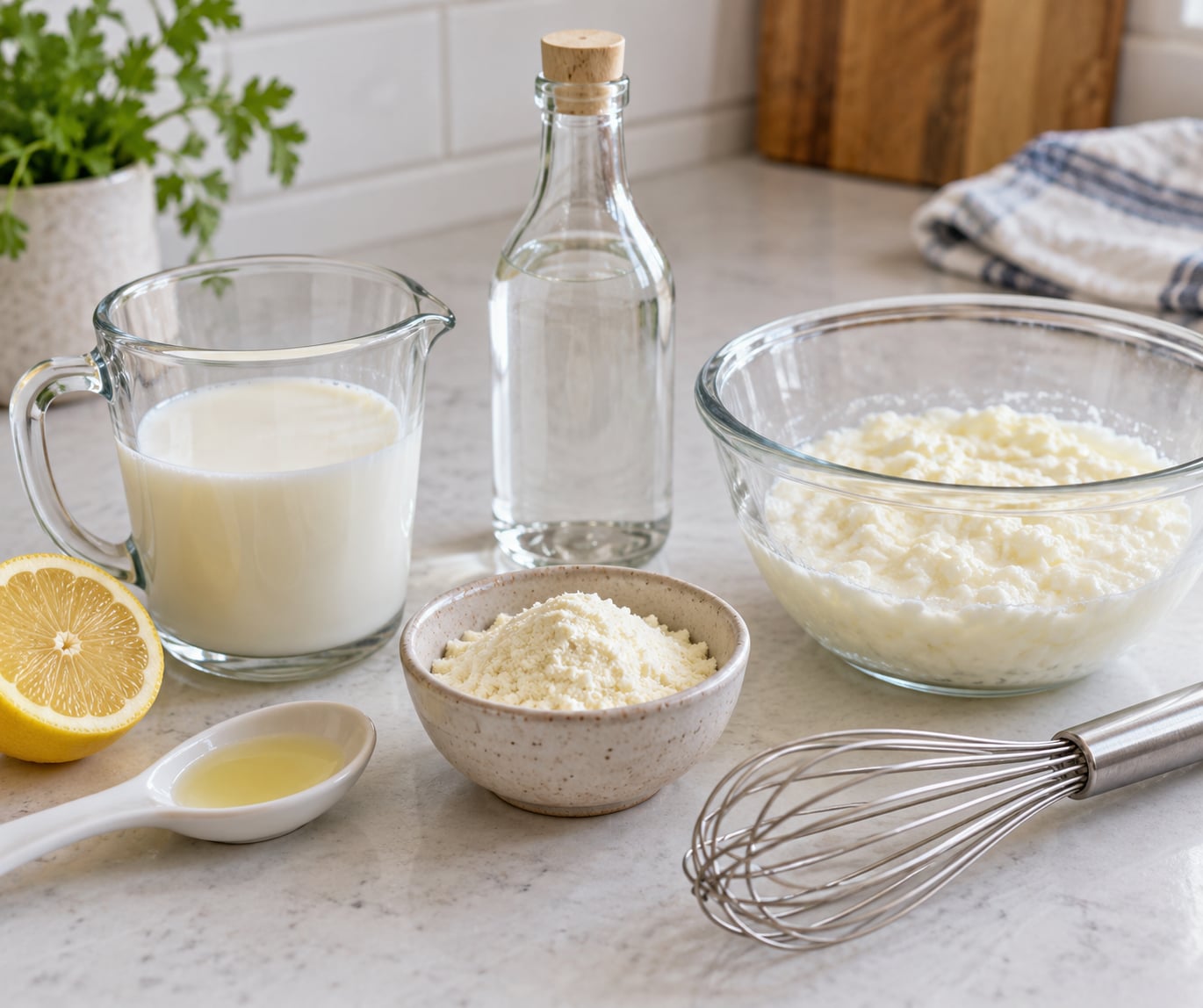
If you have five minutes and a bottle of vinegar, here’s how to make buttermilk substitute at home: stir one tablespoon of white vinegar or fresh lemon juice into a cup of milk, let it stand until it looks lightly thickened, and use it wherever the recipe calls for buttermilk. It takes almost no effort, needs one bowl, and works for pancakes, biscuits, muffins, cakes, dressings, and fried chicken.
The trick is the acid, not the milk. Buttermilk earns its place in a recipe because it’s slightly sour, and that sourness is what reacts with baking soda. Acidified milk gives you the same leavening and the same tender crumb.
What You Need
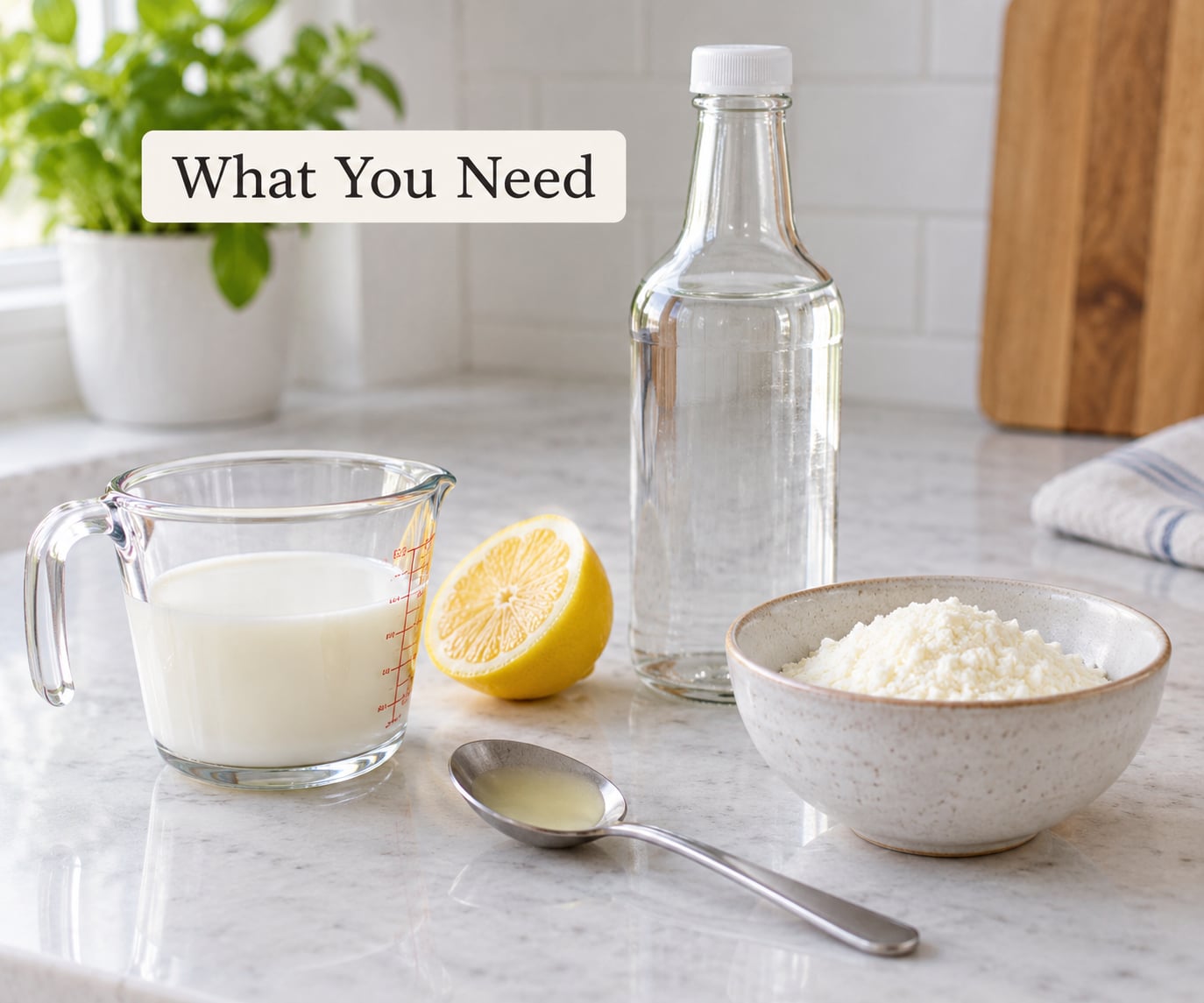
There are two ways to make a buttermilk substitute at home, and both start with plain milk.
The first is acidified milk. You add an acid to milk and let it sit. The usual acids are white vinegar (1 tablespoon per 1 cup of milk), fresh lemon juice (1 tablespoon per cup), or cream of tartar (1 and 3/4 teaspoons per cup). This is the fastest method and the one most recipes are built for.
The second is cultured dairy thinned with milk. Stir together half a cup of plain yogurt or sour cream with half a cup of milk. Kefir works the same way at a one-to-one ratio, and powdered buttermilk reconciles with water in the pantry.
Whole milk, low-fat milk, and buttermilk all contain roughly the same milk solids, so any of them works. Room-temperature milk curdles faster and more evenly than milk straight out of the fridge.
This substitute is meant for recipes that call for buttermilk. It is not a drizzle for cereal and it does not replace the milk solids in a plain cake batter.
Step-by-Step
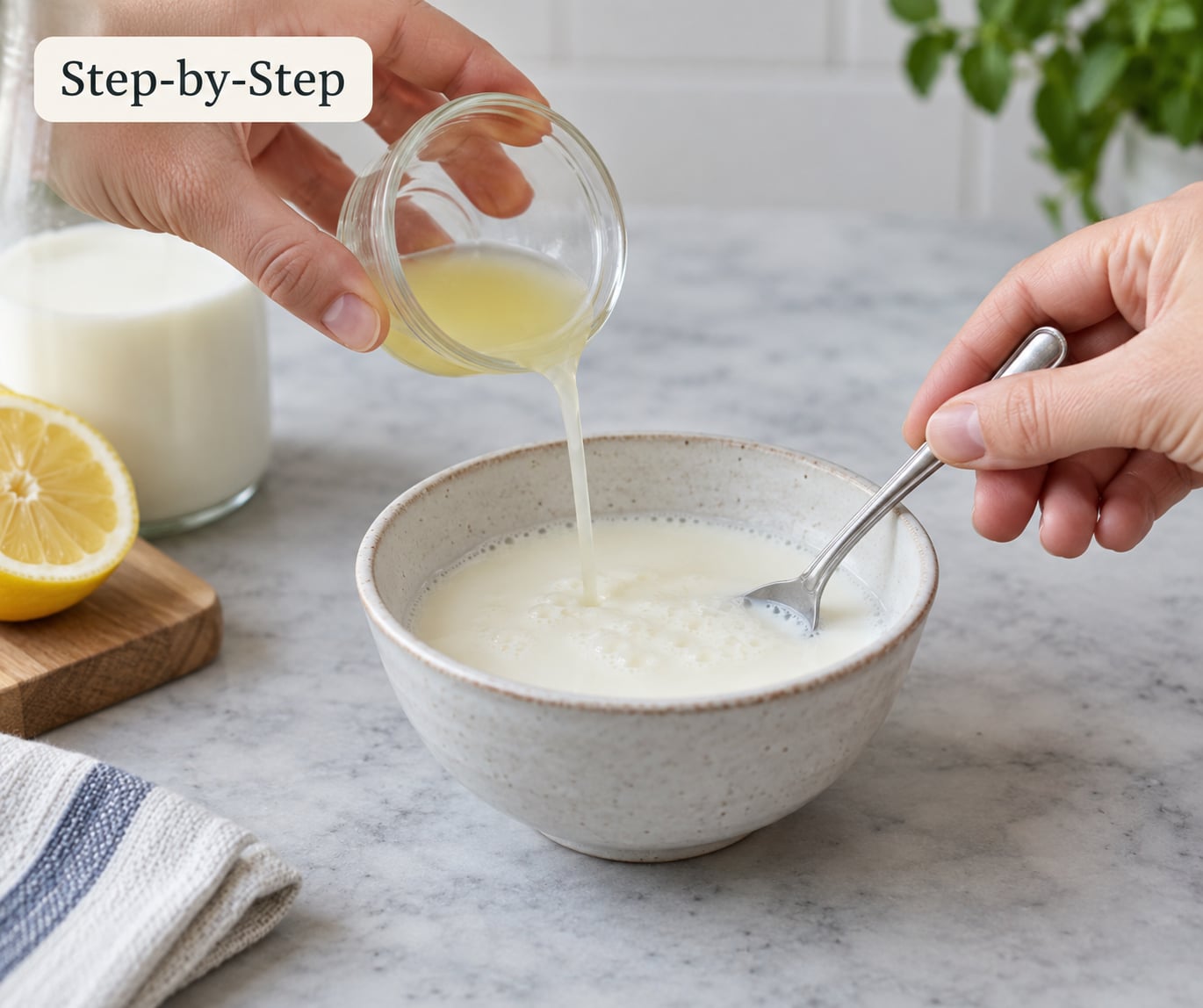
How to make buttermilk substitute at home with vinegar or lemon juice
- Measure the milk. Pour 1 cup (240 ml) of milk into a small bowl or a glass measuring cup. Let it come to room temperature first if you have a few minutes.
- Add the acid. Stir in 1 tablespoon of white distilled vinegar or 1 tablespoon of fresh lemon juice.
- Stir until combined. Ten seconds with a fork is enough. You want an even white liquid, not streaks.
- Wait 5 to 15 minutes. The surface will start to look faintly lumpy and slightly thicker, like milk that has been left out. That’s your cue.
- Use it. Pour it in where the recipe called for buttermilk. Don’t add any extra liquid, and don’t skip the rest if the recipe needs the acid to activate.
For a double batch, two cups of milk takes two tablespoons of acid and the same 15-minute rest. Scaling is linear, so measuring by the cup keeps the ratio honest.
Step-by-Step: Using a Powdered Buttermilk Alternative
Powdered buttermilk is the simplest option when you bake often and want zero thinking. It keeps for months in a cool cupboard, so it solves the problem of buying a quart and letting the rest go bad in the fridge.
- Check the label for the ratio. Brands differ; most call for roughly 2 tablespoons of powder per half cup of water to rebuild one cup of buttermilk.
- Mix powder with water first. Whisk the powder into the water until smooth, then let it thicken for a few minutes.
- Replace the buttermilk, don’t add to it. This is the mistake that wrecks cakes. If the recipe lists 1 cup of buttermilk, your mixture must total 1 cup, not 1 cup plus the powder.
How to Choose the Right Substitute for Your Recipe
Match the method to what you’re making, not to what you have on hand. Here’s how the four options stack up.
| Method | Ratio for 1 cup milk | Rest time | Best for |
|---|---|---|---|
| White vinegar | 1 tablespoon | 5 to 15 minutes | Biscuits, cornbread, savory batters, fried chicken |
| Lemon juice | 1 tablespoon | 5 to 15 minutes | Pancakes, muffins, lemon cakes, dressings |
| Cream of tartar | 1 and 3/4 teaspoons | About 15 minutes | Recipes needing smooth texture with no visible curds |
| Yogurt or sour cream | Half cup each | None | Rich flavor, fried chicken brines, thicker batters |
Pancakes and waffles do best with lemon juice, especially when the batter already has vanilla or berries. Biscuits and scones want vinegar, because the sharpness disappears against baking soda and butter. Cakes are the fussiest: yogurt thinned with milk gives the best flavor, while acidified milk is fine but slightly blander.
For fried chicken and other marinades, use the sour cream or yogurt blend. A thicker coating clings to the meat, and the added fat gives a better crust. Add one extra tablespoon of acid directly to the seasoned flour as well.
Salad dressings and ranch-style sauces are the easiest case. Any of the four works, since you’re using small amounts and the flavor stays in the bowl. The powder works here too if that’s what your pantry has.
For plant-based cooks, soy milk acidifies most reliably and behaves the closest to dairy. Oat and almond milk are thinner, so use a tablespoon and a half of acid per cup and expect a looser result. If you’re baking, keep baking soda at the level the recipe specifies rather than reducing it.
The same acid trick carries into sides, where a little tang cuts through richness. Our guide to restaurant-style mashed potatoes at home uses a splash of acid for exactly that reason. Cooking for a crowd? Our walkthrough on how to make a brunch at home has the timing worked out so the pancakes hit the table hot.
Common Mistakes
Almost every failed substitute comes down to one of six things.
- Too much acid. Double the vinegar and your cake tastes sharp and the crumb turns crumbly. Measure with the tablespoon, not the splash.
- Cold milk. Straight-from-the-fridge milk resists curdling, so you get thin, slightly sweet milk that never thickens. Let it sit on the counter, or warm it briefly, before adding acid.
- Expecting yogurt-thick curds. Acidified milk goes faintly lumpy at the surface; it does not break into heavy curds like yogurt. Over-aciding it gets you there, at the cost of flavor.
- Adding extra liquid. Your substitute measures one cup, so it replaces one cup of buttermilk. Pouring in an extra splash softens the crumb and thins the batter.
- Skipping the rest. The acid has a few minutes to reach the milk proteins. Stir and bake immediately and you lose most of the tenderizing and browning.
- Making too much. Acidified milk is best within a couple of days, and the tang fades after that. Freeze extras in ice cube trays and keep them about three months.
Two habits fix most of the rest. Measure acid with a proper spoon instead of pouring from the bottle, and always let the mixture reach room temperature. If you’re doubling a recipe, double both the milk and the acid rather than eyeballing the second cup.
Frequently Asked Questions
What can I use if I don’t have buttermilk?
Stir 1 tablespoon of white vinegar or fresh lemon juice into 1 cup of room-temperature milk and let it stand 5 to 15 minutes. Cream of tartar, thinned plain yogurt or sour cream, and powdered buttermilk all work too. For baking, match the volume of milk in the recipe so the batter’s moisture stays the same.
How much vinegar do I need for 1 cup of milk?
One tablespoon of white vinegar per cup of milk is the standard ratio, about 15 ml of acid to 240 ml of milk. Use distilled white vinegar rather than cider or balsamic, which are too strongly flavored. Rest the mixture 5 to 15 minutes until the surface looks lightly thickened.
Is lemon juice or vinegar a better buttermilk substitute?
Both work at the same 1 tablespoon per cup. Vinegar has a sharper, more neutral acidity that suits biscuits and savory batters. Lemon juice adds citrus flavor that flatters pancakes, muffins, and cakes, and pairs well with lemon zest or blueberry recipes. Neither will make the milk look like cultured buttermilk.
Can I make buttermilk substitute ahead of time?
Yes, but the tang fades. Mix it up to a day ahead and keep it covered in the fridge; use it within a couple of days for the freshest flavor. For longer storage, pour it into ice cube trays, freeze, then move the cubes to a bag, where they keep about three months.
Does a buttermilk substitute work for fried chicken?
It works well, and the acid helps tenderize the meat. Use the vinegar or lemon method for a thin buttermilk-style marinade, and add a tablespoon of acid straight to the seasoned flour dredge. Thinned sour cream gives a thicker, richer coating. Let the chicken rest in the marinade, then fry until it reaches 165F inside.
Can I use plant milk to make a buttermilk substitute?
Yes, though plant milk needs slightly more acid than dairy. Soy milk acidifies most reliably and is the closest match for protein and body. Almond and oat milk work but are thinner, so use about a tablespoon and a half of acid per cup. Coconut milk curdles unevenly and suits curries more than pancakes.
Conclusion
The simplest method is one tablespoon of white vinegar or lemon juice stirred into one cup of room-temperature milk, left to stand 5 to 15 minutes until lightly thickened. Measure the acid with a spoon rather than pouring, and use room-temperature milk so the acid actually bites.
When you’re substituting in a specific recipe, start by checking what the recipe calls for. Baking soda recipes need the acidity and should use one tablespoon of acid per cup of milk. Fried chicken and other marinades do better with the thicker yogurt or sour cream blend. Then use the substitute within a couple of days, or freeze it in cubes.