
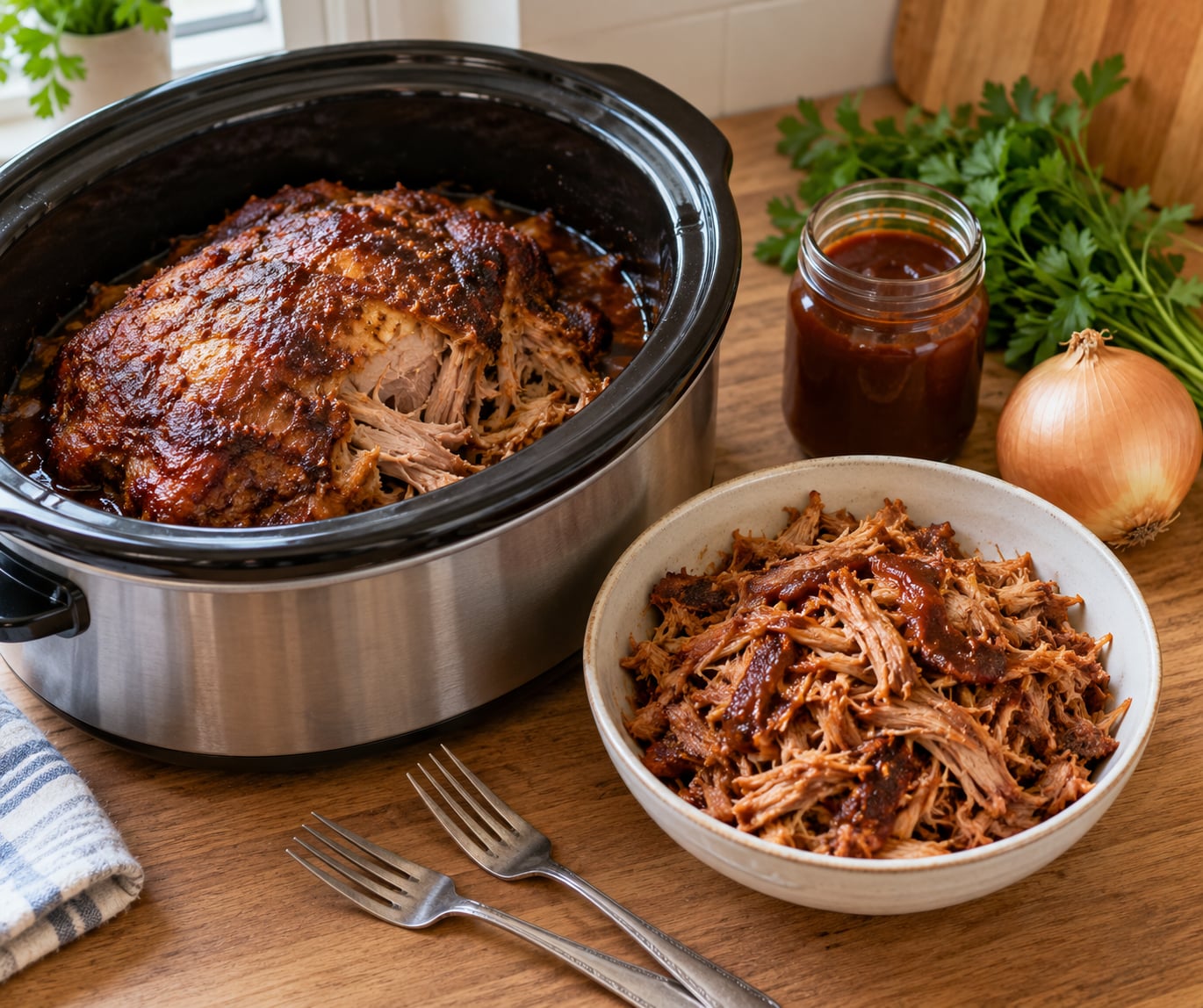
How to make pulled pork in a slow cooker is mostly about picking the right cut and giving it time. Season a bone-in pork shoulder, cook it covered on low for 8 to 10 hours until the internal temperature hits 195°F, then shred it warm and toss with sauce. Active time is about 20 minutes, and the whole thing feeds a crowd.
The recipe below is the version I make for weeknight meals and for the days when the whole family is hungry at different times, which is most of them. Pulled pork is also the best make-ahead food I know, since the leftovers turn into tacos, quesadillas, and freezer meals for the rest of the month.
What You Need
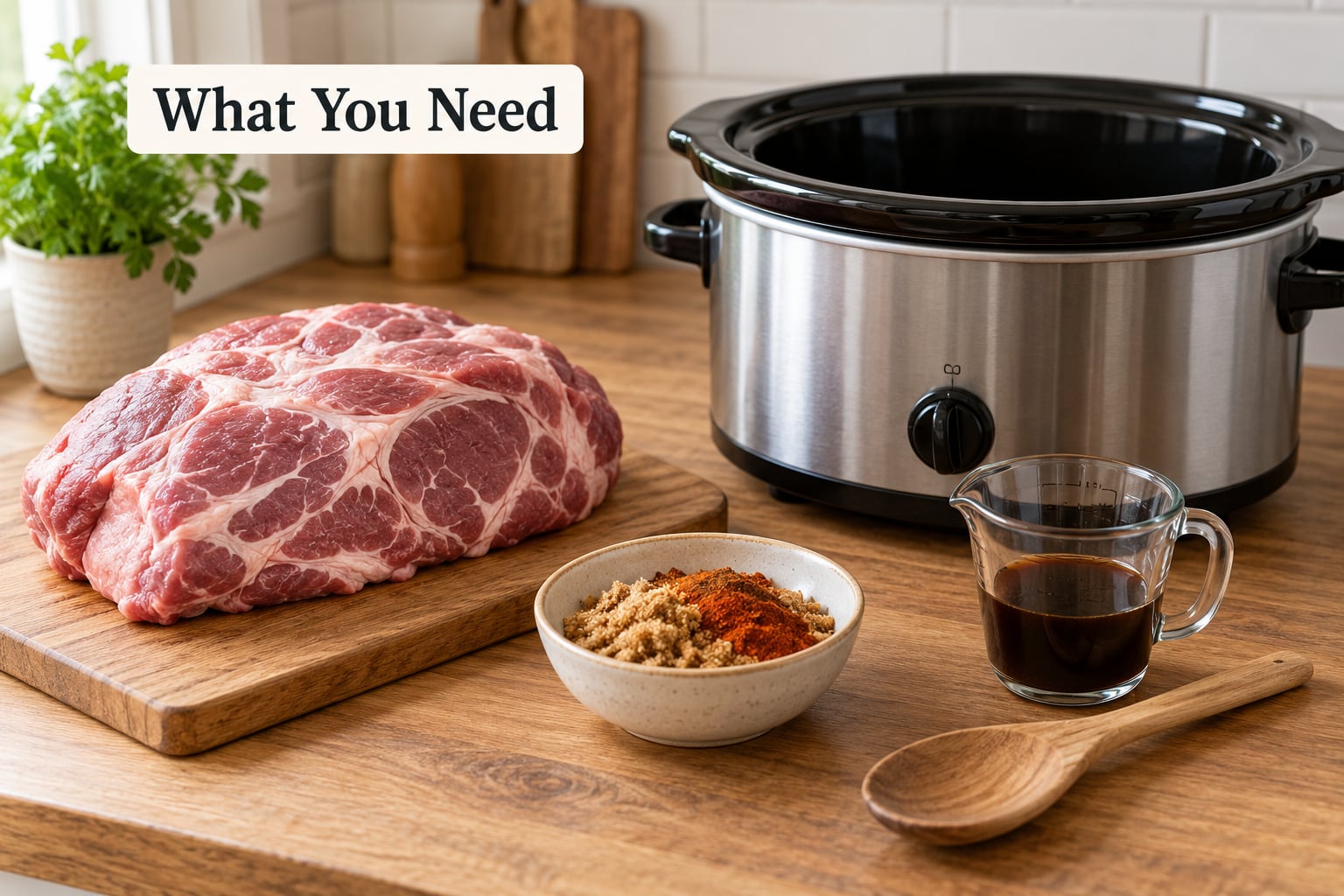
Everything here comes from a pantry except the pork. The measurements are written for a 6-quart cooker holding a 4- to 8-pound roast, which is the sweet spot where the meat sits in a tight, humid space instead of swimming in juices.
The Pork
- Bone-in pork shoulder (Boston butt), 4 to 8 pounds — the best choice for flavor and for staying moist through a long cook.
- Boneless pork shoulder, 4 to 8 pounds — easier to trim and easier to fit, and it shreds just as well.
Dry Rub
- 2 tablespoons kosher salt or coarse sea salt
- 2 tablespoons brown sugar
- 2 tablespoons smoked paprika
- 1 tablespoon chili powder
- 1 tablespoon garlic powder
- 1 tablespoon onion powder
- 1 teaspoon black pepper
- 1 teaspoon cumin
- 1 teaspoon dried oregano
- 1/2 teaspoon cayenne pepper, optional
Liquid and Sauce
- 1 cup chicken broth or water
- 1/2 cup Worcestershire sauce, plus more for the pot
- 1 tablespoon apple cider vinegar
- 1 cup barbecue sauce, for after shredding
- 1 large onion, cut into rings or thick slices
Use kosher or sea salt rather than table salt. Table salt is roughly twice as salty per tablespoon, and a shoulder has a lot of surface area for it to soak into.
Equipment
A probe thermometer is the one tool that changes the outcome. Without one, you are guessing, and guessing is how you end up with tough meat at hour eight. Two forks for shredding and a cutting board big enough for the roast round out the list.
What You Can Substitute
Brown sugar swaps for honey or maple syrup, and smoked paprika works as plain paprika if you want less smoke. Apple cider vinegar takes the place of white vinegar, and water works in place of broth. None of these change the cooking time.
Changing the pork, the liquid volume, or the cooker size does change it. Those are the only three variables worth fussing over.
Step-by-Step: How to Make Pulled Pork in a Slow Cooker
Choose and Prep the Pork
Buy a pork shoulder, which is also sold as a Boston butt or a picnic shoulder. The picnic shoulder comes from the lower arm and runs leaner; the Boston butt comes from the upper shoulder and carries more fat, and that fat is what bastes the meat for eight hours.
Avoid pork loin for this recipe. Loin is nearly fat-free muscle with no connective tissue to break down, so it stays tough no matter how long you cook it, and it dries out while it waits. It is the single most common reason someone’s first batch of pulled pork failed.
Trim the roast anyway. Leave a quarter-inch layer of fat on the surface, but cut away any thick slabs, which render into a greasy pool at the bottom of the crock. Slice two or three deep slashes into the meat if you like, then push a couple of garlic cloves into each one for flavor that reaches the center.
Pat the surface dry with paper towels. A wet roast steams instead of taking on rub, and the bark you want never forms.
Season the Pork
Mix the rub ingredients in a bowl until the color is even. Seasoning works best in two passes: rub on about two-thirds of the mixture, then the rest right before the pork goes into the cooker, so the top layer has not dissolved into a paste during prep.
Push the rub into every surface, including the sides and the ends, and do not forget the bottom. It does not matter that it looks like far too much. The seasoning will not all survive eight hours, and the seasoning is the only place salt and sugar come from.
Pour the broth, Worcestershire sauce, and vinegar around the pork, not over it. Liquid pooled on top washes rub off the surface and leaves the seasoning where you least want it.
Load the Cooker and Start the Clock
Scatter the onion across the bottom of the crock and set the roast on top so it sits slightly above the liquid. That keeps the underside from sitting in a puddle and lets steam move around the meat.
Put the lid on and set the cooker to low. Cook for 8 to 10 hours, or 4 to 5 hours on high. A large or frozen roast needs closer to the long end of that range.
Leave the lid alone. Every time you lift it to check, you let heat escape, and most slow cookers take 20 to 30 minutes to climb back to temperature. Checking every hour can add an hour to your cook.
Slow Cook Until Shreddable
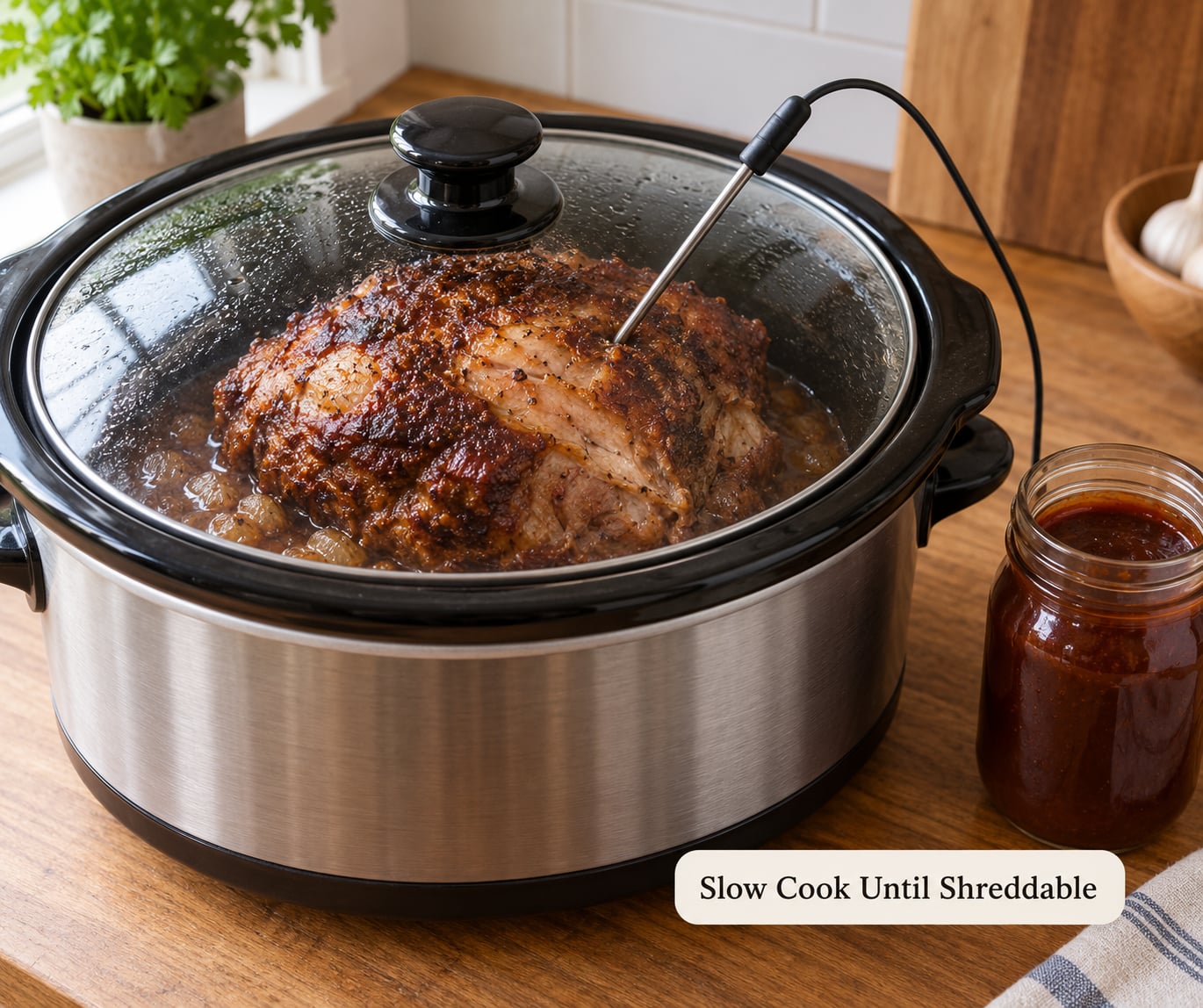
Time alone is a rough guide, so use temperature. Insert the probe into the thickest part of the roast, avoiding any bone. For food safety, intact pork needs to reach 145°F, and slow cookers hold that safe temperature easily. For texture, keep going until the center hits 195°F to 205°F, which is where collagen has converted to gelatin and the muscle fibers fall apart.
A low setting runs around 190°F and a high setting around 300°F at the stone. The low setting gives the fat more time to render slowly, which is the difference between juicy and greasy, so low is the better choice if you have the hours.
How to Read the Time
- 3 to 4 pounds: 7 to 8 hours on low, or 3.5 to 4.5 hours on high.
- 5 to 6 pounds: 8 to 9 hours on low, or 4.5 to 5.5 hours on high.
- 7 to 8 pounds: 9 to 10 hours on low, or 5 to 6 hours on high.
These times are estimates from the moment the cooker settles back to temperature, not from the moment you press the button. A frozen roast adds 45 to 60 minutes on low.
When It Is Done
Check the temperature at around the seven-hour mark on low, then every 45 minutes after. You are looking for 195°F to 205°F and a roast that gives slightly when you press it.
The fork test is a reasonable backup. Slide a fork into the thickest part and twist; if it comes free with almost no resistance, the meat is ready. Thermometers are more reliable, though, since temperature stays consistent between roasts while texture varies a little.
Rest the meat for 20 to 30 minutes before you shred it. The juices settle back into the fibers during that time, which is the difference between moist pulled pork and dry pulled pork.
If You Notice Something Odd
A thin layer of orange-tinted grease on top is normal; that is the fat rendering. If liquid ever rises to the halfway mark of the roast, spoon some off so the meat is not braising. If the meat is already shreddable four hours early, cut it anyway, because pork shoulder will not get tough again in a covered cooker.
Shred, Sauce, and Serve the Pulled Pork
Pull the roast out and set it on a cutting board, or lift it out with a big spoon if the bone is stubborn. Use two forks, one in each hand, to pull the meat apart in the direction of the grain. Shredding hot is far easier than shredding cold; a chilled roast fights you the whole way.
Skim the fat off the reserved juices in the crock. Toss the shredded meat with a splash of those juices first, then fold in about half the barbecue sauce. Adding sauce after shredding keeps the meat texture better than simmering it in sauce, which is the reason most saucy slow cooker pulled pork turns to mush.
Taste and add the rest of the sauce gradually. You want the meat to look dressed, not drowned, and the sauce should stick to the strands rather than pool at the bottom of the bowl.
For the last thirty seconds before serving, put the sauced pork in a covered pot on warm with a splash of extra liquid if it looks tight. It arrives at the table hot and loose.
Serve it in split buns with a vinegar-based slaw, or pile it over nachos. It works as a taco filling, folded into a quesadilla, or turned into pulled pork mac and cheese. If you want to round out a low-effort dinner, a grain bowl built around leftover pork is an easy second act.
Common Mistakes and Tips
The Meat Is Bland
Under-seasoning is usually the cause, and it is almost always caused by rushing the rub. Season all sides generously, use salt rather than leaning on the spices, and hold back a final sprinkle for right before the lid goes on.
The Meat Will Not Shred
If the fork test still fails at eight hours, give it two more hours rather than trying to force it. Pork shoulder that has not hit 195°F has not finished breaking down. Cutting the meat into two or three chunks before cooking helps a lot, because more edges mean more surface for heat to reach.
The Meat Is Dry
Three causes account for nearly every dry batch: pork loin instead of shoulder, cooking on high for too long, or letting it sit on the warm setting for hours. Fix the cut first, then slow the heat down, and pull the pork at 205°F rather than pushing past it.
The Result Is Greasy or Watery
Too much liquid turns pulled pork into soup. Keep it at about a cup, and keep it around the meat rather than over it. For grease, trim the thick fat cap before cooking and skim the surface afterward.
The Crock Is Too Full
A crowded cooker cooks unevenly because heat cannot move around the meat. Fill no more than two-thirds of the crock, and cook in batches if you need to. This also answers a question readers ask constantly about pull-apart pork in a small 4-quart cooker: it works, but only for a small roast.
You Pulled It Too Early
Undercooked pork is tough and disappointing. If the temperature is below 195°F, the collagen has not converted yet and the meat will not pull apart, no matter how long you shred it.
Tips That Make It Easier
- Prep the night before. Trim, season, and refrigerate the pork in a sealed bag overnight. Set it in the cooker with the liquid in the morning and walk out the door. This is the only way to make it work on a rushed morning.
- Use the delay start. If your cooker has one, set it for the morning so the roast starts while you are at work. Add cold liquid and cold meat together, never warm meat into a cold crock.
- Add smoke flavor cheaply. A teaspoon of liquid smoke in the pot, or a splash of whiskey, gives a smoky note that a slow cooker cannot produce on its own. Go light, since it is easy to overshoot.
- Schedule the sauce. Do not simmer the meat in barbecue sauce for the last hour. Shred first, then toss, so the texture stays right.
- Let leftovers sit overnight. Pulled pork reheated in its own juices on day two tastes better than it did fresh out of the pot.
Freezing works well, and pulled pork is one of the few things I freeze without thinking twice. Cool the meat fully, leave the sauce off, and bag it flat in single-meal portions. Thaw in the refrigerator overnight, then warm it with a splash of broth or water and the sauce added at the end.
Refrigerate leftovers within two hours of serving and eat them within three to four days. Reheat them in a covered pot over low heat or in a 300°F oven, adding a little liquid so the meat steams instead of drying. A slow cooker on warm with a cup of broth is an easy option, and it does not take long.
Leftover pulled pork rarely goes to waste. It is a quick filling for a pork chop dinner that stays juicy, it works well folded into a homemade patty on a bun with mustard, and it tops a grain bowl the next day with whatever vegetables you have left.
Frequently Asked Questions
What is the best cut for pulled pork in a slow cooker?
Pork shoulder, also sold as a Boston butt, is the best cut. It carries enough fat to stay moist and enough connective tissue to break down into shreds at 195°F. A boneless shoulder works well and is easier to trim. Avoid pork loin, which is too lean and stays tough no matter how long it cooks.
How long does pulled pork take in a slow cooker?
Plan on 8 to 10 hours on low, or 4 to 5 hours on high, for a 4- to 8-pound roast. The slow cooker high setting does not sear, so the total time on high is much closer to the low time than most recipes suggest. Check temperature rather than the clock, and keep going until the center reaches 195°F.
How do I know when pulled pork is ready to shred?
Use a probe thermometer in the thickest part of the roast, away from bone. You want 195°F to 205°F, where collagen has turned to gelatin and the muscle fibers give up. The fork test works as a backup: a fork pushed into the meat and twisted should slide out with almost no resistance. Rest the meat 20 to 30 minutes first.
Can I add vegetables to pulled pork in a slow cooker?
Yes. Onions, sliced bell peppers, and halved baby potatoes work well because they soften at the same rate as the pork. Add sturdy vegetables at the start and delicate ones such as peppers in the last hour. Adding vegetables releases extra liquid, so cut back the broth to about half a cup if you skip the liquid entirely.
How should I store and reheat leftover pulled pork?
Refrigerate within two hours in an airtight container and eat within three to four days. Reheat in a covered pot over low heat, in a 300°F oven, or in a slow cooker on warm with a splash of broth so the meat steams. For freezing, cool the meat fully, leave the sauce off, bag it flat, and add sauce after thawing.
Conclusion
The method is short enough to remember: season a trimmed pork shoulder generously, cook it covered on low for 8 to 10 hours until the center reaches 195°F to 205°F, rest it, shred it warm, and add the sauce only after it is in strands. Cut, temperature, and patience do all the work.
Start with the cut. Buy a bone-in Boston butt, trim the thick fat cap, and mix the rub while the coffee brews. Everything after that takes care of itself.