
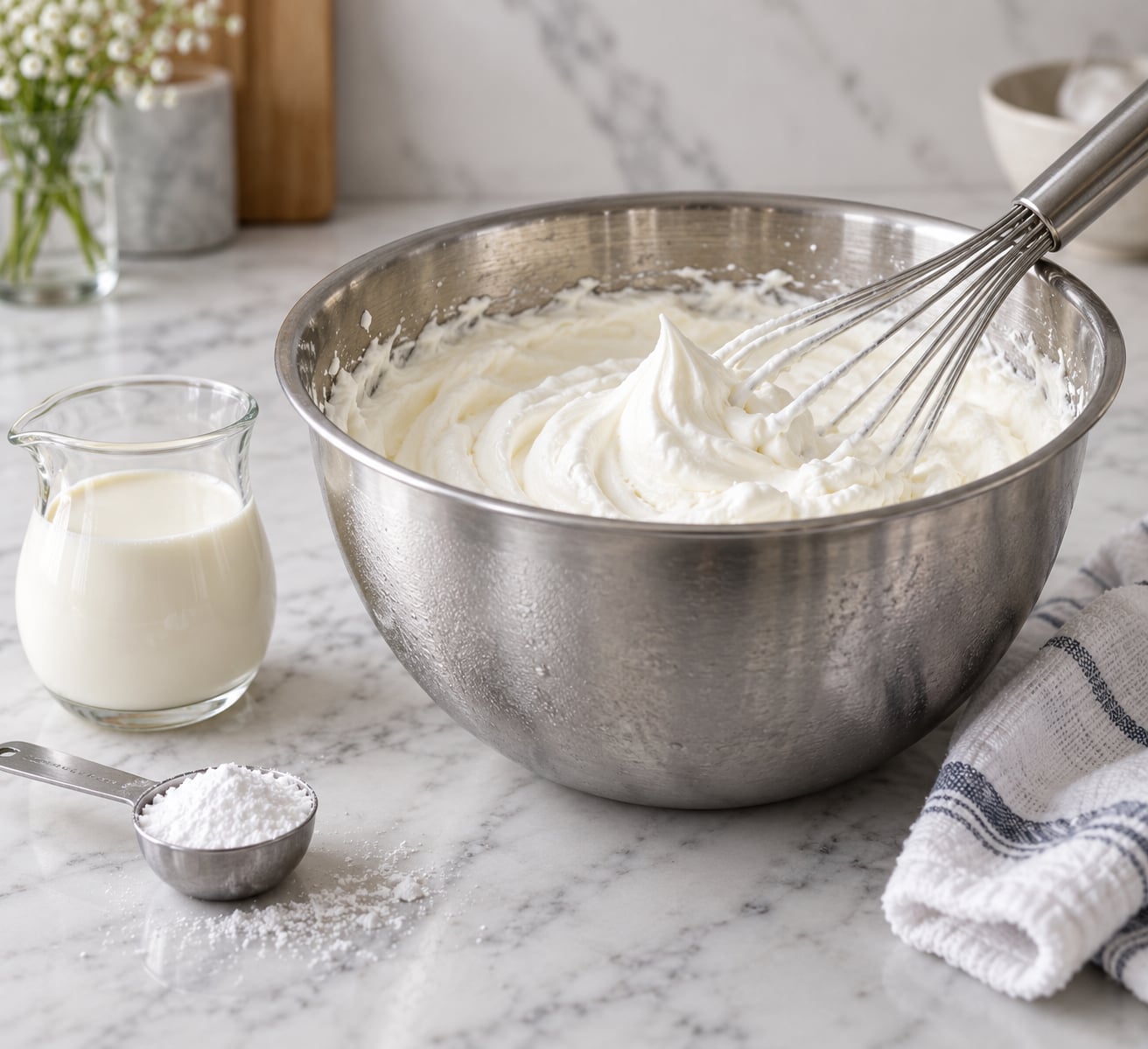
You can whip cream by hand in about two to three minutes using cold heavy cream, a chilled bowl, and a balloon whisk. No mixer required. The whole trick is keeping the fat cold and stopping the moment the peaks look the way you need them.
Hand-whipping is slower than a mixer for big batches, and nobody pretending otherwise. For one or two cups it is faster than digging an appliance out of the cabinet, and the texture is just as good.
What You Need
Everything for a basic batch fits in one wide bowl. Exact quantities matter more here than brand names.
- 1 cup heavy cream or heavy whipping cream at 36% milkfat or higher, straight from the fridge
- 1 to 2 tablespoons confectioners sugar for a dessert topping, 2 to 3 tablespoons for a sweetened pastry filling
- Half a teaspoon vanilla extract and a small pinch of salt
- One balloon whisk — the rounded, all-metal kind with plenty of wires
- One wide, shallow metal bowl that fits your hand on the rim so you can turn it
- A damp kitchen towel to sit under the bowl
Granulated sugar works too, but it takes longer to dissolve. For a batch larger than two cups, go with the powdered kind so you do not end up with a grainy bottom.
The cream is the one item you cannot substitute around. Here is how the common dairy options actually behave when you put a whisk to them.
| Cream | Milkfat | Whips to stiff peaks? |
|---|---|---|
| Double cream | About 48% | Yes, quickly and very stably |
| Heavy cream / heavy whipping cream | 36% and up | Yes, the reliable all-rounder |
| Whipping cream | 30 to 35% | Soft and medium peaks only |
| Light whipping cream | About 30% | Loose peaks, collapses fast |
| Half and half | 10 to 18% | No |
| Non-dairy creamer | 0% | No, it deflates within minutes |
Cooks who bake seriously are blunt about this one: it has to be real cream. No low-fat, no half and half, no plant cream expecting a miracle.
One cup of cream at 36% roughly doubles in volume, so 1 cup gives you about 2 cups whipped, half a cup gives you about 1 cup, and 1.5 cups gives you close to 3. Plan on that when you are making a pie.
Step-by-Step
How to Chill the Bowl and Cream
Put the bowl, the whisk, and the cream in the fridge for 20 minutes. If you have a few minutes more, freeze the bowl and whisk for 15 to 20 minutes instead — the freezer is what makes the difference on a warm day.
Most people who whip by hand freeze a large all-metal balloon whisk and a wide shallow metal bowl before starting, then work in half-cup to one-cup batches. Both ideas are sound.
Metal conducts cold straight out of the freezer, which is why it needs less chill time than glass. Glass insulates, so if that is all you have, give it a full 30 minutes in the freezer. Metal also wins on grip, since the handle gets cold fast.
Then roll the damp towel and wedge it under the bowl. A slipping bowl wastes more time than a slow wrist ever does.
How to Whip Cream Until It Forms Peaks
Pour the cold cream into the cold bowl. Add the sugar, salt, and vanilla now, then start whisking slowly with small circles at the bottom of the bowl until the mixture looks slightly thickened and the sugar has disappeared.
That first minute is not wasted time. It dissolves the sugar before any air goes in, which is what keeps the finished cream from tasting gritty.
Next, move to a steady back-and-forth motion across the bowl, resting the rim on one tine for leverage and letting your index finger ride a neighbouring tine for balance. Pace beats speed — a medium, even rhythm usually reaches soft peaks in two to three minutes, and a hard, fast arm just tires out.
Turn the bowl a few degrees as you go so the far side does not sit untouched. As the cream thickens, lift your wrist and use less of your arm, letting the whisk do the work.
Here is what each stage looks like, and what it is for.
| Stage | What you see | Best for |
|---|---|---|
| Ribbon stage | The cream falls off the whisk in a wide ribbon and leaves a trail that slowly closes | Too thin to use, this is just the start |
| Soft peaks | Peaks flop over when you lift the whisk | Topping pancakes, French toast, and hot chocolate |
| Medium peaks | Peaks curl over and hold their shape briefly | Filling tarts, folding into mousse, spreading on cake |
| Medium-firm peaks | Peaks hold but the tips bend under a spoon | Piping on cakes and cupcakes |
| Stiff peaks | Peaks stand straight up and hold when the bowl is tipped | Dolloping on pie, filling cream puffs, no-churn ice cream |
Stop earlier than feels right for anything you will pipe. Piping bags squeeze the cream, and stiff peaks that look ready in the bowl can go grainy in the bag before they reach the cake.
Once you pass stiff, the fat starts breaking down into water and solids. The cream goes dull and grainy, then a minute later it turns to butter. That is the whole reason this is a fifteen-second check rather than a two-minute check.
How to Keep Whipped Cream Stable
Plain whipped cream is a fragile foam. It holds for a few hours, then slowly weeps into a puddle. Three fixes make it hold for days.
Loosen it with a splash of milk. Beat a tablespoon of cold milk into finished cream to bring it back to soft or medium peaks. This is the fastest recovery when your cream has softened slightly but not yet broken.
Add a stabilizer. Sprinkle one teaspoon of gelatin over four teaspoons of cold water, let it sit five minutes, then heat it briefly until dissolved. Cool it to room temperature, whisk it into the cream at soft peaks, and chill the bowl for an hour. Gelatin-stabilized cream keeps for about a week in the fridge.
Fold, do not stir. When adding cocoa powder, citrus zest, or coffee, cut down the side of the bowl with a spatula and fold through in a few turns. Stirring knocks out the air you just built.
Store finished cream in the fridge in a bowl covered with plastic wrap or a lid, and press a little wrap directly onto the surface so it cannot form a skin. Use it within a day for soft peaks and within three days for something stabilized.
You can freeze it too. Spoon dollops onto a tray, freeze until solid, then move them to a bag. They keep a couple of months and thaw in about ten minutes, though the texture comes back softer, so they are better for folding than for piping.
Common Mistakes
Most failed whipped cream comes down to one of these six things.
- Using cream that is too low in fat. Anything under 30% milkfat will never reach stiff peaks. Fix: heavy cream, 36% and up, every time.
- A room-temperature bowl. Warm glass warms the cream and the foam collapses before you notice. Fix: chill the bowl, and freeze the whisk if you have time.
- Whipping at full speed from second one. Fast whipping pushes big air bubbles in early, and the foam collapses under its own weight. Fix: start slow for the first minute, then settle into a steady pace.
- Dumping in all the sugar at once on a large batch. Undissolved grit settles and dulls the texture. Fix: add sugar gradually after the cream starts to thicken.
- Walking away from the bowl. Cream goes from stiff to grainy in well under a minute. Fix: stay at the counter and check every fifteen seconds once it gets close.
- Overmixing into butter. Past the grainy stage the fat solids clump into butter and whey. Fix: stop at the stage you need and use it right away.
There is one more fix worth knowing. If you have already gone grainy, whisk in one to two tablespoons of cold cream by hand. The loose liquid re-wets the fat and brings it back to a usable texture, though it will never return to the volume it had at stiff peaks.
Tips for Fluffy Whipped Cream
A few details separate good whipped cream from great whipped cream, and none of them add time.
More wires in the whisk means more air per stroke. A big all-metal balloon whisk beats a small flat whisk every time, and a thin flat whisk is really a mixing tool, not a whipping one.
That pinch of salt is not optional in my kitchen. A quarter teaspoon sharpens the vanilla and stops the sweetness from tasting flat, and nobody can taste it as salt on its own.
For flavor, add anything delicate at the soft peak stage. Vanilla bean paste, a spoonful of espresso powder, lemon zest, or cinnamon sugar all go in at the same moment. For herbs such as mint or rosemary, steep the leaves in the cream overnight in the fridge, strain, and whip that cream cold. Cream also makes a surprisingly good topper for coffee, and our guide to making coffee taste better at home covers the rest of that setup.
If you have no whisk, you have options. A fork works, and the honest verdict is that it takes roughly three times as long and only suits a quarter cup or less. A mason jar with a lid works well for single servings: three ingredients go in, you shake for two minutes, and the cream comes out whipped. The ranking is the same either way, with a fork and a whisk both in the works but only the whisk at volume.
For a large gathering, whipping by hand is genuinely the wrong method. Small electric hand mixers turn a juice-glass-sized batch in about 30 seconds, and a stand mixer handles a quart without breaking a sweat. Whip by hand in half-cup to one-cup batches and combine them at the end if you have no machine.
A last serving note: whipped cream deflates fast on a warm plate, so spoon it onto dessert right before eating rather than in advance. A little shaved chocolate or crushed biscuit on top hides any weeping and adds crunch. The same timing logic applies when you are pouring for a whole table instead of plating one dessert, and our guide to making tea properly for guests handles the rest of that service.
Frequently Asked Questions
Can you make whipped cream by hand with a fork?
Yes, a fork works, but expect roughly three times the time a balloon whisk takes, and keep the batch under a quarter cup. Two tines cannot move much air per stroke, so the cream also stays looser. A mason jar with a lid is the better no-whisk option, since shaking a small batch takes about two minutes and aerates it evenly.
How long does it take to whip cream by hand?
Two to three minutes for one cup of cream, using a chilled bowl and a balloon whisk at a steady medium pace. Larger batches take longer per cup, and a room-temperature setup can add several minutes while the fat struggles to hold air. A hand mixer cuts a single serving to roughly 30 seconds.
Can you make whipped cream without heavy cream?
Not properly. Cream needs at least 30% milkfat to form a stable foam, so half and light whipping cream will only reach loose soft peaks, and non-dairy creamer with no fat deflates within minutes. If double cream is what you have, use it. Otherwise, serve mascarpone or creme fraiche whipped with a little sugar instead of chasing a substitute.
Why is my whipped cream not getting stiff?
Three causes cover almost every case. The cream is under 30% milkfat, it started too warm, or it was poured at too high a proportion. Chill the bowl and the cream together, use heavy cream at 36% and up, and check the peaks every fifteen seconds. Adding more sugar or whisking longer will not fix thin cream.
What is the right cream to sugar ratio for whipped cream?
Use one tablespoon of sugar per cup for a plain topping, two tablespoons for a dessert topping, and two to three tablespoons for a sweetened pastry filling. Powdered sugar dissolves fastest and keeps large batches from tasting grainy. Always add the sugar in the first minute, before the cream takes in much air.
Can I freeze whipped cream?
Yes. Spoon dollops onto a tray, freeze them until solid, then move them into a bag and keep them for a couple of months. Thaw one dollop in the fridge for about ten minutes. The thawed cream is softer than fresh, so it is better folded into desserts than piped onto a cake.
Conclusion
Start cold and stay slow. Bowl, whisk, and cream straight from the fridge, sugar in during the first minute, then a steady back-and-forth motion until the peaks look right.
That is the whole technique behind how to make whipped cream by hand. Check the bowl every fifteen seconds near the end, stop one stage before what feels comfortable, and you will get cream that holds its shape and tastes like it came from somewhere better. This guide was checked and updated for 2026.