
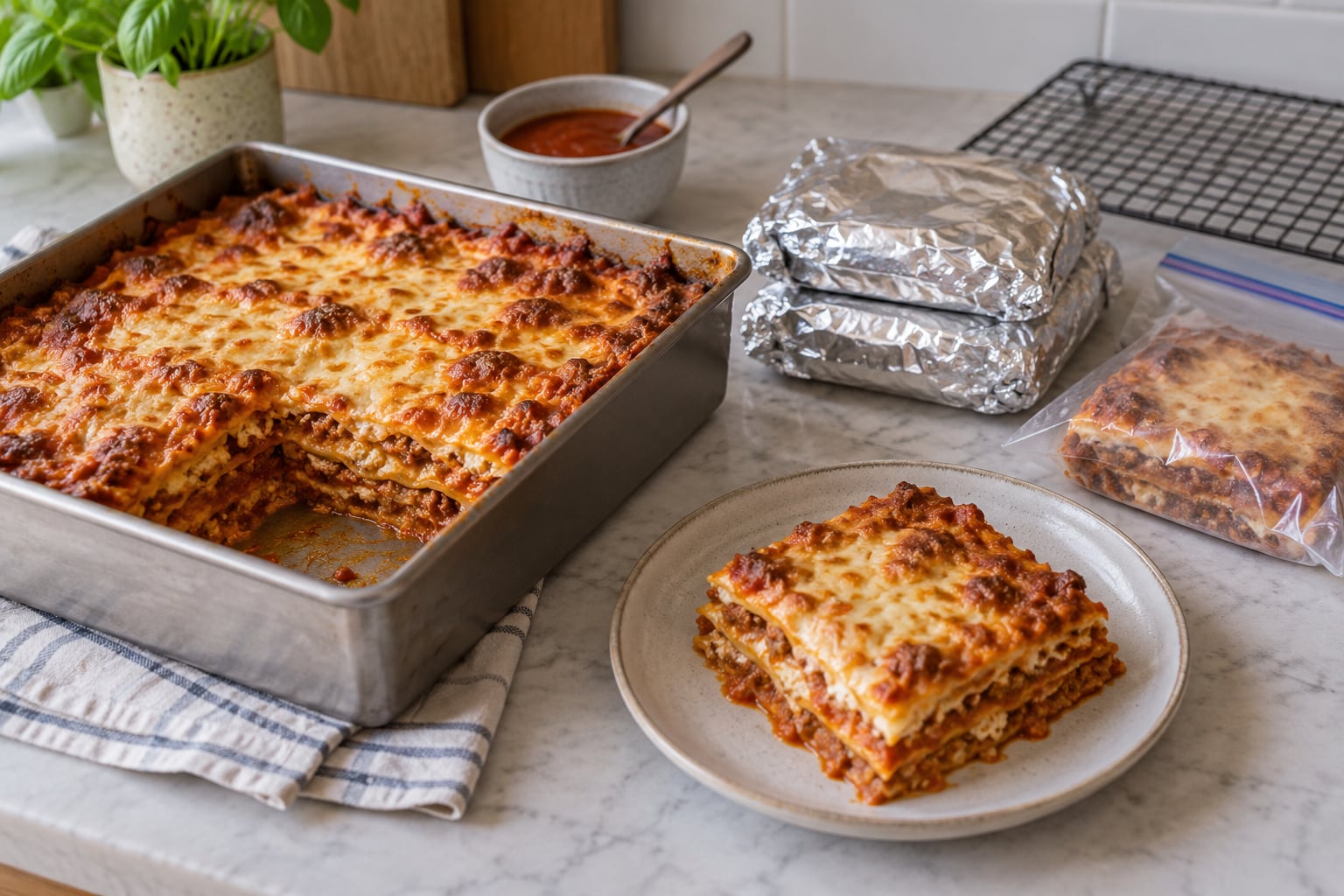
You can absolutely make lasagna ahead and freeze it. The reliable method is to bake the assembled dish first, cool it until it stops steaming, cut it into portions, wrap each one twice, and freeze it at 0°F. Later, thaw it overnight in the refrigerator and reheat until the center is steaming hot. Budget about 25 minutes of active work on top of the bake, plus an overnight thaw.
Most of the disappointment people hit with freezer lasagna comes down to two things: wrapping a hot pan, and thawing it on the counter. Fix those and the dish holds up for weeks. If you are also planning a whole weekend of cooking, our guide to how to make appetizers you can prep ahead follows the same batch-and-freeze logic.
What You Need
The equipment matters less than the wrapping. Here is the short list.
- An 8-inch square or round baking dish. Metal, or a glass dish your manufacturer marks freezer-to-oven safe.
- A wire cooling rack. A flat rack keeps steam moving under the pan instead of trapping it.
- Heavy-duty plastic wrap and heavy-duty aluminum foil. Both, for every portion. One layer of each is the minimum.
- Freezer bags or a shallow freezer-safe container for the wrapped portions, and masking tape or a marker for labeling.
- A rimmed baking sheet for the long bake, so any drips that escape the foil land somewhere catchable.
Skip glass and ceramic unless they are explicitly freezer-to-oven rated. A hot lasagna going straight into a freezer can send a cold shock through the pan, and ordinary tempered glass may crack. If you want to freeze in a pan you already own, wrap the cold dish in foil first and never set a frozen glass pan directly on a cold freezer shelf floor.
For the filling, cook any meat or poultry before it goes in. Ground beef, sausage, and meatballs need to reach 160°F, and poultry, including chicken sausage and any shredded chicken, needs 165°F. Cool the cooked filling a few minutes before assembly so you are not layering hot meat into cold pasta.
Step-by-Step: How to Make Lasagna Ahead and Freeze It
Read the whole sequence once before you start, because the order matters. Cooling comes before wrapping, and labeling comes before the portion goes into the freezer, not after.
1. Prepare the Filling and Sauce
Simmer the sauce until it holds together on a spoon rather than running off the edge. A thin sauce turns to a puddle in the freezer and gives you a soggy bottom layer on reheating day. If your sauce feels loose, reduce it a few minutes longer or stir in a couple of spoonfuls of tomato paste.
Let the cooked filling and sauce cool to roughly room temperature. Ten minutes on the counter is enough. You are not trying to chill them, just to stop them from melting the cheese as it goes into the pan.
2. Assemble the Lasagna
Spread a thin layer of sauce in the bottom of the dish so the noodles do not stick to the pan. Then build your layers: noodles, sauce, cheese, filling, and repeat.
Stop one inch short of the rim. Layers settle during baking, and a dish filled to the top spills sauce onto the oven floor. A slightly underfilled pan also gives the center room to freeze and reheat evenly instead of staying cold in the middle. The last visible layer should be sauce and cheese, never a bare noodle, because a bare noodle dries out and browns in the oven.
3. Bake Until Properly Cooked
Cover loosely with foil and bake at 375°F until the edges bubble and the center is tender when tested in the middle with a knife. For an 8-inch dish that is usually 40 to 50 minutes. If your filling contains meat, confirm it has already been cooked to 160°F, or 165°F for poultry, and that the reheated serving reaches 165°F.
This first bake is not optional if you want a tidy freezer. Unbaked lasagna has nothing holding it together, so individual portions crumble when you try to lift them out. A fully set bake gives you clean edges and slices that survive wrapping and thawing.
4. Cool the Lasagna Completely
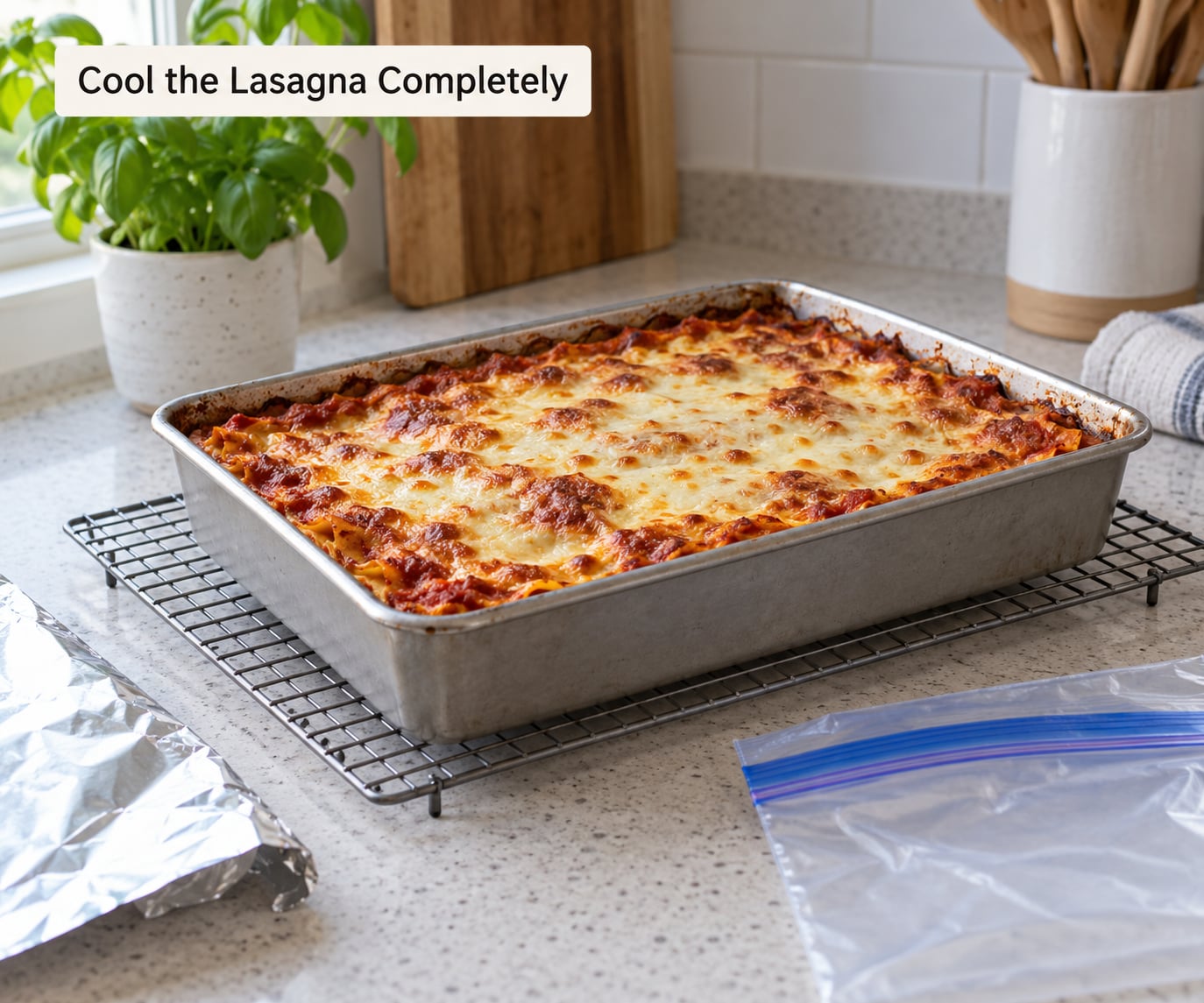
Set the pan on a wire rack and leave it alone. The lasagna should be close to room temperature and give off no steam before you touch it, which usually takes 45 to 60 minutes.
This is the step people skip, and it is the one that ruins dishes. Wrapping a warm pan seals moisture inside the plastic, and that moisture turns to condensation and then to ice crystals on the lasagna. You get soggy noodles and freezer burn in the same package.
5. Portion and Wrap the Lasagna
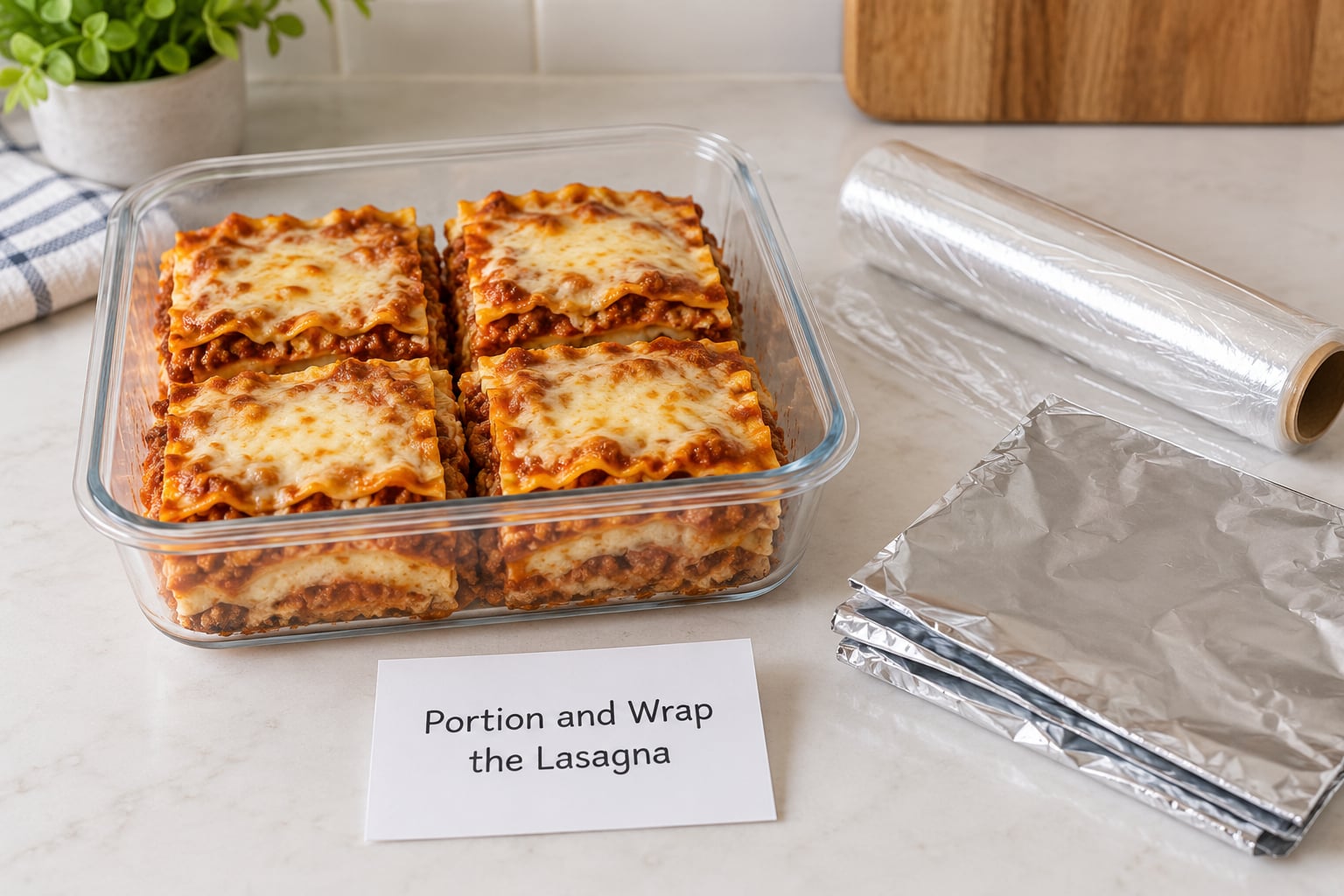
With a sharp knife, cut the cold lasagna into squares or wedges that fit your largest single serving. A damp knife between cuts keeps the slices from tearing.
Slide a wide spatula under each portion and lift it out carefully, keeping a hand on the side of the piece. If the bottom sticks, run the knife along the pan edge first to sever any cheese that welded itself to the metal.
Wrap each serving snugly in plastic wrap, pressing out the air as you go, then wrap it again in foil. That double layer is what prevents freezer burn, and it is the answer to how to make lasagna ahead and freeze it without ending up with dry edges. Slices that fit a loaf pan or a small square container can skip the foil and go straight into a lidded container, which is faster if you are freezing eight portions instead of one.
6. Label and Freeze the Portions
Label every package before it goes into the freezer, not after. Write the type of lasagna, the date you froze it, and one line of reheat instructions. I write “fridge overnight, 350°F covered 40 min” so nobody has to think on a Wednesday evening.
Keep your freezer at 0°F. Frozen lasagna is at its best within about 2 to 3 months. It stays safely frozen much longer as long as it is kept continuously frozen, but the noodles keep losing moisture and the edges get drier the longer it sits, so plan your first two to three months.
Stack the portions flat rather than on their sides, and push them to the back of the freezer where the temperature is steadiest.
7. Thaw the Lasagna Safely
Move the portion from freezer to refrigerator the night before you plan to eat it. Cold fridge thawing takes 8 to 12 hours for a single serving, and the center comes out evenly thawed with no icy middle.
If you need it the same day, put the wrapped portion on a baking sheet at room temperature and give it about 30 to 45 minutes, checking at the 30-minute mark. Do not leave any lasagna, thawed or fresh, sitting at room temperature for more than two hours.
Microwaving a frozen portion to thaw it is not recommended. The outside turns hot and rubbery while the center is still solid ice. If you must use a microwave, set it to 30% power in short bursts and stop as soon as the edges give, then finish on the counter.
8. Reheat Until Piping Hot
From thawed, put the portion in a small baking dish, add a splash of sauce or broth only if the edges look dry, cover with foil, and bake at 350°F for 35 to 45 minutes. Remove the foil for the last 10 minutes if you want the cheese browned.
From frozen, unwrap everything first, put the portion in a dish, and bake covered at 375°F for 60 to 75 minutes. Line a rimmed baking sheet underneath if you are worried about drips.
Microwave reheating works for a single slice. Cover loosely, use 50% power, and turn the dish a quarter turn every 60 seconds. Heat until the center is steaming hot. For any lasagna with meat, the center should reach 165°F.
Common Mistakes and How to Fix Them
Freezing a Hot Lasagna
Warm food releases moisture as it cools, and that steam gets trapped in the wrap. Cool the pan on a rack until it no longer steams, then wrap. If you are in a hurry, you can speed it along by setting the pan in an ice bath after ten minutes.
Wrapping the Whole Pan in a Single Bag
A full pan takes up a shelf, ties up your only good baking dish, and means you must thaw the entire thing to eat one serving. Cut and wrap individual portions instead. If you genuinely want a whole-pan backup for a gathering, freeze the dish unbaked in a disposable foil pan, cover it tightly, and plan on baking it from frozen.
Overfilling the Pan
A dish filled to the rim bubbles over and pushes sauce onto the oven floor. Keep the top layer as sauce and cheese, and stop an inch short of the edge so the center has room to cook through.
Thawing on the Counter for Hours
Room temperature is a danger zone. Refrigerate the portion overnight, or use a short 30-to-45-minute counter thaw inside a two-hour limit and get it into the refrigerator or the oven.
Reheating a Portion Straight From Frozen in the Microwave
You will get a hot ring and an icy center. Thaw first, then reheat. If time is the issue, the covered oven at 375°F for 60 to 75 minutes handles a frozen portion better than any microwave setting.
Adding Too Much Sauce Before Reheating
Lasagna gives off liquid as it reheats, so pouring sauce on top makes the bottom layer soupy. Start with a tablespoon of sauce or broth, only if the edges look dry, and add more to taste.
Once the rhythm is there, the rest is easy. Batch your other make-ahead dishes the same way, whether that is a breakfast casserole you can assemble ahead of time or a holiday stuffing that does not turn to mush in the pan. Two habits carry the most weight: use oven-ready no-boil noodles, which hold up far better than regular dried noodles after thawing, and make the sauce a little thicker than feels right. Fresh pasta sheets work too, but freeze them blanched or use them uncooked only if the box says they are meant for it, since delicate fresh sheets tear apart during the bake.
Frequently Asked Questions
Can you freeze unbaked lasagna?
Yes, and many cooks prefer it. Assemble the dish, top it with sauce and cheese, then wrap it tightly without baking. The noodles cook fresh in the oven, which keeps them from turning mushy. Baking first gives you cleaner slices that are easier to portion, so choose baked for weeknight convenience and unbaked when texture matters most.
How long does lasagna last in the freezer?
For the best quality, use frozen lasagna within about 2 to 3 months. It stays safely frozen much longer as long as your freezer holds 0°F continuously, but the noodles dry out and the sauce loses body the longer a portion sits. Label every package with the date so you use the oldest first.
Should lasagna be frozen in a whole pan or individual portions?
Individual portions win for most people. They freeze flat, stack easily, and let you thaw only what you will eat. A whole pan takes up an entire shelf, ties up your best baking dish, and forces you to reheat the whole thing for one serving. Freeze unbaked in a foil pan only when you are feeding a crowd.
What is the best way to thaw frozen lasagna?
Move the portion to the refrigerator the night before, wrapped or in a covered container, and give it 8 to 12 hours. For a faster option, set it on a baking sheet at room temperature for 30 to 45 minutes. Never leave lasagna at room temperature longer than two hours, and avoid microwaving a frozen portion to thaw it.
Can you microwave lasagna from frozen?
You can, but the results are uneven and the texture suffers. A microwave heats the edges long before the center, so you get a hot ring around an icy middle. Thaw the portion in the refrigerator first, then reheat in the microwave at 50% power, covered loosely, turning the dish every 60 seconds until the center is steaming hot.
How do you keep frozen lasagna from drying out or getting mushy?
Wrap each portion in plastic wrap and then foil, pressing out air at every layer, and freeze it flat at 0°F. Use oven-ready no-boil noodles, and make the sauce thicker than usual before assembly. A splash of sauce or broth during reheating helps if the edges look dry. Stay within two to three months for the best texture.
Conclusion
Bake the lasagna until the center is tender and the edges bubble, then let it cool on a rack until it no longer steams. Cut it into portions, wrap each one in plastic wrap and foil, label with the type and the date, and freeze flat at 0°F. Move a portion to the refrigerator the night before you want it, then reheat covered at 350°F until the center is piping hot, or 165°F if it contains meat.