
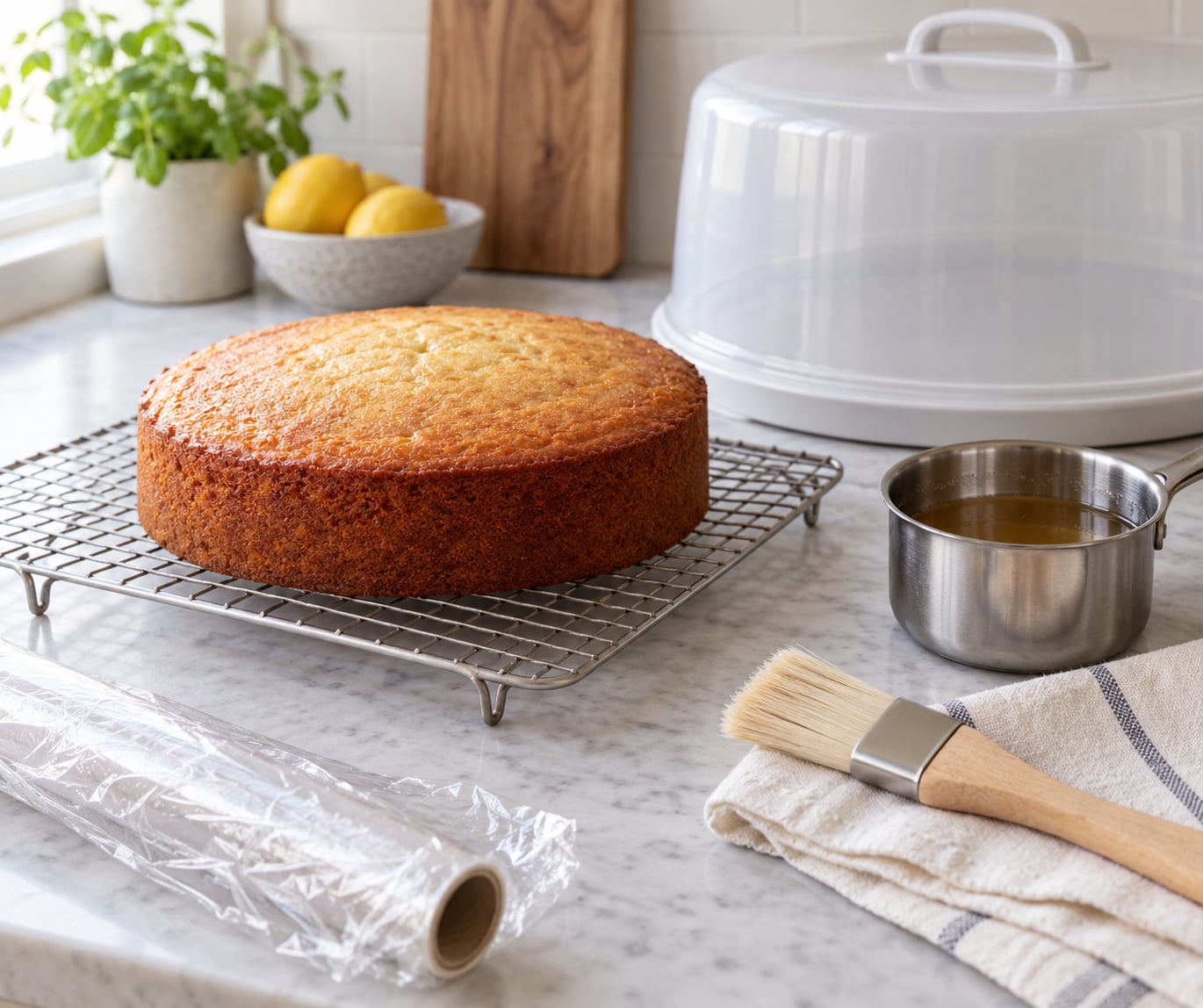
To keep a cake moist after baking, brush the warm layers with a sugar syrup, let them cool only until the warmth leaves the crumb, then wrap them airtight so the steam cannot get out. Ten minutes of active work and no special equipment. The whole method fails on one thing: timing.
Fresh cake is full of water vapour. Leave it sitting uncovered on a rack and that vapour walks out of the crumb, the structure sets, and there is no way to get it back. Wrap too early instead and you catch condensation that turns the texture gummy rather than moist. Both failures come from the same place: rushing the cover.
While you are at it, this guide assumes flat, evenly baked layers. If yours dome in the middle and frosting has to be thick enough to hide it, start with how to make a layer cake that does not dome so every step below works on a level cake.
What You Need to Keep a Cake Moist After Baking
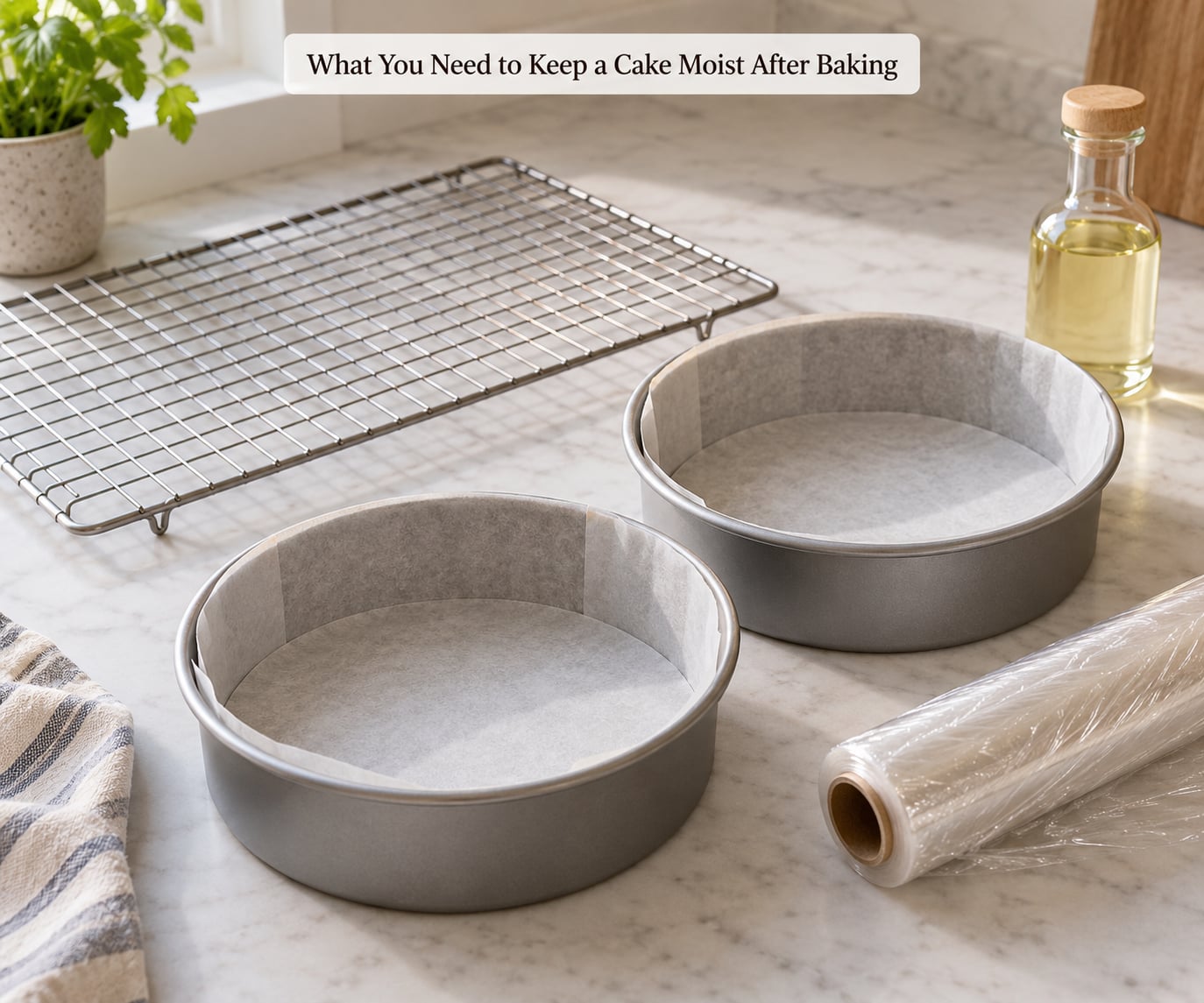
None of this is specialised equipment. It is what you need within arm’s reach at the moment the timer goes off, because the useful window for wrapping is short.
- Wire cooling rack that lifts the cake off the counter so air circulates underneath instead of steaming the base.
- Parchment rounds to slide under a stubborn layer so you never have to invert a hot pan onto a rack.
- Plastic wrap for the first seal, pressed directly onto the crumb.
- Aluminum foil as an outer layer for cakes that sit more than two days, or anywhere the fridge has strong smells.
- Airtight cake container or cake carrier if the cake is frosted or if you are storing slices.
- Pastry brush and a small saucepan for a sugar syrup you can make while the oven is preheating.
- Instant-read thermometer to take the guesswork out of doneness, which is the real cause of dry crumb.
- Pan grease or cooking spray, because a layer that sticks sheds its edges when you turn it out.
Step-by-Step
How to Cool the Cake Without Letting It Dry Out
Let the cake rest in the pan for 1 to 2 minutes if it is a thin layer, and 10 to 15 minutes if it is a bundt or pound cake. Then turn it out onto a rack right away. A cake sitting in its pan past that point has a wet base and a dry top, which is the worst of both worlds.
Cooling times on the rack depend on height rather than recipe:
- One-inch layer cake: 20 to 30 minutes on the rack.
- Two or three layers stacked: 45 to 60 minutes, since the upper layers sit in the rising heat of the ones below.
- Bundt, pound or tube cake: 1.5 to 2 hours, and these benefit most from a syrup because the crumb is so dense.
The test for when to cover is simpler than any timer: hover the back of your hand a few inches above the top of the cake. If you feel no warmth and no steam rises to your palm, it is ready to wrap. Cooler than that is fine and still better than a dry night on the rack. If you want a cold layer for frosting, set it on the rack inside the fridge or a cool room instead of the counter.
Wrap the Cake at the Right Moment
Wrap while the cake is warm to the touch, never piping hot. That is the rule that resolves the conflicting advice floating around online: you want the warmth gone, but you do not want the moisture gone with it. Warm cake inside plastic gives up its remaining steam as condensation rather than losing it, and the crumb stays tender.
Make the syrup first, so it is cool enough to brush. Bring equal weights of sugar and water to a boil for a light syrup, then stir in a vanilla bean or peel and let it cool completely. A heavy, thinner syrup at one part sugar to two parts water gives you more liquid to work with for a large or dense cake.
| Syrup | Sugar | Water | Yield | Best for |
|---|---|---|---|---|
| Light, 1:1 | 1 cup | 1 cup | about 1.5 cups | sponge and butter layer cakes |
| Heavy, 1:2 | 1 cup | 2 cups | about 2.5 cups | pound, bundt and fruit cakes |
Poke the warm layer all over with a skewer, then brush on 3 to 4 tablespoons of syrup per 9-inch round. Let it soak for 10 to 15 minutes before the frosting goes on. Bakers on r/Baking describe this as the moment to moisten layers, immediately before sealing them with buttercream or another frosting, and the order matters more than the syrup itself.
Simple syrup is not the only option. Any thin, sweet liquid works, and the thread asking for alternatives on r/Baking gets the same answer repeatedly: milk, brewed coffee cooled to room temperature, fruit juice, or a splash of liqueur in a grown-up cake. Fruit juice works beautifully on spice and carrot cakes, and strong coffee on chocolate ones.
To wrap an unfrosted layer, press plastic wrap directly onto the crumb, smoothing out the folds so no air pockets sit against the cake. A second layer, wrapped the other way so the seams do not line up, makes the seal much tighter. Add foil outside that for anything past two days.
For a frosted cake, give the frosting 20 to 30 minutes to set, or 15 minutes in the fridge, before wrapping. Wrapping frosting that is still soft lifts it off the cake in sheets. If you want clean layers to work with, the beginner guide to frosting a cake smoothly covers how to set a crumb coat first.
Choose the Correct Storage Method
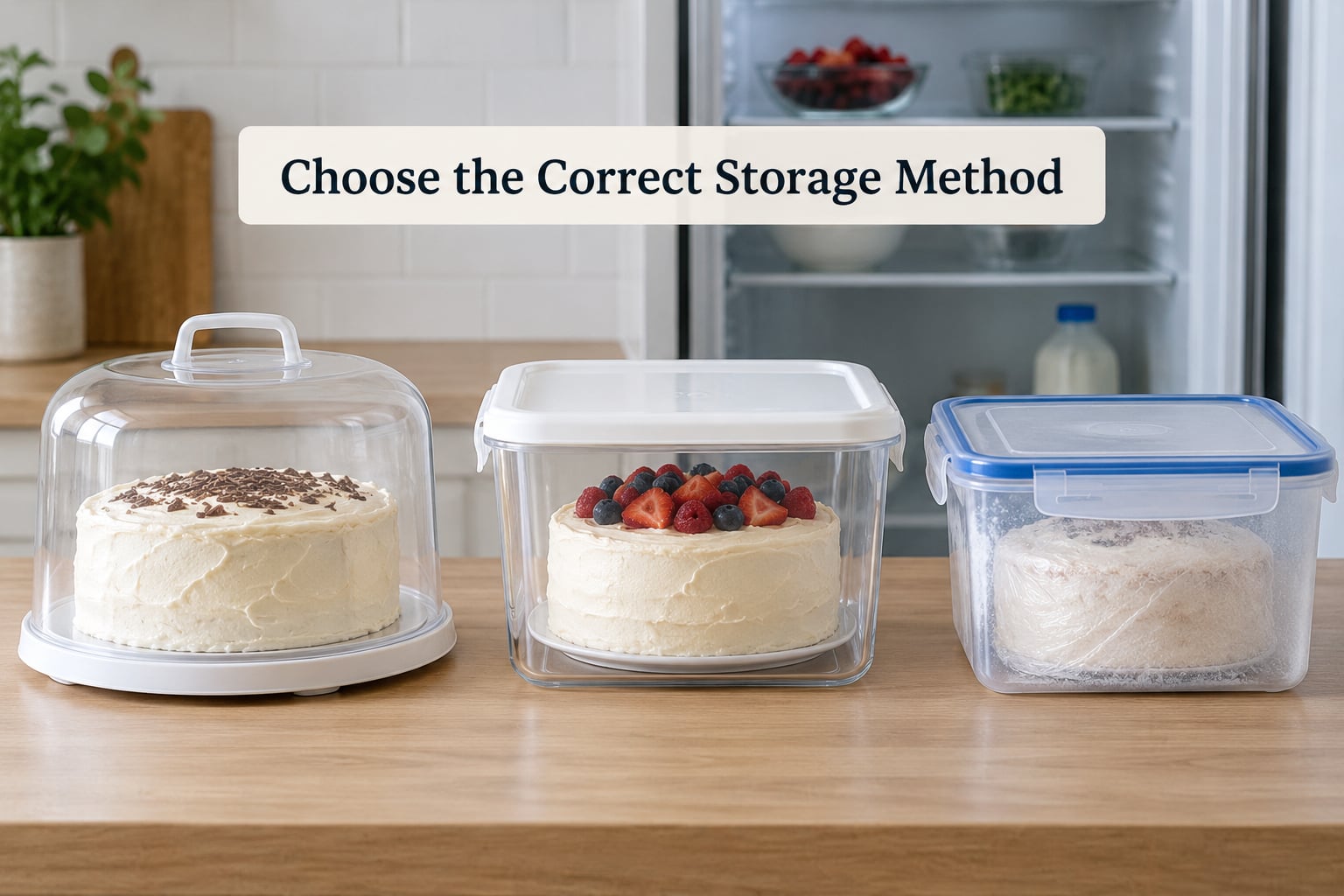
A wrapped cake at room temperature is the right default for anything frosted with buttercream, ganache or a glaze. The refrigerator is a different tool, not a safer upgrade: cold starch retrogrades faster than room-temperature starch, which is why an unwrapped plain layer goes stale in the fridge overnight while the same cake wrapped on the counter is fine for two days.
Refrigerate for perishable frosting or filling instead. Cream cheese frosting, whipped cream, custard filling, curd or fresh fruit filling should not sit out longer than 2 hours at room temperature, or 1 hour if the room is above 90 degrees F. Keep the fridge at 40 degrees F or below, and always wrap the cake before it goes in so it cannot pick up refrigerator odors.
| Cake type | Wrapped, on the counter | Wrapped, refrigerated | Wrapped, frozen |
|---|---|---|---|
| Sponge cake | 1 day | 3 days | 2 months |
| Butter or oil layer cake | 2 days | 5 days | 2 months |
| Bundt or pound cake | 2 days | 5 days | 3 months |
| Fruit or spice cake | 3 days | 7 days | 3 months |
| Carrot or banana cake | 1 day | 3 days | 2 months |
| Buttercream-frosted cake | 2 days | 5 days | 2 months |
| Cheesecake | 2 hours | 5 days | 1 month |
| Gluten-free cake | 1 day | 3 days | 2 months |
| Vegan cake | 2 days | 5 days | 2 months |
Gluten-free cakes hold water differently. There is no gluten network to trap it, so they often need a syrup, and they turn stale sooner than a wheat cake with the same frosting. Vegan cakes skew wetter rather than drier because there is no butter to set the crumb, so they are the group most at risk from a soggy bottom if wrapped before cooling.
Take a refrigerated cake out 45 to 60 minutes before serving, still wrapped. Unwrapped, it goes straight from cold and dry-looking to condensation on the surface.
Keep Moisture In When Serving and Reusing Leftovers
Cut cake goes stale faster than whole cake because the exposed crumb on every face starts losing water. Press plastic wrap onto the cut sides, or put slices in an airtight container, and skip the cake dome alone, which protects against dust but not against air.
A slice of plain bread tossed in the container is a real trick that works on cake, brownies and cookies, and it shows up constantly in r/foodhacks and cooking groups. Treat it as a supplement rather than a substitute: it helps a cake that is already in the container, and it does nothing for a layer you forgot to wrap.
To bring a stale slice back, put it on a plate with a barely damp paper towel beside it, not on it, and microwave in 10 to 15 second bursts. Check between bursts. The steam from the towel gets absorbed into the crumb and the slice softens without going wet.
For a dry layer cake that has already cooled, the syrup rescue still works. Pores in the crumb that have lost their water will drink it back up. Poke the layer densely with a skewer, warm the light syrup, brush on 4 tablespoons, wait 15 minutes, then frost. The crumb softens noticeably within the hour.
To transport a cake, level the surface first, put a non-slip mat under the box, and chill the layers before assembling so the frosting firms up during the journey. Carry the cake at room temperature rather than cold, and set it flat the whole way.
Common Mistakes
Wrapping a piping hot cake. Condensation forms inside the wrap and the crumb turns gummy. Give the cake the hand test above, then wrap.
Waiting too long to cover because you are afraid of sogginess. This is the mistake that actually dries cakes out. Fear of condensation leads people to leave layers on the rack for hours, and the crumb dries while they hesitate.
Overbaking. Across the CakeCentral threads and r/Baking posts that still rank for this question, the leading diagnosis for a dry cake is simply that it spent too long in the oven. Test with a toothpick and pull it while a few moist crumbs still cling, not when it comes out spotless. An instant-read thermometer showing 200 to 205 degrees F in the thickest part is a useful second check. If your oven overshoots, pull earlier than the recipe suggests.
Baking dark pans at the recipe temperature. A dark metal pan transfers heat faster. Drop the oven temperature 25 degrees F, and avoid the convection setting, which browns the outside before the inside has set.
Refrigerating a plain layer cake. It dries out faster in the fridge than on the counter and picks up neighbouring smells unless it is wrapped.
Measuring flour by volume. Scooping and leveling into a cup packs in more flour than the recipe meant, which tightens the crumb and dries it. Measuring flour correctly costs ten seconds and changes the texture of everything you bake.
Confusing staling with spoilage. Staling is the starch hardening and the crumb drying out. It is reversible with a damp towel and a few seconds in the microwave. A sour smell, visible mould or a slimy surface is spoilage, and no amount of syrup rescues that.
For the next bake, three formulation changes do more for moisture than any storage trick. Replace an equal weight of butter with vegetable oil, which leaves a moister crumb. Add 2 tablespoons of oil and one extra egg to a batter that feels dry, though more eggs than that start to work against you. Sour cream or buttermilk in place of part of the milk adds both fat and acid, and a little extra leavening keeps a cake tender rather than dense.
Bakery cakes hold moisture longer for a formulation reason as much as a storage one. Commercial mixes carry emulsifiers such as mono- and diglycerides, plus humectants like sorbitol and invert sugar, which slow the movement of water out of the crumb. Add a tight frosting seal and commercially wrapped layers, and you have a fair part of the answer to why a supermarket cake feels different on day three.
Frequently Asked Questions
Should I wrap a cake while it is still warm?
Wrap while the cake is warm to the touch, but never hot. Let it sit in the pan for 1 to 2 minutes, turn it onto a rack, and cool until no steam rises to the palm of your hand. Wrapping a piping hot cake traps condensation and makes the crumb gummy. Wrapping too cold is safer but wastes moisture while the cake sits uncovered.
How long should a cake cool before wrapping it?
A single layer needs 20 to 30 minutes on a cooling rack after a short rest in the pan. Stacked layers need 45 to 60 minutes because the ones above sit in rising heat. A bundt or pound cake should cool 1.5 to 2 hours, and those benefit most from a simple syrup. If you need a cold layer for frosting, chill it on the rack rather than letting it cool on the counter.
Does wrapping cake in plastic wrap make it soggy?
Only when the cake is still hot enough to steam. Once the warmth has left the crumb, plastic wrap pressed directly onto the surface is the single most effective way to keep cake moist because it stops water vapour escaping. Watch for fogging inside the wrap after an hour. Clear means the cake was dry enough; a haze of condensation means you wrapped it early.
Should I refrigerate a frosted cake to keep it moist?
Only when the frosting or filling needs it. Cream cheese frosting, whipped cream and custard fillings should not sit out longer than 2 hours at room temperature, or 1 hour above 90 degrees F. Plain sponge and butter cakes dry out faster in a refrigerator than on a counter, so wrap them and leave them at room temperature. Bring a chilled cake back to room temperature in its wrap before serving.
Can I freeze a cake with frosting?
Yes. Buttercream and ganache freeze well, and most layer cakes freeze unfrosted even more reliably. Freeze uncovered on a plate until firm, then wrap tightly in plastic wrap and foil or bag it so air cannot reach it. Thaw wrapped at room temperature for 2 to 3 hours, or overnight in the fridge. Frostings with cream cheese or whipped cream thaw best in the refrigerator.
How do I revive a cake that is already dry?
For one slice, put it on a plate with a barely damp paper towel beside it and microwave in 10 to 15 second bursts. The steam softens the crumb without wetting the surface. For a whole dry layer, poke it all over with a skewer, warm 4 tablespoons of simple syrup, brush it on and wait 15 minutes before frosting. Staling is recoverable; spoilage is not.
The Short Version
Do this in the order that matters: rest the cake briefly in the pan, turn it onto a rack, and the moment the warmth has gone, brush on 3 to 4 tablespoons of syrup and press plastic wrap straight onto the crumb. Most of the dryness people fight is not a storage problem at all. It is overbaking, so pull the next cake a minute or two earlier than the recipe says.