
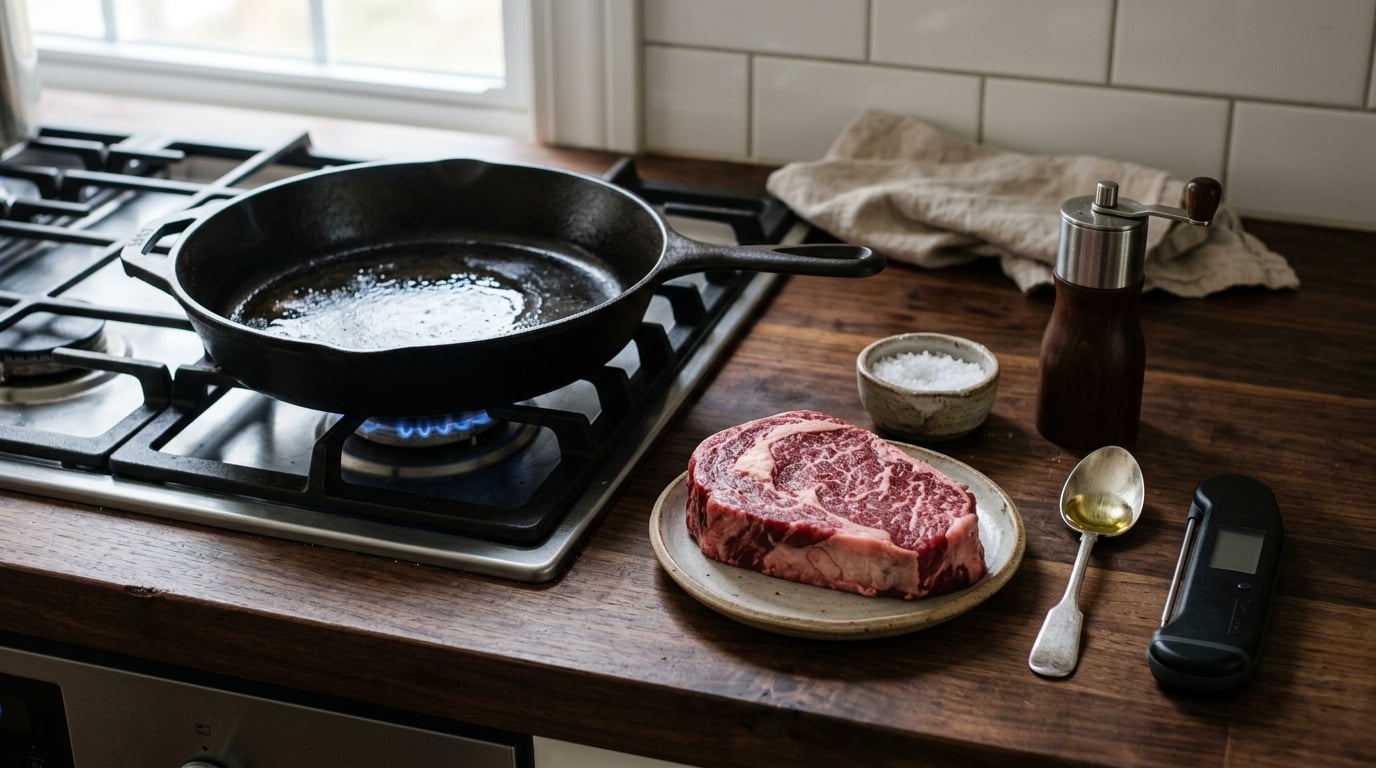
To cook a steak in a cast iron skillet, preheat the pan for 5 to 10 minutes on medium-high heat, coat it with a high-smoke-point oil, then lay a dry, well-salted steak away from you and leave it untouched for 2 to 4 minutes per side. Baste with butter and herbs, verify the temperature, then rest it 5 to 10 minutes before slicing.
That is the whole method, and it takes about 20 minutes of actual cooking once the steak has come to room temperature. Cast iron is one of the few home pans heavy enough to hold a searing heat, which is exactly what turns a wet, pale slab of beef into something with a deep brown crust.
The hardest part is not the technique, it is restraint. The steak goes in, you walk away, and you do not nudge it, flip it early, or stare at it. Heat does the work.
What You Need
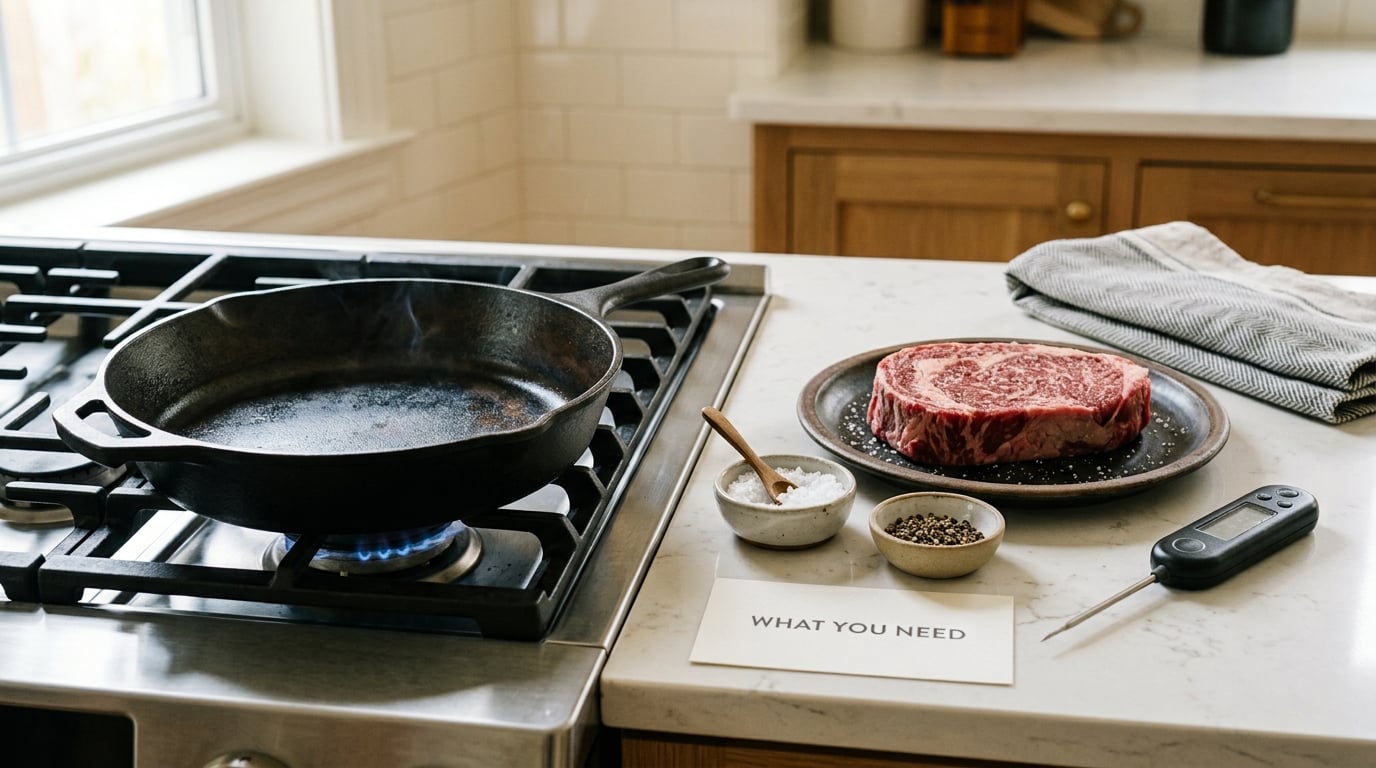
A heavy skillet is the whole tool list, but a few things make the difference between a good steak and a great one.
- A cast iron skillet, 10 or 12 inch. Ten inches handles one steak with room around the edges. Twelve inches handles two, though crowding drops the pan temperature and the crust suffers.
- An instant-read thermometer. This is the single most useful item on the list. Touch tells you roughly; a thermometer tells you exactly.
- Coarse kosher salt and coarse ground black pepper. Fine salt dissolves into the meat. Coarse salt stays on the surface where it belongs.
- A high-smoke-point oil. Avocado, canola, grapeseed, or beef tallow for the sear. About one tablespoon is plenty.
- Butter, one or two smashed garlic cloves, and a woody herb. Rosemary or thyme, for the baste after the flip.
- A dry towel or paper towels. For the steak, not the pan.
On the steak itself, aim for a boneless cut 1 to 1.5 inches thick. Ribeye and New York strip both work well because the fat cap and marbling feed the baste. A thinner steak sears faster than most people expect and burns the outside before the middle catches up, and anything much thicker than 1.5 inches wants an oven finish.
Tempering matters too. Take the steak out about 30 minutes before you cook it so the center is not stone cold when the edge is already overdone.
Step-by-Step: How to Cook a Steak in a Cast Iron Skillet
1. Prepare the Steak
Pat the steak dry on both sides, then season it on every surface with coarse salt. If you like pepper, add coarse ground black pepper now, right before cooking, so it does not burn during the long preheat.
Drying is the step people skip, and it is the one that decides whether you get a crust. Surface moisture has to boil off before browning can start, and while it boils the steak steams itself grey. A damp steak in a hot pan also sticks, because the thin layer of water glues it to the metal.
Seasoning goes on before the pan goes on the burner, never after. Salt needs a few minutes to penetrate the surface, and the steak should hit the heat already seasoned.
2. Heat the Cast Iron Skillet
Set the skillet over medium-high to high heat and leave it for 5 to 10 minutes. Cast iron takes far longer to heat than a stainless or nonstick pan, and it steals heat from the steak the moment the steak lands, so a pan that feels hot to a quick touch is not actually ready.
Use one of three cues to know the pan is there:
- A drop of water flicked onto the surface skitters, dances, and evaporates within a second or two.
- A thin haze of smoke rises from the pan itself, before any oil goes in.
- An infrared thermometer aimed at the cooking surface reads between 450F and 475F.
Add about one tablespoon of oil once the pan is hot, then let the oil run until it shimmers and flows freely. Oil that smokes heavily at this point is already past its smoke point, and it will taste acrid, so if the kitchen fills with smoke, turn the burner down and let the pan settle for a minute.
3. Sear the First Side
Lay the steak into the pan away from you, holding the edge closest to you and lowering the far side first, so any spatter goes away from your arm. If the sizzle is immediate and sustained, the pan was ready.
Now leave it alone. Do not move the steak, do not flip it, do not press it. Two to four minutes is the working range for a 1 to 1.5 inch steak on medium-high heat. You are building a crust, and every movement costs you part of it.
You will know it is close to ready when the edges firm up and the juices running toward the pan edge stop dripping steadily and start to bead. If the steak releases from the pan with a gentle tug and no scraping, it is time to turn. If it is welded down, it needs another 30 to 45 seconds. That stick is not a failure, it is just the crust still bonding.
4. Turn and Finish Cooking
Turn with tongs, not a fork, so the juices stay in the meat. Immediately drop in a tablespoon of butter, a crushed garlic clove, and a sprig of rosemary or thyme. Tilt the pan and spoon the foaming butter over the top of the steak repeatedly for 30 to 60 seconds. This baste is what carries garlic and herb flavor onto the surface, and the milk solids in the butter brown against the hot crust.
Now check the temperature before you cut. Insert the instant-read thermometer into the thickest part, aiming at the center without touching bone.
| Doneness | Internal temperature | What the center looks like |
|---|---|---|
| Rare | 125F to 129F | Deep red, cool and wet |
| Medium-rare | 130F to 134F | Red center with a pink band near the crust |
| Medium | 135F to 144F | Pink throughout, firmer, juices run clear |
| Medium-well | 145F to 154F | Mostly gray-brown with a hint of pink |
| Well-done | 160F and above | Gray-brown all the way through, noticeably dry |
Whole cuts of beef are safe to eat at 145F with a three-minute rest, according to USDA guidance. Most cooks pull earlier than that for taste, not safety.
Carryover cooking is real: the hot pan keeps raising the center temperature after you lift the steak out, by roughly 5 to 10F on a thin cut. Pull a medium-rare steak at 125F to 130F and it will land in the right window while it rests.
Thicker cuts change the plan. Once the crust is set on both sides, move the skillet to a 375F to 400F oven, or set the whole pan over low heat on the stove, and cook until the thermometer says so. That is a reverse sear in spirit: hard sear first for flavor, gentle finish for the center.
| Thickness | First side | Second side | Rest |
|---|---|---|---|
| 3/4 inch | 2 to 3 minutes | 1 to 2 minutes | 5 minutes |
| 1 inch | 3 to 4 minutes | 2 to 3 minutes | 5 to 7 minutes |
| 1.5 inch | 3 to 4 minutes, then baste | 3 to 4 minutes, then oven finish if needed | 7 to 10 minutes |
| 2 inch and up | 3 minutes, crust only | 3 minutes, then oven at 375F to 400F | 10 minutes |
5. Rest and Slice the Steak
Move the steak to a warm plate or a wooden board and wait the full rest time. Resting lets the muscle fibers relax and stops the juice from shooting out the moment you cut. A steak sliced straight off the heat bleeds onto the board, and that juice is flavor you are throwing away.
Find the grain before you cut. Look at the surface and you will see the direction the fibers run, usually lengthwise along the length of the muscle. Slice across it at a slight angle, in strips about a quarter to a half inch thick. Cutting against the grain shortens the fibers, which is the difference between a tender bite and a chewy one.
Common Steak Cooking Mistakes
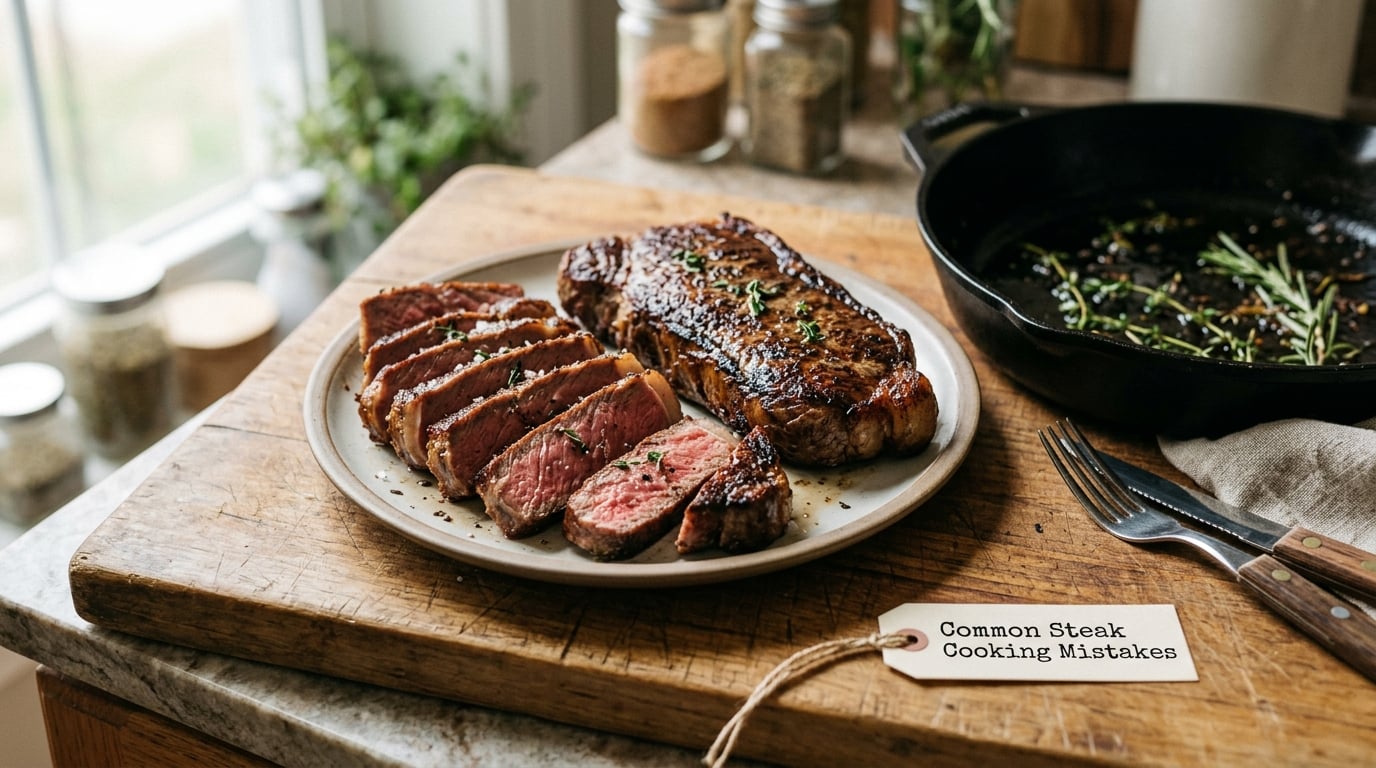
Almost every bad cast iron steak traces back to one of six things.
The steak sticks to the pan. Do not yank. The crust is simply not ready yet, so give it another 30 to 45 seconds. If it sticks badly even at the end, the pan was not hot enough or the surface was damp. Cookhouse cast iron is used at extreme heat for exactly this reason, and cast iron owners on r/castiron will tell you white hot is the standard, not a stunt.
The crust comes out pale or grey. Three causes: the pan was too cool, the steak was wet, or you moved it too much. Check the pan with the water flick test, dry the surface, and give the steak a full uninterrupted 3 to 4 minutes.
The pan smokes from the moment it heats up. Some smoke before the oil goes in is a sign of temperature, not failure. A lot of smoke means the burner is too high, the oil is past its smoke point, or leftover residue is burning off. Use a high-smoke-point oil, add it once the pan is hot, and drop the heat a notch if the kitchen fills up.
The crust goes black and bitter. That is burnt, not browned. It means the steak sat too long, the sugar in the seasoning burned, or the butter baste ran dry in the pan. Pull the baste before the butter browns past golden, and scrape the fond if it starts going dark.
The outside is overdone while the center is still raw. This is the thin-cut problem. A steak under 1 inch cooks in under six minutes total, so temperature-check at three minutes and trust the thermometer over the clock. It is also what the reverse sear solves for thick cuts: start low and slow, finish with a hard sear.
You slice it too early. Skipping the rest is the most common avoidable mistake in the whole process. Even five minutes changes the texture.
Caring for the Skillet Afterwards
Hot cast iron and cold water crack the pan, so let it cool on the burner for a few minutes first. Then scrape out the fond with a wooden spoon or chainmail scrubber, rinse with hot water, dry it thoroughly on the burner, and rub a paper towel with a thin layer of neutral oil over the surface. Do not soak the pan, and do not put cold water on hot iron.
Most home cooks hit this much more often than a restaurant does, so it is worth being deliberate about. A properly seasoned pan is a nonstick surface, and it only stays that way if you keep oiling it after the cleanup.
Frequently Asked Questions
What thickness of steak is best for a cast iron skillet?
One to 1.5 inches thick is the sweet spot. Anything under three-quarters inch finishes in under six minutes total and burns on the outside before the center is warm, and anything over 2 inches needs an oven finish. Buy a steak from a butcher rather than a prepacked one if you have had repeat failures, since supermarket cuts are often too thin to sear well.
How hot should a cast iron skillet be before cooking steak?
Hot enough that a drop of water skitters across the surface and evaporates in a second or two, which on most home stoves is 5 to 10 minutes over medium-high heat. An infrared thermometer aimed at the cooking surface should read 450F to 475F. A faint haze of smoke from the bare pan is a good secondary cue, and cast iron takes longer to heat than stainless steel.
Do I need oil to cook steak in cast iron?
A little high-smoke-point oil makes a big difference, and it is not about seasoning. Without it the beef can grip the iron directly and tear the crust off when you turn. Use about one tablespoon of avocado, canola, grapeseed, or beef tallow once the pan is hot. Save butter for the baste after the flip, since it burns at searing temperatures.
What temperature should steak be cooked to?
Medium-rare lands at 130F to 134F, medium at 135F to 144F. USDA guidance sets 145F with a three-minute rest as the safe minimum for whole cuts of beef, so pull a medium-rare steak earlier, around 125F to 130F, and let carryover cooking finish the job during the rest. Always check the thickest part with an instant-read thermometer.
How long should I cook each side of steak in a skillet?
Two to 4 minutes per side on medium-high heat for a steak 1 to 1.5 inches thick, and that is the range that matters most. The clock is a rough guide because burner strength varies, so use browning, firmness, and an instant-read thermometer instead. Leave the steak completely untouched during the first side to build the crust.
Is it safe to eat steak cooked below 145F?
USDA guidance puts the safe minimum internal temperature for whole cuts of beef at 145F followed by a three-minute rest, so cooking steak below that carries real risk of foodborne illness. Many home cooks eat steak rare at lower temperatures by personal preference, and that is a risk decision you make yourself. For vulnerable groups including pregnant people, older adults, and young children, follow the 145F guidance.
Conclusion
Do two things first: preheat the cast iron skillet for a full 5 to 10 minutes until a flicked drop of water skitters across it, and pat the steak completely dry before salting it. Those two steps decide most of your crust before any heat reaches the beef.
From there the method is simple: a tablespoon of high-smoke-point oil, 2 to 4 minutes untouched per side, a butter and herb baste, a temperature check, and a real rest. The thermometer tells you when to stop, and it stays the right way to cook a steak in a cast iron skillet long after the pan is seasoned and the pan is yours.