
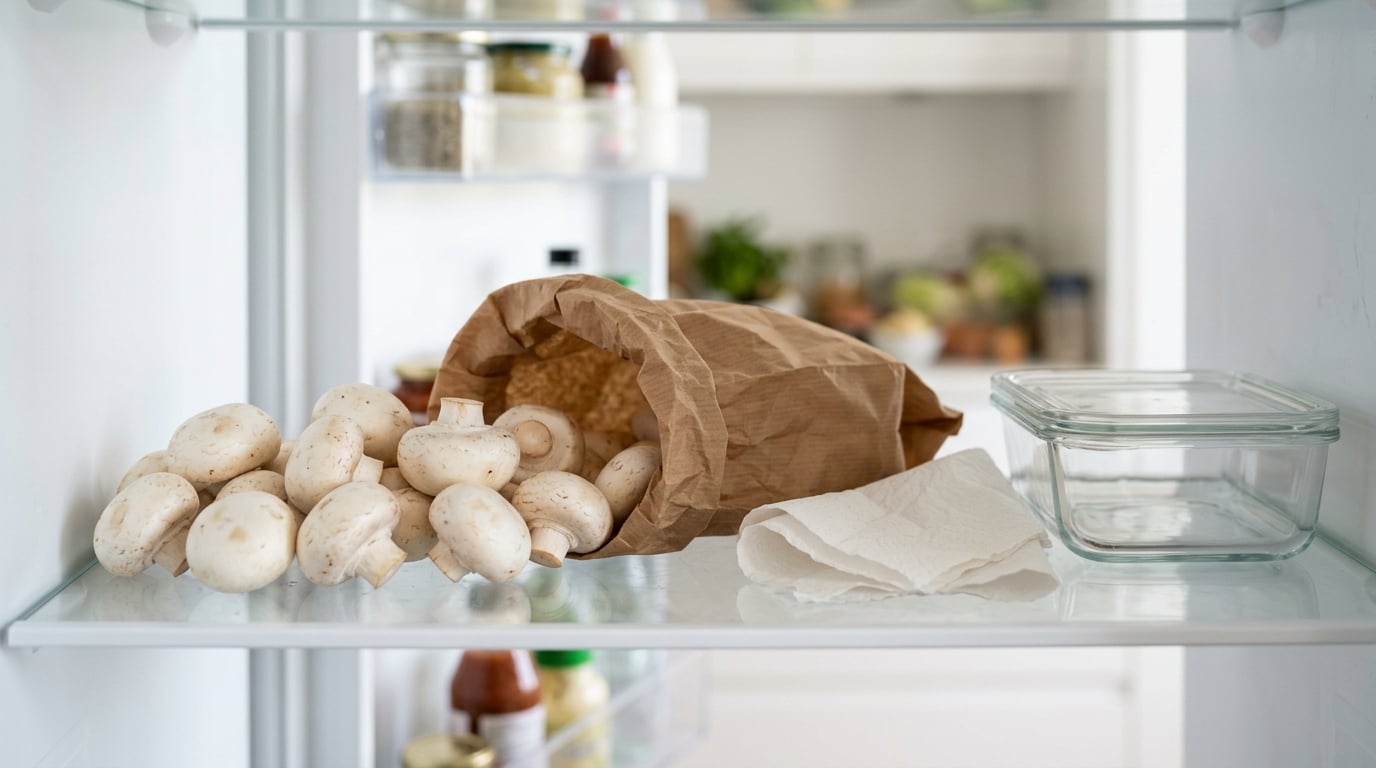
To store mushrooms in the refrigerator, keep them unwashed, move them out of any plastic packaging, and put them in a loosely folded brown paper bag on a main fridge shelf near the front. Skip the crisper drawer. Whole mushrooms will hold roughly 4 to 7 days that way, sliced ones about 1 to 3 days. It takes under a minute to set up.
Mushrooms are living tissue that keeps breathing and giving off moisture long after they’re picked. Seal them up and that moisture has nowhere to go, so the caps turn wet, then slimy, then fuzzy with mould. The whole game is keeping them dry and slightly ventilated.
Table of Contents
- What You Need
- Step-by-Step: How to Store Mushrooms in the Refrigerator
- Frequently Asked Questions
- Are mushrooms ok to eat after a week in the fridge?
- Can I store mushrooms in a Ziploc bag?
- Why are my mushrooms getting slimy in the fridge?
- How can I store mushrooms in the refrigerator without using a paper bag?
- How to store sliced mushrooms in the fridge
- Is it better to keep mushrooms in the fridge or out of the fridge?
- Conclusion
What You Need
Not much, and none of it is specialised.
- A brown paper bag. A lunch bag or small grocery bag works. The porous paper is the point.
- One dry paper towel. Optional, and only worth adding if your bag tends to go damp within a day.
- A main fridge shelf. The upper-middle area, where the air moves and the humidity sits lower than in the drawers.
- A backup container. A glass or ceramic bowl with a loose lid works if you’re out of paper bags.
What you don’t need is an airtight box or a sealed zip bag. Those are the two containers most likely to ruin a punnet of mushrooms.
Step-by-Step: How to Store Mushrooms in the Refrigerator
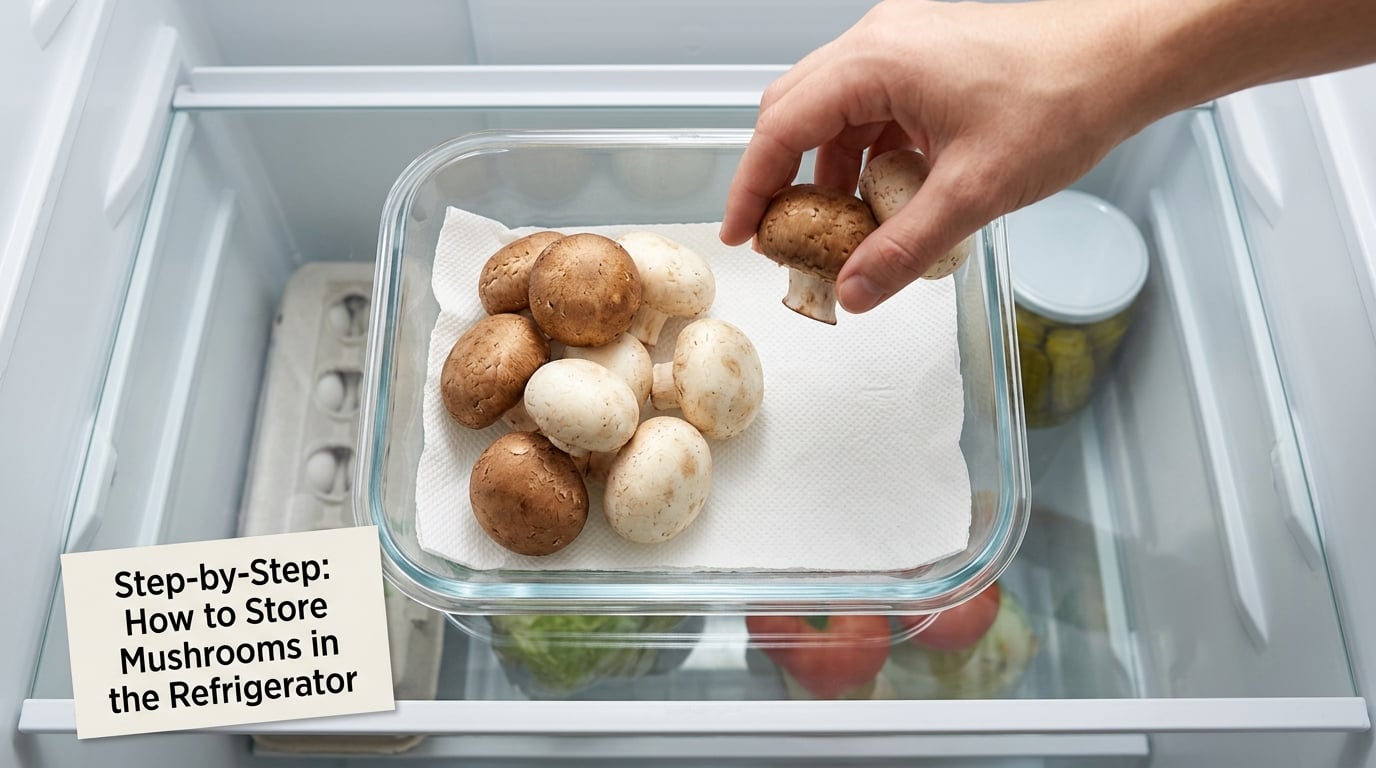
Step 1: Pick Mushrooms Worth Storing
Sort the mushrooms before they go anywhere. Firm caps, dry surfaces, and a clean earthy smell mean good shelf life. Leave anything with visible fuzzy mould, a slime coating, or a sour off-odour in the store aisle rather than trying to save it.
Gently wipe off loose dirt with a dry paper towel. Don’t scrub and don’t rinse at this stage.
Step 2: Keep Them Unwashed Until You Cook Them
Whole mushrooms are about 90 percent water, and water on the surface is the fastest route to slime. Washing early gives the bacteria already on the cap a wet place to multiply. Dry them right before you cook, then cook immediately.
Pre-washed packaged mushrooms are the exception, and they need their own method. Transfer them out of the tub, blot the surface dry on a paper towel, and store them in a vented container lined with a fresh towel. Expect 1 to 3 days, and treat any cloudiness or standing liquid in the bottom as a discard signal.
Step 3: Use the Right Container
Loosely fold the top of a brown paper bag, put the mushrooms inside in a single layer if you can, and leave the fold open enough that air passes through. That’s it. Some cooks add a paper towel liner and swear by it; others report that a towel inside the bag traps moisture and speeds up mould. Both results are real, because the bag is the variable that changes.
A simple rule settles it: add a dry paper towel only if your bag is already damp within a day. If the paper is dry on day one, leave the towel out. Replace the bag every two or three days rather than waiting for it to soften.
The common methods break down like this.
| Storage method | Container | Where in the fridge | Typical shelf life | Verdict |
|---|---|---|---|---|
| Loosely folded brown paper bag | Paper bag, open top | Main shelf, near the front | 4 to 7 days | The one to use |
| Paper bag with a paper towel | Paper bag plus towel | Main shelf | 5 to 10 days | Works when the bag stays dry |
| Glass or ceramic bowl with a loose lid | Covered loosely | Main shelf | 4 to 6 days | Good substitute |
| Glass container with paper towel liner | Airtight, lined | Main shelf | 3 to 5 days | Fine, check the towel often |
| Original plastic clamshell | Factory packaging | Any shelf | 2 to 5 days | Use within about five days |
| Sealed zip bag or airtight box | Non-breathable plastic | Any shelf | 1 to 2 days, often slimy | Avoid |
| Crisper drawer, any container | Varies | High-humidity drawer | 2 to 4 days | Avoid the drawer |
| Uncovered on an open shelf | None | Main shelf | 2 to 3 days, dries out | Only for a day or two |
The fridge itself matters too. Mushrooms keep best around 34 to 39°F (1 to 4°C). The crisper drawer is set to a higher humidity so leafy greens stay crisp, and that trapped moisture is exactly what mushrooms don’t want. The coldest spot in the fridge, right by the back wall, dries them out faster than it preserves them.
Step 4: Put Them on a Main Shelf, Near the Front
Slide the bag onto an upper-middle shelf toward the front of the compartment, where the air circulates. Keep it away from raw meat and strong-smelling cheeses, because mushrooms pick up odors quickly through their porous caps.
One layer is better than a pile. If you have more than a punnet, use two bags rather than stacking.
Step 5: Check Them Before You Cook Them
Give the bag a quick look every couple of days. Browning on the cut stem and slightly wrinkled caps are normal and mostly a sign of moisture loss, not spoilage. Older mushrooms are still safe; they just taste deeper and earthier.
Sliminess, fuzzy white or green mould, and a sour or ammonia-like smell mean the mushrooms are done. Throw them out rather than cutting the bad ones off, because the damage is already through the tissue.
Storage life depends heavily on how the mushrooms are cut.
| Mushroom form | Refrigerated shelf life | Best container |
|---|---|---|
| Whole white button or cremini | 4 to 7 days | Loosely folded paper bag |
| Baby bellas, whole | 5 to 7 days | Loosely folded paper bag |
| Portobello, whole | 3 to 5 days | Paper bag, stems down |
| Sliced mushrooms | 1 to 3 days | Vented container, paper towel lined |
| Pre-washed or pre-packaged sliced | 1 to 3 days | Out of the tub, onto a dry towel |
| Shiitake | 5 to 7 days | Paper bag; sturdy, keeps well |
| Oyster mushrooms | 4 to 7 days | Paper bag; use quickly for best texture |
If a whole package is going to sit past its use-by date, freezing beats throwing it out. Blanch sliced mushrooms for two minutes, cool them, and freeze them flat; they’ll hold for several months and are only useful in cooked dishes. Drying works too, and brings out more mushroom flavour than the fresh version.
Common Mistakes to Skip
Washing before storing. The single most common reason home cooks get slimy mushrooms. Dry is the goal.
Leaving them in the sealed plastic tub or bag. That packaging is sized for a short trip home from the store, not for days in a fridge.
Using the crisper drawer. It feels right and it is wrong. High humidity is for greens.
Folding the bag shut like a package. Loose means air can pass. Sealed defeats the whole approach.
Reading browning as spoilage. Brown stems and wrinkled caps are cosmetic. Slime and fuzz are not.
Storing everything in one crowded pile. Overlapping caps trap heat and moisture between mushrooms.
Frequently Asked Questions
Are mushrooms ok to eat after a week in the fridge?
Usually, yes. Whole mushrooms stored unwashed in a loosely folded paper bag on a main shelf often keep 7 to 10 days, and slightly wrinkled or browned caps are normal. Discard them if the surface feels slimy, if you see fuzzy white or green mould, or if they smell sour. Cutting off the soft parts does not make spoiled mushrooms safe, because bacteria move through the tissue.
Can I store mushrooms in a Ziploc bag?
You can, but you won’t like the result. A sealed bag traps the moisture the mushrooms keep releasing, and the caps usually turn wet and slimy within a day or two. If that’s all you have, leave the top of the bag open, add a folded paper towel inside to soak up condensation, and move the mushrooms out into a paper bag as soon as you can.
Why are my mushrooms getting slimy in the fridge?
Three things cause it: moisture sealed in, moisture washed on, and humidity in the crisper drawer. Mushrooms release water vapour as they respire, so any airtight plastic or high-humidity drawer keeps that water sitting on the cap. Switch to a loosely folded brown paper bag on an upper-middle shelf, and skip the rinse until the mushrooms are going into the pan.
How can I store mushrooms in the refrigerator without using a paper bag?
A glass or ceramic bowl with a loose plate or lid over it works nearly as well, sitting on a main shelf. Another option is a cotton or linen produce bag, which breathes like paper and can be washed and reused. A roll of paper towel wrapped around the pile and set in a basket is a third option. Avoid airtight plastic, and check any liner after a day and swap it if damp.
How to store sliced mushrooms in the fridge
Sliced mushrooms lose moisture through the cut surfaces, so they dry out and brown faster than whole ones. Use a container lined with a dry paper towel, a lid set slightly ajar rather than sealed, and a main shelf. Plan to use them within 1 to 3 days. If you are meal prepping, slice the night before rather than several days ahead.
Is it better to keep mushrooms in the fridge or out of the fridge?
For whole white button, cremini, and portobello, refrigerate. Mushrooms kept at room temperature usually turn soft and dull within two or three days, even in a breathable bag. Shiitake and dried-style varieties tolerate a cool, dark counter for a few days, and oyster mushrooms keep a day or two there, but cold storage still gives you the longest usable window overall.
Conclusion
Start by leaving the mushrooms dry and taking them out of the plastic. Fold the top of a brown paper bag loosely, drop the mushrooms in one layer, and put the bag on an upper-middle shelf near the front of the fridge, away from the crisper drawer. That single change takes a punnet that would have gone soft in three days and stretches it to most of a week, with no extra equipment and no guesswork.