
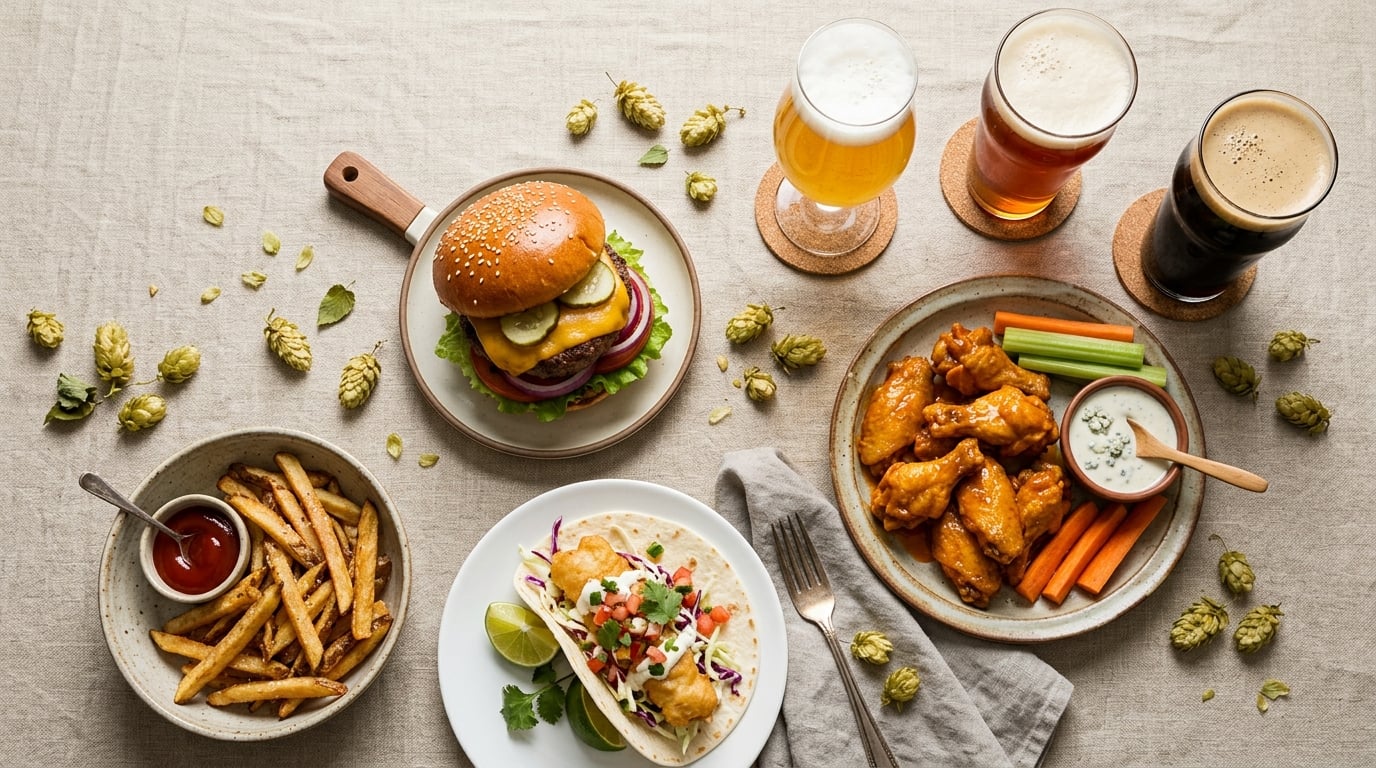
To know how to pair beer with food, match the weight of the beer to the weight of the dish, then decide whether you want the two to complement each other or to contrast. Carbonation and hop bitterness scrub grease and reset your palate, while malt sweetness softens heat. Once you can name the dish’s dominant flavor, choosing takes about ten seconds.
That sounds obvious until you’re standing in front of a forty-item tap list with the food already ordered. The vocabulary alone — IBU, mouthfeel, dry finish — is enough to send most people back to the lager they know. What follows is a method instead of a list, so you can pair anything on that board with anything on the plate.
I’ve cooked and poured at a lot of small gatherings where nobody planned the pairings, and the best results almost always came from the same habit: taste the dish first, then decide what the beer needs to do, whether cut through it, match it, or fix a problem.
How to Pair Beer With Food Step by Step
Five steps, in this order. Most of the work happens in the first two, before the beer even enters the picture.
Start With the Dish
Before you look at a single beer, name what the food is actually saying on the plate. Most dishes lead with one of six things: sweet, savory, acidic, spicy, rich, or roasted. A glazed pork shoulder leads with sweet and roasted. A plate of fried chicken leads with rich and salty. A shrimp scampi leads with acidic and rich.
Then look at the sauce. This is the part most guides skip, and it’s usually the part that decides the pairing. The protein in a chicken breast is fairly neutral, so a beer paired with plain chicken tells you almost nothing. The same chicken brushed with a sweet molasses glaze wants an amber or brown ale, because malt sweetness mirrors the sauce instead of fighting it.
Write the dominant flavor in one or two words. That word is what you are about to match.
How to Pair Beer With Food by Matching Intensity
Match the intensity of the beer to the intensity of the dish. A delicate white fish or a light salad will be flattened by a heavy-bodied stout or a double IPA; the beer simply overpowers everything on the fork. A plate of short ribs or a rich braised stew will taste thin and watery next to a pale lager.
You can sanity-check intensity with two numbers on the label. ABV tells you how much alcohol is carrying the flavor, and IBU, or International Bitterness Units, tells you how much hop bitterness. Under 15 IBU reads as gentle, 20 to 40 as noticeable bitterness, above 50 as assertive. A five percent pilsner and a five percent imperial stout are not the same strength of drink even though the number matches.
The comfortable rule of thumb: light dishes with light beers, bold dishes with bold beers.
Consider the Beer Style
Each part of the beer does a different job at the table, and once you know which job you need, the style almost picks itself.
Carbonation is the workhorse. Bubbles physically scrub oil off your tongue and reset your taste buds, which is why a crisp lager or a wheat beer makes fried food taste cleaner. Bitterness does something similar for fat, and it’s the reason hoppy beers are the go-to answer for spicy and heavily charred dishes.
Malt sweetness and caramel notes handle savory, sweet and roasted food. Roasty coffee and cocoa flavors in a porter or stout line up with a barbecue glaze or a chocolate dessert. Acidity in a sour beer cuts rich dishes and matches anything already bright with vinegar, citrus or pickle.
Hops bring aroma, which is where the details live. Citrus hops suit anything with lemon, herbs or a bright acidic sauce. Pine and resin hops belong with smoky, charred or gamey meat. Tropical hops are softer and fruitier, so they sit comfortably with spicy and Caribbean-influenced dishes.
Build and Taste the Pair
Put a small portion of each on the plate at the same time. Taste a bite of the food, then a sip of beer, then both together. That third taste is the one people skip, and it’s the only one that tells you whether the pair actually works.
Four things worth noticing: does the beer leave you wanting another bite of food, or does it leave you flat? Does the food make the beer better or just wetter? Is any single flavor shouting over the others? After two or three bites, does your palate feel refreshed or tired?
When it feels unbalanced, the fix is nearly always one-sided. Beer too dominant means adding acidity, sweetness or freshness on the plate, or moving to a lighter beer. Food too dominant means reaching for more carbonation, more bitterness, or a smokier or more acidic style. Adjust one element at a time and taste again.
Apply the Method to Popular Dishes
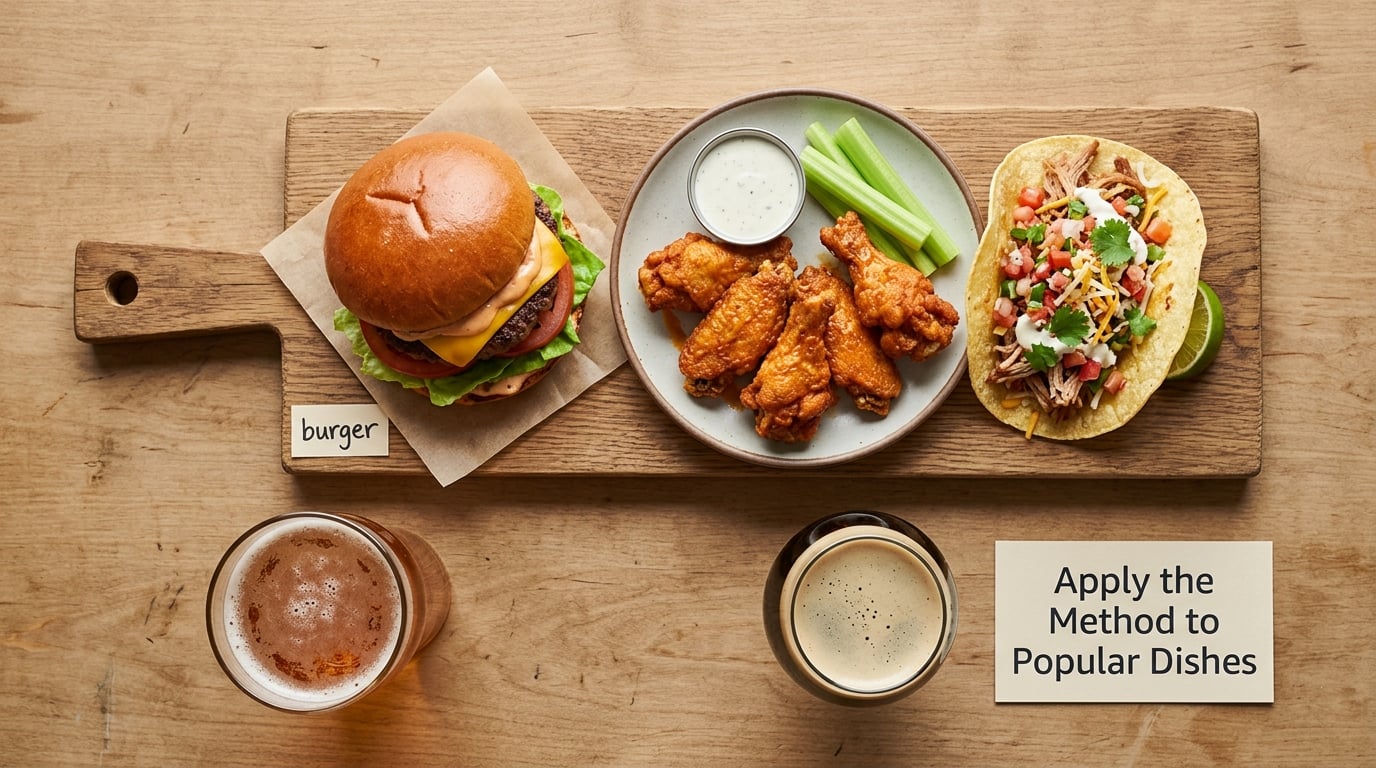
The method becomes fast once you have run it a few times. Here is the same four-column version in one place, using intensity and the dominant flavor as the sort keys.
| Dish | Dominant flavor | Beer style | Why it works |
|---|---|---|---|
| Cheeseburger with fries | Rich, salty | Pale ale or amber ale | Moderate carbonation lifts the grease, malt sweetness answers the bun |
| Grilled chicken with a lemon marinade | Acidic, light | Wheat beer or pilsner | Bright and clean, and it does not fight the citrus |
| Steak with a peppercorn sauce | Rich, savory, peppery | Porter or stout | Roasted malt echoes the char, bitterness cuts the fat |
| Baked salmon with a herb crust | Delicate, buttery | Pilsner or saison | Light body, no roast, nothing that overpowers the fish |
| Green salad with a vinaigrette | Acidic, fresh | Witbier or light lager | Carbonation mirrors the acidity in the dressing |
| Margherita or pepperoni pizza | Salty, oily, sweet | Pale ale or amber lager | Medium body, enough malt for the sauce, not so much that tomato disappears |
| Barbecue ribs or pulled pork | Sweet, smoky, rich | Amber ale or brown ale | Caramel malt mirrors the glaze, smoke matches the cook |
| Bratwurst with sauerkraut and mustard | Rich, sour, sharp | Pilsner | The traditional regional match; bitterness and acidity cut the fat |
| Chicken wings | Fried, spicy | IPA | Hop aroma and bitterness handle heat and cut through the fry |
| Fish tacos with lime and hot sauce | Acidic, spicy, light | Lager or pale lager | Clean and neutral, so lime and chile stay loud |
| Chocolate cake or brownies | Sweet, roasted | Stout or porter | Coffee and cocoa notes, plus enough body to feel like a second dessert |
| Oysters or steamed mussels | Briny, delicate | Gueuze or saison | Acidity and funk cut the richness and mirror the brine |
A couple of notes on the ones people get wrong most. Fried chicken is not a light-beer dish; richness cuts both ways, and a pale ale gives you enough structure to keep tasting it. Fish tacos fail with a heavy IPA, where the hops bury the fish entirely.
If you’re cooking rather than ordering, safety comes first: poultry to 165°F (74°C), ground meat to 160°F (71°C), whole cuts and fish to 145°F (63°C). Those temperatures matter more than any pairing decision, and they also tell you how much of the dish’s flavor is already locked in by the time it hits the plate.
Common Mistakes
Most bad pairings fail for one of five reasons, and each has a simple fix.
Matching by color. A dark beer is not automatically a match for dark meat, and a pale one is not automatically wrong for a rich dish. Color describes roast and malt, which is only part of what you need. Fix: go back to the dominant flavor word you wrote down in step one.
Ignoring sweetness. This is the most common error. A sweet barbecue sauce, a honey glaze or a caramelized onion will make a dry, bitter beer taste sour and thin. Fix: add malt sweetness — an amber ale, a brown ale or a bock — or reduce the sweet element on the plate.
Picking a beer that’s too hoppy or too strong. A double IPA at 8% with 60 IBU beside a delicate fish or a salad leaves you tasting hops and nothing else. Fix: aim for the same intensity band as the dish, and remember that hop aroma and hop bitterness are not the same thing. A beer can smell intensely hoppy while drinking smooth.
Serving at the wrong temperature. Beer poured straight from a fridge tastes flat against food. Fix: let bottles and cans sit out for ten to fifteen minutes, and serve most lagers and ales cool rather than ice cold, around 45 to 55°F (7 to 13°C). Stronger styles like imperial stouts and barrel-aged ales want closer to 55 to 65°F (13 to 18°C).
Pouring the beer too cold for the style. A heavy porter or a doppelbock served near freezing has no aroma left to work with. Fix: warmer glass, smaller pours, and let it sit a minute before you judge it.
Two habits that fix most problems at once: taste the beer on its own first, so you know what it’s actually doing, and alternate bites and sips rather than finishing one and then starting the other. If you’d like to plan ahead, a light to heavy progression across a meal usually works better than jumping around.
Frequently Asked Questions
What temperature should beer be when paired with food?
Serve most lagers and ales cool rather than ice cold, roughly 45 to 55 F (7 to 13 C). Beer straight from a refrigerator tastes flat next to food because the cold suppresses the aroma you are trying to match against the dish. Stronger styles such as imperial stouts, doppelbocks and barrel-aged ales do better closer to 55 to 65 F (13 to 18 C). Letting a bottle sit out for ten to fifteen minutes before opening it makes a noticeable difference.
What type of glass should I use when pairing beer with food?
Match the glass to the style, and a pint glass is a perfectly good default for everything from pale ales to stouts. A tulip or stemmed glass suits hoppy ales and Belgian styles because the shape keeps the aroma concentrated and leaves room for a head. A snifter or a small tumbler works for strong, dark, high-alcohol beers, where you want less surface area. The wrong glass will not ruin a pairing, it will just cost you some aroma.
How do you pair very hoppy beer with food?
Give a very hoppy beer something to do rather than standing back from it. Bitterness and carbonation cut through fat, so fried chicken, wings, burgers and charred or heavily smoked meats are natural partners. Hop aroma varies by variety: citrus hops suit anything bright and acidic, pine and resin hops suit game and smoke, and tropical hops are fruitier and sit well with spice. Keep the dish at least as strong as the beer, or the hops will flatten it out.
Can nonalcoholic beer be paired with the same foods?
Mostly yes. Nonalcoholic and low-ABV beers are made on the same grist and follow the same style families, so a nonalcoholic pilsner handles fried food and a nonalcoholic amber ale takes on a sweet barbecue glaze the same way their alcoholic counterparts do. They do tend to be lighter in body and sometimes sweeter, so you may want to start a little drier or more bitter than usual and let a rich dish do more of the work.
How do you choose different beers for several dishes at one meal?
Sort your dishes by intensity and move from light to heavy as the meal progresses, rather than trying to find one beer that fits everything. A crisp lager or wheat beer suits a salad or a first course, a pale or amber ale covers a burger or pizza, and a porter or stout closes out a steak or a dessert. A single beer for the whole table is fine too, in which case pick the middle of the range and make it the most versatile pour on the table.
Start With the Easiest Pair
Name the dish’s dominant flavor, match the beer’s intensity to the dish’s, then decide whether the beer should complement it or cut through it.
For your first attempt, pick a familiar dish you already know by heart — a burger, a roast chicken, a bowl of fries with something salty — and pour a balanced everyday beer alongside it. A pale ale or amber lager at 4 to 5% ABV is the most forgiving starting point there is.
From there, adjust one lever at a time. Add malt sweetness for anything sweet or caramelized, reach for roast and smoke for charred meat, push the carbonation and bitterness when the dish is rich or oily, and dial everything back when the food is delicate. Once you’ve run that loop two or three times with beers you like, the forty-item tap list stops being intimidating.