
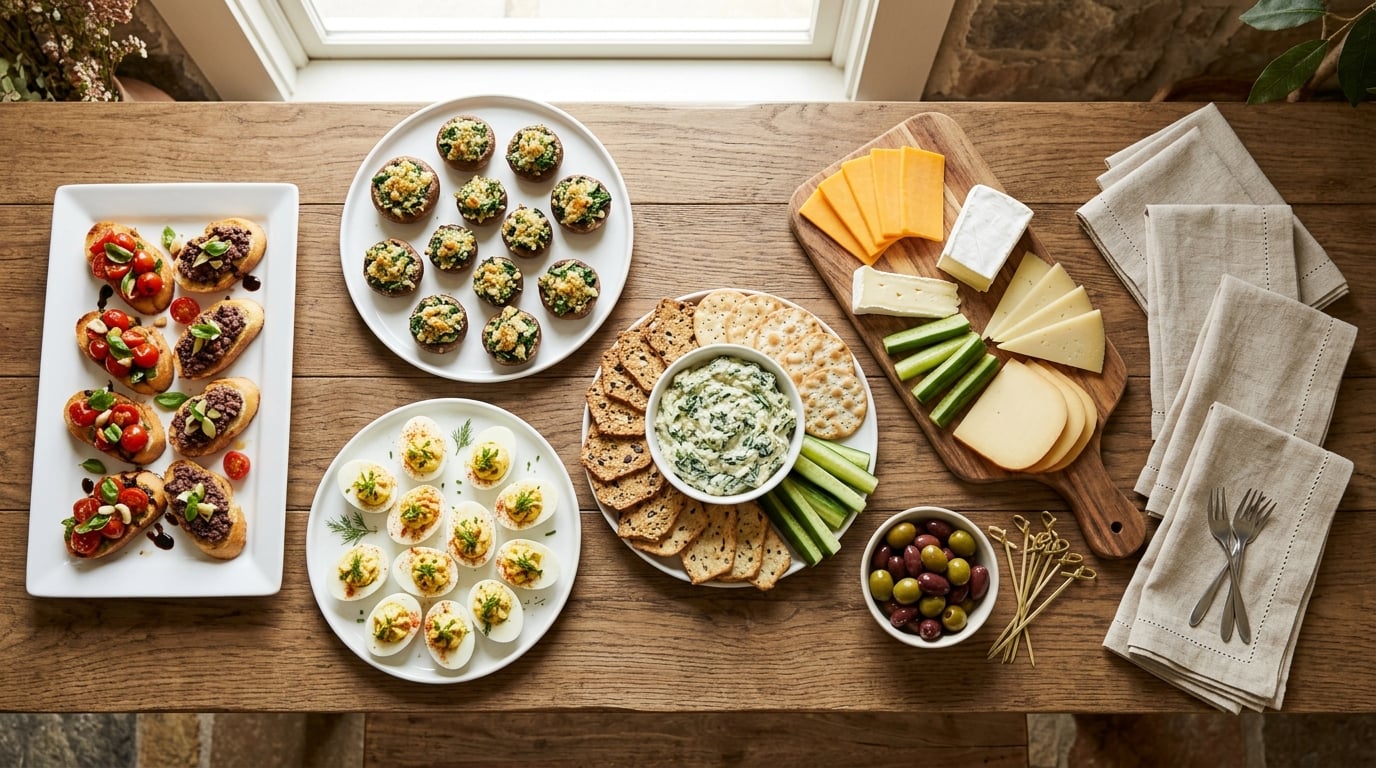
If you are working out how many appetizers per person for a dinner party, plan on 3 to 4 small bites per guest for a two- to three-hour evening, 5 to 6 for a longer grazing-style hang, and 8 to 12 miniature portions when the appetizers are the whole meal. Those numbers shift more with serving time and portion size than with the head count itself.
Most of the confusion here comes from mixing up two different things. Some hosts mean six pieces in total across the spread, while caterers mean six pieces per person, spread across everything on the table. Once those two are sorted, the arithmetic gets easy.
I run a restaurant, so the useful part of this answer is the number and the reasoning behind it, not a pile of vague suggestions. Here is how to size an appetizer spread for a dinner party, what one piece actually weighs, and how to adjust for the party you are actually throwing.
Table of Contents
- How Many Appetizers per Person for a Dinner Party?
- Appetizer Planning at a Glance
- What Changes the Appetizer Count?
- How Many Pieces Count as One Appetizer Bite?
- Appetizer Quantities by Party Style
- How to Build a Balanced Appetizer Menu
- Examples for 4, 6, 8, and 10 Guests
- How to Avoid Running Out or Overbuying
- Frequently Asked Questions
- Conclusion
How Many Appetizers per Person for a Dinner Party?
Plan 3 to 4 pieces per person when a full dinner follows and guests are standing, mingling and drinking for two to three hours beforehand.
- 3 to 4 pieces per person for a standard dinner party with a substantial main course, running 2 to 3 hours.
- 5 to 6 pieces per person for a grazing table, open house or long evening where guests drift in and out over 3 to 4 hours.
- 8 to 12 pieces per person when appetizers replace dinner entirely, whether that is a cocktail reception or a casual supper built from finger foods.
- 10 to 14 pieces per person for reception-style passed hors d’oeuvres at a wedding or large celebration where food is the entire event.
The shortcut most restaurant kitchens use is a weight rather than a count. A standard appetizer portion lands somewhere around 2 ounces, or roughly 55 grams, of food per person per hour of service. Three ounces is a reasonable target when a meal follows; four ounces works when the appetizers have to hold people until later.
One confession worth making: a plated dinner is roughly equivalent to five to seven pieces of a heavy appetizer. That is why a heavy spread before a rich main course does more damage than most hosts expect. Guests arrive at the table already full, and the main course goes untouched.
The number that matters most is total pieces, not total dishes. Three well-made appetizers with 5 pieces per person beats seven dishes with 2 pieces each, and it is a fraction of the work.
Appetizer Planning at a Glance
The table below maps the four most common hosting situations to a bites-per-person figure, a total for a 10-guest party, and the kinds of food that suit the format.
| Scenario | Party length | Bites per person | Total for 10 guests | Foods that fit |
|---|---|---|---|---|
| Seated dinner party | 2 to 3 hours before the meal | 3 to 4 | 30 to 40 bites | Stuffed mushrooms, bruschetta, olives, deviled eggs |
| Cocktail hour | 1 to 2 hours, no dinner | 6 to 8 | 60 to 80 bites | Passed skewers, meatballs, wings, pinwheels |
| Grazing table | 3 to 4 hours, casual | 5 to 6 | 50 to 60 bites | Cheese board, charcuterie, dips, crackers, crudites |
| Appetizer-only dinner | 2 to 3 hours, food is the meal | 8 to 12 | 80 to 120 bites | Sliders, wings, flatbread, substantial dips, mini sandwiches |
How to Calculate the Right Amount
Multiply your confirmed guest count by the bites per person for your scenario, then add a buffer of 5 to 10 percent.
For 10 guests at a dinner party with a main course: 10 multiplied by 3.5 bites equals 35 bites, plus a buffer of about 10 percent, which is roughly 39. Round to 40 and you have a safe, non-wasteful target.
A few rules of thumb for the buffer:
- Add 5 percent for parties of 10 or fewer, where leftovers are more likely than shortages.
- Add 10 percent for parties of 11 to 25 guests.
- Add 15 to 20 percent for 25 guests or more, or for events where a late-arriving second wave will find picked-over platters.
Count only guests who will actually eat. A table of eight adults eats very differently from a table of two adults, four children and a couple of people nursing drinks through the whole evening. Planning for the real number of eaters is the cheapest way to avoid waste.
Then divide the total across the number of appetizer types you are serving. If you are making four kinds of bites and need 40 total, that is 10 pieces of each. It is easier to build and to restock than one giant tray of one item.
What Changes the Appetizer Count?
Six variables move the number away from the baseline, and duration is usually the biggest one.
How Long the Party Runs
Appetizers are a holding pattern, and people eat more of them the longer the wait is. A two-hour gap between arrival and dinner needs the low end of the range. A four-hour open house needs the high end, or you will be pulling empty platters while guests are still arriving.
How Heavy Dinner Is
Beef, dense casseroles, risotto and creamy pasta all need fewer appetizers in front of them than a salad-based main. If dinner is rich, plan the low end. If dinner is a light roast chicken with vegetables, you can afford the middle or high end of the range.
Size of the Bite
This is where most estimates go wrong. A single slider is a substantial piece. A deviled egg half is not. Count by weight rather than by object when you can, and a two-ounce target per person per hour keeps you honest.
Category of Food
Cold, light items like olives, crudites and crackers are consumed quickly and in small amounts. Rich, hot items like wings, sliders and stuffed pastries slow guests down. Plan fewer pieces of the heavy stuff, and more of the raw vegetables and crackers that people mindlessly nibble.
How Thirsty the Room Is
Guests drinking through an evening eat considerably more than guests nursing water or sparkling water. If the bar is flowing, move up one tier. If drinks are minimal, stay at the low end.
Passed Trays Versus a Self-Serve Table
Passed hors d’oeuvres get eaten faster because you are offering them. Guests take two or three from each tray and keep moving. At a self-serve table, people take a piece, put it on a plate, and often forget about it. Plan about 25 percent more food for a self-serve table than for the same menu passed on trays.
How Many Pieces Count as One Appetizer Bite?
One bite is a single item you can eat in one or two mouthfuls, weighing roughly one-half to three-quarters of an ounce.
Common items translate like this:
- One meatball counts as one piece, a standard cocktail meatball. Large ones count as one and a half.
- Two deviled egg halves count as one piece, since each half is a single mouthful.
- One small chicken wing (flats or drumettes, boneless or not) counts as one piece. A whole wing counts as one and a half to two.
- Two stuffed mini peppers or two bruschetta bites count as one piece.
- One skewer with two or three bite-sized items on it counts as one piece. Two skewers counts as two.
- Three small crackers with spread count as one piece, roughly a quarter cup of dip per person per hour.
- One two-inch piece of pinwheel or roll-up sliced from a larger pinwheelled sandwich counts as one piece. A whole mini sandwich counts as two.
- One slider counts as two pieces. It is one of the bigger items on the table.
- A quarter cup of dip with dippers counts as one piece-equivalent on its own.
- Two ounces of cheese or charcuterie on a board counts as one piece-equivalent per person.
Those equivalences are why a caterer quote of nine pieces per person can feel enormous. If three of those pieces are sliders, the actual food on that table is closer to a full meal.
Where the piece count and the weight count disagree, trust the weight. About 2 ounces of appetizer per person per hour is the anchor that reconciles the conflicting numbers you will find online.
Appetizer Quantities by Party Style
Dinner parties range from a six-person supper club to a fifty-person open house, and the right quantity shifts with the formality and the length of the event.
Casual Family-Style Dinner
Plan 3 bites per person. These groups eat fast, arrive hungry and often help themselves twice. Put the platters on the table rather than on a side station so people can pass and serve themselves, which slows the pace slightly and cuts down on waste.
Formal Seated Party
Plan 3 to 4 bites per person and serve them on small plates in the dining room before guests are seated, not passed in the living room. Two well-made items are enough here. A formal table already has a lot going on, and three to four bites keeps everyone ready for the meal.
Cocktail Reception
Plan 6 to 8 bites per person for a two-hour reception with no meal. Passed trays work well here, and three to four different items gives variety without spreading yourself thin. Add one hot item, since a warm bite resets the energy of a room that has been standing for an hour.
Holiday Open House
Plan 5 to 6 bites per person per hour of visiting time. Guests arrive and leave in shifts, so a rolling arrival means some platters need to be replenished rather than all of them being enormous. Staging in waves matters more than volume on this one.
Grazing Table
Plan 5 to 6 bites per person for a 3 to 4 hour casual hang. A grazing table is mostly dips, boards, crudites, crackers, olives and cheeses, with maybe one hot item added later. Budget by weight instead: roughly 2 ounces per person per hour of the board items, and more of the raw vegetables than feels reasonable at first.
How to Build a Balanced Appetizer Menu
A balanced spread pairs categories rather than piling up more dishes: one protein item, one vegetable-forward item, one dip or board, and something with crunch.
Three to five different appetizers is plenty for most home parties. Across four items, 40 total bites would divide up like this:
- One protein bite (meatballs, wings, stuffed mushrooms): 40 percent of the total, or about 16 pieces. This is the item people actually queue for.
- One dip or board: 30 percent, or about 12 portion-equivalents, plus a generous amount of dippers.
- One raw vegetable or fruit item: 20 percent, or about 8 portions. Crudites, melon, grapes or marinated olives.
- One bakery or cracker item: 10 percent, or about 4 portions, with extra crackers for dipping.
That 40-30-20-10 split works whether you are serving 20 bites or 400. It keeps the spread from turning into a protein festival with a garnish.
A few balance notes that matter in practice:
- Vegetarian guests should not need to negotiate for food. If your spread is mostly meat, add one clearly vegetarian item in a separate dish with its own utensil, such as a spinach-artichoke dip, stuffed mushrooms or a vegetable skewer.
- Gluten-conscious guests can be accommodated cheaply with a bowl of vegetables, olives or rice crackers alongside the main dips. Label them and keep the utensils separate so nobody has to ask.
- Cold and hot staging is the simplest way to look generous without cooking twice. Bring out the dips, boards and crudites first, then a hot item around the 25-minute mark, then let the room settle before dinner.
- Make-ahead foods carry the evening. Meatballs, stuffed mushrooms, pinwheels, marinated olives and baked dips can all be finished a day ahead and just reheated or unchilled on the day.
Whatever else you serve, make sure there is something that can be eaten with one hand. Half your guests will be holding a drink or a plate and a napkin, and food that needs cutlery gets skipped.
Examples for 4, 6, 8, and 10 Guests
The formula works out cleanly at common party sizes, for a standard dinner party with a main course and for an appetizer-heavy evening with no meal.
Four Guests
With dinner: 4 multiplied by 3 equals 12 bites, plus a 5 percent buffer gives about 13. Make 14 and serve two dishes, seven pieces of each. With no dinner: 4 multiplied by 10 equals 40 bites, and you want four items of 10 each.
Six Guests
With dinner: 6 multiplied by 3.5 equals 21 bites, plus the buffer gives about 23. Make 24, or four dishes of six. With no dinner: 6 multiplied by 10 equals 60 bites, across four dishes of 15 each. A tray of about 30 small bites comfortably covers this.
Eight Guests
With dinner: 8 multiplied by 3.5 equals 28 bites, plus the buffer gives about 31. Make 32 pieces, which is two full platters, or four dishes of eight. With no dinner: 8 multiplied by 10 equals 80 bites. That is three platters of 27 or four dishes of 20.
Ten Guests
With dinner: 10 multiplied by 3.5 equals 35 bites, plus 10 percent gives about 39. Make 40 pieces across four dishes. With no dinner: 10 multiplied by 10 equals 100 bites, plus the buffer, so roughly 110 pieces. Expect four to five platters, and plan on replenishing at least one of them mid-evening.
As a tray guide, a standard rectangular party tray holds roughly 24 to 30 small finger foods such as pinwheel slices, stuffed peppers or deviled egg halves. Loaded meatballs and wings fit fewer. When in doubt, plan more trays with less on each one, because a table that is restocked looks far better than a single tray picked clean at minute twenty.
How to Avoid Running Out or Overbuying
Serve your appetizers in waves rather than all at once, starting with a smaller batch and holding the rest in the fridge or oven.
Most hosting failures come down to a single dynamic: everything is out at minute ten, the platters look picked over by minute thirty, and the late arrivals find scraps. A few habits fix that.
- Bring out about two-thirds at the start and keep the rest chilled or hot and ready. Put the backup out when the first wave thins out, usually around the 30-minute mark.
- Hold backups at proper temperatures. Keep cold items refrigerated and hot items in the oven or a slow cooker until they go out. Do not leave a slow cooker on the counter from the moment you plug it in.
- Reset the table, not just the food. Wipe down the platters, move the empty ones out of reach, and replace the dip bowl if it is down to a smear. Guests eat what they can see.
- Label dietary items with small tent cards or toothpicks. It removes the awkward moment where a guest hovers over a bowl trying to work out whether it contains nuts.
- Plan for latecomers by holding back a tray in the kitchen. It takes thirty seconds to bring out and it rescues the guests who walk in at minute fifty.
On food safety, the rule that matters is time at room temperature. Perishable foods left out longer than two hours should be discarded, or after one hour if the outdoor or room temperature is above 90°F. That applies to meat-filled bites, egg-based appetizers, creamy dips, cut fruit and anything with cheese on it. Crispy items, crackers, plain chips and unopened jarred dips are not the concern.
Hot foods should be held at 140°F or above, and cold foods at 40°F or below. A shallow serving tray of skewers warms up fast in a warm room, so smaller and more frequent batches are safer as well as prettier.
For leftovers, refrigerate perishable appetizers within two hours, and use cooked food within three to four days. Meatballs and baked dips reheat well. Pinwheels and stuffed mushrooms soften in the fridge but still make a decent lunch. Dips with dairy or mayo in them are the ones to be cautious with, so keep the portion you expect to be used out small and put the rest away early.
Frequently Asked Questions
How many appetizers per person when dinner is also served?
Plan 3 to 4 pieces per person for a dinner party where a full meal follows, assuming a two- to three-hour gap between arrival and dinner. Multiply your guest count by 3.5 for a practical target, then add a 5 to 10 percent buffer. Going above 5 pieces per person before a rich main course is where you start seeing guests arrive at the table already full.
How many appetizers should I make for 10 guests?
For a standard dinner party with dinner to follow, 10 guests need about 35 bites, so make 40 once you add the buffer. For an evening with no meal at all, plan 10 to 12 bites per person, which is 100 to 120 pieces, or four to five full party trays. Divide the total evenly across four different appetizers so the table looks generous and each dish is easy to restock.
How many pieces of finger food are enough per person?
For a short gathering, 4 to 6 finger food pieces per person is enough. For an evening cocktail party, plan 6 to 8. When the finger food is the whole meal, guests need 10 to 14 pieces each, and those pieces need to be substantial. As a cross-check by weight, aim for about 2 ounces of appetizer food per person per hour, or 4 ounces when no meal follows.
What is a good number of appetizers for a wedding reception?
For a reception where food stands in place of dinner, plan 10 to 14 pieces per person, and go to the higher end for a two-hour-plus event. For a two-hour cocktail hour before a plated meal, 6 to 8 pieces per person is the working number. Caterers and event planners generally price appetizers per person as a total across the whole spread, not per type of dish, so clarify that before you order.
How much food do I need for an appetizer-only dinner party?
Plan 10 to 12 bites per person for a two- to three-hour evening where appetizers are the meal, plus a 10 to 15 percent buffer. For 12 guests that is roughly 150 pieces. Build a spread with real substance in it: sliders, wings, flatbread, a hearty dip, a cheese and charcuterie board and one hot tray. Light finger food alone will not carry guests through a full evening.
Conclusion
Start by deciding how your party actually runs, because that single choice settles the number. Dinner following means 3 to 4 bites per person, a long grazing hang means 5 to 6, and appetizers standing in for the meal means 8 to 12.
Multiply that by your guest count, add a 5 to 10 percent buffer, and divide the total across three or four dishes. Serve it in waves rather than all at once, and hold a tray back in the kitchen for whoever walks in late. That is the whole method.