
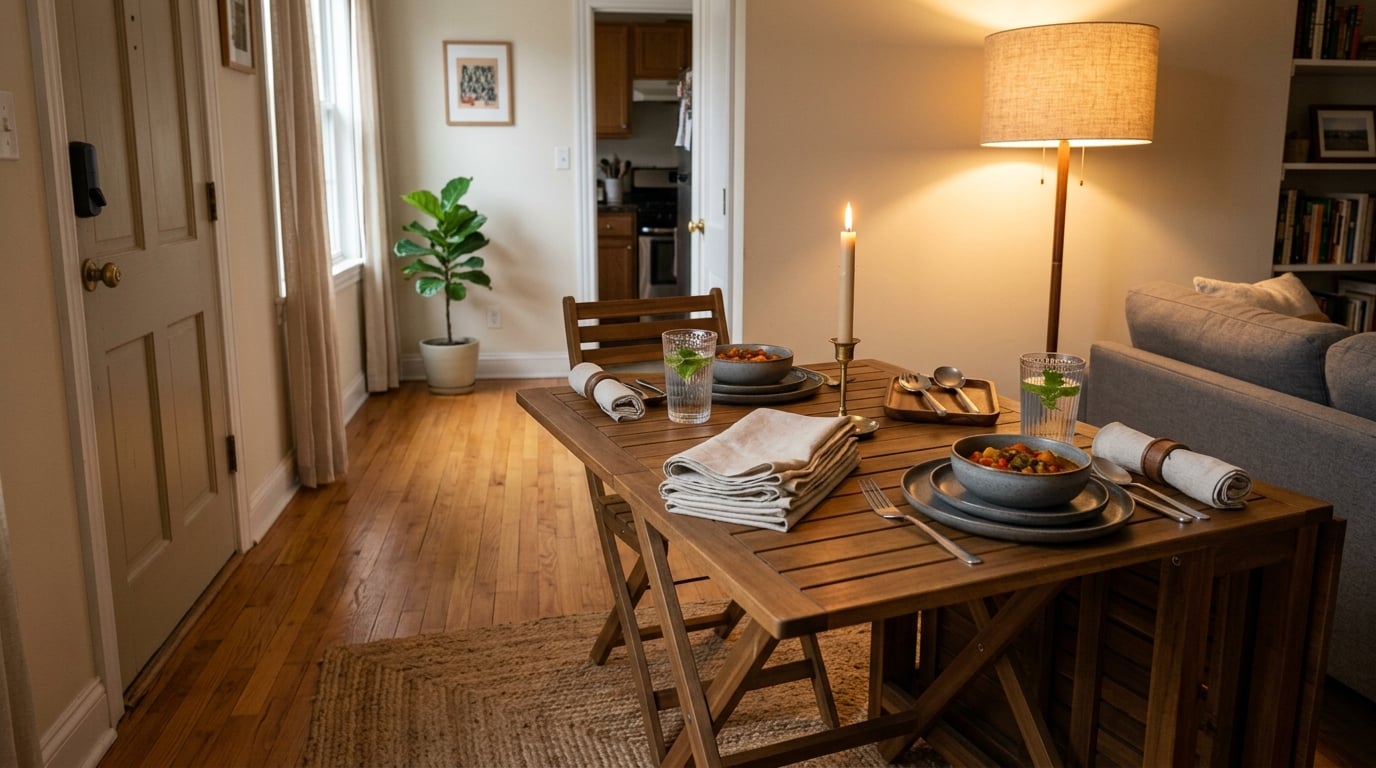
To host a dinner party in a small apartment, you size the guest list to the room, clear a 36-inch path from the door to the bathroom, and serve a menu that a small kitchen can finish without you living at the stove. A studio seats four comfortably, a one-bedroom handles six, and a two-bedroom stretches to eight. Nobody is sizing up your square footage. They are sizing up whether you planned well.
Most of the anxiety around this comes from treating the apartment as fixed. It is not. You move the coffee table, borrow a folding table, push the sofa against a wall, and the room does twice the work it did on a Tuesday.
Here is the method I use, roughly 48 hours out to the last dish in the drying rack.
Table of Contents
- What You Need
- Step-by-Step
- Choose a party size your apartment can support
- Plan how to host a dinner party in a small apartment with a compact menu
- Set up distinct zones for cooking, eating, and coats
- Make the food mostly ahead of time
- Create a simple arrival and serving plan
- Keep guests comfortable without over-hosting
- Close the evening with a quick reset
- Common Mistakes
- Frequently Asked Questions
- How many people can I comfortably host in a small apartment?
- What is the easiest menu for a small-apartment dinner party?
- Where should guests put their coats and bags?
- How can I host dinner without bothering my neighbors?
- Should I prepare every dish before guests arrive?
- How do I clean up quickly after hosting a dinner party?
- Conclusion
What You Need
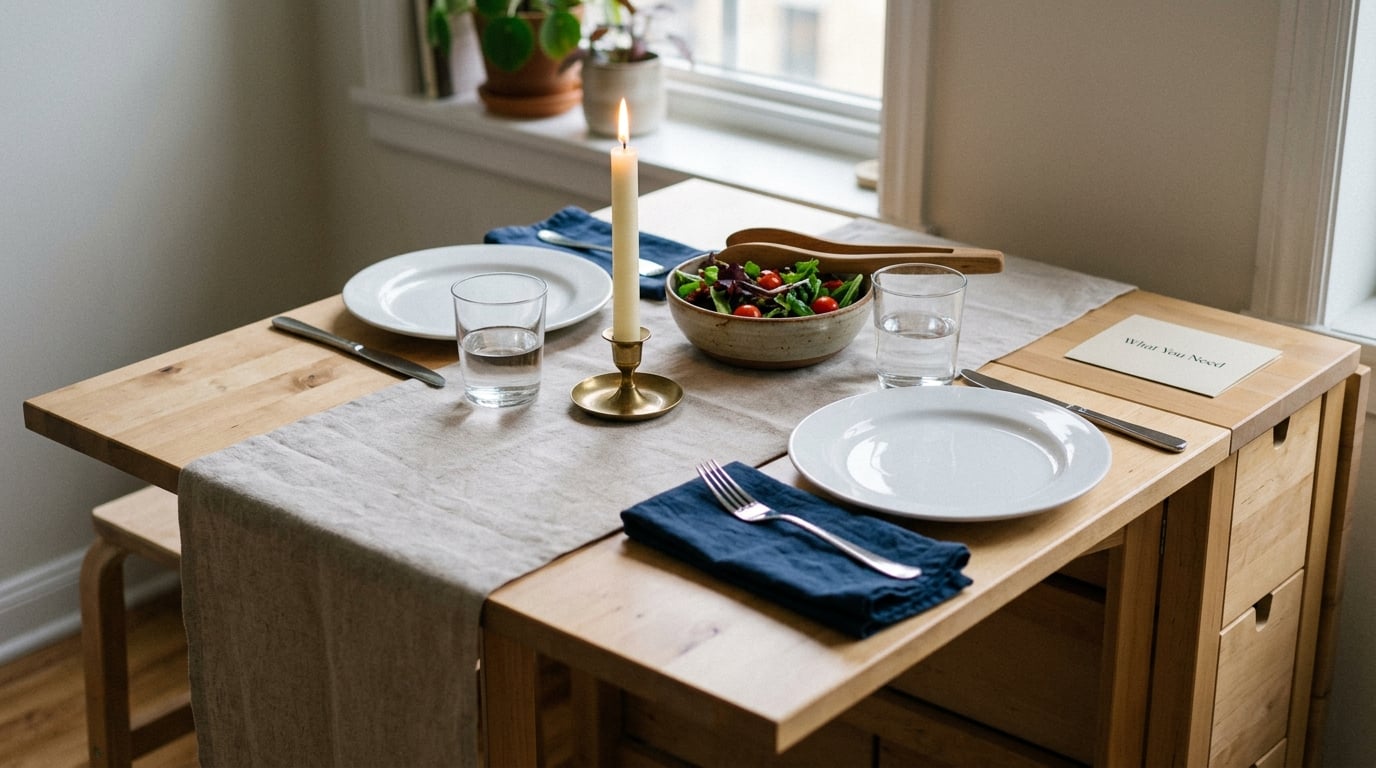
Gather these before anyone arrives, and keep the pile small. The goal is that every object has a home tonight, not that you own a matching set of anything.
- Surface for eating. A folding card table, a drop-leaf table, or the coffee table with a runner and a couple of stools. Borrow it if you must.
- Seating for every guest plus two spare. Mix chairs, barstools, a bench, and floor cushions. Mismatched seating reads as relaxed, not cheap.
- One place setting per person, plus two extras. Plates, forks, knives, napkins. Running out of forks mid-meal is the fastest way to kill the mood.
- A separate drinks station surface. A bar cart, a dresser, a console, a kitchen counter nobody uses for prep. Ice, drinks, opener, and cup opener live here, not on the dining table.
- Serving gear that nests. One big platter instead of four bowls. A single carafe instead of a bottle graveyard. A lazy Susan if the table is round and there are more than four eaters.
- Two towel tricks for the kitchen. A damp towel over the oven handle for hot dishes, and a separate one for spills. Label one if your guests include teenagers.
- A bin for coats, bags, and shoes. A canvas hamper, a large duffel, or a lidded basket parked in a corner that is not a doorway.
- Lighting. One dimmable overhead source, one lamp, and two candles or a string of warm lights. Overhead fluorescents are what make a room feel like a break room.
- Kitchen backup. A slow cooker or small oven space for keeping something warm, foil, a cutting board that fits over your sink, and extra trash bags.
- Names. A list of who you invited, their dietary needs, and one helper if a friend will be in the kitchen with you.
Borrow the bulky one-use items. A card table and folding chairs live in a closet somewhere in every city, and asking to borrow one is a normal thing to ask.
Step-by-Step
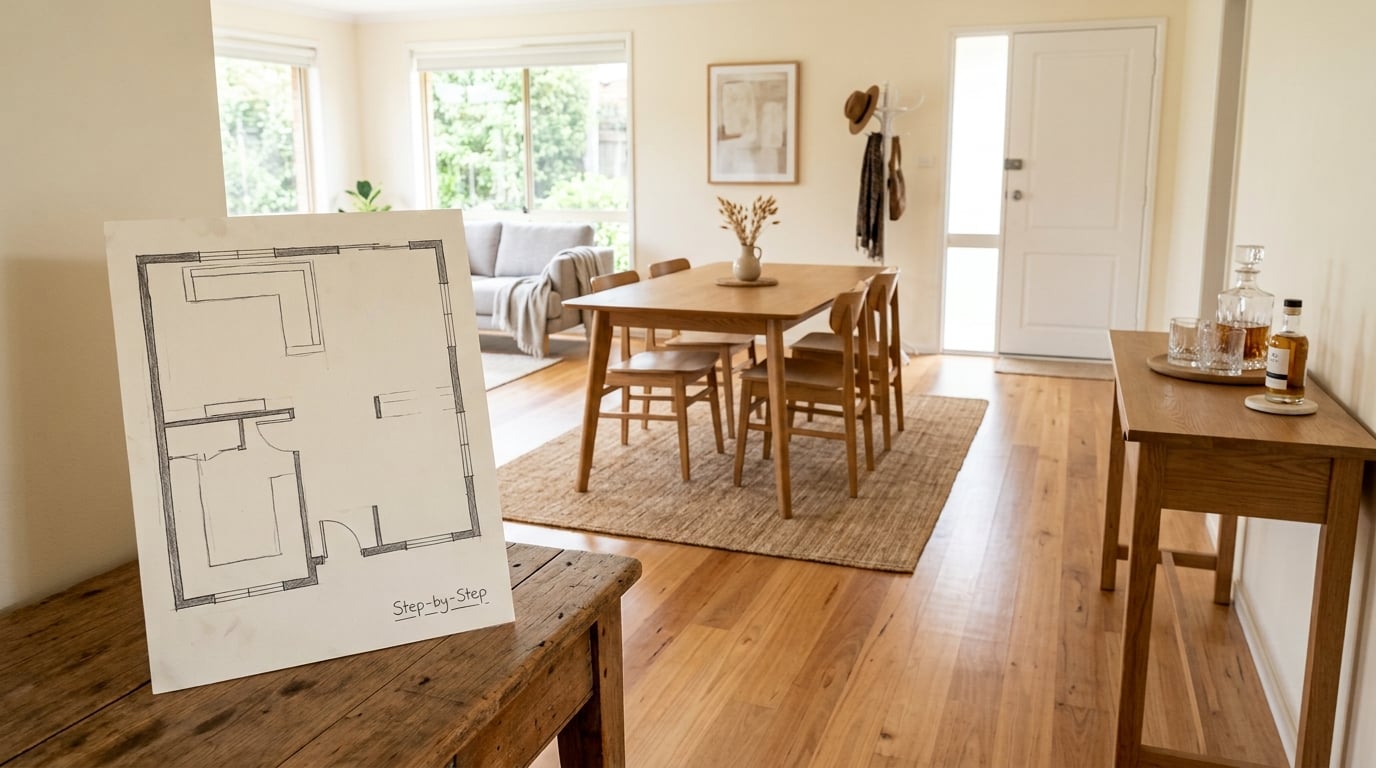
Choose a party size your apartment can support
Count seats first, then subtract two for the people who need to get up and move around. A fold-down table that seats six comfortably holds four when a chair is pulled out at each place.
| Apartment | Sit-down dinner | Table setup | Menu that works |
|---|---|---|---|
| Studio, about 400-550 square feet | 3 to 4 guests | Coffee table, stools, one end of the sofa | One-dish, served in the kitchen |
| One-bedroom, about 550-800 square feet | 4 to 6 guests | Folding table in front of the sofa, chairs on both sides | One main plus a make-ahead side |
| Two-bedroom or a one-bedroom with a dining nook | 6 to 8 guests | Actual table plus floor seating at the ends | One main, one side, one dessert |
| Open house, no seating required | 10 to 15 guests over two hours | Food on a counter, drinks on a separate surface | Bites sized to eat standing up |
Some hosts push well past these numbers. Someone on r/bitcheswithtaste described serving twelve people for dinner in a tiny apartment, and party.pro reported hosting nineteen in 475 square feet. Both worked because the format was open house and the food was handheld. A sit-down dinner of twelve in a studio is a different proposition, and no amount of rearranging fixes it.
Give yourself the number that still leaves the bathroom reachable without squeezing past three people. In a one-bath apartment, the bathroom is a bottleneck, not a suggestion.
Plan how to host a dinner party in a small apartment with a compact menu
One main dish, one make-ahead side, one salad or bread, one dessert. That is the whole menu, and it is enough for six to eight people. Anything more means you are cooking in a kitchen the size of a hallway.
Build the menu backwards from your equipment. A sheet pan, one pot, and a microwave produce a braise, a grain, and a vegetable without a second burner. A Dutch oven gives you a stew that improves overnight and reheats without drying out, which is the most forgiving dinner format in a small kitchen.
Do the dietary work early. Ask about allergies when you confirm the date, not at the door. Keep one dish that is naturally accommodating, usually a grain or a vegetable, so a guest with a restriction is not eating the side dish everyone else is skipping.
Keep food safety tight, especially in a warm room. Chill perishables within two hours, and remember safe minimum internal temperatures: 165°F for poultry, 160°F for ground meat, 145°F for whole cuts of meat and fish. If you are serving buffet-style, set out small platters and swap them out every 20 minutes rather than leaving a big bowl sitting out.
Have guests bring something, but be specific. Naming ice, a specific bottle, or an appetizer that travels well reads as planning, not as passing the buck. It also protects your tiny kitchen from three people standing in it at once.
Set up distinct zones for cooking, eating, and coats
Three zones, and the apartment stops feeling cramped. Cooking stays in the kitchen. Eating takes over one wall. Coats and bags get a corner that is not in front of a door.
Then walk the route from the front door to the bathroom with a tape measure open in your hand. Clear 36 inches along it. That single measurement does more for a small apartment party than any decor choice.
Give every guest 24 inches of table edge. That is roughly a dinner plate plus elbows, and it is how you decide whether a folding table actually seats six or only four. Behind each chair, keep 30 inches of clearance so people can pull back without hitting the wall or a console.
A few layout tricks help:
- Move the coffee table to a side wall or out of the room entirely for the night. It is the single biggest obstacle in a typical living room.
- Push the sofa flush to the wall and let guests sit on the floor with cushions, which frees the whole center of the room.
- Put the table parallel to the sofa rather than perpendicular, so the conversation splits into two facing rows instead of everyone craning around a corner.
- Keep the kitchen doorway clear of chairs. People carry plates through it, and a chair in that spot guarantees a collision.
- Set a second, low surface near the sofa for drinks, so nobody walks past you mid-plate to refill a glass.
People who host in small homes keep the bathroom usable for a full evening. If you can, serve in the living room so a guest can slip away without cutting through the kitchen conversation. r/SmallHome regulars talk about splitting a room into two or three chair clusters for exactly this reason, and it works better than one big crowd.
Make the food mostly ahead of time
Almost everything should be finished before the doorbell, with a final 10 or 15 minutes of heat. The moment guests arrive, you are a host, not a cook.
A workable 48-hour schedule:
- Two days out. Confirm the guest count, ask about restrictions, and decide the menu. Shop. Pick anything that must marinate, chill, or rise.
- Day before. Make the dessert, the sauce, and any braise. Set the table, count plates and forks, and confirm you have two spare cups.
- That morning. Chop vegetables, cook the grain, dress the salad but keep it undressed. Set up the drinks station so filling the ice bucket is your last ten-minute job.
- Final 40 minutes. Turn the oven on, warm the main, and light the candles. Take the trash out before guests come.
- Guests arrive. No cooking unless something needs a final 5 minutes. Everything else is on the table or on the counter.
Reheat in batches so the oven is not cycling the whole evening. Cover pans loosely with foil to hold moisture, and hold dishes at 140°F or warmer if they will sit more than 30 minutes.
Create a simple arrival and serving plan
Put the drinks station as far from the kitchen as your apartment allows, ideally near the front door. Two benefits: guests get a drink and stop moving immediately, and nobody drifts into your cooking space.
Some hosts spread food and drinks to two different rooms so people do not walk the length of the apartment and back. r/partyplanning users make the same argument about holiday gatherings, and the logic holds for a Tuesday dinner.
For a sit-down meal, tell people how it works in one sentence when they sit down. If you are serving family style, say which dish goes where. If it is one-dish, say it yourself, from the front. Nobody wants to ask where the serving spoon is while four people are watching.
Have a helper. One friend who is not shy about the kitchen can run plates, refill water, and clear as you finish. That single arrangement is the difference between hosting and juggling.
Keep guests comfortable without over-hosting
Small rooms amplify everything, including discomfort. Three things do most of the work.
Light. Turn off the ceiling light. A lamp, two candles, and one warm string of lights changes the perceived size of a room more than anything else you can do in ten minutes. An oversized paper lantern on a plug-in socket does the same job for almost nothing, and it stores flat between parties.
Temperature. Six people and one oven in a small apartment raises the temperature fast. Crack a window before guests arrive, not after, and keep the door to the hallway open if your building allows it. Serve one cold dish.
Noise. This is the part nearly every small-space guide skips. Doors close with a soft click, not a slam. Keep the music low enough that people raise their voices slightly to hear each other across the table, which is a good sign. If your building has quiet hours, end before them and do not extend past them without apology. If there is a doorman or a superuser, mention the gathering and ask about anything time-sensitive, like deliveries or move-ins.
You can lower the stakes for yourself too. Guests are not evaluating your square footage, and they are not comparing your table to the one in the photo you scrolled past at 1 a.m. In forum threads about hosting in tight spaces, the consistent message is that people notice warmth and planning, not floor area. One r/bitcheswithtaste commenter put it plainly: nobody is worried about the size of the room when they are happy to be there.
When the group gets too loud, do not raise your voice over it. Lower the music a notch, turn the lamp down, and start moving toward the couch. People follow the room’s energy without being told.
Close the evening with a quick reset
End on a time you told people about. A host who says the evening wraps at eleven gets far fewer awkward exits than one who lets it trail off.
When guests go:
- Walk the room and put perishables into the refrigerator within two hours, including anything left on the counter.
- Sweep the floor, check corners for shoes, and empty the bin so it is not a problem in the morning.
- Take dishes down to the sink, run water over anything with sauce on it, and let them sit. Do not scrub at midnight.
- Wipe the drinks station and the table. Move the folding table back to wherever it lives and fold the chairs.
- Put the extra chairs, the spare plates, and the cooler back in storage. If you skip this, you will find the folding table in August.
Leftovers go into containers that stack, and the ones you will not eat get offered to guests on the way out. A small apartment gets a lot faster with less in the fridge.
Common Mistakes
Inviting one or two too many. The extra guest does not just add a chair. They add a body in the kitchen doorway and a second bathroom line. Set your limit from the table edge, not from your guest list ambition.
Trying to seat everyone at once. A sit-down meal of eight in a one-bedroom is a squeeze. Two smaller sittings, an hour apart, feels generous by comparison and still gets everyone fed properly.
Leaving the coffee table in the middle. Move it to a wall. This is the free square footage you already own.
Blocking the path to the bathroom. Keep 36 inches clear from door to bath. Guests will not complain, they will just avoid coming back.
Serving a four-dish menu from a small kitchen. You will be at the stove while the party happens in the other room. Cut to one main, one side, one salad, one dessert.
Putting the drinks on the dining table. No room for plates, and elbow space disappears. Use a second surface near the door.
Using your good dishes and running out. Set two extra place settings at the start. Nobody counts your spare forks.
Forgetting the neighbor. Soft door closers, low music, and an honest end time. That is the whole etiquette list.
Not telling guests what you need. Naming the specific thing, like a bag of ice or a bottle of something specific, comes across as thoughtfulness. A vague “bring whatever” gets you nothing and feels like a test.
A few things that consistently help: pick up three or four key items from your guest list and name them outright, designate a coat corner before anyone arrives, and make a habit of clearing plates as they are used. In a small space, a table that stays clean is what keeps the room from feeling full.
Frequently Asked Questions
How many people can I comfortably host in a small apartment?
A studio seats three to four for a sit-down dinner, a one-bedroom handles four to six, and a two-bedroom stretches to six to eight. Base the number on seating and flow rather than square footage: give every guest 24 inches of table edge, keep 36 inches of walkway to the bathroom, and remember one bathroom serves a seated dinner poorly above six people. Open house formats can double the count if food is handheld and drinks sit away from the kitchen.
What is the easiest menu for a small-apartment dinner party?
One main, one make-ahead side, one salad or bread, and one dessert. Choose dishes you can cook in a single pot or on a sheet pan, since most small kitchens have one prep surface and limited burners. A braise or baked dish is the most forgiving choice, because it reheats without drying out and often tastes better the next day. Ask about allergies when you confirm the date and keep one naturally accommodating dish on the table.
Where should guests put their coats and bags?
Designate one spot before anyone arrives, and make it a container rather than a pile. A canvas hamper, large duffel, or lidded basket in a corner that is not a doorway works well. Shoes go under the same spot, not scattered across the entry. In a one-bedroom, the coat corner doubles as your overflow storage, and mentioning it early, such as with a sign or a single sentence, keeps it from becoming a heap in the hallway.
How can I host dinner without bothering my neighbors?
Three habits cover most of it. Close doors quietly, keep music at a level where people lean in slightly rather than shout, and set an end time out loud that respects your building’s quiet hours. If there is a doorman or building manager and you expect a large group, a short heads-up in advance prevents most complaints. Cracking a window early also reduces the stuffiness that makes people turn the music up.
Should I prepare every dish before guests arrive?
Almost. Finish everything except the final 10 or 15 minutes of heat, so you are hosting rather than cooking. Two days out you shop and start anything that chills or rises. The day before you make the dessert, sauce, and braise. That morning you chop, cook the grain, dress nothing, and set up the drinks station. Leftovers last: chill perishables within two hours, and keep hot dishes at 140°F or warmer.
How do I clean up quickly after hosting a dinner party?
Run water over anything with sauce on it, fill the sink with hot soapy water, and let it soak while you finish the room. Then sweep, empty the bin, and put perishables away. Clear one surface completely, the drinks station first, so the apartment looks reset even if dishes remain. Before bed, refrigerate leftovers, fold the folding table, and return spare chairs to storage. Skipping that last step is how the card table disappears for six months.
Conclusion
Learning how to host a dinner party in a small apartment comes down to three decisions, not a bigger apartment. Confirm a guest count your table and bathroom can carry, pick a one-dish menu you can finish before the doorbell, and set up only the zones you actually need: a table, a drinks surface, and a coat corner.
Start with the guest count this week. Everything else follows from that number.