
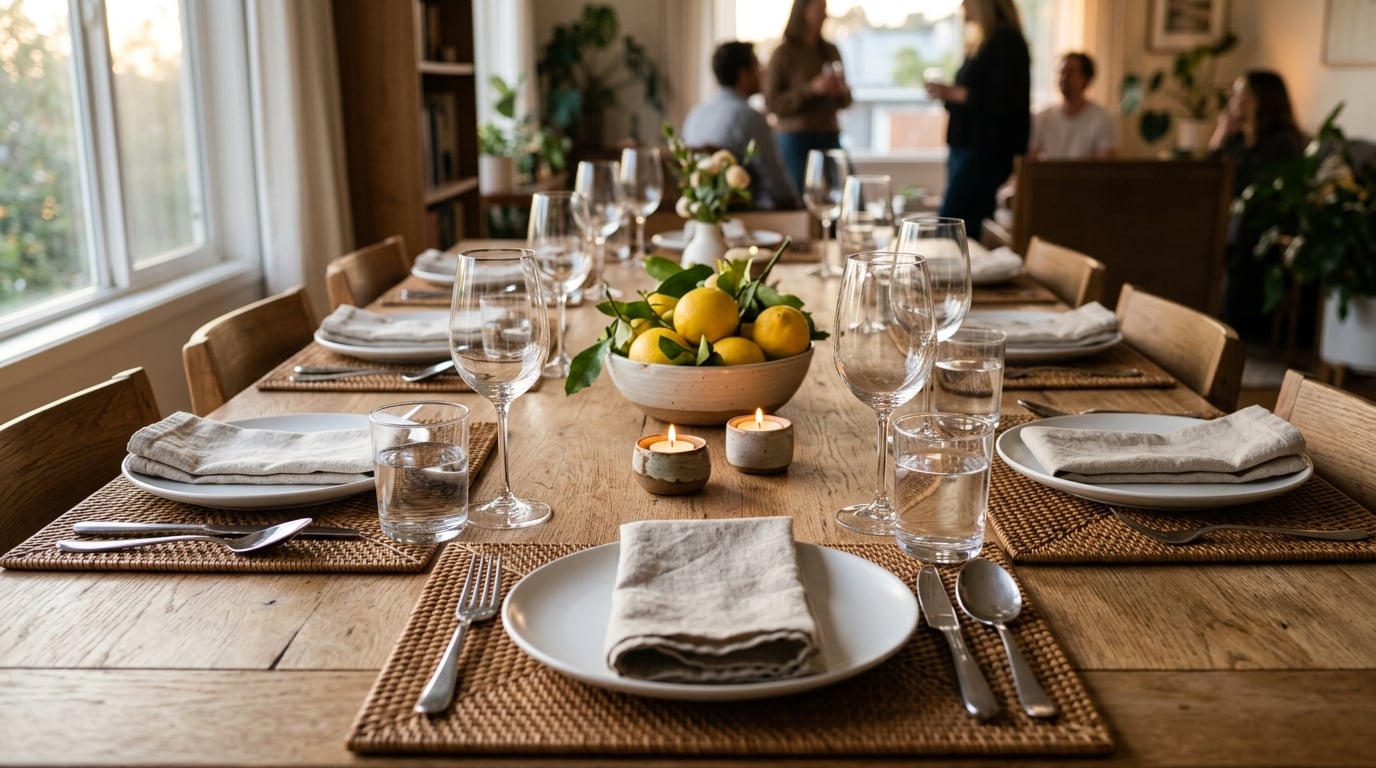
If you have never done it before, learning how to set a table for a casual dinner party comes down to five pieces per guest: a plate, a fork on the left, a knife and spoon on the right, a water glass above the knife, and a napkin. Skip the charger, the presentation plate, the dessert flatware and the stemware, and the table looks like someone thought about it without trying too hard.
The whole setup takes about 20 minutes once you know where things go, and you can set most of it the night before. That last part is what makes the difference between a host who enjoys their own dinner party and a host still sliding plates around while guests stand in the kitchen holding a drink.
A note on word choice, because it trips people up: casual and informal mean the same thing here. There is no separate formal-free version of this table to learn, and nobody at your party is taking notes on your flatware.
What You Need
Count one setting per person plus one spare. The spare is not paranoia; a plus-one, a dropped fork and a dietary swap will all use it.
Per place setting
- A placemat, woven bamboo or a fabric one, roughly 12 by 18 inches
- A dinner plate, 10 or 11 inches
- A salad plate, 7 or 8 inches, if you are serving a first course
- A dinner fork, a dinner knife and a soup spoon
- A water glass or tumbler
- A cloth or paper napkin
For the middle of the table
- One or two serving dishes and a serving spoon or tongs for each one
- A water carafe or a large bottle, plus a pitcher for anything cold
- A low centerpiece: a bud vase, a shallow bowl, or three small vases instead of one tall one
- Two or three unscented taper candles or tealights, and something to light them with
Worth having nearby but not on the table
- A side table or a bar cart for drinks, so the dining surface stays clear
- A small stack of extra napkins, because the one in the place setting disappears within ten minutes
- A serving tray, so clearing between courses is a single trip
None of this has to be new or matched. Everyday stoneware or casual porcelain works, and so does a drawer of plates in four different patterns. Hosts on dining forums describe the same thing again and again: the table reads as intentional when the food and the company are good, and mismatched dinnerware stops looking like a flaw about the second minute.
How to Set a Table for a Casual Dinner Party, Step by Step
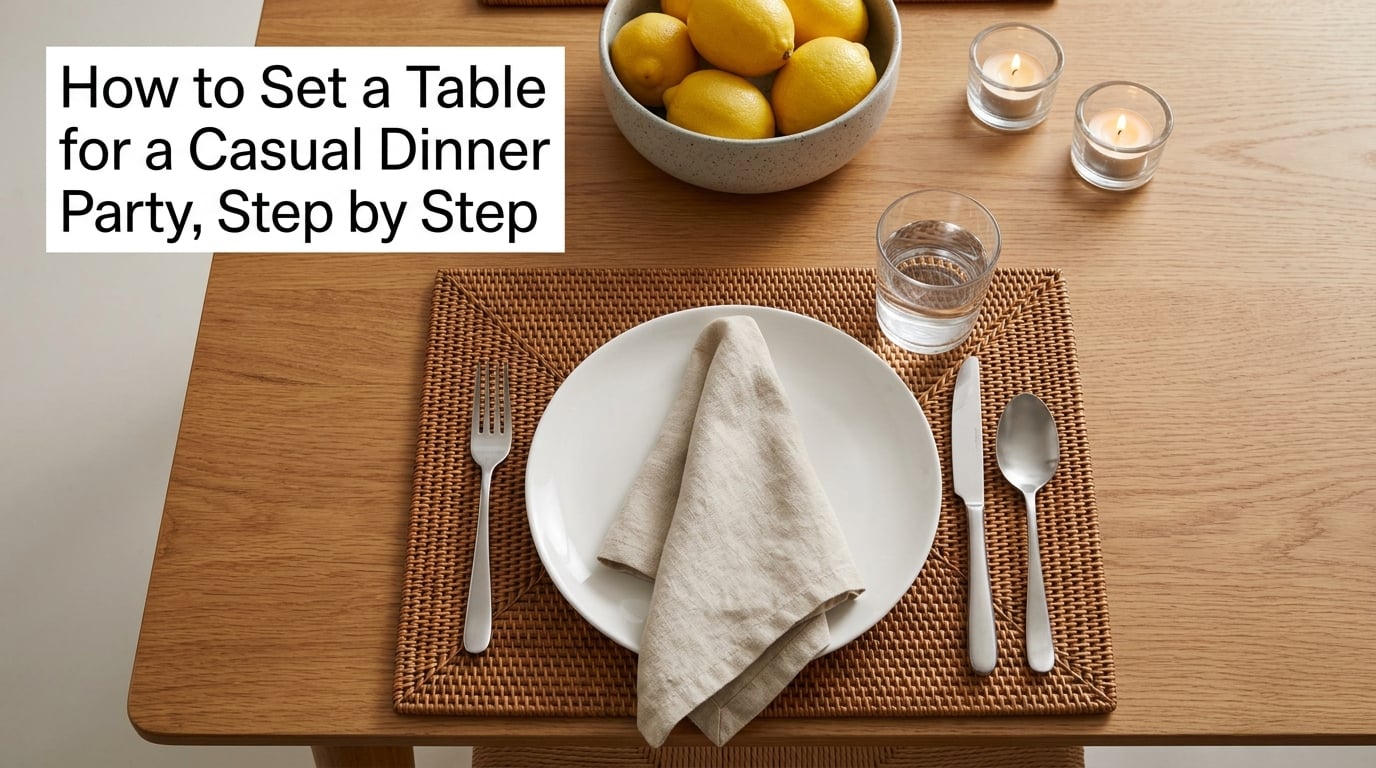
The order below matters less than you think, but there is one: cloth first, then plates, then flatware, then glasses, then flowers and candles last. That way nothing has to be moved twice.
Choose the Table Layout and Linens
Put the cloth or runner down first and smooth it out. A bare wood table is perfectly fine for a casual dinner, especially if it is in good shape, and a runner laid across the middle gives you a place to set serving dishes without them tipping off a cloth edge.
Leave enough room. A place setting needs roughly 24 inches of table width across and 18 inches deep, and you need another 12 inches somewhere for the serving dishes if they are going on the table rather than on a sideboard.
If your table is small, stop worrying about it and shorten the guest list instead of squeezing settings together. Glasses pressed up against forks make a table look cluttered in a way nobody can explain, and guests end up lifting each other’s cutlery to drink.
Place Plates and Napkins
Set each dinner plate about an inch in from the edge of the placemat, centred in front of that person’s chair. Where the napkin goes depends on how you are serving.
For plated courses, the napkin goes on the plate. For family-style service, put the folded napkin to the left of the fork so it is out of the way during the meal. That left-side spot is traditional because it sits just inside the left hand, which is the hand holding the fork.
Roll the napkins loosely or fold them into a simple fan. There is no rule that says they have to be crisp, and a slightly rumpled cloth napkin looks better at a casual dinner than a starched one that crackles when anyone moves.
Arrange Forks, Spoons, and Knives
One fork goes on the left of the plate and the knife goes on the right, blade facing inward toward the plate. The spoon goes to the right of the knife if you are serving soup; if you are not, drop it and keep only the three pieces people will actually use.
Use the thumb rule for alignment: slide your thumb from the bottom of the fork handle up to the tines, and the same angle on the knife and spoon. Their bottom edges should land on the same line near the plate. Nobody measures this, but it is what stops a table from looking slightly crooked.
Leave a gap between the fork and the plate edge. A fork jammed against the plate reads as fussy rather than careful.
Set Water and Drinking Glasses
The water glass goes directly above the knife tip, which is about one to two inches above the top edge of the dinner plate. If you are serving wine, that glass sits to the upper right of the water glass, slightly behind it.
Think of it as a clock face: water at about 12, wine at about 2, and anything else stacked behind the water glass so it never lands in front of the wine.
Wine is optional at a casual dinner. A tumbler, a water glass and a couple of sturdy glasses for beer or a mixed drink is a complete, well-set table. Guests will not notice the absence of stemware, and nobody will leave early because you skipped it.
Add Serving Dishes and a Small Centerpiece
Put the food within reach but not on top of anyone’s placemat. Family-style serving works best when the main dish sits in the centre of an empty stretch of table or on a small side table, with the serving spoon angled so it can be picked up one-handed.
Keep the centerpiece low. The useful number is about 12 inches from the table surface to the top of the arrangement, which stays below the seated eye line so guests can see each other across the table. Anything taller turns into a wall, and a wall is the opposite of what a dinner party is for.
Unscented tapers are the safe choice. Scented candles smell fine to the person lighting them and faintly like perfume to everyone at the far end. Tealights or flameless LED candles solve that entirely if the table is somewhere the breeze reaches.
Finish with Simple Table Details
Walk the length of the table before you call it done. Every person needs an unobstructed patch roughly the size of a placemat in front of them, with their own glass and their own napkin, and nothing borrowed from the person sitting next to them.
Then dim something. Turning off overheads and leaving a lamp, a few tapers and whatever light is coming in the window does more for a table than any amount of decoration, and it takes ten seconds.
A name card is only worth it when the seating is complicated. If there are eight chairs and no plan, one clear table works. If you are placing people around a conversation you want to happen, cards earn their place. Write the names, hand out the napkins, and go change into something that isn’t an apron.
The Five-Item Minimum for a Weeknight Table
Some nights you do not want a project. Five items per person is enough for a completely respectable table: a plate, a fork, a knife, a glass and a napkin.
Skip the placemat and lay the cloth only. Skip the spoon unless you are serving soup. Use tumblers instead of stemware and light one candle instead of three. That version takes about eight minutes for six people, which is faster than finding matching napkins.
This is also the right setting for a Tuesday dinner where nobody is being seated formally, or for a kitchen counter with four stools where a full table is not happening at all.
A Timeline That Beats the Panic
The night before
- Decide the menu and the guest count, and confirm any dietary needs
- Pull out the cloth, placemats, napkins and flatware and count settings plus one spare
- Wash the glassware so it is not hiding in the dishwasher at 6pm
- Buy or pick up anything you are missing, including flowers or candles
About 30 minutes before guests arrive
- Set the cloth and placemats
- Set plates, flatware, glasses and napkins, following the steps above
- Fill the water carafe and put the drinks on a side table
- Move serving dishes out, then place them once the food is nearly ready
- Light the candles last, dim the overheads, and start the music
Nothing on either list has to happen while anyone else is in the room. That is the entire point.
Casual vs Formal: What Actually Changes
Most people are not sure where casual ends and formal begins, which is why tables come out looking over-dressed. These are the only differences that matter.
| Element | Casual dinner | Formal dinner |
|---|---|---|
| Base plate | Dinner plate straight on the placemat | Charger or presentation plate under everything |
| Flatware | Fork, knife, spoon at most | Five or more pieces plus a fish knife and dessert fork |
| Glassware | One water glass, maybe a tumbler | Water, wine, red, white, champagne |
| Napkin | Left of the fork or on the plate | Formal fold, on the plate |
| Plates served | Family-style from the middle | Plated and served from the left |
| Centerpiece | Low, under 12 inches, informal | Tall, symmetrical, no flowers that drop petals |
| Timing | Set the night before | Set after guests are seated, reset between courses |
The five classic table settings people ask about are informal, casual, formal, banquet and buffet. Only the first two apply to a dinner at home, and the difference between them is mostly about how much flatware you set out and whether the plates arrive from the kitchen or from the middle of the table.
Common Mistakes
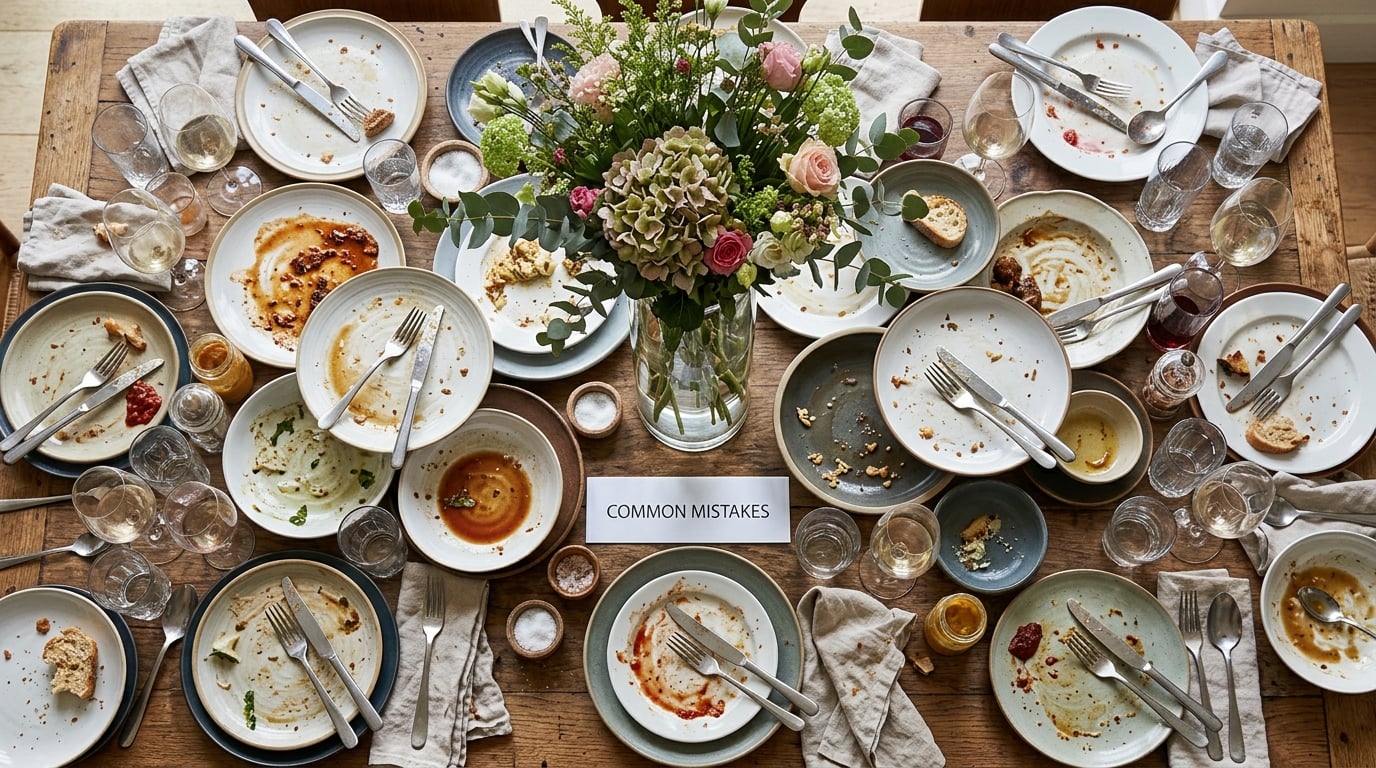
Overcrowding the table. It is the most common problem and the easiest to fix. Move the water carafe, the drinks and the second serving dish to a side table or a bar cart. The dining table is for eating, not for storage.
A centerpiece taller than about 12 inches. Your guests will spend dinner looking at stems. Switch to a low bowl, drop three bud vases along the length, or move the arrangement to a console entirely.
Glasses in the wrong spot. Water goes above the knife. Anywhere else and someone will reach across a plate to grab it, which is the exact thing a place setting is supposed to prevent.
Flatware bottom edges all over the place. Line up the fork, knife and spoon with the thumb rule, then step back and look. Alignment is what separates a table that looks composed from one that looks busy.
Setting every piece you own. Dessert forks, soup spoons, fish knives and a second water glass all belong in a formal setting. For a casual dinner, set what you will use and put the rest away.
Forgetting the serving spoons. Bring food to the table and leave no way to serve it. This sounds basic and still happens most weeks.
Scented candles. The room smells like a department store by the second course. Unscented tapers, or flameless candles if anyone is sensitive to smoke.
Setting the table while guests arrive. Not a setting mistake, but it ruins the mood. Set it before you open the door.
Tips
For a round table, plates go where the chairs are rather than around a square. Put serving dishes in the middle without crowding the outer ring, and skip the centerpiece if the table is small; a single low vase off to one side reads better than a tight circle of flowers.
For a buffet, the rule changes completely. Set nothing per place, stack plates at the start of the line, put cutlery and napkins at the end, and put drinks on a separate table so the queue is one line instead of three.
For family-style service, leave a full setting at every seat and keep the centre clear enough to land a hot dish safely. Each serving dish needs its own spoon, and bread goes in a basket with a small knife rather than sliced.
For a small apartment table, a coffee table or a console in another room handles the serving dishes while the dining table keeps only the settings. Two tablecloths in the same neutral colour make two tables look deliberate.
Outdoors, clip or weigh down the cloth, keep candles in hurricane glass or go with LED, and use a lantern on a low table for light after sunset. Citronella candles handle mosquitoes and nothing else, so keep food covered if the bugs are serious.
When dinnerware does not match, group by size rather than by pattern. All the white plates together, all the coloured plates together, rather than one white and one coloured at each seat. Mixed patterns look intentional; random mixes look accidental.
For dietary restrictions, do not build a separate setting or a separate serving dish that marks someone out. Put the dish they can eat on the table like everything else, keep serving spoons with their own dishes, and ask quietly in advance about allergens rather than at the door.
On timing: the night before, set the cloth, lay out the placemats, count settings, and pick what you are going to cook. About 30 minutes before guests arrive, set the plates, flatware, glasses and napkins, then add the serving dishes and light the candles last.
Frequently Asked Questions
What is the proper way to set a casual table?
A casual setting is a placemat, a dinner plate, a fork on the left, a knife on the right with the blade facing in, a spoon beside the knife if you need one, a water glass above the knife tip, and a napkin. No charger, no presentation plate, no dessert flatware, no extra glasses. Set only the pieces you will actually use during the meal.
Does the napkin go on the left or the right?
For a plated dinner, the napkin goes on top of the dinner plate. For family-style service, fold it and place it to the left of the fork. That spot is standard because it sits just inside the left hand, the one holding the fork, so nobody has to reach across the plate for it mid-meal. A rolled or loosely folded napkin both work.
Do my plates and glasses have to match?
No. Most hosts set a casual table with whatever they own. Group pieces by size rather than by pattern so the table looks considered, and keep one consistent element such as the napkins or the glassware to tie it together. Mismatched stoneware and casual porcelain are normal at this level of hosting.
Do I need a tablecloth for a casual dinner party?
A tablecloth is optional. A bare wood table in good condition looks fine, and a plain runner gives you a landing spot for serving dishes. If your table has marks, stains or a finish you would rather not see, a cloth solves that in a second. Skip floor-length cloth on a small table; it pools under the chairs.
How high should a dinner party centerpiece be?
Keep it under about 12 inches from the table surface so it stays below the seated eye line and guests can talk across the table without leaning around it. Low options include a shallow bowl of fruit, a few small bud vases spaced along the table, or tealights and low tapers in holders. Put anything tall on a console instead.
What should I leave off a casual table?
Leave off chargers and presentation plates, dessert and salad forks you will not use, a stack of duplicate water glasses, scented candles, and any centerpiece above about 12 inches. Also move drinks and the water carafe to a side table so the dining surface stays clear. A casual table looks better with fewer pieces, not more.
Start with the cloth, set the plates, add one fork on the left and a knife on the right, put the water glass above the knife tip, and finish with something low in the middle. That is the whole table, and how to set a table for a casual dinner party stops being stressful the moment you accept that fewer pieces look better than more.