
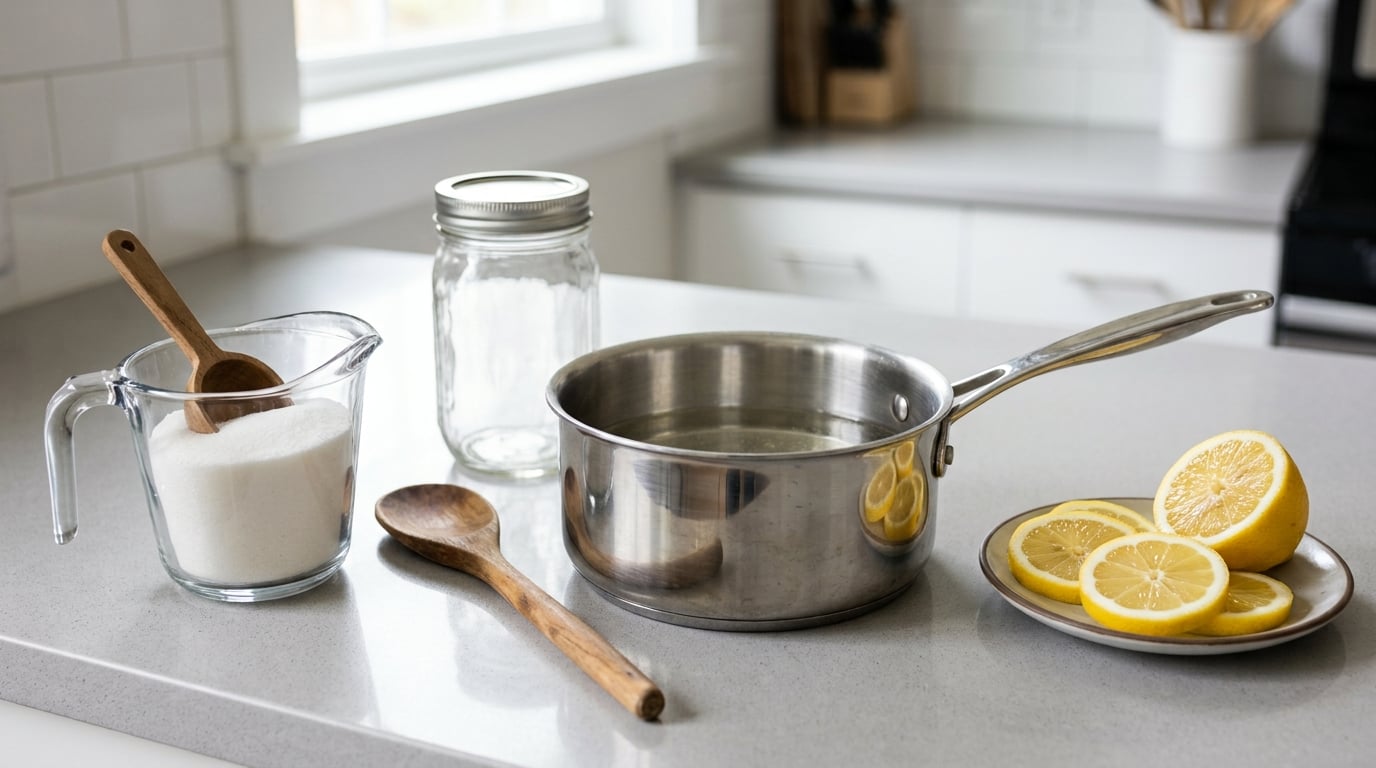
To make simple syrup for drinks, combine equal parts sugar and water in a saucepan, heat over medium-low, and stir until every grain of sugar has dissolved. Cool it to room temperature, then store it in an airtight jar in the fridge. That 1:1 ratio takes about five minutes and gives you a clear, pourable sweetener that dissolves completely in cold liquid.
That last part is the whole reason anyone makes it. Granulated sugar dumped into iced tea sinks to the bottom and sits there in a gritty layer. Sugar that is already dissolved behaves like liquid, so it spreads evenly through the drink no matter how cold or how full of ice the glass is.
It is also the base sweetener of most classic cocktails. On r/cocktails, experienced mixers are blunt about this: a true simple syrup should carry no flavor of its own, only sweetness. Flavor comes from what you infuse into it later, not from the base recipe.
Some people buy a bottled version instead, which works fine for a single drink. A homemade batch costs a fraction of that, keeps for weeks, and lets you decide the sweetness level and the infusion yourself.
If you are building a small home bar, the equipment is minimal and the technique is short. Here is everything you need, followed by the method and the fixes for the mistakes that trip people up most.
What You Need
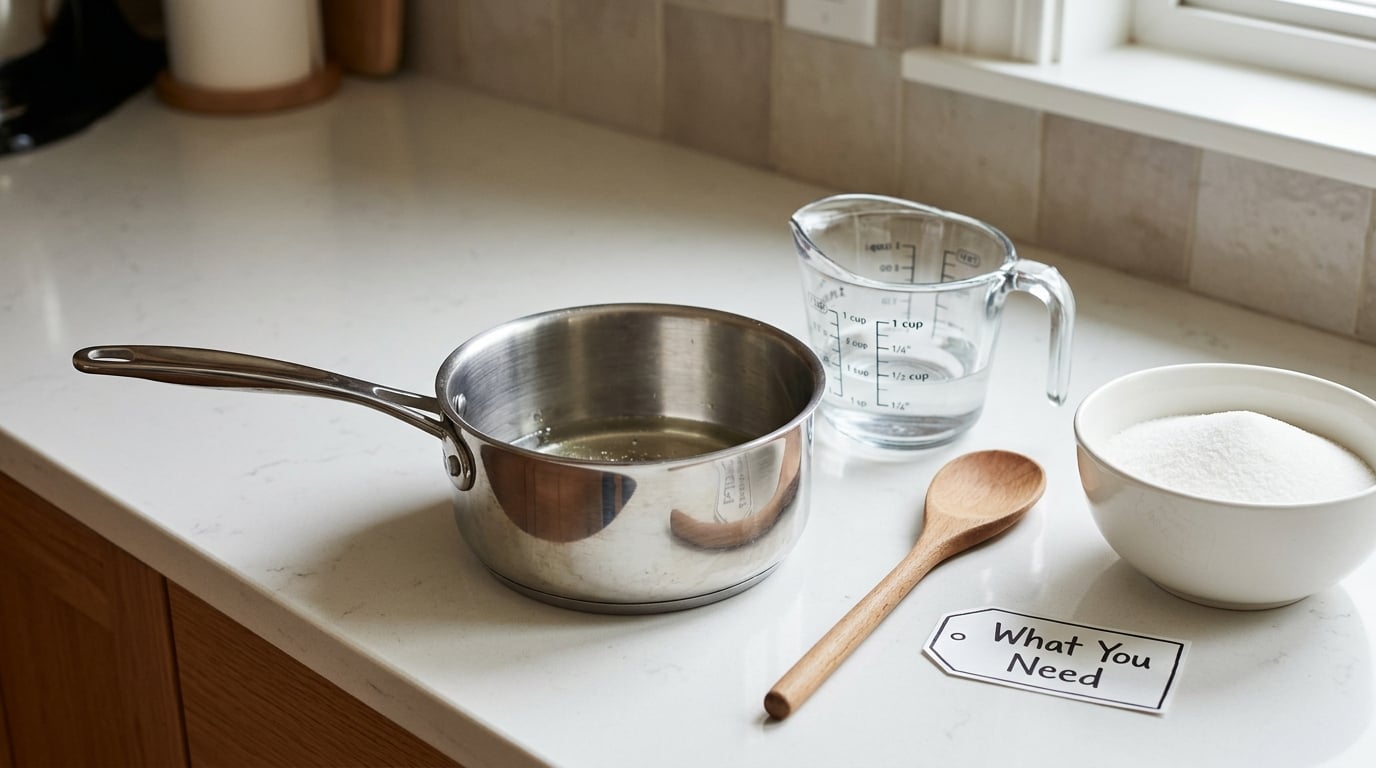
Ingredients for the base 1:1 recipe
- 1 cup (200 g) granulated white sugar
- 1 cup (240 ml) water
That is the entire shopping list. Everything below is optional.
Equipment
- A small saucepan with a heavy base, so heat spreads evenly and nothing scorches on one spot
- A wooden spoon or silicone spatula that can handle heat and reach into the corners
- A dry heat-safe container with a tight lid: a glass mason jar, a swing-top bottle, or a plastic squirt bottle
- A fine-mesh strainer or a small piece of cheesecloth, for infused batches
- A kitchen thermometer, useful once you move on to richer or flavored syrups
On storage vessels, people tend to land in one of two camps. A glass jar is what most kitchen cabinets already hold and shows you the color and clarity of the syrup at a glance. A plastic squirt bottle is messier to fill but portions as it pours, which matters when you are dosing an Old Fashioned one drink at a time and do not want to eyeball a glug of sticky syrup into the glass.
Step-by-Step: How to Make Simple Syrup for Drinks
Four steps, and three of them are basically waiting. That is why a five-minute recipe stays a five-minute recipe even on a weeknight.
How to Make Simple Syrup for Drinks: The 1:1 Method
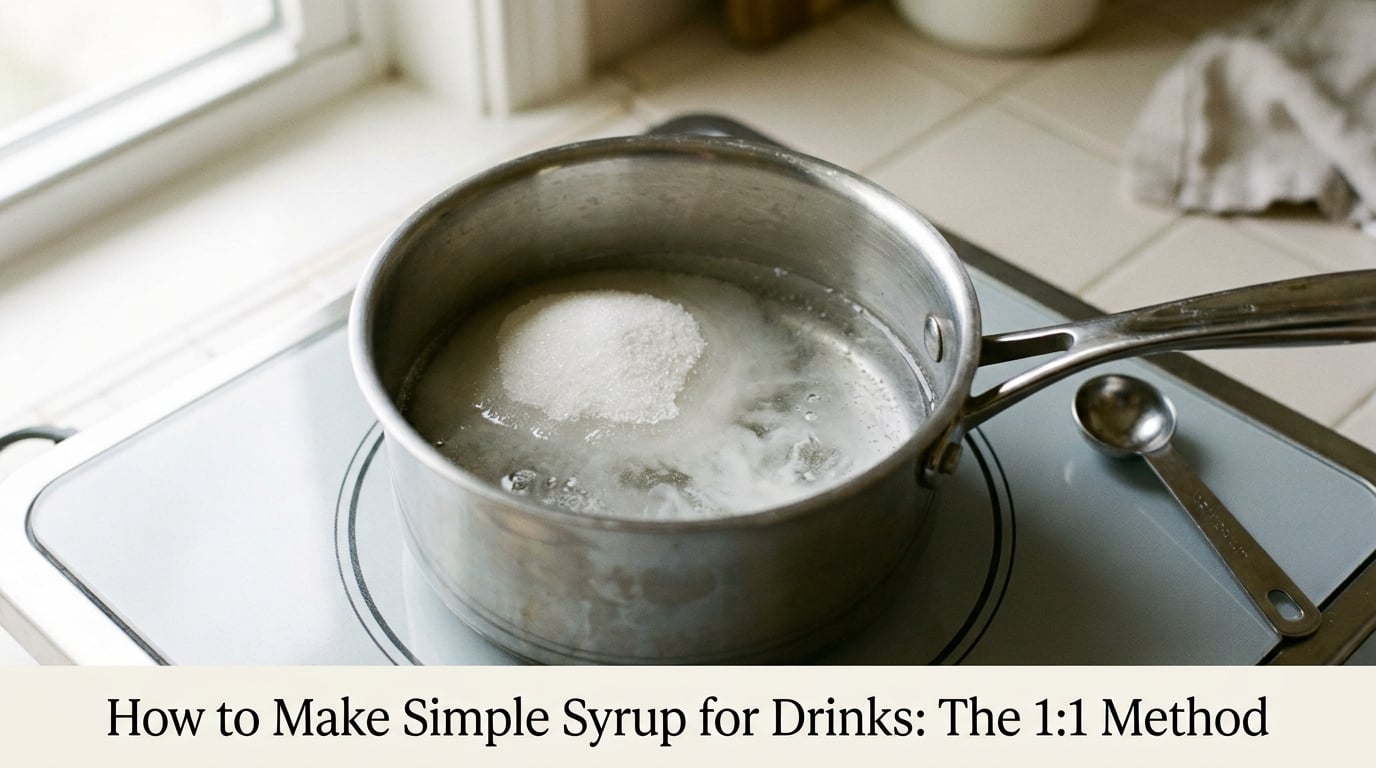
Combine 1 cup sugar with 1 cup water in a heavy saucepan. Either measurement works for home drinks: 200 g of sugar to 240 ml of water lands close enough to equal parts that the texture behaves the same, and using cups keeps the recipe readable for anyone scaling it up.
- Combine. Put the sugar and water in the pan together. Stir for about 30 seconds before turning on the heat, so the sugar is wet rather than sitting in a dry mound on the bottom.
- Heat and stir. Set the burner to medium-low. Stir steadily until the sugar dissolves completely, usually 3 to 5 minutes.
- Check the cues. The mixture goes from grainy and cloudy to clear, and a spoon drawn across the bottom of the pan leaves a faint trail for a second instead of a wet one. Tasting it should read sweet but not cloying.
- Cool and store. Take the pan off the heat and let it cool to room temperature, then pour into a dry, airtight container and refrigerate.
Step four is not optional. Warm syrup poured into a cold jar traps condensation inside the lid, and that water slowly dilutes what you made.
How to Make Simple Syrup for Drinks Without Burning the Sugar
Keep the heat at medium-low and never walk away from the pan. Boiling is the mistake to avoid, not because a rolling boil is inherently dangerous, but because water boils off faster than sugar dissolves, and as the water leaves, the temperature climbs past the point where sugar starts to caramelize. You get a flat, bitter, faintly burnt note that no amount of dilution hides.
Use the pan size as your guide. A small pan over medium heat heats faster than a large one, so drop to the lowest setting if your sugar is disappearing before you have even warmed your hands on the handle.
And keep a lid within reach. Boiling sugar syrup is sticky, hot enough to cause real burns, and it will stick to your skin, your counter and your shoes. Turn the burner off before you reach for anything.
There is a useful shortcut here: you never actually need to boil. Just warm water dissolves sugar perfectly well on its own, and a thermometer is the only reliable way to hit the same endpoint every time. That matters more for thick, 2:1 rich syrup than for a thin 1:1 batch.
How to Flavor Simple Syrup for Drinks
Dissolve first, then steep, then strain. Adding herbs or spices to the pan before the sugar dissolves just gives you another chance to scorch something.
Make the plain 1:1 syrup, take it off the heat, drop in your flavorings, and let it sit covered for 15 to 30 minutes. Longer steeping pulls out more, and more is not always better: lemon zest left for two hours turns bitter as the pith leaches in. Taste at 15 minutes and again at 30, then strain through a fine-mesh sieve or a folded piece of cheesecloth into a clean jar.
A few that work well straight out of the gate:
- Ginger — coin-thin slices, 30 minutes. Pairs with whiskey sours and adds bite to a Paloma.
- Lemon or orange zest — 15 to 20 minutes only, and zest the colored layer, not the white pith. Built for lemonades, Gimlets and Tom Collinses.
- Cinnamon sticks — 30 minutes. Good in hot apple cider, cold brew coffee and rum drinks.
- Lavender — culinary lavender, a small handful, 20 minutes. Two minutes too long and it tastes like soap. Excellent in a French 75 or a lemon lavender soda.
- Jalapeño — split a chile, scrape out most of the seeds, steep 20 minutes. This is the one people underestimate; it works best for margaritas and Paloma variations.
- Cold brew coffee or strong tea — swap the water for strong-brewed cold brew or tea, or steep tea bags into the finished syrup. Makes an instant concentrate for iced coffee and matcha.
Food safety matters more here than with the plain base. Plain sugar syrup is stable because of the sugar concentration, but fresh fruit, milk, cream and cut herbs can carry bacteria into a jar you will not heat again. Skip the dairy and the fresh-fruit mash unless the batch gets refrigerated and used within a few days. Dried spices, whole citrus peel and dried herbs travel much better.
If you want flavor without a second pot, half a teaspoon of vanilla, mint or orange extract stirred in once the syrup has cooled works well. Start at half a teaspoon and taste.
How to Store Simple Syrup and Use It in Drinks
Cool the syrup fully, pour it into a clean dry container, seal it tight, and refrigerate. Label it with the date, especially if you make several infusions at once.
Advice on shelf life ranges all over the place, from two weeks to a month, and the honest answer is that the number depends on three things: how concentrated the syrup is, whether anything perishable went into it, and how warm your kitchen is. Plain 1:1 syrup in a sealed jar in the fridge usually keeps three to four weeks. It darkens slightly over time, which is harmless.
| Type of syrup | Where it lives | Realistic life |
|---|---|---|
| Plain 1:1 simple syrup | Sealed jar, fridge | 3 to 4 weeks |
| Infused with herbs, zest or whole spices | Sealed jar, fridge | 2 to 3 weeks |
| Infused with fresh fruit, milk or cream | Sealed jar, fridge | 3 to 5 days |
| Alcohol-preserved syrup | Sealed bottle, cool dark cupboard | Several months |
A little vodka in the finished syrup slows spoilage enough for it to sit on a shelf, which is the trick older bar posts use. It is not magic: the preservative effect really only kicks in once the syrup is around 20% alcohol by volume, which for most home batches means using nearly equal parts spirits, and then you have made a liqueur rather than simple syrup. For most kitchens the fridge is simpler and better.
If crystals form at the bottom of the jar, nothing has gone wrong. The syrup became saturated, then something disturbed it — a cold night, a fridge running colder than usual, a spoon bumping the side. Set the jar in a pan of warm water and swirl until they dissolve again. Do not microwave it.
Which ratios actually matter
| Ratio by volume | What it gives you | Best in |
|---|---|---|
| 1:1 sugar to water | Thin, neutral, the standard | Iced tea, lemonade, spritzes, any shaken drink |
| 2:1 sugar to water | Rich syrup, noticeably thicker | Old Fashioned, iced coffee, desserts, baked goods |
| 1:2 sugar to water | Light, thin, less sweet per pour | Tall fizzy drinks, large batches of punch |
Every ratio dissolves the same way. The only difference is how much sweetness and how much body you get per spoonful.
Which sugar to use
| Sugar | Flavor impact | Reach for it when |
|---|---|---|
| Granulated white or caster | None. Clean and clear. | Everything, by default |
| Demerara | Slight caramel note, soft amber color | Rum, whiskey, anything spirit-forward |
| Sucanat | Deep molasses, dark color | Dark, spiced drinks where molasses belongs |
| Light or dark brown | Noticeable molasses, less sweet | Whiskey sours, autumn drinks |
| Honey | Floral, thicker | Tea, hot toddy-style drinks |
White granulated sugar dissolves fastest and gives the clearest result, so it is the right starting point. Everything else is a flavor decision, not a technique change.
Where to use it
The non-alcoholic uses are where a homemade batch really earns its shelf space. Two tablespoons in a glass of iced tea, cold brew coffee or an iced matcha latte beats granulated sugar every time. It works in homemade lemonade, in sparkling water with a squeeze of lemon, and in a hot toddy where the syrup dissolves instantly in hot water.
For cocktails, the classic list runs long: Old Fashioned, Margarita, Mojito, Tom Collins, Daiquiri, Gimlet, French 75, Espresso Martini. A default starting point for a drink built on 2 ounces of spirit is half an ounce of 1:1 syrup, then adjust.
One practical note for stirred drinks. Simple syrup mixes more easily when everything is cold, which is why a stirred cocktail built on syrup wants a pre-chilled mixing glass. Shaken drinks are easier still, because the agitation does the work for you.
Common Mistakes and How to Fix Them
Boiling the syrup. This is the top offender. Water evaporates faster than sugar dissolves, concentration climbs, and the syrup turns bitter. Fix: medium-low heat, stir until dissolved, stop as soon as the mixture is clear.
Not stirring, or stirring too fast. Sugar that sits still on the bottom of a hot pan will still scorch, and a fast stir can splash hot sticky liquid onto the burner. Fix: a slow, steady sweep around the base, corners included.
Bottling it while it is still warm. Condensation forms under the lid and dilutes the syrup over the following days. Fix: cool to room temperature first, and pour into a dry container.
Using too little water. A heavy-handed measuring cup gives you a syrup that thickens fast and can crystallize as it cools. Fix: weigh it if you have a scale, and if the mixture looks like it is tightening before all the sugar is gone, add a splash of hot water.
Storing perishable additions for weeks. Fresh fruit, cut herbs and any dairy in a syrup you will not reheat is the one genuine safety problem in this whole process. Fix: use dried spices, whole peels or extracts instead, or keep the fruit batch to a few days in the fridge.
Confusing simple syrup with a liqueur. If the syrup has a fruit flavor and noticeable body from steeping, most people mean an infused syrup. If it has been reduced with spirits until it is heavy and alcoholic, that is a liqueur. Neither is a problem, but they store differently and are used differently.
A quick note on scaling, since most people batch. Double the recipe, keep the same 1:1 ratio, and expect it to take a bit longer to dissolve because more cold sugar and water have to heat together. Use a larger pan rather than doubling in a small one, or the heat struggles to keep up.
| Sugar | Water | Grams | Approx. servings |
|---|---|---|---|
| 1/2 cup | 1/2 cup | 100 g sugar, 120 g water | 8 to 10 drinks |
| 1 cup | 1 cup | 200 g sugar, 240 g water | 16 to 20 drinks |
| 2 cups | 2 cups | 400 g sugar, 480 g water | 32 to 40 drinks |
| 4 cups | 4 cups | 800 g sugar, 960 g water | 64 to 80 drinks |
At roughly half an ounce per drink, a one-cup batch covers roughly sixteen to twenty cocktails. For a party, the four-cup version in a large pot does the job and keeps for weeks in the fridge.
Frequently Asked Questions
What is the formula of simple syrup?
The formula is 1:1 by volume: one part sugar to one part water. One cup of granulated white sugar with one cup of water gives roughly 400 ml of finished syrup. The sugar dissolves as the water heats, which is why the syrup stays clear and pourable and mixes evenly into cold drinks instead of leaving a layer of grit at the bottom of the glass.
Is simple syrup 2 to 1 or 1 to 1?
Plain simple syrup is 1:1, one part sugar to one part water by volume. A 2:1 ratio makes rich simple syrup, which is thicker and sweeter per spoonful and suits spirit-forward stirred drinks such as an Old Fashioned. Neither is more correct; the ratio sets how sweet and how viscous the finished syrup feels when it hits the glass.
How long will homemade simple syrup last?
Plain 1:1 simple syrup keeps three to four weeks in a sealed jar in the fridge. Infused syrups made with herbs, zest or whole spices keep two to three weeks. Anything made with fresh fruit, milk or cream lasts only three to five days refrigerated. A syrup that has darkened, clouded with sediment or smells off should be discarded rather than strained and reused.
What type of sugar is best for making simple syrup?
Granulated white sugar is the best default. It dissolves fastest, produces the clearest syrup and adds no flavor of its own, which is what a true simple syrup should do. Demerara, brown and sucanat work just as well but bring caramel or molasses notes, so they are a flavor choice rather than a technique change. Measure them packed for the same 1:1 ratio.
Can you boil simple syrup too long?
You can, and it is the most common way to ruin a batch. Boiling drives off water faster than the sugar dissolves, so the solution grows more concentrated until it passes the point where sugar caramelizes. The result is bitter and faintly burnt. Keep the heat at medium-low, stir until the syrup is completely clear, and take it off the heat right then.
Is simple syrup shelf stable?
Plain sugar syrup is not shelf stable on its own, because the 1:1 concentration is not high enough to stop spoilage indefinitely. Stored sealed in the fridge it keeps for three to four weeks. A small amount of alcohol slows things down, but preservation only really kicks in near 20% alcohol by volume, which turns the syrup into a liqueur rather than simple syrup.
Conclusion
The easiest first step is the whole recipe: equal parts sugar and water, medium-low heat, stir until the mixture is completely clear, then cool it fully and seal it in the fridge. From there, scale the batch to match how many drinks you actually make, and try one infusion when the base is down to muscle memory.