
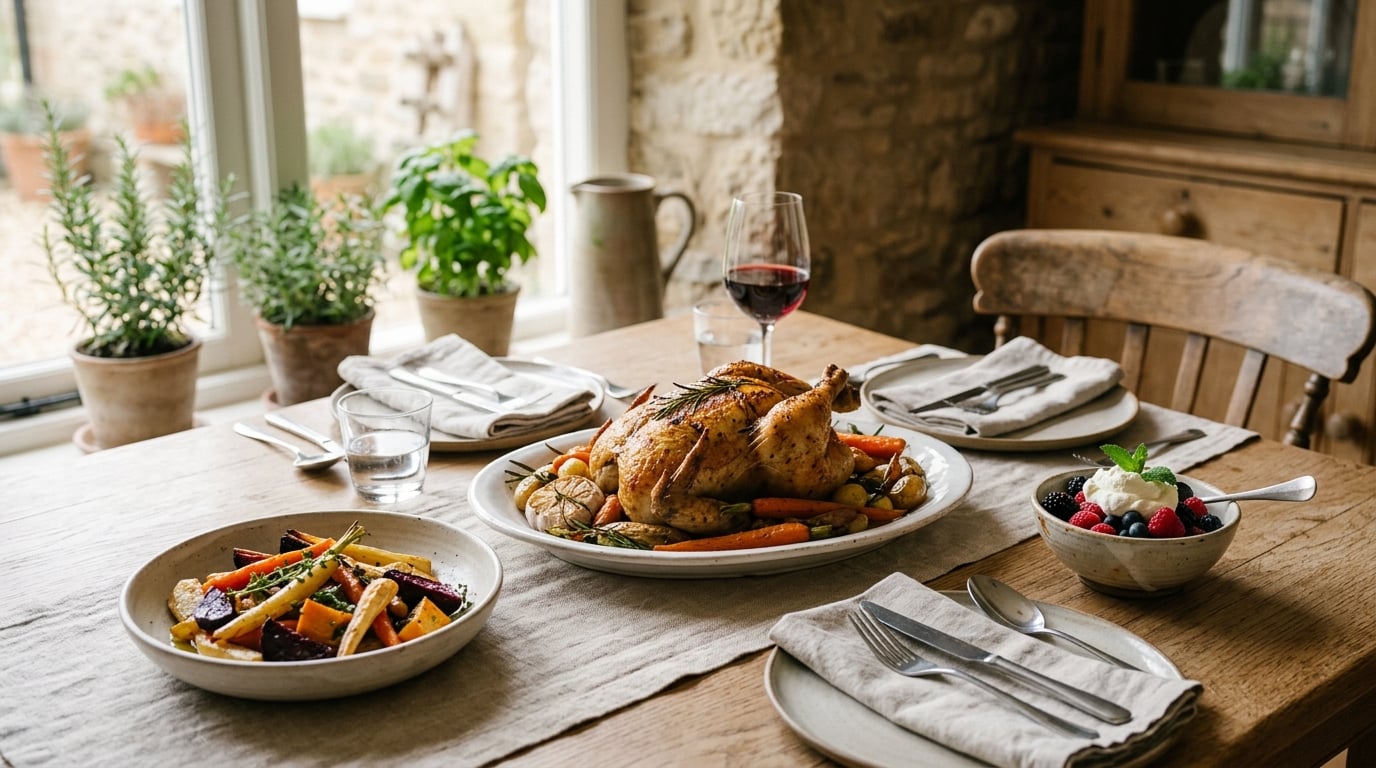
A three-course dinner menu is three dishes served in sequence: a starter, a main course with its sides, and a dessert, each cleared before the next one arrives. To build one at home, pick your main first, choose a starter and a dessert that contrast with it, then work backward from your serve time so everything is ready before your guests sit down.
Most of the work in a three-course dinner happens before anyone reaches your door. The night itself should be assembly, not cooking, because the failure mode is familiar: three dishes competing for one oven, four burners and one pair of hands, so the starter shows up lukewarm, the main arrives overcooked, and dessert never happens at all.
Only one dish should need you at the stove after guests arrive. Everything else is finished, resting, waiting in the fridge, or sitting on the table untouched. If you take that rule seriously, a three-course dinner for six takes about two and a half hours of total effort, spread over a day or two, and about 20 minutes of real work once people are eating.
What You Need
Before you pick a single dish, make five decisions. They are quick, and each one removes a problem later in the evening.
- Guest count. Count everyone who will actually eat, not everyone who was invited. Portions for a starter are much smaller than people assume, so a generous estimate costs you very little.
- Dietary needs. Ask about allergies and restrictions early, ideally a week ahead. One vegan guest or one nut allergy changes your menu decisions more than any plating trick will.
- A theme. A cuisine, a season, or a mood. It is a shortcut, not a rule, but a single theme keeps a menu from looking like a pantry dump.
- Equipment. One sheet pan, one large pot, an oven that holds a full-size roasting pan, and a wide serving platter for the main. An immersion blender is a nice-to-have for soups and sauces made ahead.
- Serving pieces. Decide which course travels on which dish now, so you are not hunting for a plate at 7:15 while the sauce breaks.
Then look at your kitchen honestly. Count burners and oven racks, and clear counter space. The single most useful thing most hosts do is empty the dishwasher and run an empty cycle, because a clean, open dishwasher is where the finished main waits while you plate the starter.
Step-by-Step
Learning how to build a three course dinner menu at home comes down to nine decisions made in the right order, mostly before the day itself. Here is the sequence that works.
1. Choose a Theme and Set the Menu Structure
Decide on a direction first, then give yourself one dish per slot. A starter, a main, a dessert. Sides count as part of the main, not as a fourth course, and no one will think less of you for serving them in one bowl beside the entrée.
Structure matters more than ambition. A warm soup, a roast chicken with two vegetables, and a fruit-and-cream dessert reads as a considered three-course meal. Three difficult dishes read as a host in trouble.
2. Balance Flavors, Textures, and Portions
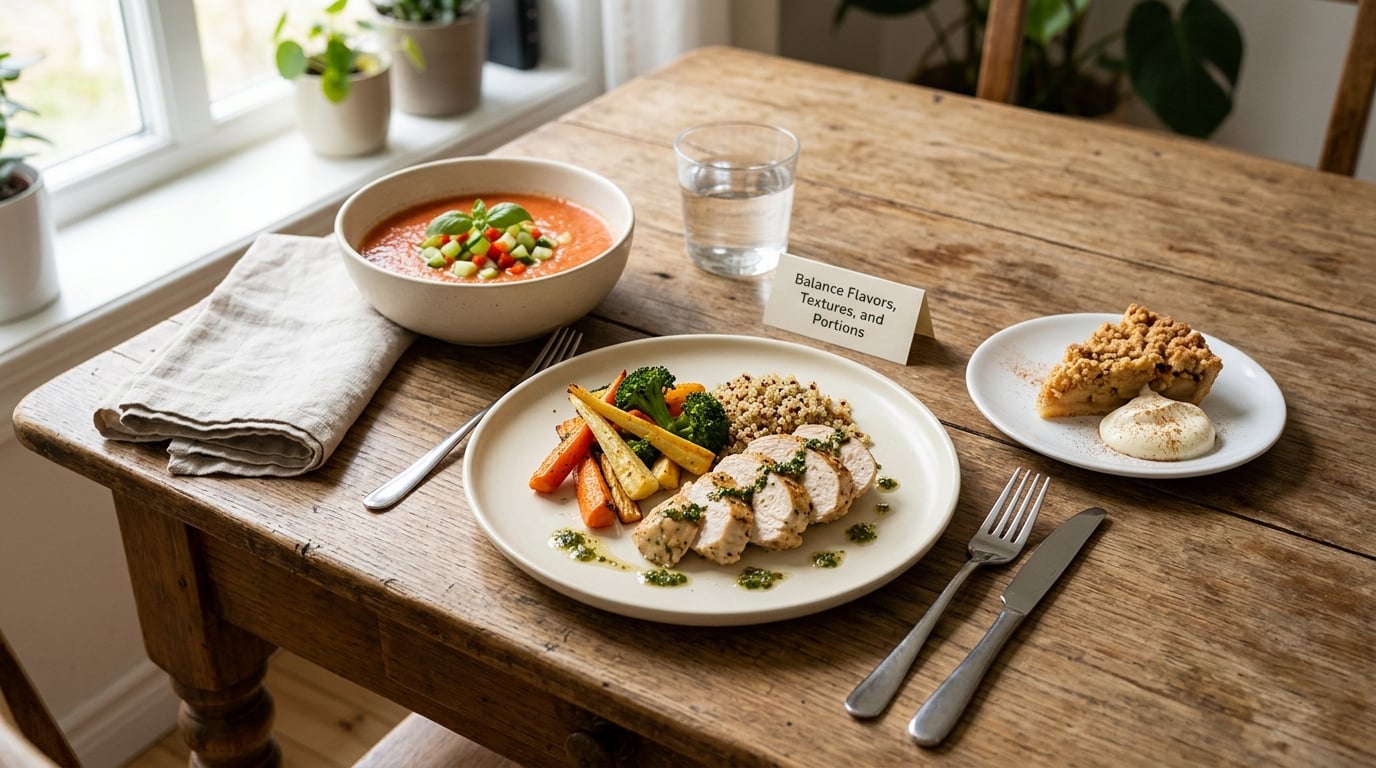
Give each course one job. The starter wakes the palate up, the main satisfies, the dessert closes. When a dish tries to do two jobs at once, the meal gets heavy in the middle and nobody wants dessert.
Contrast is the tool that makes it work. Alternate rich and light, hot and cool, soft and crisp. Home cooks converge on a clean structure: a chilled starter, a hot main, and a cool or room-temperature dessert. Cold soup, seared fish, then a chilled cheesecake is the version people describe most often in cooking forums, and it is not an accident.
On portions, go light early. A starter for a seated dinner is about four to six small bites per person, so a dozen cap skewers comfortably feeds four. The main is where you spend: roughly a half pound of boneless protein per adult guest, a bit more if there is no substantial side. Save the generosity for course two.
3. Plan Preparation and Cooking Timelines
Work backward from the moment you want to sit down, not forward from when you wake up. For a 7:30 p.m. serve:
- Two days before: shop, and make the dessert. Cakes, custards, panna cotta, cookies and freezer-friendly bars are all better after a night’s rest.
- The day before: make your sauce, your braise, or your marinated main. Do all your chopping. Set the table. Clear the fridge of anything you need for tomorrow.
- Four hours before guests arrive: set the table, put out the starter components, chill the drinks.
- Ninety minutes before: start the main. This is the only dish that gets cooked on the day.
- Twenty minutes before: plate the starter, then stay out of the kitchen until plates are cleared.
The recovery rule matters as much as the schedule. If a course runs late, serve the dish that’s ready and tell the table what changed. People forgive a swapped order far more easily than they forgive a cold main and a burnt starter.
4. Prepare the Courses in the Right Order
Work cold and make-ahead components first, then cook the main near serving time, and treat dessert as a course you finish, not one you attempt.
A real order looks like this: chilled starter components and dips assembled in the morning, a sauce or vinaigrette mixed and refrigerated, vegetables blanched and shocked, the main marinated since yesterday, dessert made two days ago and held properly.
When it comes time to cook, start the oven and the main, then let the main rest while you dress the starter. Resting is the most-skipped step in home entertaining and the one that most improves a roast. Fifteen to twenty minutes on a warm plate buys you a forgiving window to plate everything else.
5. Cook and Check Food Safety
Use a thermometer and stop guessing. Follow the USDA minimum internal temperatures: 165°F for poultry, reheated leftovers and casseroles; 160°F for ground meat; 145°F for whole cuts of beef, pork, lamb and fish.
Holding is where home dinners get risky. Keep hot food at 140°F or above, which for most homes means a low oven around 200°F with a dish of water for humidity. Keep cold food at 40°F or below, so a chilled starter goes back into the fridge if service runs long.
Two hours is the limit for perishables sitting at room temperature, and one hour if the room is above 90°F. Perishables should not go back into the fridge you used for raw meat prep unless you cleaned it first.
6. Serve the Courses for a Polished Experience
Bring each course out when the one before it has been cleared, and give people time. A starter should occupy the table for fifteen to twenty minutes, the main for thirty to forty, dessert for as long as it takes to finish coffee.
Set the table for the whole meal, not just the first course: fork and knife for the starter, a clean set for the main, dessert forks or spoons on a small plate up front. Water glasses stay filled. Between courses, clear with one trip, wipe the crumbs, and bring the next dish from the same direction each time.
Presentation at home comes down to a wide bowl for the starter so it looks generous, a hot platter for the main with a second pair of tongs, and dessert served on small plates so people take a portion rather than a wedge. Nothing needs to be architectural.
7. Adapt the Menu for Different Guests
Build substitutions that keep the structure rather than the exact recipe. A carrot soup can become a chilled pea and mint soup; a herb-crusted chicken main can become a braised mushroom and lentil main that needs the same timing; a fruit dessert can become a poached pear with the same cream.
For a beginner, cook one difficult dish and two easy ones, not three easy ones that taste like it. A baked salmon with a herb oil, a green salad with a sharp vinaigrette, and a chocolate pot de creme made the day before looks like a restaurant meal and is forgiving in three separate places.
And if one guest eats only one thing, make that dish the one you are most confident about. Keep the plate small and the portion generous; nobody wants a full plate of food they cannot touch.
Common Mistakes
- Choosing three heavy dishes. A rich starter plus a buttery main plus a dense dessert is how a three-course meal turns into a nap. Fix it by making the starter acidic or chilled and the dessert light, fruit-based, or frozen.
- Cooking everything on the day. Two hard dishes at once means one of them is always late. Fix it by picking a main that waits well, a braise, roast, stew or baked pasta, and making the dessert two days ahead.
- Ignoring allergies. Discovering a nut allergy at 7 p.m. ruins the evening. Fix it by asking when you invite people and by keeping one dish that is plainly safe for everyone, like a baked potato or a plain green salad.
- Overcrowding the table. Three plated courses plus serving dishes, bread and condiments leaves nowhere to put an elbow. Fix it by serving the starter family-style in one bowl, and keeping dessert plates on the sideboard until the main is cleared.
- Skipping rest time. Slicing meat the second it leaves the oven floods the board and dries the meat. Fix it by budgeting fifteen to twenty minutes of rest and using it to dress the starter.
- Scaling a starter by guesswork. Eight guests do not need eight times the recipe for something they will each pick at once. Fix it with actual quantities, and remember that anything served family-style is easier to add than to subtract.
- Trying to cook and serve at once. If you are carrying a hot pan to the table, something on the stove is unsupervised. Fix it by finishing the kitchen before the first course goes out.
One last piece of advice from people who host often: write the dessert on the menu card and put the ingredients out visibly the day before. Guests talk about dessert, and the anticipation does half the work for you.
Frequently Asked Questions
What does a 3 course menu consist of?
A three course menu is three dishes served in sequence: a starter such as a soup or small salad, a main course with its sides, and a dessert. Each course is cleared before the next is brought out, so the meal builds in stages. Sides, bread and salad served alongside the main are part of the main course, not separate courses, and a fourth item like soup or fish is optional.
How to time three courses so everything is ready together?
Work backward from your serve time. For a 7:30 p.m. dinner, make the dessert two days earlier, make the sauce or braise the day before, chop and set out the starter in the morning, and start the main about ninety minutes before guests arrive. Only one dish should need attention after people sit down. If a course runs late, serve what is ready and explain the swap rather than rushing.
What are some easy ideas for a 3-course meal?
Keep one hard dish and two easy ones. A baked salmon with herb oil, a green salad with a sharp vinaigrette and a chocolate pot de creme made the day before works well. A classic tomato soup, baked chicken thighs with roasted vegetables and a berry fool is about as hard as it gets. One-pot braises, baked pasta and roast chickens are the safest choices for a first attempt.
How should I set up a table for a 3-course menu?
Set the whole table at once rather than resetting between courses: starter cutlery, then a clean set for the main, then dessert spoons or forks on a side plate. Serve the starter family-style in one bowl so the table stays uncrowded, and keep dessert plates on the sideboard until the main is cleared. Water glasses stay filled the entire meal.
How far in advance can I prep food for a party?
Three days is comfortable for a make-ahead menu. Soups, sauces, braises and casseroles improve after a day or two in the fridge. Cakes, custards, panna cotta and cookies can be made two days ahead. Dressings and marinated proteins keep two to three days. Chopped vegetables last about a day, and nothing involving raw seafood should be prepped earlier than the morning of the dinner.
What should I do if one course is late?
Serve the course that is ready and name the change. Nobody minds eating the salad first or having dessert before the main, because the alternative is a lukewarm main that nobody enjoys. If the main is delayed more than fifteen minutes, put out bread, cheese and crudites to hold attention, and use the extra minutes to rest the meat rather than to cook it harder.
Conclusion: Start With the Main Course
To build a three course dinner menu at home, choose the main course first, then build lighter dishes around it and schedule everything backward from the moment you want to sit down. One hard dish, two easy ones, and a dessert made in advance will get you through the evening in a home kitchen, and that is the whole trick.