
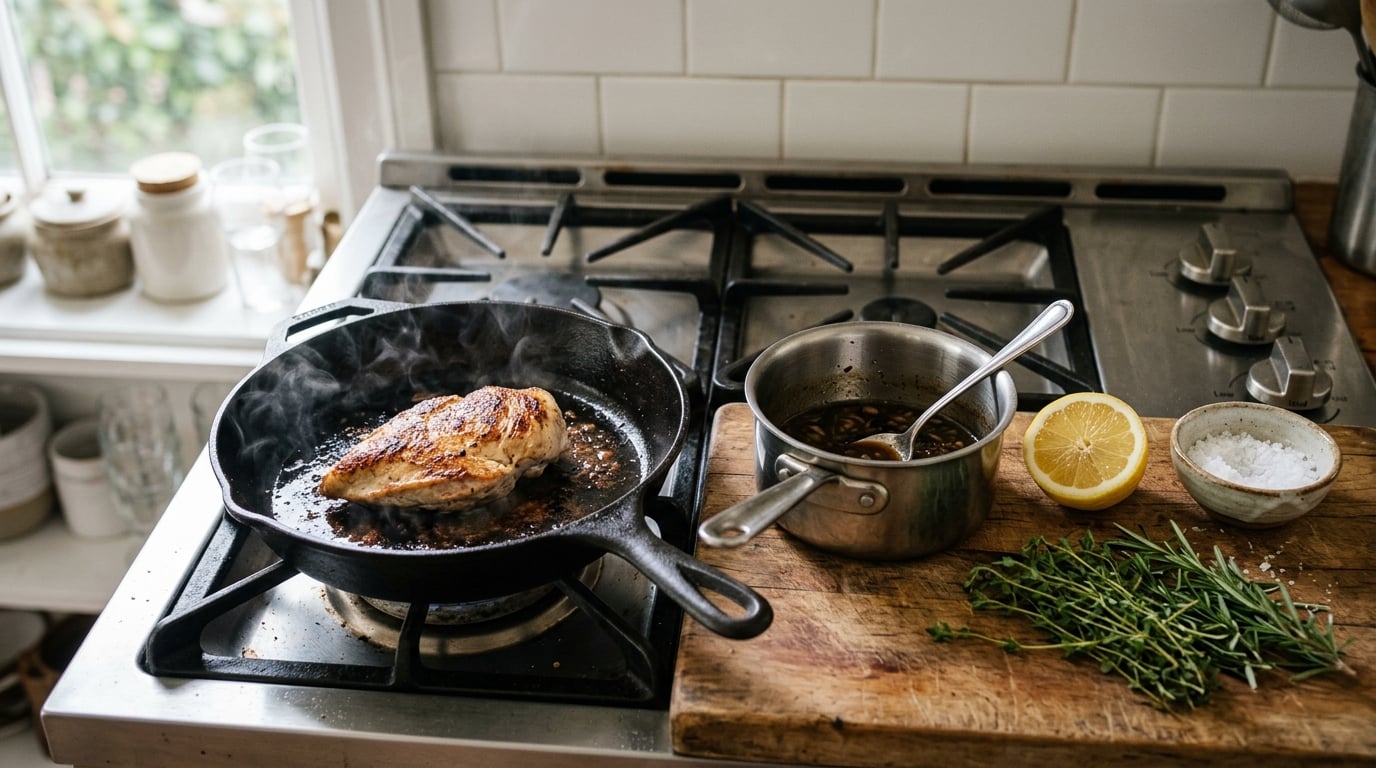
Restaurant food tastes better because kitchens cook hotter, season harder, and serve on time. Why restaurant food tastes better than home cooking comes down to five things: more salt, more fat, real browning, a long-built sauce underneath, and food that hits the table at its peak. None of them need a secret ingredient. Almost all of them are doable in your kitchen tonight.
Kitchen work on both sides of the pass teaches you that quickly. The gap is real, and after a few years of watching home cooks lose to the same four or five problems, it stops being mysterious. It is volume, heat, and timing.
Table of Contents
- What Makes Restaurant Food Taste Better?
- How Do Restaurants Create More Flavor?
- Why Does Restaurant Food Taste Better Than Home Cooking?
- Does Better Food Make the Biggest Difference?
- How Can Home Cooking Taste More Like a Restaurant?
- Which Restaurant Techniques Are Easy to Copy at Home?
- What Can Restaurants Do That Most Home Kitchens Cannot?
- Frequently Asked Questions
- The Best Place to Start
What Makes Restaurant Food Taste Better?
Here is the short version before the detail. Restaurants season food at every stage rather than once at the end, they use noticeably more salt and more butter, they brown food at a heat most home burners cannot hold, they build sauces on stock simmered for hours, and they plate within minutes of finishing.
There is a sixth factor that is not about the food at all, which is the dining room itself. Hold that one to the end, because it is the smallest of the seven and the one that gets overblown.
- More salt, applied in layers. A restaurant dish is seasoned at four or five points in the cook, so the seasoning builds up instead of sitting on the surface.
- More fat. Butter, olive oil, cream, and stock go in at quantities a home recipe rarely calls for, and fat is what carries flavor compounds to your tongue.
- Higher heat. A gas range in a line kitchen puts out far more heat than a domestic burner, and that heat is what produces browning.
- Better sourcing. Produce that was picked ripe, produce that tastes like something, and proteins that were not sitting in a plastic tray for a week.
- Layered sauces and long stock. The sauce is not a recipe, it is a reduction of something simmered since morning.
- Tighter timing. Food is plated to leave the pass, and the pass is built around a few minutes of rest.
- The room around it. Noise, lighting, service, and expectation change how the same bite is perceived.
That is the whole list. The rest of this article explains what each one is doing to the food, and what you can change on a weeknight.
How Do Restaurants Create More Flavor?
A line kitchen does not do anything magical. It does a handful of ordinary things with much more discipline than a home kitchen does, and the discipline is what shows up in the plate.
Mise en place removes the panic
Mise en place means everything measured, chopped, and portioned before the heat goes on. It is the reason a restaurant cook seasons to taste instead of guessing. When the prep is done, tasting and adjusting takes seconds. When you are mid-cook with a half-sliced onion and a spoon in the drawer, tasting feels like an interruption, so you skip it.
Seasoning in layers, not once
Salt is added to the onions, then to the meat, then to the sauce, then at the pass. Each layer dissolves into the liquid the next layer sits in, so the seasoning moves inward instead of staying on the surface. A home cook who salts once at the end is doing the opposite: leaving flavor on the outside of the food where it falls off with the first bite.
The same logic applies to acid. A squeeze of lemon or a spoon of vinegar at the end is not a garnish, it is a correction. Food that tastes heavy or flat usually tastes heavy because nothing is balancing the fat.
High heat and the Maillard reaction
The Maillard reaction is the chemical browning that happens when food gets hot enough and dry enough on the surface. It is the crust on a steak, the color on roasted chicken, the fond in the bottom of a pan. Below roughly 300°F the surface steams instead of browns, and steaming is the opposite of flavor: it produces a pale, wet, boiled texture.
Most home pans lose their heat the moment food hits them. A cold cast iron skillet plus a cold steak plus an ordinary burner equals a pan that sits in the 200s, and the meat poaches in its own liquid. Restaurants solve this with burners that recover fast, pans that hold temperature, and thin batches that hit the surface hard and leave it alone.
Resting, sauce work, and the last-minute finish
Resting after cooking is not a restaurant affectation. Meat that is sliced immediately dumps its juice onto the board, and the juice is the flavor. Ten to fifteen minutes of rest lets the muscle fibers relax and hold what they have.
The pan sauce is where restaurant food gets its depth, and almost nobody builds one at home. Those browned bits stuck to the pan after a sear are called fond. You deglaze them by pouring in liquid, and the fond dissolves into it. Wine, stock, or a splash of water, then reduce, then whisk in cold butter off the heat, and you have a sauce that tastes like it took a day. It took about six minutes.
Why Does Restaurant Food Taste Better Than Home Cooking?
Here is the side-by-side. Read the third column, not the second, if you are looking for something you can act on.
| Factor | What the restaurant does | What most home cooks do | The home fix |
|---|---|---|---|
| Salt | Seasons at four or five stages | Salts once at the end | Season at each stage and taste each time |
| Fat | Butter, oil, and cream used generously | Measures or omits | Finish with a knob of cold butter off the heat |
| Heat | Strong burners, hot pans, thin batches | Cold pan, crowded pan, medium heat | Preheat the pan a full minute, cook in small batches |
| Stock | Simmered from bones since morning | Bouillon and water | Simmer bones and aromatics for four hours, freeze in portions |
| Sauce | Built from the fond, reduced, mounted | Recipe with no pan residue | Deglaze the pan and reduce with butter |
| Emulsions | Dressing emulsified until glossy | Shaken oil and vinegar, separates | Add mustard and emulsify slowly, or add yolk |
| Timing | Plated to leave the pass | Served several minutes late | Rest, then plate right before eating |
| Herbs and acid | Fresh, added off heat | Dried, added early, no acid | Tear herbs at the end, finish with lemon or vinegar |
| Saltiness judgment | Tastes constantly, adjusts | Trusts the recipe and hopes | Taste with the recipe next to you, not from memory |
Why Restaurant Food Tastes Better Than Home Cooking: Recipe Fidelity Is Not the Variable
The most common complaint in cooking forums is the one that sounds like a puzzle. Someone followed the exact recipe, measured everything, and still could not match the restaurant version. Recipes in print list quantities, but a restaurant kitchen works in ratios that recipes flatten. A published recipe says one tablespoon of butter because the home cook needs a number, not because the kitchen that produced the dish used a tablespoon.
The other thing recipes cannot carry is the state of the food when it was written. A recipe that assumes a screaming-hot pan, a well-rested steak, and a finished stock will fail in a cold kitchen, and no amount of measurement changes that. So the gap you are chasing is usually not in the ingredient list. It is in the pan temperature, the salt timing, and the sauce underneath.
Does Better Food Make the Biggest Difference?
Ingredients matter, but they are not where most of the gap lives. Produce picked ripe and eaten the same day tastes different from produce that has been in a cold chain, and you can hear that difference: a tomato from a decent supermarket in July simply tastes like more than a January one.
Better stock and better fat belong on the same list. A pan sauce built on a four-hour stock has a rounded depth that a bouillon cube cannot approach at any price. The honest ranking, though, is that technique comes first. A home cook with a good pan and disciplined seasoning will beat a home cook with beautiful produce and a lukewarm skillet every time.
How Can Home Cooking Taste More Like a Restaurant?
Ten fixes, ordered by the ratio of impact to effort. The first three are where nearly all the gain lives.
- Preheat the pan properly. Medium heat for two full minutes before the oil goes in. A shimmering pool of oil, not a smoking one, means the pan is ready.
- Salt in layers. At the start of the aromatics, again when liquid goes in, again at the simmer, and taste before serving.
- Brown in batches. If the food touches the pan in a single layer, it browns. If it is piled, it steams.
- Deglaze and reduce. After searing, pour in wine or stock, scrape the fond loose, reduce by half, and finish with cold butter.
- Balance the acidity. A squeeze of lemon or a teaspoon of vinegar at the end fixes food that tastes heavy. Try before adding more salt.
- Add umami instead of salt. Parmesan, tomato paste cooked into the sauce, dried mushrooms, anchovy, miso, soy, or a pinch of MSG all amplify savory taste so you can use less salt.
- Rest meat before slicing. Ten to fifteen minutes, loosely covered.
- Build a stock once. Four hours of bones, onion halves, bay, and peppercorns makes a month of sauces. Freeze it in portions.
- Emulsify your dressing. An emulsion is a suspension of tiny droplets that stays combined instead of separating. Mustard and slow whisking make a vinaigrette that clings to lettuce rather than pooling at the bottom of the bowl.
- Finish with fresh herbs off the heat. Torn basil, parsley, chives, and dill added to a hot pan wilt and go bitter. Add them off the heat and they stay green and aromatic.
If you want restaurant-level savoriness with less salt, focus on the umami row. MSG, miso, tomato paste, anchovy, and dried mushroom all register as savory depth, which is a different signal from salty. Cooks in every kitchen use this without calling it a technique.
Which Restaurant Techniques Are Easy to Copy at Home?
Some restaurant methods need a commercial kitchen. Most do not.
- Pan sauce from the sear, about six minutes including the rest. This is the single best value on the list.
- Simple vinaigrette, three ingredients and two minutes, emulsified rather than shaken.
- Sheet-pan efficiency, roasting everything on one tray at 425°F gives you the same browning a line cook gets from a grill, with less work.
- Dry brining, salt on a steak or chicken forty minutes before cooking draws moisture out and then lets it reabsorb seasoned liquid. It seasons the meat all the way through instead of only the surface.
- Components in advance, a restaurant cooks onions, bases, and stocks earlier in the day. Doing the same on a Sunday turns a weeknight cook into a fifteen-minute cook.
- Resting, free, and the step most home cooks skip.
What Can Restaurants Do That Most Home Kitchens Cannot?
Honest list. Restaurants have stronger burners, commercial ranges, high-capacity pans that hold temperature, and a ventilation hood that keeps the kitchen cool enough to work in. They have steamers, salamanders, and immersion circulators. None of that is magic, but some of it is not reproducible on a domestic stove.
A kitchen line also has people doing one task each, prep cooks included, so the cook at the range is only cooking. They order produce daily from suppliers who ship hours after picking. And they cook the same dish four hundred times a week, which means every step has been adjusted until nothing gets improvised.
There is one more thing, and I want to be honest about it because it is the one people get most worked up about. The room changes the food. You waited, you were served, the lighting is low, there is noise, you are relaxed and slightly hungry, and you have paid for the plate. In that setting the same chicken tastes better. On a Wednesday at your own counter it is the same bird. The room is real, and it is worth a few percent, not a multiple.
Frequently Asked Questions
What makes restaurant food taste better?
The short answer is more salt and more fat, applied in layers rather than once at the end. Add high heat for real browning, sauces built on long-simmered stock, a finishing knob of butter, and food plated within minutes of being cooked. Freshness and the dining room contribute, but technique accounts for most of the difference you can actually fix at home.
Is home cooked food better than restaurant food?
For nutrition, portion control, and cost, home cooking is usually the better deal. A restaurant entrée frequently carries more sodium and fat than the same dish made at home, and restaurant portions are sized to satisfy, not to nourish. For flavor intensity on a specific night, the restaurant usually wins, and most of that gap closes once you season in layers and brown properly.
Do you prefer home cooked food or food from a restaurant?
Home cooking wins on a Tuesday. The table is mine, the seasoning is mine, and leftovers exist. A restaurant wins on the night I do not want to cook, or when I am making one dish I cannot make well, like a whole fish or a proper croissant. The honest answer is that a well-made restaurant meal and a well-made home meal taste more similar than the internet claims, once the home cook seasons harder.
Is umami basically MSG?
Umami is a taste, detected by receptors that respond to glutamate. MSG is the most concentrated and pure form of that glutamate, so it is a concentrated umami, not a different thing. Parmesan, tomato, mushrooms, anchovy, miso, and soy all deliver umami without it. Cooks use these to make food taste savory and fuller-tasting, which lets you reach the same satisfaction with less salt.
Why is restaurant food so salty?
Because salt plays two roles at once. It suppresses bitterness and it lifts sweetness and aroma, so a well-salted dish tastes more like itself, not just saltier. A restaurant cook tastes four or five times during a service and corrects each time, so salt accumulates gradually. A home cook tastes once, usually at the end, and either underseasons to be safe or oversalts the whole pot at once.
Why do restaurant salads taste so much better than home ones?
Almost always the dressing. Restaurant vinaigrettes are emulsified, meaning mustard and slow whisking hold the oil in tiny suspended droplets so the dressing clings to the leaves instead of sliding off. A home dressing shaken in a jar separates within minutes and tastes thin. The other reason is seasoning inside the salad itself: the greens, the salt, and the dressing get tossed together and sit for a minute before the plate leaves.
The Best Place to Start
Start with the pan. Preheat it properly, cook in small batches, and let the food brown without moving it. That single change fixes the most common complaint, and it costs nothing.
Then season in layers instead of once, and finish every dish with either acid or cold butter. Do those three things and the gap between why restaurant food tastes better than home cooking and how your dinner actually tastes gets a lot smaller. Updated for 2026, and still the best cooking advice we have.