
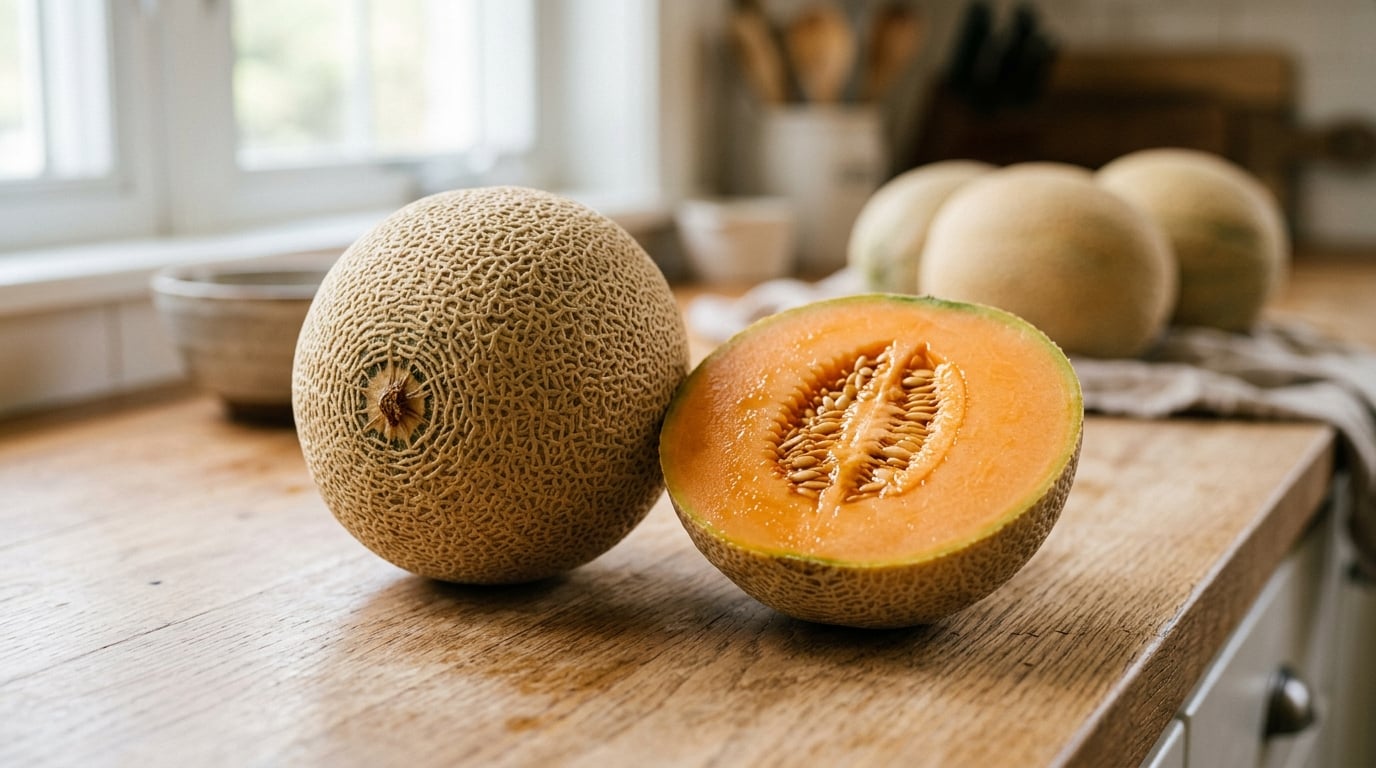
To pick a ripe cantaloupe at the store, pick it up and smell the blossom end first. A sweet, musky aroma plus a golden-tan rind, a slightly dimpled stem scar, and a weight that feels heavy for its size is a melon that will be good to cut into tonight. The whole check takes about 30 seconds, and it matters more than you might think: cantaloupe is a non-climacteric fruit, which is a fancy way of saying it never gets sweeter after it is picked.
That one fact changes the whole shopping trip. Bananas soften on the counter, tomatoes get sweeter on the windowsill, and cantaloupe does neither. A melon picked a day early will soften slightly and will never develop the sugar it is missing, no matter how long it sits. So the ripeness calls happen in the produce aisle or they do not happen at all.
Here is the short version, in the order the checks are most worth doing:
- Smell — a sweet, musky, fruity scent at the blossom end. Nothing at all usually means underripe. Vinegary or fermented means past its window.
- Weight — for its size, it should feel dense, not hollow-feeling. Two melons of the same diameter, one heavier every time.
- Rind color under the netting — creamy beige to sandy gold. Green under the webbing is a warning, not a crime.
- Stem end — a smooth, slightly concave scar, the kind growers sometimes call a belly button. A jagged edge or a stem still clinging on means it came off the vine too early.
- Feel — firm overall with a faint give at the blossom end. A rind that dents under your thumb is going soft, not ripe.
Two words of terminology before we go further, because this trips up more shoppers than anything else. The stem end is where the vine detached, and the stem scar is the smooth little plug left behind. The blossom end is the opposite side, where the flower used to be, and it usually has a small dimple or scar of its own. That blossom end is the side you smell and the side you press.
Table of Contents
- What You Need
- Step-by-Step: How to Pick a Ripe Cantaloupe at the Store
- Common Mistakes
- Frequently Asked Questions
- How can you tell if a cantaloupe is ripe without squeezing it?
- Should a cantaloupe feel soft when you pick it up?
- What color should a ripe cantaloupe be?
- Can a cantaloupe ripen after you buy it?
- What month are cantaloupes ready to pick?
- What can I do with an underripe cantaloupe?
- How should I store cantaloupe after buying it?
- Final Tip
What You Need
Not much. This is not a recipe, and you do not need any equipment to do it properly.
What you do need is a flat comparison spot. Most stores stack melons in a sloped bin, and stacked fruit hides exactly the damage you are looking for. Pull two or three out and set them side by side on the flat part of the produce case, or ask the person stocking to point you at the ones that came in today rather than the ones that have been sitting since Tuesday.
Two hands help. Holding the melon in one hand while you press and sniff with the other is the whole technique. Squeezing hard with your thumb is not part of it.
Optional, for the trip home: a produce bag or a loose bag from the produce section to keep it from rolling around with the other groceries, and a paring knife later, not at the store, if you want to cut and check the flesh color before committing to a whole melon for a fruit salad or a party.
Wear something you do not mind getting melon smell on. The blossom end of a ripe one is remarkably aromatic, and that scent transfers to fingers, bags and cardboard boxes faster than you would expect.
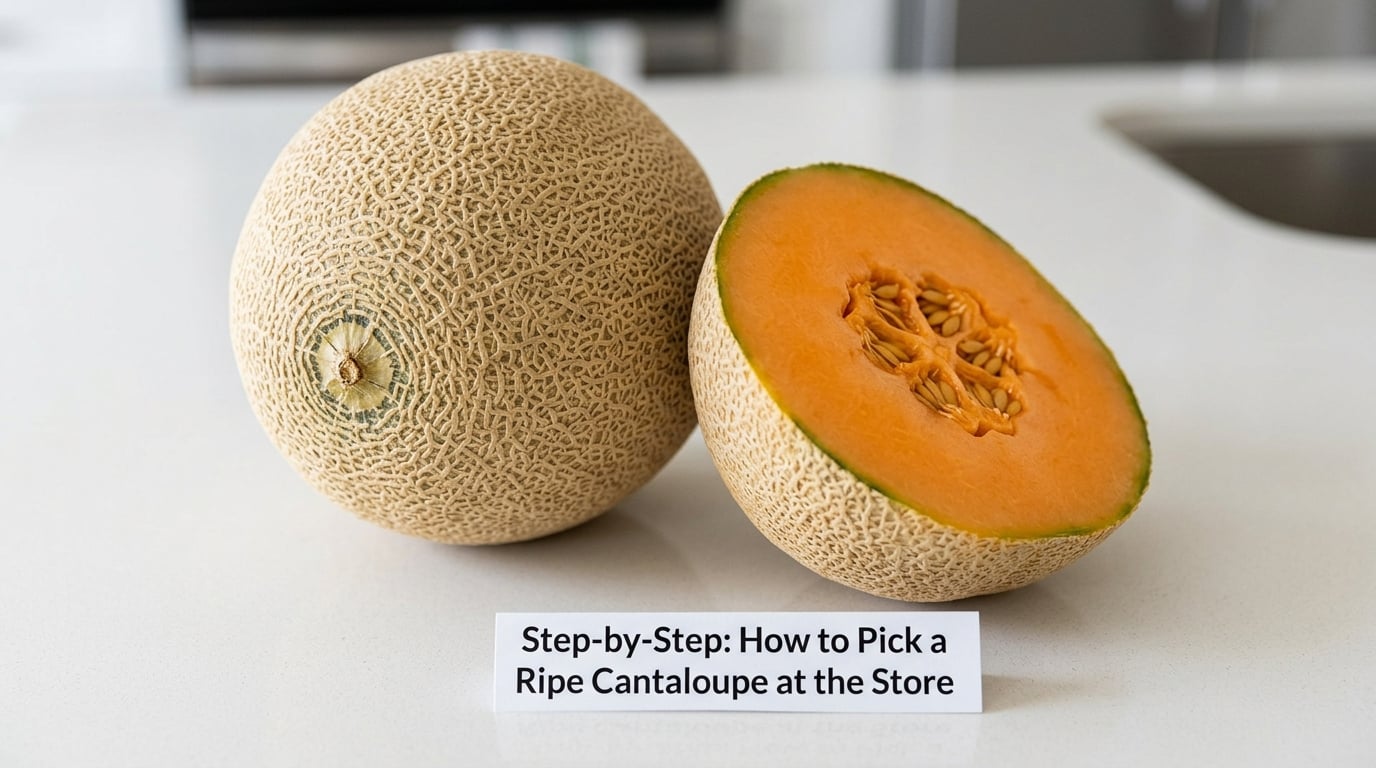
Step-by-Step: How to Pick a Ripe Cantaloupe at the Store
1. Check the Smell First
A ripe cantaloupe smells sweet and musky at the blossom end, and that aroma is the most reliable single test in the store. Lift the melon, find the dimpled side opposite the stem scar, and put your nose close to it. You are looking for something closer to a ripe pear or a cut melon than to a cucumber.
Nothing at all is information. A cantaloupe with no aroma usually needs more time on the vine than it got, which means the sugar never fully developed. Hold it to your nose for a few seconds before you rule it out, though, because a light scent is easy to miss on a busy trip.
Sharp, sour, vinegary or boozy smells send the other direction. That is a melon breaking down, usually past peak but not always ruined, and it needs to be used within a day rather than stored.
Home cooks and shoppers in produce forums reach for the same conclusion, that aroma at the blossom end beats every other signal they can check without cutting. It is the check most of them run first, every time.
2. Look for a Heavy Melon
Pick up two melons of roughly the same diameter and compare. The heavier one is usually the fuller one, with more flesh behind the rind and more juice in the cells. Cantaloupes lose moisture as they age, and that shows up as weight before it shows up anywhere else.
Weight on its own is not proof of ripeness. A large, well-watered unripe melon can outweigh a small ripe one. Treat it as a tiebreaker between two melons that both smell right, not as a first test.
3. Inspect the Rind and Color for a Ripe Cantaloupe
Look at the skin between the raised netting, not at the netting itself. A ripe store melon tends toward creamy beige, sandy gold, or a warm tan. Green under the webbing suggests the rind has not finished coloring, which often tracks with underripe flesh.
The netting should be well raised and clearly defined, tight to the fruit with no bald patches. Sparse or flattened webbing is common on melons that were harvested immature or grown in cooler weather, and growers treat full, even netting as one of their three main outside cues alongside a non-green rind and a sweet scent.
Now look for damage. Skip anything with mold, a crack, a leaking spot, sunken soft patches, or bruises dark enough to see through the netting. A small pale scratch from handling is normal and not a problem. Deep, wet, or discolored bruising is.
One warning about color: it varies by variety, and rejecting a melon for being the wrong shade is one of the most common ways shoppers throw out a perfectly good one. Charentais types and canary melons run noticeably paler, almost grey-beige, while Athena and Gala types go deeper orange-tan. A pale melon with a strong sweet smell and a clean, well-netted rind is ripe. A uniformly deep orange melon with no aroma and green patches under the webbing is not.
Color tells you more about variety and growing conditions than about the sugar inside.
4. Press the Stem End Gently
Put your thumb on the blossom end, the dimpled side, and press very lightly. A melon at its peak gives slightly, like a ripe peach. What you do not want is a thumbprint that stays in the rind, a surface that feels watery or slack, or any leaking juice at the seam.
Most of the field is still firm. Think of the flesh as firm but not rock-hard, with maybe a millimeter of movement at the very end.
Now flip it over and look at the stem end. A melon picked at the right moment has a clean, smooth, slightly concave scar with no jagged edges and no stem stub sticking out. Some sources describe this as an outie versus an innie, and a convex or raised scar tends to mean the fruit released before it was ready.
A stem still attached, or a scar with a torn, raised rim, is a sign it was picked early. That is not fatal, but combined with a weak smell it points to a melon that will be watery and bland.
Growers who pick their own melons use a related test called full slip: a light touch should make the fruit release cleanly from the vine. You cannot do that in a store, but the stem scar is the leftover evidence of the same thing, and it is worth a two-second look.
5. Buy and Store the Chosen Melon
Two final checks. Confirm the melon matches the weight of its neighbors, and confirm the bottom of the bin is not hiding a bruised one you already set aside.
Then get it home and out of the sun. Whole, uncut cantaloupe keeps in the refrigerator for roughly 5 to 15 days depending on how ripe it already was, and the window narrows fast once it is cut. Refrigerated melon that was picked ripe and stayed cold is the best case.
Leave it on the counter for a day or two only if you picked one that is firm and nearly ready, and even then expect softening, not sweetening. The counter treatment people recommend for other fruit simply does not apply here.
Once you cut it, look at the flesh. Deep orange, evenly colored, and juicy is the expected result. Pale, whitish, or watery flesh with a cottony seed cavity means you got an underripe one. Scrape out the seeds, cut away the pale outer ring near the rind, and use the rest in a chilled fruit salad or blend it into a smoothie, where a little acidity covers a lot.
For a melon bought already cut in a clamshell, skip the smell test on the stem end because it is gone and use your nose on the cut surface instead, plus a look at the packaging. Clear juice pooling at the bottom of the tray, a dull grayish tint to the flesh, or a fermented smell all mean it has been sitting too long. Pre-cut melon is the single most common way people get a bad cantaloupe, and the risk is worth taking on only for a same-day use.
Here is the whole checklist in one place, so you can hold it in your head at the display.
- Color under the netting — ripe is creamy beige to sandy gold; underripe is green under the webbing; past its window is yellowed, greasy, or sunken in spots.
- Stem end — ripe is a smooth, slightly concave scar; underripe leaves a jagged edge or a stem attached; past its window the scar is dark, wet, or leaking.
- Blossom-end aroma — ripe is sweet and musky; underripe gives up little or nothing; past its window it turns vinegary, fermented, or boozy.
- Weight — ripe is heavy for its size; underripe is light for its size; past its window it is losing weight and wrinkling.
- Feel at the blossom end — ripe is firm with a slight give; underripe has no give at all; past its window it is soft, leaking, and denting under a thumb.
- Netting — ripe is raised and even with no bald patches; underripe is flat or patchy; past its window it has mold or fuzzy growth.
Common Mistakes
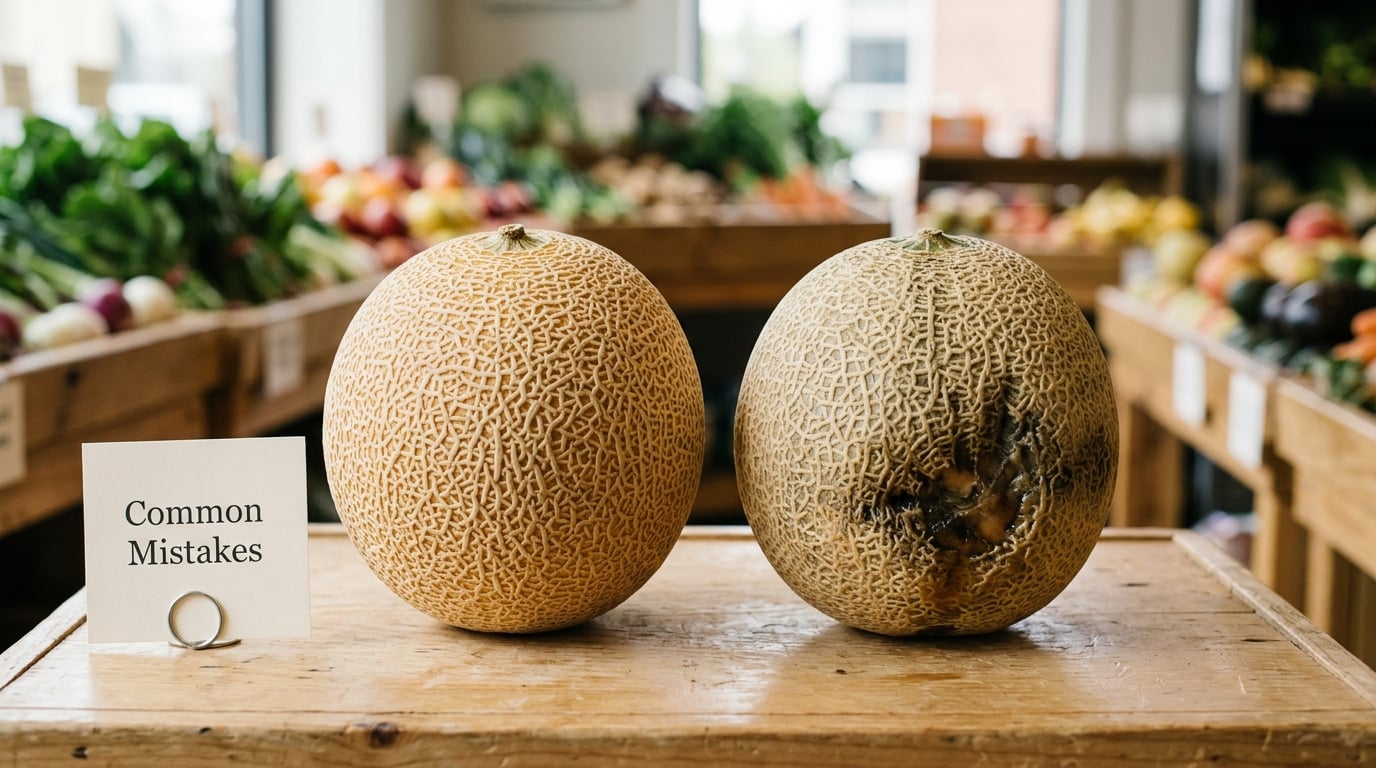
Most wasted melons come down to one of a handful of habits, and most of them are habits I have had too.
Judging by color alone. Color is a supporting signal, not a verdict. Lighting in a store changes how a melon reads, variety changes the target shade, and a well-colored unripe melon will fool you every time. Color is the fourth check, after smell and weight.
Pressing too hard. If pressing leaves a lasting dent, you have damaged the flesh whether it was ripe or not. A light touch at the blossom end tells you plenty. Pressing the whole rind until it creaks is a way to bruise the fruit and learn nothing.
Treating soft as ripe. Softness is how overripe fruit presents, not how ripe fruit presents. The melon you want is still firm across the body, with a tiny bit of give at one end. A melon that feels slack all over is a different problem, and no amount of cutting will bring it back.
Waiting for a counter ripen. This is the expensive mistake. Cantaloupe is non-climacteric, meaning it does not continue converting starch to sugar after harvest. It will soften and its aroma will strengthen, which can make it smell riper than it tastes, and that is precisely the trap. A bland melon on day four was bland on day one.
Assuming every ripe melon smells strongly. Aroma intensity varies with variety and with how cold the fruit is. A melon straight from a refrigerated case may need a minute in your hands before it gives anything up, and a lightly scented Charentais can still be excellent. Weight, stem scar and feel cover you when the nose comes up short.
Trusting the tap test. You will read that a hollow sound when you knock on a cantaloupe means ripe fruit. You will also read the opposite claim, that hollow means hollow and overripe. Both are out there, and the honest answer is that the sound test is weak. A hollow knock on a big, well-netted melon mostly tells you it is big and full of air, not that the flesh is sweet. It cannot distinguish a melon picked yesterday from one picked two weeks ago. Use it never, or use it as a last tiebreaker.
Ignoring season. Cantaloupe is a warm-season crop, and the quality difference between a melon bought inside its window and one bought in January is not subtle. In the US the main harvest runs from late June through September, with July and August generally the sweetest weeks. Outside that window the fruit has usually traveled a long way and sat in warehouses, which is why out-of-season melons so often disappoint. Check the season first, and lower your expectations the further you are from it.
Buying by the pound without lifting the melon. You pay for every ounce, and a heavier melon for the same diameter is the one with more flesh and more juice in it. Ten seconds of comparison pays for itself.
Frequently Asked Questions
How can you tell if a cantaloupe is ripe without squeezing it?
Use smell as the strongest first clue, then weight and appearance. A ripe cantaloupe has a sweet, musky aroma at the blossom end, feels heavy for its size, and shows a creamy beige to sandy gold rind under well-raised netting with a smooth, slightly dimpled stem scar. You never need to press the fruit at all to make a confident pick.
Should a cantaloupe feel soft when you pick it up?
It should feel mostly firm, with a little gentle give near the stem end. If the rind is very soft, wrinkled, leaking, or covered with mold, skip it. A slight softness at the blossom end can be normal in a perfectly ripe melon, but softness across the whole fruit means it is going over rather than getting better.
What color should a ripe cantaloupe be?
Look for a tan, beige, or creamy gold background under the raised netting, not a bright green rind. Color is only a supporting signal, because variety and store lighting both change how a melon reads. Charentais and canary melons look greyer while Athena and Gala types run deeper orange-tan, so confirm with a strong sweet smell at the blossom end.
Can a cantaloupe ripen after you buy it?
Not in the way you mean. Cantaloupe is a non-climacteric fruit, so it will not develop more sugar after harvest, and a brown paper bag or a warm counter will not change that. A melon with a mild aroma and no damage can soften and become more fragrant over a day or two, but the sweetness is already fixed.
What month are cantaloupes ready to pick?
Cantaloupe is a warm-season crop that in the US is generally harvested from late June through September, with July and August usually the sweetest weeks. Melons bought well outside that window have typically been shipped and stored, which is why out-of-season fruit so often tastes flat. If you want good melon, buy inside the window when you can.
What can I do with an underripe cantaloupe?
Eat it soon rather than saving it, because it will not improve. Cut away the pale outer ring near the rind, scoop out the seedy center, and dice the rest. Underripe melon works well blended into a smoothie with lime, folded into a fruit salad with a sharp dressing, or salted and served alongside cheese and cured meat to balance the muted sweetness.
How should I store cantaloupe after buying it?
Refrigerate a whole uncut melon and use it within about a week for best flavor, though ripe fruit bought from a store may last up to 15 days chilled. Cut melon should be wrapped or covered and used within three days. Keep it away from ethylene-producing produce like apples, bananas, and pears, which speeds softening.
Final Tip
Start with aroma, confirm with weight and condition, and let the stem-end texture support the decision rather than make it. Smell the blossom end first, pick the heavier of the two good-smelling melons, check for bruises and a clean stem scar, and you will get it right far more often than a color check alone will ever get you there.