
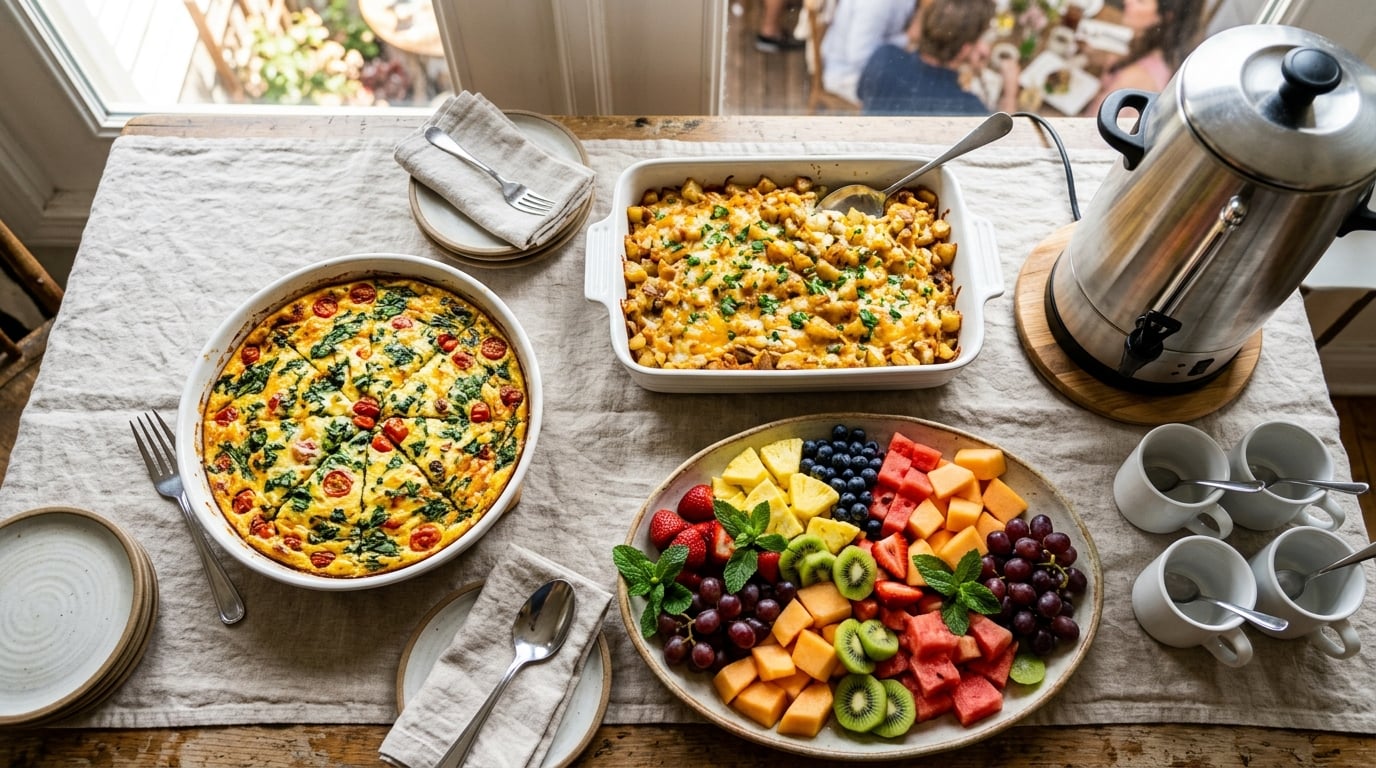
The trick to learning how to make brunch for a crowd without stress is doing almost nothing on the morning of the event. Shop and cook the night before, pick one dish as your hero, and set everything on a buffet so guests serve themselves while you stay at the table. Most of the work takes three hours the evening before and 30 minutes the morning of.
That sounds obvious once you have done it. It is not obvious the first time, when you have eight people arriving at ten and a kitchen that still needs chopping. The plan below fixes the head count, the menu, the shopping, the cooking order, and the cleanup before you start.
Table of Contents
- What You Need
- Step-by-Step: How to Make Brunch for a Crowd Without Stress
- Common Mistakes
- Frequently Asked Questions
- How much food should I prepare for brunch for a crowd?
- Can I make brunch ahead of time the night before?
- What is the easiest brunch menu for a large group?
- How do I keep hot brunch food warm while serving guests?
- How can I accommodate vegetarian guests at brunch?
- How long can leftover brunch food be kept safely?
What You Need
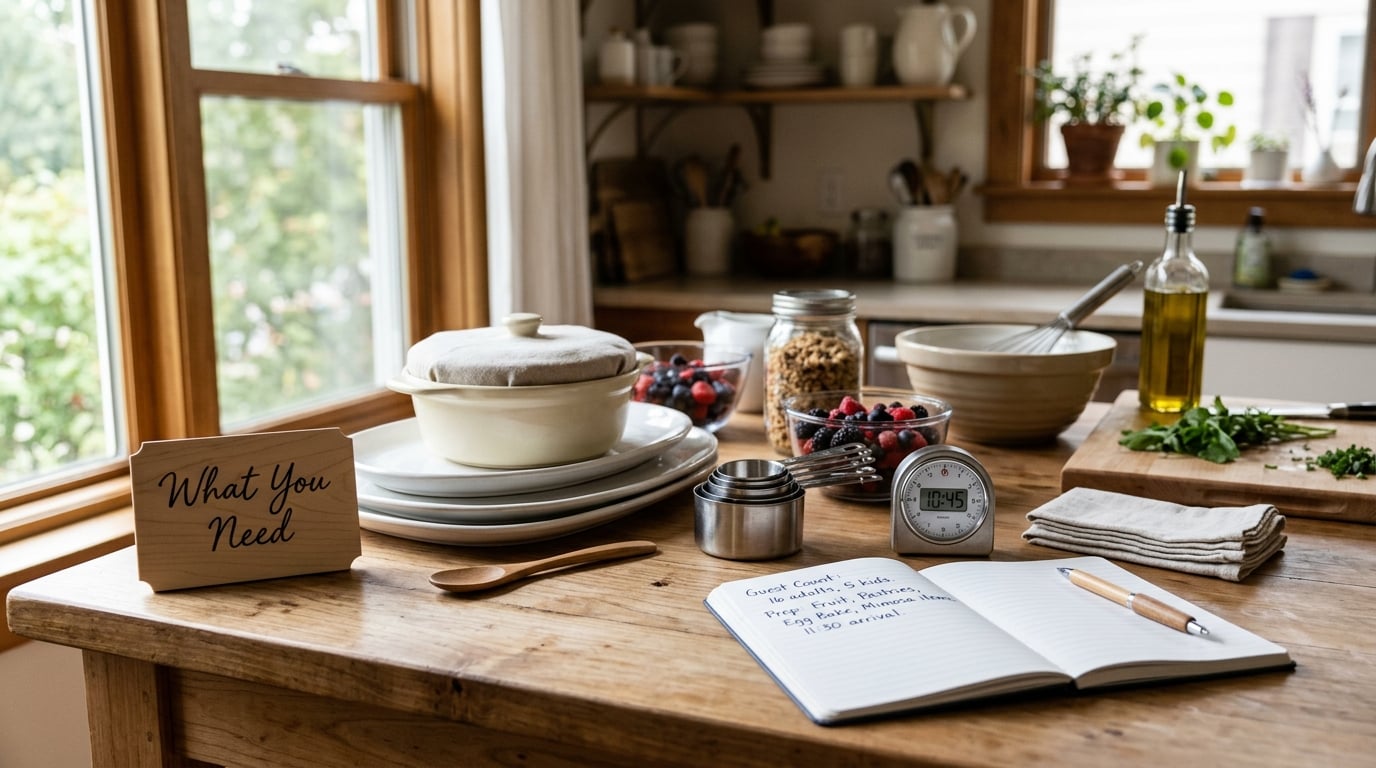
Start with three decisions: how many people are coming, what kind of brunch this is, and what you already own. Everything else follows from those.
Pick a number and a format
Plan on 12 or more people and this becomes a crowd. Below 12 you are cooking breakfast. Confirm the number two days ahead, then add two more plates for the friend who brings someone.
A buffet spread suits a mixed group, a long holiday table suits a seated family, and a bagel spread suits a casual drop-in. Pick the format first, because it decides whether you need platters or plates.
How much food per person
Most hosts under-buy on fruit, pastries and coffee, and over-buy on the main dish. That imbalance is why the table runs out of coffee at 10:40 while half the frittata is still in the pan.
| Item | Per person | 8 guests | 12 guests | 16 guests | 20 guests |
|---|---|---|---|---|---|
| Pastries or baked goods | 1 to 1.5 each | 10 | 15 | 20 | 25 |
| Fresh fruit, cut | 1/2 to 3/4 cup | 5 cups | 8 cups | 10 cups | 13 cups |
| Eggs, for a baked egg dish | 2 | 16 | 24 | 32 | 40 |
| Hash potatoes or potatoes | 1/2 cup | 4 cups | 6 cups | 8 cups | 10 cups |
| Bagels or bread | 1 each | 8 | 12 | 16 | 20 |
| Coffee, brewed | 1.5 cups | 1 quart | 1.5 quarts | 2 quarts | 2.5 quarts |
| Juice | 3/4 cup | 1.5 quarts | 2 quarts | 2.5 quarts | 3 quarts |
| Butter and cream cheese | 2 to 3 tbsp | 1 lb | 1.25 lbs | 1.5 lbs | 2 lbs |
For the hero dish, count one and a half servings per person if it is the only substantial entrée, and one serving per person if you are also serving potatoes, a salad and bread. When in doubt, err toward the smaller number. Brunch leftovers have to fit in your fridge for the next four days.
Equipment and serving pieces
The real shortage is never food. It is platters, forks, mugs and somewhere to put everything. For 12 guests, gather three large platters, three medium bowls, two covered casserole dishes, a dozen forks, a dozen plates, 12 to 15 mugs, two serving spoons per dish, a stack of napkins, and a cutting board per station.
A slow cooker and a toaster oven earn their keep on a day like this. If you do not own them, a rice cooker set to warm and a covered low oven both work in a pinch. Set out two cutting boards and one big bin of ice, so nothing sits out longer than it should.
Step-by-Step: How to Make Brunch for a Crowd Without Stress
Choose a Simple Brunch Menu
A crowd brunch needs seven components, and only one of them should require real cooking. Build from this list and the menu scales to any head count without new dishes appearing.
- One hero dish: a frittata, a crustless quiche, a hash brown casserole or a baked French toast. This is the item you make from scratch to signal effort.
- One egg dish: usually a scrambled egg casserole or a strata, baked rather than cooked to order.
- One make-ahead starch: hash brown casserole, breakfast potatoes made the night before, or a coffee cake.
- One no-cook item: a bagel spread with cream cheese, lox, sliced tomato and cucumber, or a cheese board.
- One salad: a greens bowl with a simple vinaigrette on the side, dressed separately so it stays crisp.
- One sweet: pastries from a bakery, muffins, or cinnamon rolls warmed that morning.
- One fruit: cut the night before, stored cold, displayed in a bowl with citrus on top.
That is a full table with one oven meal and one skillet. Anything more becomes two brunches, and you cannot cook two brunches in one kitchen.
Shop and Prep the Night Before
Almost everything on that list can be bought or prepared the evening before. The rule is simple: anything involving a raw egg goes in the fridge, anything involving a hot oven goes in the oven, and everything else waits.
The night before you can buy the pastries, fruit, bagels, coffee and juice; slice the fruit and cover it; chop the potatoes and onion for the casserole; whisk the egg mixture for the frittata; mix the vinaigrette; shred the cheese; and set out the platters and utensils. You can also bake the hero dish, cool it uncovered for 20 minutes, then wrap and refrigerate it.
Some items freeze well if you are hosting two days later: hash brown casserole, cinnamon rolls and baked goods freeze individually on a sheet pan, then transfer to a resealable freezer bag. Thaw overnight in the fridge and bake from cool, adding about 10 minutes to the recipe time. Cooked frittata and quiche also freeze for up to two months, though the texture is better within a month.
Leave these for the morning: the coffee, the pastries coming out of the oven, anything with fresh herbs or delicate greens, and the hard-boiled eggs if you are doing a deviled style. Also skip the cutting board mess you can do ahead. Prep the night before; finish the morning of.
Finish Cooking in a Manageable Order
On the day, work backwards from your serving time. If guests arrive at 10:00 and brunch is meant to start at 10:30, hot food should come out around 10:15.
Start with the item that takes longest. Oven casseroles go in first at 350°F, followed by the skillet frittata or the coffee cake. While those cook, set up the room: drape the table, fill the coffee urn, pour juice into pitchers, unwrap the cold dishes and arrange the no-cook items. Put the drinks station together last so cold things stay cold.
Reheat the hero dish and any potatoes in the oven at 325°F until they hit 165°F, which takes about 20 minutes for a full casserole dish. Turn the oven down to 200°F afterward and use it as a holding cabinet for the next 45 minutes. Warmed pastries go in with the potatoes for the last 8 minutes so they are hot but not dry.
Write the last few steps on an index card and stick it to the fridge. Your list should say roughly: oven on, casseroles in, coffee on, platters out, fruit out, drinks station. That card is the difference between a host in the kitchen and a host at the table.
Set Up a Self-Serve Brunch Table
A self-serve brunch buffet is what buys you the freedom to sit down. Arrange it as a one-way line in a fixed order so nobody crosses back through the whole spread twice.
Put plates, napkins and forks at the start of the line. Then follow with the hot items, then the no-cook items, then fruit, then salad, then condiments, and end the line with the drinks station. A separate drink station away from the food keeps the queue moving and stops people from carrying a full plate back through the spread.
For the drinks, set up a coffee urn, a kettle with two or three tea options, one or two pitchers of juice, and a small tray with a bottle of bubbly, two pitchers and a bowl of sliced citrus and berries for anyone who wants to make their own. A few labels and small squares of masking tape on folded cards tell guests what is dairy-free, gluten-free or vegetarian without anyone asking.
Fill serving bowls no more than two-thirds full. A full bowl looks generous and gets picked clean fast, which forces a second trip and a jam. Put out extra forks and spoons for anything that needs them, and place the trash and recycling bins at the end of the line, not across the room.
Keep Food Safe and Handle Leftovers
A brunch runs two to three hours, which puts you inside the two-hour window for food sitting out at room temperature. Anything perishable has to be above 140°F or below 40°F, and you need a thermometer to know for sure.
Hold hot casseroles at 165°F or warmer, and use the low oven or a slow cooker on warm. Take the food out of the danger zone only when you are ready to serve. Cold items like fruit, yogurt parfaits, cream cheese and smoked salmon go back in the fridge within two hours, sooner if the room is warm or the door is propped open.
Cook to the safe minimum internal temperature, checked with a thermometer in the thickest part. Poultry and any dish containing turkey or chicken reaches 165°F. Ground meat, including sausage and ground beef in a strata or frittata, reaches 160°F. Whole cuts of beef, pork and lamb, plus fish, reach 145°F with a three-minute rest. Egg dishes, including a quiche or a French toast casserole, reach 160°F.
For leftovers, cool food in shallow containers rather than one deep bowl, and refrigerate within two hours. Most cooked brunch dishes keep 3 to 4 days in the fridge, and baked goods freeze a month or more. Skip the egg-based hero dish if nobody is likely to eat it within four days.
Brunch Menus That Scale
Once the formula is in place, the head count only changes quantities.
For 12: a 9-inch-by-13-inch frittata, one 9-inch-by-13-inch hash brown casserole, 15 pastries, 8 cups of fruit, one bagel spread, one greens bowl, and one coffee cake.
For 16: a 10-inch-by-14-inch quiche plus a second frittata, two casseroles, 20 pastries, 10 cups of fruit, a bagel spread with sliced vegetables, a salad, and 25 muffins or rolls. This is the size where you want a second coffee source, such as a second urn or a batch kept in a thermal carafe.
For 20 and up: move to sheet-pan portions. A full sheet pan of hash brown casserole serves about 10, a sheet pan of breakfast potatoes serves about 12, and a loaf pan of coffee cake feeds 10. Add a second no-cook station, such as both a bagel spread and a cheese and cracker platter, because at that size the line is the bottleneck, not the food.
The simplest stress reducer at 16 or more is asking guests to each bring one item. Assign it early by text, keep the list short, and specify what is still missing. Fruit, bread and a bag of pastries are easy wins that people rarely volunteer for.
Common Mistakes
Cooking too many dishes. Every extra recipe is another oven slot, another dish to wash, and another thing that runs cold. Six components is the ceiling. Put the extras on your list of things to buy instead.
Cooking on the morning of. The only morning cooking should be reheating and a coffee cake at most. If your menu requires more than 30 minutes of oven time in the last three hours, move it to the night before.
Skipping the equipment check. Twelve forks and 12 plates for 14 people ends the party early. Count forks, mugs and plates the day before and borrow the difference from a neighbor.
Making eggs to order. Omelets, pancakes and made-to-order waffles turn your stove into a ticket rail right when you want to be talking to people. Bake the eggs the night before and serve them from a warm dish instead.
Crowding the table. Small bowls and over-full platters make a buffet look impressive and function badly. Bigger surfaces matter more than the amount of food, so borrow serving pieces before you borrow recipes.
Leaving food out too long. A friendly brunch is not a food-safety exemption. Keep cold food under 40°F, hot food above 140°F, and use a thermometer so you are guessing less.
One last habit, and it is the one I notice most in my own hosting: put a small bin of ice under every cold platter. It costs nothing, keeps the food safe through a long morning, and stops the cheese from turning to glue on a warm counter.
Frequently Asked Questions
How much food should I prepare for brunch for a crowd?
Plan on about 1.5 servings of your main dish per person if it is the only substantial entree, or 1 serving if you are also serving potatoes, a salad and bread. Beyond that, most hosts under-buy on fruit, pastries and coffee rather than food. A good rule is 1 to 1.5 pastries each, half a cup to three quarters cup of fruit, one bagel or slice of bread, and 1.5 cups of coffee per guest.
Can I make brunch ahead of time the night before?
Yes, and for 12 or more guests it is the whole plan. The night before you can bake the frittata, quiche or casserole, chop the fruit, mix the vinaigrette, shred the cheese and set out the platters. Refrigerate the cooked dish once it has cooled uncovered for 20 minutes. Reheat it the next morning at 325F until the center reaches 165F, which takes roughly 20 minutes for a full dish.
What is the easiest brunch menu for a large group?
A bagel spread plus one baked casserole is the lowest-effort combination that still looks generous. Set out sliced bagels, two or three cream cheese flavors, smoked salmon, sliced tomato, cucumber and red onion, then add one sheet-pan hash brown casserole or egg bake. Add fruit, pastries from a bakery and a coffee urn, and you have covered sweet, savory, fruit and drinks with about 90 minutes of total work.
How do I keep hot brunch food warm while serving guests?
Use your oven. After the casseroles finish at 350F, turn the oven down to 200F and leave the door closed with the food inside, which holds it above 165F for roughly 45 minutes. A slow cooker on the warm setting works the same way. Keep the food out of the oven until the moment you are serving, and check the center with a thermometer rather than guessing from the top.
How can I accommodate vegetarian guests at brunch?
Make the hero dish vegetarian and nobody needs a separate plan. A frittata, crustless quiche, mushroom hash brown casserole, or a breakfast potato and cheese bake all work. Add a greens salad with vinaigrette on the side and a yogurt parfait bar, which covers guests avoiding eggs and meat. Then use small folded labels on the platters so nobody has to ask a question out loud.
How long can leftover brunch food be kept safely?
Most cooked brunch dishes keep 3 to 4 days in the refrigerator at or below 40F. Refrigerate leftovers within two hours of serving, and cool them in shallow containers rather than one deep bowl so they chill quickly. Skip the egg-based hero dish if nobody is likely to eat it within four days. Baked goods and unfilled pastries freeze a month or more, and reheat straight from frozen in the oven.
Start tonight, not tomorrow. Confirm the head count, choose the one dish you are willing to bake, and check that you have enough forks, mugs and platters for everyone coming. Do the shopping tomorrow, cook the day before, and on the day itself you are reheating and setting out platters, which is the version of this plan where you actually get to enjoy your brunch.