
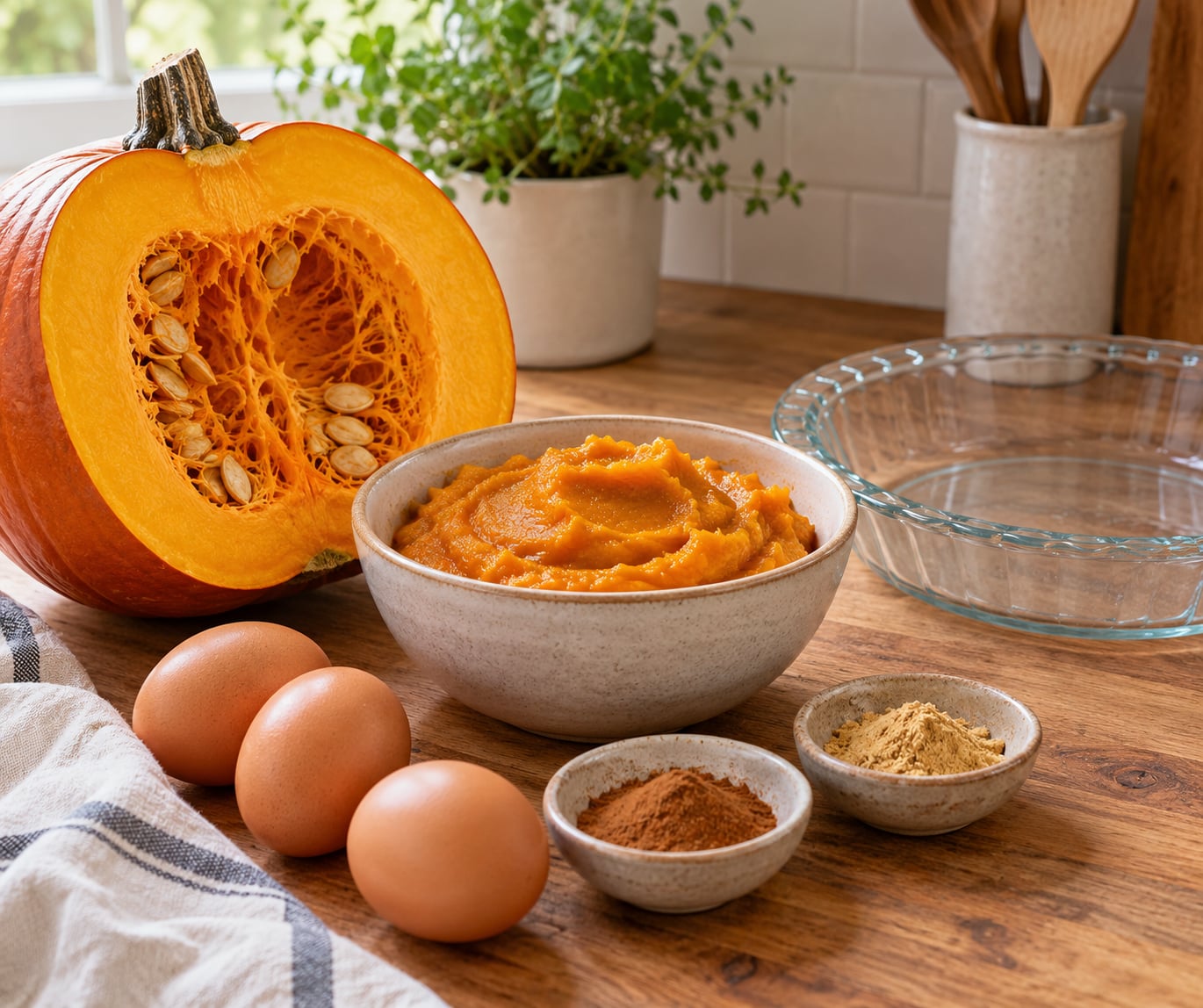
To make pumpkin pie from fresh pumpkin, you roast a whole sugar pie pumpkin until tender, scoop and puree the cooked flesh, simmer or strain off the excess water, then bake it in a partly baked crust as an egg-and-evaporated-milk custard. The whole process takes about 1 hour 45 minutes, and almost all of that is oven time you can walk away from.
The reason to bother with a fresh pumpkin is flavor. Roasting caramelizes the pumpkin’s natural sugars and concentrates them, so the filling tastes deeper and less like a canned shortcut. The catch, and the reason most fresh-pumpkin pies turn out weepy, is that roasting releases a lot of water into the flesh, and that water goes straight into your filling unless you take it out.
Get that one step right and the rest of this is straightforward. Here is the version I’d hand a friend: a store-bought crust, par-baked so the bottom stays crisp, and a filling that sets into a clean slice rather than a puddle.
What You Need to Make Pumpkin Pie from Fresh Pumpkin
You’ll split the shopping list into two blocks, the way the recipe breaks down in practice. Everything for the puree comes first, because the puree has to cool before it can go into the filling.
For the fresh pumpkin puree
- 1 sugar pie pumpkin, about 3 pounds, halved and seeded
- Water, for the roasting pan
That one pumpkin yields roughly 2 cups of puree, which is exactly what a 9-inch pie needs. A larger baking pumpkin gives you more, so you get mini pies out of it or a second dessert.
For the crust and filling
- 1 unbaked 9-inch pie crust, chilled, or homemade dough
- 2 large eggs
- 3/4 cup granulated sugar
- 1 teaspoon ground cinnamon
- 1/2 teaspoon ground ginger
- 1/4 teaspoon ground nutmeg
- 1/4 teaspoon ground cloves
- 1/2 teaspoon salt
- 1 can (12 ounces) evaporated milk
- 2 tablespoons molasses, optional, for the darker old-fashioned version
- 1 tablespoon butter, for the crust rim
A homemade pumpkin pie spice blend works fine in place of the four spices, at roughly 2 teaspoons of the blend for the whole pie.
Tools
- Rimmed baking sheet, lined with foil
- Large spoon for scraping the cooked flesh
- Food processor or blender
- Fine-mesh sieve, or cheesecloth over a sieve, if the puree looks wet
- 9-inch pie plate, oven-safe glass or metal
- Cooling rack
No special equipment beyond that. If you’re prepping a big meal and want the side dishes to hold up too, our guide to appetizers you can prep ahead takes the same day-of logic in a different direction.
Step-by-Step: How to Make Pumpkin Pie from Fresh Pumpkin
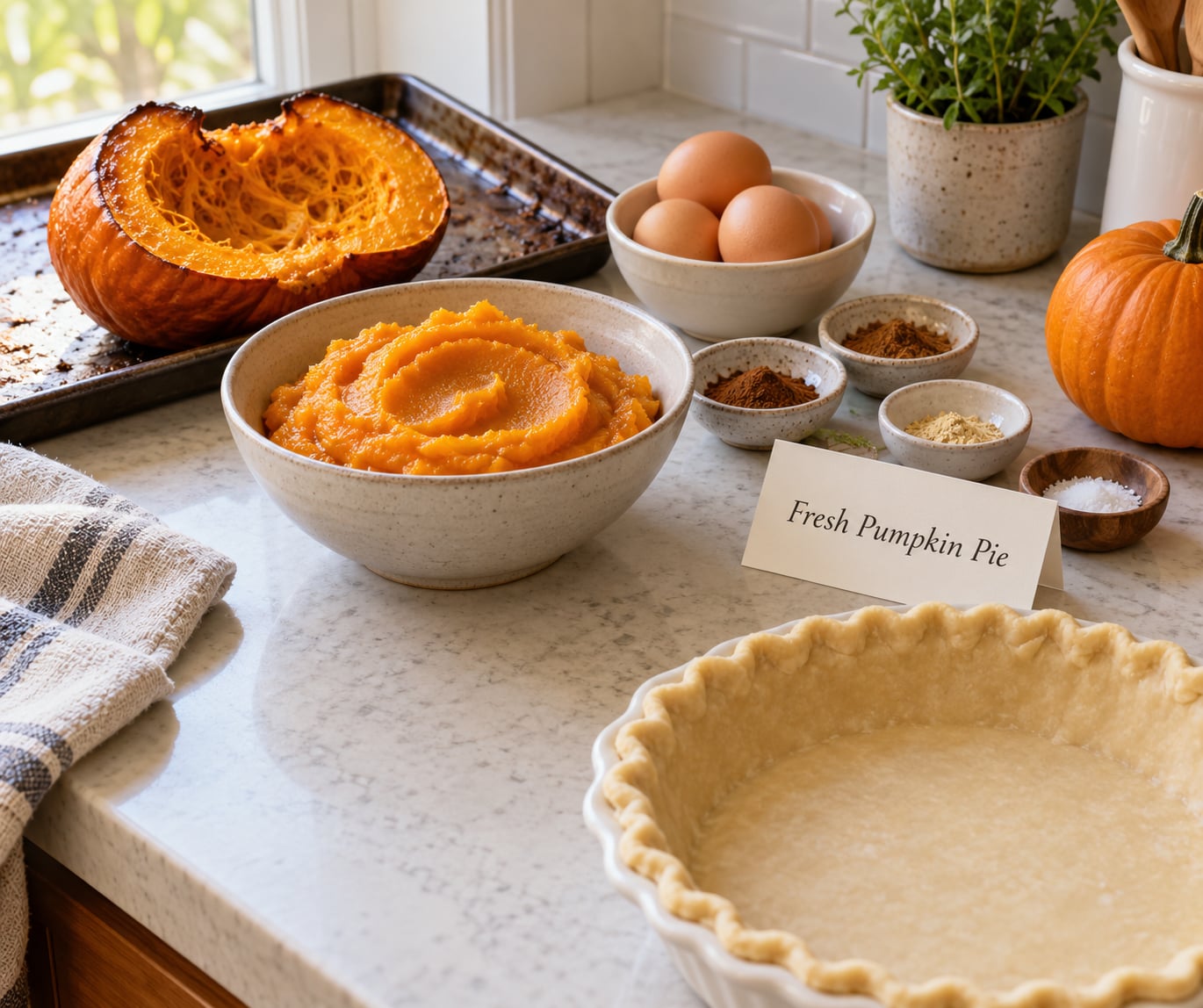
The method breaks into four stages: prepare the puree, build the filling, bake the pie, then cool it properly. Most of the actual work is in the first stage, and it’s the one people rush.
How to Prepare Fresh Pumpkin for the Filling
Start with a sugar pie pumpkin, also sold as a pie pumpkin or New England pie pumpkin. These are small, dense and sweet. Carving pumpkins and jack-o’-lanterns are much wetter and blander, and they need extra reduction to be usable. If a carving pumpkin is all you have, it will still work, but expect to simmer the puree longer and add more sugar to compensate for the flatter flavor.
Preheat the oven to 400°F (200°C). Cut the pumpkin in half crosswise through the stem, scoop out the seeds and all the stringy pulp, and place the halves cut-side down on a foil-lined rimmed baking sheet with a splash of water in the pan. The steam keeps the flesh from scorching against the metal.
Roast for 40 to 50 minutes, until a sharp knife slides into the thickest part of the flesh with no resistance. Smaller pie pumpkins often finish closer to 40 minutes, big ones take the full 50 or a little more.
Let the halves cool for 15 minutes so you don’t burn your hands, then scoop the cooked flesh away from the skin with a large spoon. Scrape the skin clean and discard it.
Puree the flesh in a food processor until completely smooth. Now the critical step: put the puree in a saucepan and simmer over medium heat for 10 to 20 minutes, stirring often, until it thickens to the consistency of thick apple butter. That’s your moisture reduction. If your puree already looks dense and holds a spoon upright, skip the simmer and just measure it.
For an extra-dry result, press the puree through a fine sieve or a cheesecloth-lined sieve for about 15 minutes and discard whatever liquid comes out. Yield drops to roughly 1.5 cups, which is still plenty for one pie.
How to Make Pumpkin Pie from Fresh Pumpkin Filling
While the puree cools, get the crust ready. Par-baking it is the single best defense against a soggy bottom. Dock the base with a fork all over, press the pie plate into the middle of the dough, and bake at 425°F (220°C) for 10 to 15 minutes, until the base looks dry and lightly set. Pull it out, flute the edges if the dough has shrunk away from the rim, and set the shell aside to cool.
Beat the 2 eggs in a large bowl until completely blended, then whisk in the sugar, spices and salt. Add the cooled puree and mix until the color is even and there are no dry streaks of spice.
Pour in the evaporated milk a little at a time, stirring gently, until the filling is smooth and pourable, like thick cream. That’s the right consistency. If it ribbons slowly off the spoon and leaves a clean trail when you lift the spoon, it’s ready.
Strain the filling through a sieve into the par-baked shell. This catches any stringy bits left by the processor and costs you thirty seconds. If you added molasses, stir it in with the puree rather than the milk so it distributes evenly.
How to Bake the Pie Until the Filling Is Set
Set the filled shell in the still-hot oven at 425°F (220°C) for 15 minutes, then drop the temperature to 350°F (175°C) and bake for 35 to 45 minutes more. That two-stage start gets the crust crisp and the custard moving, and the lower finish cooks the filling gently enough not to crack it.
At the halfway mark, check the crust rim. If the fluted edge is browning faster than the middle, fold a strip of foil over the edge and tuck it against the pan. Watch it again near the end.
The filling is done when a thin knife inserted about an inch from the edge comes out clean. The very center will still look slightly soft and will finish setting as the pie cools, so don’t wait for it to feel firm in the oven.
Turn the oven off and leave the door ajar with the pie inside for 15 minutes, then move the pie to a rack. That slow cool is what keeps a custard from cracking into shards, and it’s the step most recipes skip.
How to Cool and Serve Fresh Pumpkin Pie
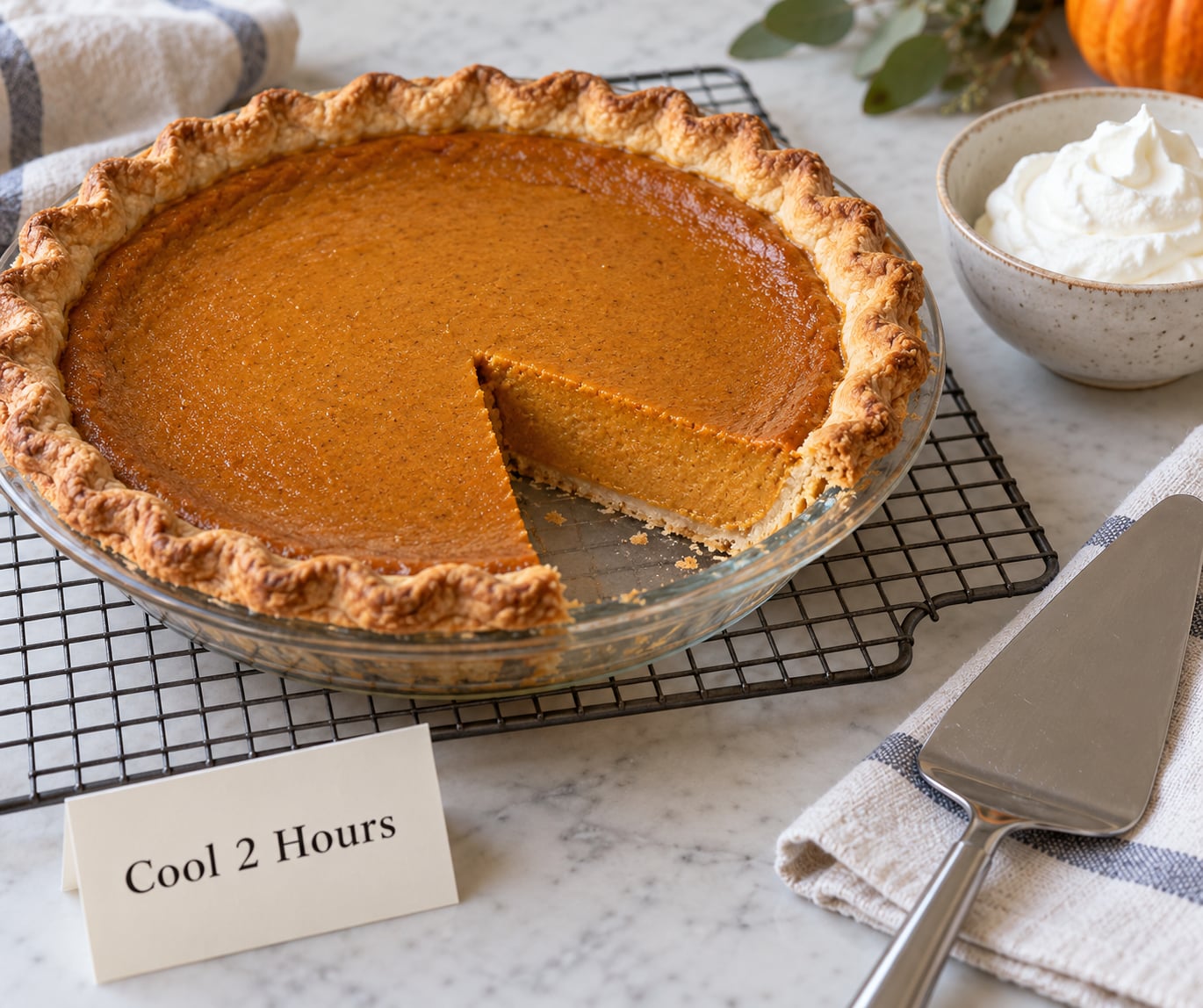
Let the pie cool on the rack for at least 2 hours, longer if your kitchen is warm. Pumpkin pie is a custard, and a custard cut while it’s still warm releases its water onto the board. A fully cooled slice holds its shape and comes off the knife clean.
Serve it at room temperature or slightly chilled, which is honestly where pumpkin pie is at its best. Whipped cream is the obvious pairing, but lightly salted crème fraîche, a thin layer of salted caramel, or a small scoop of vanilla ice cream all work.
For storage, cool the pie completely, then loosely cover it and refrigerate it for up to 4 days. For longer keeping, cut the cooled pie into slices, wrap each one individually, and freeze it for up to 2 months. Thaw a slice in the refrigerator overnight, or set it on the counter for an hour before serving.
Baked pumpkin pie made with fresh pumpkin keeps well because the custard is already cooked through. If you want the make-ahead side of this sorted before the holiday, our guide to stuffing that isn’t soggy covers the same low-moisture logic from the other half of the table.
Common Mistakes
Almost every disappointing pumpkin pie traces back to one of five things. Here’s how to spot and fix each one.
The filling is watery
Fresh roasted puree carries far more water than canned. Reduce it in a saucepan for 10 to 20 minutes until it thickens, or press it through a cheesecloth-lined sieve for 15 minutes. Draining after baking is not a fix; the custard has already separated by then.
The bottom is soggy
Par-bake the crust at 425°F (220°C) for 10 to 15 minutes before the filling goes in. Fill a cooled shell, not a warm one. A warm shell keeps the butter soft and the dough pliable, which is how you get a bottom that never crisps.
The crust edges burn before the center sets
Custard pies run long. Cover the rim with foil halfway through, and start hot for 15 minutes before dropping to 350°F (175°C) so the crust gets its browning early while the filling has plenty of time left.
The custard is cracked
Overbaking is the cause, not underbaking. Pull the pie when a knife an inch from the edge comes out clean, and let it cool in the switched-off oven with the door cracked open. Do not slice it warm.
The filling is stringy or the pie tastes bland
That points to a carving pumpkin. Sugar pie pumpkins are noticeably sweeter and less fibrous. If that’s all you had, extend the simmer to 20 minutes and add another 2 tablespoons of sugar to the filling.
One more that catches people: dough shrinking down into the pan. Chilling the disc before rolling, and again after fitting it to the plate, helps. Some home bakers weight the shell with dried beans during the par-bake, then tip them out before filling.
Frequently Asked Questions
Can I use fresh pumpkin instead of canned pumpkin pie filling?
Yes, and most bakers who have tried it never go back. Fresh roasted puree gives a brighter orange color and a deeper, caramelized flavor than canned. The two differences to plan for: fresh puree needs the moisture simmered off before it goes into the filling, and the pie bakes about 15 minutes longer than a canned version. A 3-pound pie pumpkin makes roughly 2 cups of puree, which is one 9-inch pie.
How much fresh pumpkin does one pumpkin pie need?
One 9-inch pie takes about 2 cups of cooked puree, and a single 3-pound sugar pie pumpkin yields roughly that much after roasting, scooping and pureeing. If you strain the puree to remove extra water, expect closer to 1.5 cups, which still works. A larger baking pumpkin gives you enough for a full pie plus a dozen mini pies or two dozen muffin-cup portions.
Should I roast or boil pumpkin before making the filling?
Roast it. Roasting at 400°F (200°C) for 40 to 50 minutes caramelizes the natural sugars and drives off water, which is exactly the flavor and texture you want in a pie. Boiling cooks the pumpkin without concentrating anything, so you end up with a thinner puree that still needs reducing on the stovetop. Either works, but roasting gives you more flavor per minute.
Why is my fresh pumpkin pie watery?
Almost always because the puree went in without being reduced. Fresh roasted pumpkin releases a lot of water, and the custard does not have enough body to absorb all of it, so the excess surfaces as a weepy layer on the plate. Simmer the puree for 10 to 20 minutes until it thickens to the texture of thick apple butter, or press it through a cheesecloth-lined sieve for 15 minutes before measuring it into the filling.
How long should pumpkin pie bake at 350°F?
Bake at 350°F (175°C) for 35 to 45 minutes, following an initial 15 minutes at 425°F (220°C) to set the crust. Fresh pumpkin pies run about 15 minutes longer than canned ones. Check with a thin knife inserted an inch from the edge; it should come out clean while the very center still looks a little soft, since it finishes setting as the pie cools.
How should fresh pumpkin pie be stored?
Let the pie cool completely, then cover it loosely and refrigerate for up to 4 days. For longer keeping, cut the cooled pie into individual slices, wrap each one well, and freeze for up to 2 months. Thaw slices in the refrigerator overnight, or on the counter for about an hour. Serve pumpkin pie at room temperature or slightly chilled rather than straight from the fridge.
Conclusion
The step that decides whether this pie works is the one before the pie exists: roast the pumpkin, puree it, and take the water out. Simmer it for 10 to 20 minutes until it thickens, and the rest is manageable.
From there, chill and par-bake the crust so the bottom stays crisp, whisk the filling until it pours like thick cream, and start hot before dropping the temperature so the crust browns without the custard cracking. Test with a knife an inch from the edge, not in the center, and let the pie cool two full hours before you cut it.