
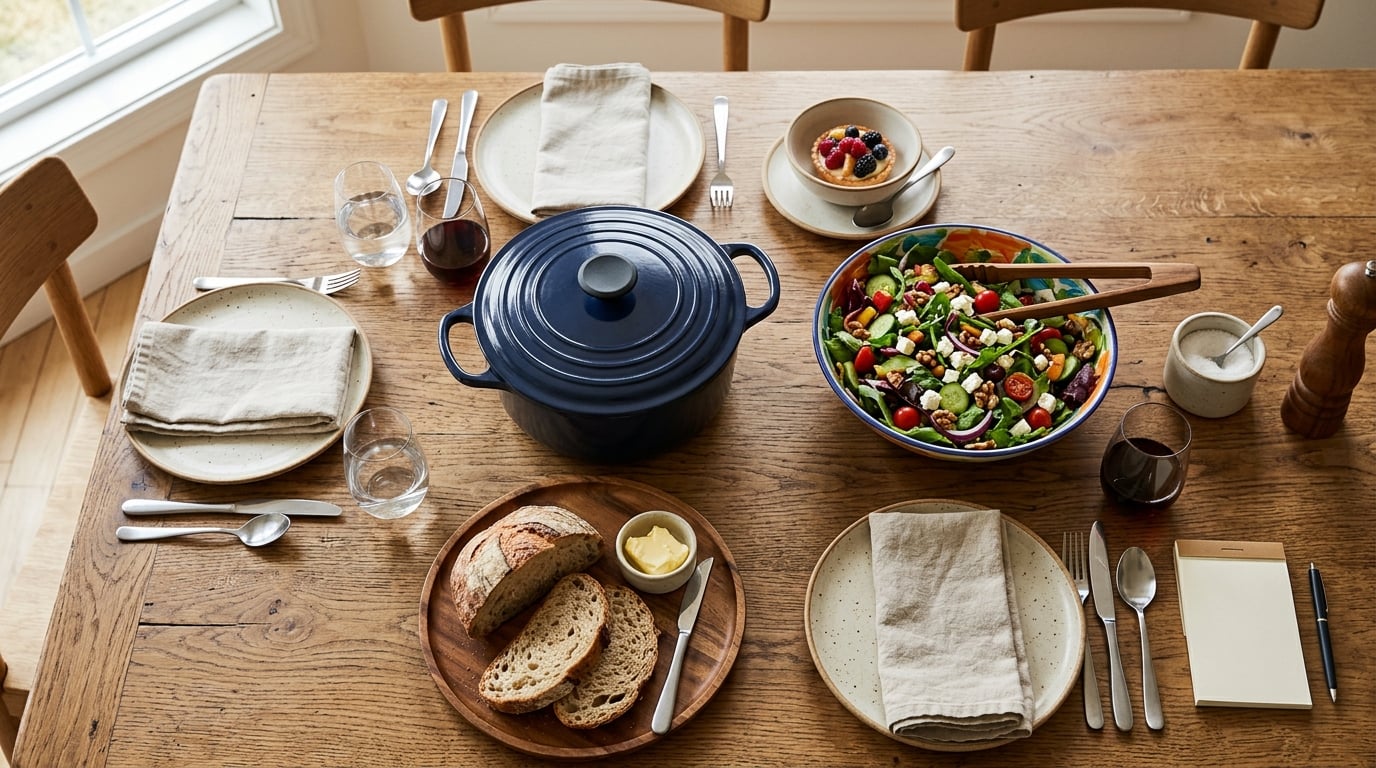
Planning a dinner party menu a week ahead means choosing dishes you can prep, cook, or freeze during the six or seven days before the party, so that on the night you only reheat, dress a salad, and open the door. The method fits in one sentence: work backward from your serving time, have roughly two-thirds of the menu finished before party day, and keep one fresh element for the evening itself. The planning itself takes about half an hour. The cooking spreads across an ordinary week.
I started planning a week out after hosting a birthday dinner where everything finished at once, in the oven, while eight people stood in my kitchen holding drinks. A week of planning would have been more work than I wanted. Six days of prep with a short list beat that scramble, and it has been the default since.
Table of Contents
- What You Need
- How to Plan a Dinner Party Menu a Week Ahead: Step-by-Step
- Set the Format and Guest Needs Seven Days Before
- Choose a Menu That Flows Six Days Before
- Build a Dinner Party Menu a Week Ahead Five Days Before
- Make the Shopping and Prep List Four Days Before
- Shop in Two Efficient Rounds Three to Two Days Before
- Prep the Make-Ahead Work the Day Before
- Finish, Warm, and Serve on Party Day
- Common Mistakes
- Frequently Asked Questions
- What should I include in a dinner party menu?
- How long before a dinner party should I start cooking?
- What are some easy dishes I can prepare in advance for a dinner party?
- Can I make mashed potatoes a day in advance?
- How much food should I serve per person at a dinner party?
- What is the 3-3-3 rule for meal prep?
- Conclusion
What You Need
Before you write a single dish down, settle six things. Most hosts lose an evening to menu brainstorming that could have taken ten minutes if these were answered first.
- Guest count. A confirmed number, not a hopeful one. Ask people to reply by a specific day and count the replies twice.
- The occasion and the register. A Tuesday supper for six and a birthday dinner for twelve are different events with different menus, even when the food overlaps.
- Dietary restrictions and allergies. Collect them now, in writing, from every guest. A week is enough lead time to build around a restriction, not enough to invent one on Thursday night.
- Serving style. Family style at the table, or buffet on the sideboard. Buffets tolerate more make-ahead food because nothing has to leave the kitchen at one instant.
- Your equipment. One large oven, a Dutch oven, a sheet pan, a slow cooker, a blender. Your menu has to be cookable with what you own, and the day-of reheating depends on how much oven space you have.
- A rough ceiling. Decide what the evening is worth to you, even if the figure only lives in your head. It shapes whether the main is a braise you make yourself or something you buy ready.
One more practical thing helps more than any recipe: a single notebook page or a notes app list titled with the date. Every item on it gets a day attached to it. That list is your whole plan, and it takes 30 seconds to update.
How to Plan a Dinner Party Menu a Week Ahead: Step-by-Step
Here is the seven-day version, running from seven days out to the evening of the party. Each step has a job, and the job is finished before you move on.
Set the Format and Guest Needs Seven Days Before
Seven days out, write the guest count, the occasion, the meal format, the serving style, and every dietary restriction on one list. Then set the menu size, which is the decision most people get wrong.
For four to six guests, plan three dishes: a starter, a main, and something sweet. For eight, add a side or a second starter. For twelve or more, add a salad and a second main, because one main course rarely fills that table and someone will still be hungry at nine o’clock.
Also decide how much advance prep is realistic for you this week. If Thursday already has a dentist appointment and a deadline, do not plan a braise that needs three hours of tending. Write down your two busiest evenings so the menu can route around them.
Choose a Menu That Flows Six Days Before
Start with the main course, because it dictates everything else, then work outward. Leiths puts it the same way: pick the centrepiece, then build around it. A make-ahead main is one that improves with rest, holds heat without drying, or reheats without fuss. Braises, roasts, baked pasta, soups, curries, and casseroles all qualify.
Choose sides that contrast rather than repeat. A rich braise wants something sharp or cold beside it: a dressed salad, a roasted vegetable with vinegar, a herbed grain. Skip the second potato.
Add a starter that is either served cold or warmed gently, so it can be plated while the main rests. A grazing board, a crudité plate with a good dip, or a chilled soup all work. Pick a dessert that must be made in advance anyway, such as a panna cotta, a tiramisu, a fruit crumble, or a chocolate cake. A week is plenty of lead time for the cake; a day is plenty for the panna cotta.
One fresh element is the whole trick. A green salad dressed at the last minute, a warm bread torn at the table, or a sauce finished with herbs you chop while the main rests gives guests something that tastes like tonight, not like Wednesday.
Build a Dinner Party Menu a Week Ahead Five Days Before
Now test the menu for balance, timing, and how the food behaves in storage. Write each dish on the list with three facts attached: when it gets made, how it is stored, and how it is reheated.
Balance means checking color, texture, and temperature across the table. If everything is beige and soft, add a green or a red somewhere. If the main is rich and heavy, keep the starter light. Vary texture as much as flavor: something crisp, something tender, something with crunch.
Timing is the part people miss. Look at the temperatures involved. A dish that needs a hot 425°F roast and a dish that needs a slow 325°F bake cannot share an oven in the same hour, so decide which one goes in first and which one waits. If two dishes finish reheating at the same moment, you have built yourself the exact problem you were trying to avoid.
Set cooking temperatures and order the menu by them. A 325°F braise reheats alongside a 350°F gratin without argument. A 425°F sheet pan of vegetables cannot, so it goes in last while the rest of the table is already eating.
Make the Shopping and Prep List Four Days Before
Build the list by grocery store section, not by recipe. Produce, meat and fish, dairy, dry goods, bakery, frozen, spices. Section order turns a 40-item list into a 12-minute walk instead of a 45-minute hunt through aisles twice.
Pull pantry items off the list. Most hosts already own oil, vinegar, salt, pepper, sugar, flour, and spices, and the week is when you discover the cumin is three months past its best or the stock cubes are gone.
Now attach tasks to days. Meat that marinates needs 24 hours, so it starts today. Dough for a tart goes into the freezer today if you are baking it Saturday. Desserts that need to set are noted for their earliest possible date.
If you are cooking with other people, this is where you assign them. A host who delegates two tasks and does not check back has a host who does all the work anyway. Give each person one dish and one deadline, written down.
Shop in Two Efficient Rounds Three to Two Days Before
Split the shopping. The first round, three or four days out, covers everything that keeps: canned goods, dry pasta, rice, grains, spices, wine, spirits, meat for freezing, cookies, and anything for the dessert if it freezes well. Buy the proteins now and put them in the freezer the same evening.
The second round, one or two days out, is fresh produce, dairy, herbs, bread, and anything refrigerated. The whole reason for two trips is that buying lettuce and herbs four days early gets you tired lettuce and limp herbs by Saturday.
Check quantities against the final guest count one more time. The most common last-minute failure is not a missing dish. It is a missing half-kilo of potatoes, and a grocery run at 5pm with fourteen people arriving at seven is the last thing you want.
Prep the Make-Ahead Work the Day Before
This is the heavy lifting, and it is the reason the whole week of planning exists. Start with the components that store best and finish with the ones that need to be freshest.
Sauces, vinaigrettes, and marinades go first; they only get better overnight. Then desserts, which can be assembled and refrigerated. Then chopped vegetables and raw proteins, marinated and covered. Then the main, if it braises or bakes. Cold sides like coleslaw and potato salad come near the end, and potato salad gets its dressing on the night, because dressed early it goes watery and heavy.
Store everything shallow and airtight. Food cools faster in a shallow container than a deep one, and putting a hot pot straight into the fridge is what raises the temperature of everything around it. Let things cool briefly, then refrigerate within two hours and keep the fridge at 40°F or below.
Label containers with the dish name and the date. At 9pm on party night, you will not recognize the pale yellow thing in the corner of the fridge, and that is when a good plan falls apart.
Finish, Warm, and Serve on Party Day
Start three hours before serving and work from a written run of show, not from memory. Cold dishes come out first. Then the oven goes on low, at 300 to 325°F, with everything covered in foil and a splash of liquid in the dish. Foil is the difference between a reheat that stays moist and one that dries out.
Space the finishes deliberately. Put the longest dish in first, the quickest last, so nothing is done at the same time. Give everything 15 to 20 minutes, then check the center of the thickest piece with a thermometer. Leftovers reheated for serving should hit 165°F throughout.
Dress the salad last, warm the bread in the oven with the main turning off, and set the table while things heat. If you can, arrange the serving dishes so you are not carrying hot pans across the room more than once. The point of the run of show is simple: you spend the evening at the table, not at the stove.
Food safety numbers worth remembering, in case you would rather not guess. Fresh poultry cooks to 165°F. Ground meat reaches 160°F. Whole cuts of beef, pork, lamb, and fish reach 145°F with a three-minute rest. Anything already cooked goes into the fridge within two hours, or into the cooler.
Common Mistakes
Planning nine dishes for six people. The menu should be one main, one or two sides, a starter, and a dessert. Anything more means four things in the oven at once and a host who tastes nothing. Cut a dish before you start shopping.
Cooking every course ahead. The two-thirds rule is the correction: two-thirds of the menu finished before party day, one fresh element on the night. A dinner with zero fresh elements tastes like leftovers, no matter how good the cooking was.
Letting the menu pick you by the shopping list. Decide the main first, then shop. The reverse order is how you end up with a beautiful roast and nothing to put beside it.
Shopping for everything at once. Four days early is fine for the dry goods and the freezer. It is a waste on salad greens. Two rounds, split by shelf life, is the fix.
Waiting on dietary restrictions until the menu is set. Ask on the same day you invite people, and put a deadline on the reply. A vegan, gluten-free, nut-allergic, or shellfish-allergic guest changes the menu from the first dish, not the last.
Reheating without a thermometer or a splash of liquid. Both take seconds and both fix the two complaints I hear most: dry chicken and gluey rice. A splash of stock in the roasting pan, foil on top, low oven.
Freezing something that should be refrigerated, and refrigerating something that should be frozen. Braises, soups, sauces, cookie dough, pastry dough, and casseroles freeze well. Salads with dressing, custards, meringue, and anything crisp go in the fridge, and get made two to three days out at most.
One last piece of advice that has nothing to do with food. Clean the bathroom on the afternoon of the party and set out the serving bowls and platters before you start cooking. When guests arrive, a house that is ready does as much for the mood as the food does.
Frequently Asked Questions
What should I include in a dinner party menu?
For six guests, plan a starter, one main, one or two sides, and a dessert. For eight, add a salad or a second starter. For twelve or more, add a second main, because one course rarely fills a large table. Pick the main first, then choose sides that contrast with it in texture, temperature, and color rather than repeating it.
How long before a dinner party should I start cooking?
Seven days out is the useful starting point, but almost nothing needs cooking that early. Day 7 is for decisions, Day 6 for choosing dishes, Day 5 for testing timing, Day 4 for the shopping list, Days 3 to 2 for two shopping rounds, Day 1 for the bulk of the cooking, and the party day for reheating and finishing.
What are some easy dishes I can prepare in advance for a dinner party?
Braises, roasts, baked pasta, soups, curries, and casseroles are the easiest mains because they improve overnight and reheat without fuss. For sides, do a coleslaw three days out, a grain salad two days out, and dress any green salad on the night. For dessert, a panna cotta, tiramisu, fruit crumble, or chocolate cake all hold.
Can I make mashed potatoes a day in advance?
Yes, and you should. Make them the day before, finish them with butter and cream, cover, and refrigerate. Reheat slowly in a covered pan with a splash of milk, or in the oven at 325°F, stirring once or twice. Wide and shallow reheats more evenly than a deep bowl, and gives the same result as made fresh.
How much food should I serve per person at a dinner party?
Plan on roughly a half kilo of raw meat, fish, or poultry per person, or about 250 grams. For sides, three to four heaped tablespoons per person works, and that is generous for a room with bread and a salad. Cooking for a few extra rather than a few fewer is the right bias, since leftovers are easier to handle than a second course.
What is the 3-3-3 rule for meal prep?
It is a common shorthand for preparing three main meals, three sides, and three snacks at the start of a week, then mixing and matching them later. It works well for everyday meal planning. A dinner party needs more control than that, so use the seven-day timeline above, which times each dish to a specific day and to your oven space.
Conclusion
To plan a dinner party menu a week ahead, settle the guest count and the meal format first, pick one make-ahead main, and let the rest of the menu fall into place around it. Decisions on Day 7, shopping split into two rounds, cooking on Day 1, and a written reheat order on the night.
Start with a single item on a list tonight. Write down your guest count, and one main course you would be happy to serve twice.