
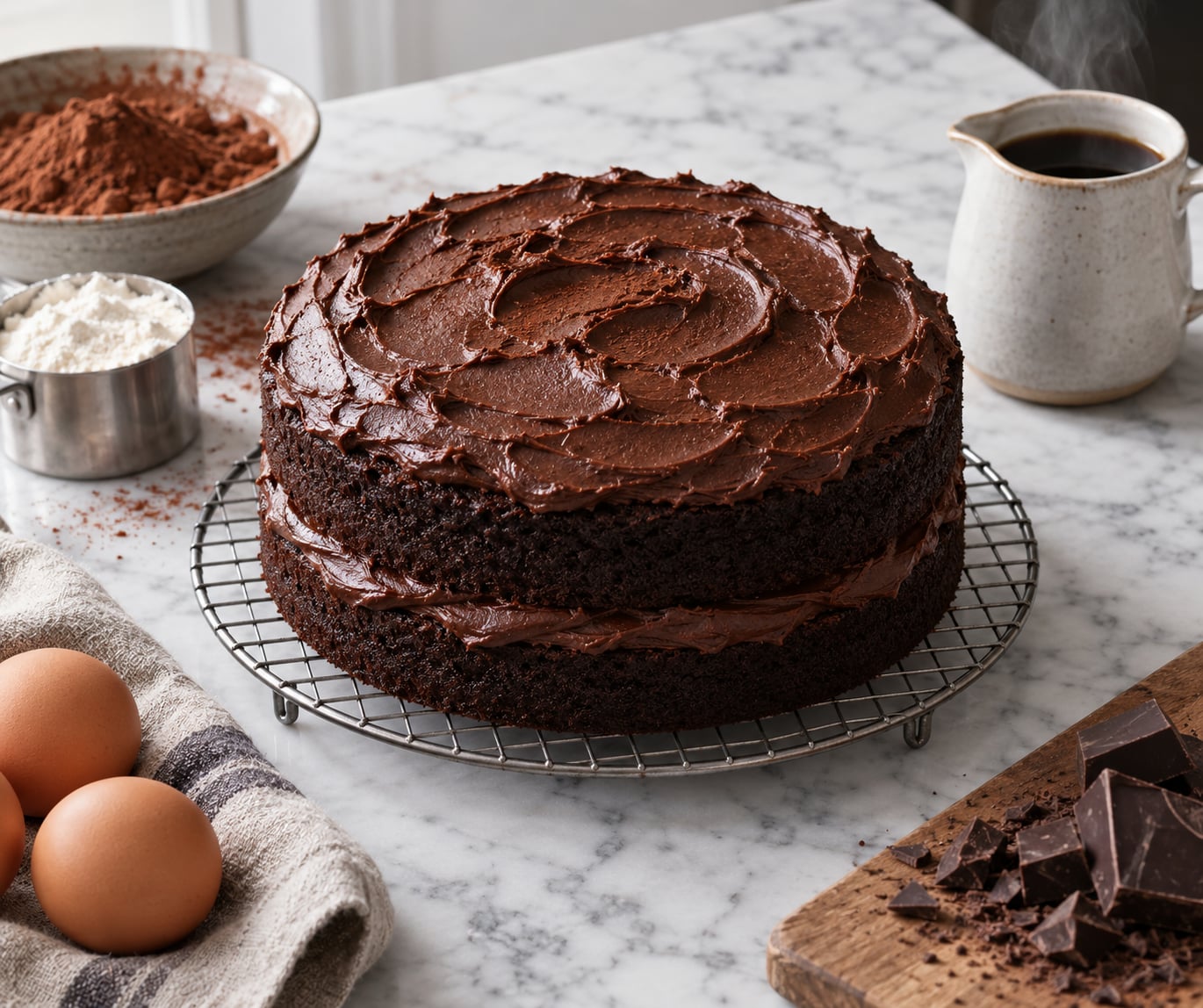
To make a moist chocolate cake from scratch that still tastes tender three days later, you need two things working together: liquid and fat. Hot coffee whisked into the batter dissolves the sugar into a syrup that holds water in the crumb, and oil plus buttermilk keep that water from escaping. More butter will not fix a dry cake. This one-bowl recipe needs no mixer, about 25 minutes of prep, and bakes in a single 350F (175C) oven.
I make this cake for birthdays and weeknight desserts in the same breath, mostly because it forgives. There is no creaming stage, no stand mixer, and nothing that has to be at room temperature except the eggs. If you have ever cut a chocolate cake and watched it crumble into dry crumbs at the knife, this is the one to try next.
Table of Contents
- What You Need
- Step-by-Step
- Common Mistakes
- Frequently Asked Questions
- Can I make a moist chocolate cake from scratch without cocoa powder?
- How do I keep chocolate cake moist overnight?
- What is the best pan size for a moist chocolate cake?
- Can I freeze a chocolate cake after baking?
- How do I fix a chocolate cake that is dry in the middle?
- Should I refrigerate a chocolate cake with whipped frosting?
- Conclusion
What You Need
Most of the ingredient list is pantry stuff you already own. The two that decide whether the cake is moist are the hot coffee and the oil, and neither one is optional if you want the tender crumb.
Cake ingredients
- 2 cups (250 g) all-purpose flour — spooned into the bowl and leveled, never packed. See the measuring note below.
- 3/4 cup (65 g) unsweetened cocoa powder — natural or Dutch process both work. Dutch process is darker and milder.
- 1 3/4 cups (350 g) granulated sugar — do not reduce it. Sugar holds moisture; that is the whole point.
- 2 tsp baking soda and 1 2 tsp baking powder — check the date. Old leavening is the quiet reason cakes come out dense.
- 1 tsp kosher salt, or 1/2 tsp table salt.
- 2 large eggs, room temperature.
- 1 cup (240 ml) buttermilk, room temperature.
- 1/2 cup (120 ml) neutral oil such as canola, sunflower, or grapeseed. Avocado oil works too.
- 2 tsp pure vanilla extract.
- 1 cup (240 ml) hot coffee — freshly brewed, or boiling water. Coffee deepens the chocolate without tasting like coffee.
No buttermilk in the fridge? Stir 1 tbsp lemon juice or white vinegar into 1 cup whole milk, let it stand 5 minutes until it looks slightly curdled, and use that. Full-fat Greek yogurt thinned with a splash of water works too, at 3/4 cup per layer-equivalent.
Tools and pans
You need two 8-inch round cake pans, 2 inches deep, a wire cooling rack, a whisk or fork, and either a kitchen scale or a proper measuring cup set. That is the full equipment list. A stand mixer is not necessary, and a springform pan is a bad idea here because the batter is soft enough to leak out of the seam.
About measuring flour: a scale beats cups every time, because a packed cup of all-purpose flour can carry 20 extra grams. If you do not have one, spoon the flour into the cup, level the top with a knife, and do not tap it on the counter.
Pan size and bake time
Bake at 350F (175C), no fan, middle rack. Use the toothpick test plus the spring-back test, not the timer alone.
| Pan | Batter needed | Bake time at 350F / 175C |
|---|---|---|
| Two 8-inch rounds, 2 inch deep | Full recipe | 28-33 minutes |
| Three 8-inch rounds | 1.25x the recipe | 30-35 minutes |
| Two 9-inch rounds | 1.4x the recipe | 32-38 minutes |
| 9 x 13 inch sheet cake | Full recipe plus 2 eggs, 1/4 cup oil | 35-42 minutes |
| 12 cupcakes, 2/3 cup each | Full recipe | 19-22 minutes |
| 10-inch Bundt, 12 cup | 1.1x the recipe | 45-55 minutes |
Deeper batter means a longer bake, which is where a lot of home bakers lose the middle of their cake. A 9 x 13 sheet holds roughly twice the volume of an 8-inch round at nearly the same depth, so the middle sets later.
Step-by-Step
Prepare the pans and oven
Heat the oven to 350F (175C) with the rack in the middle. Getting this on before you start matters, because the baking soda begins working the moment liquid hits the dry mix.
Grease two 8-inch rounds with butter or oil, then line the bottoms with parchment and grease the parchment too. The paper is not fussiness: a chocolate crumb this tender will glue itself to bare metal, and you lose a quarter inch of cake trying to peel it off.
Trim the parchment so it sits flush inside the base with no overhang. An overhanging flap darkens at the edge and catches in the knife later.
Mix the batter for a moist chocolate cake from scratch
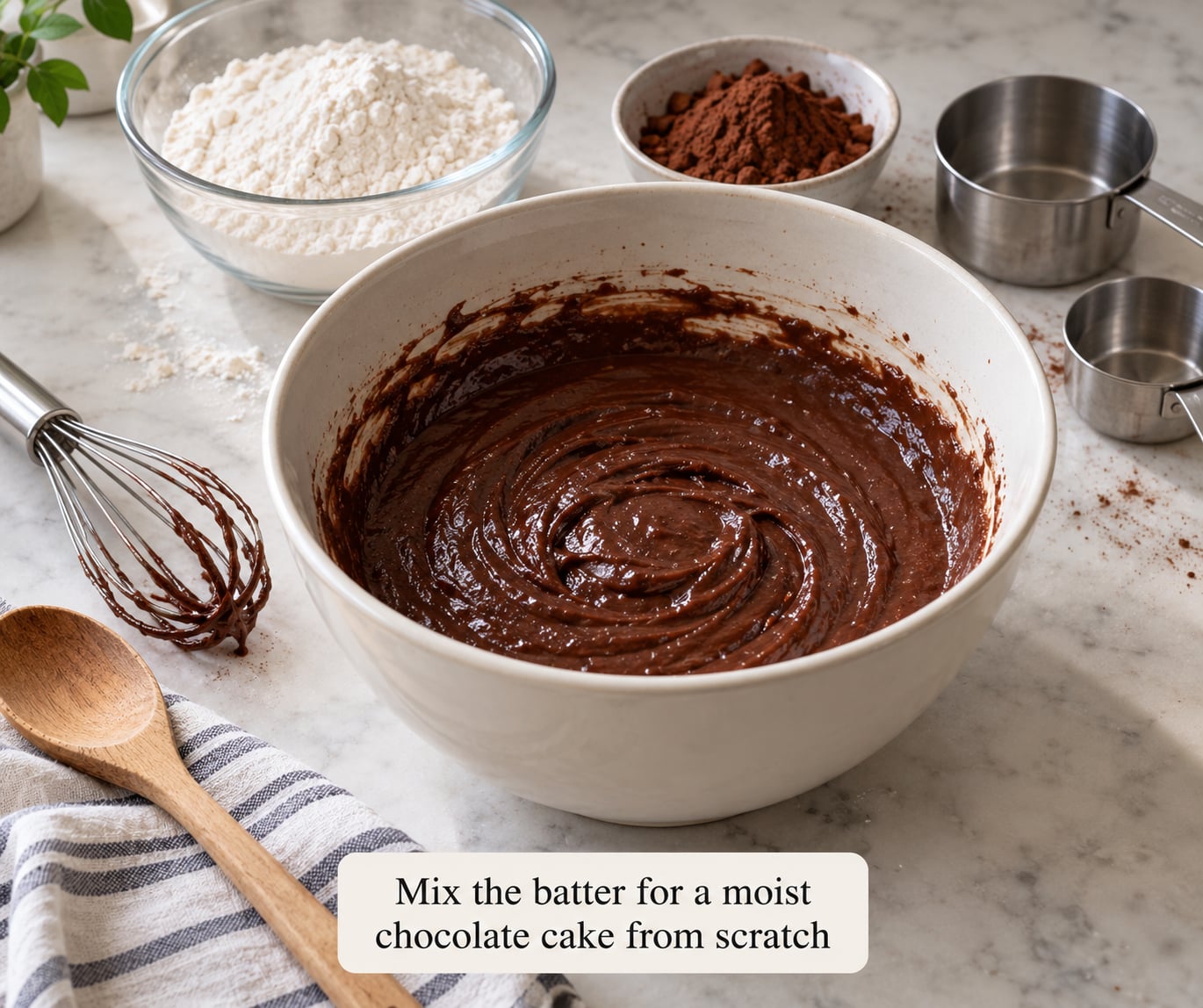
Whisk the flour, cocoa, both leavening agents, sugar, and salt together in a large bowl for 30 seconds. This dry blending is the step most recipes skip and the one that matters most. Sugar and cocoa rubbed into the flour coat the proteins and slow gluten development, so the crumb sets tender instead of chewy.
In a second bowl or a measuring jug, whisk the eggs, buttermilk, oil, and vanilla until combined. Add the wet mixture to the dry and whisk just until you no longer see flour streaks, about 30 seconds.
Pour the hot coffee in last and whisk until smooth. Expect the batter to be noticeably thinner than pancake batter. That thin, loose, almost pourable texture is correct. It looks wrong, so nearly everybody pauses here, and the cake sets into a dense moist crumb in the oven because the hot liquid kicks off starch gelatinization right away.
Do not add flour to thicken it. If the batter has visible dry pockets, whisk 30 more seconds; if a couple of small streaks remain, they disappear in the pan.
Pour the batter into the pans and slide them onto the middle rack. If the surface is not level, tap each pan once on the counter. That is also the moment to check for tunnels: any large holes mean the batter got overmixed, and the second cake is usually better than the first.
Bake the cake until it is set
Bake at 350F (175C) for 28 to 33 minutes, rotating the pans once at the 20-minute mark if your oven runs hot at the back.
Three cues tell you the cake is done. A toothpick or skewer inserted in the center comes out with a few moist crumbs, never wet batter. The top springs back when you press it lightly with a fingertip. And the edges have begun to pull away from the pan on their own, which happens a couple of minutes before the center fully sets.
Take the cake out the moment all three land. Every extra minute past this point pulls water out of the crumb, and that is the single most common reason a chocolate cake turns out dry. The cake will look slightly underdone coming out of the oven and finish on the rack.
Cool the cake before frosting
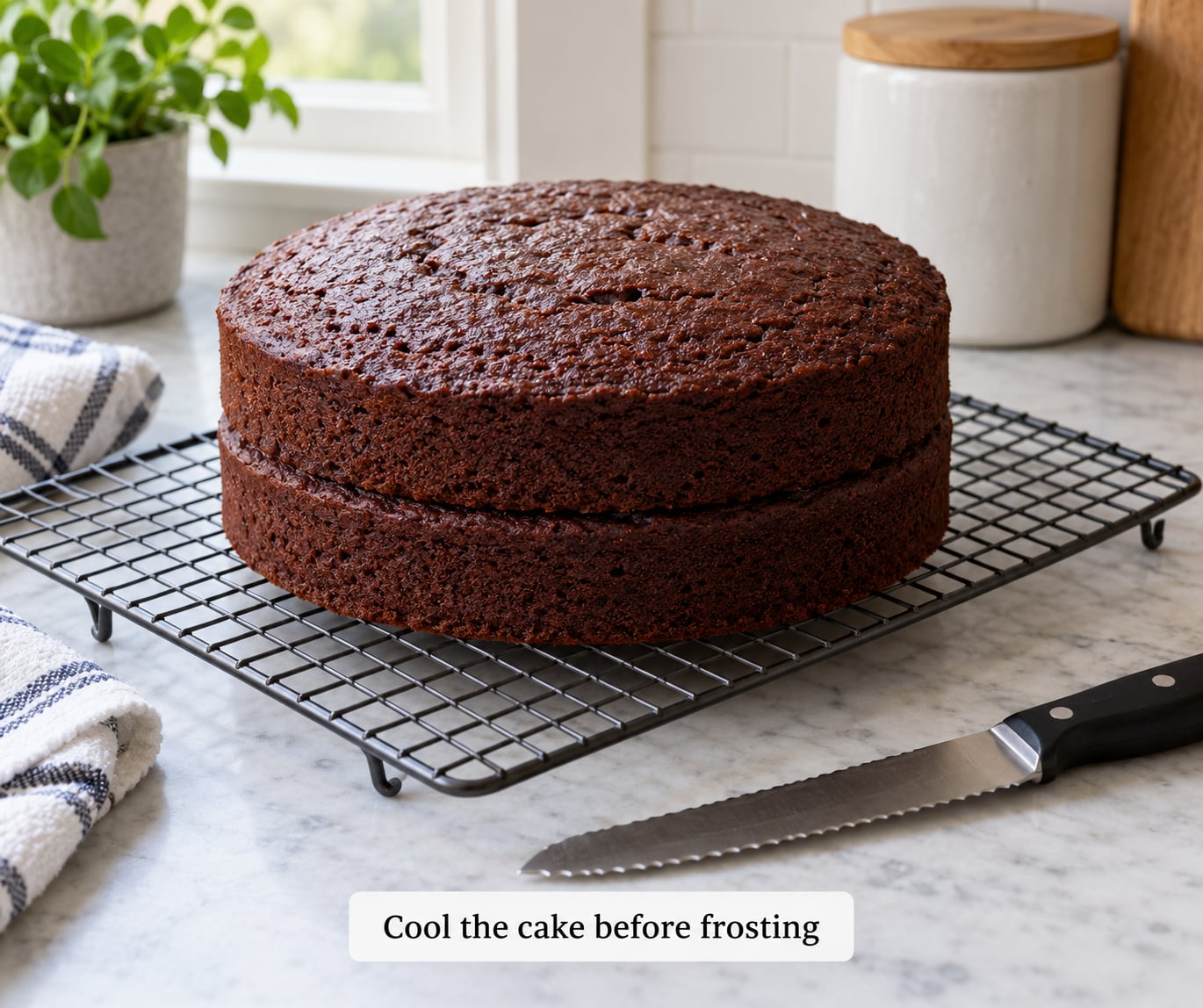
Cool in the pan for 10 minutes, then turn out onto a wire rack and cool completely, roughly 1.5 hours. If you frost a warm cake the buttercream melts, slides off, and pulls the top crumb with it.
Cooling on a rack rather than a plate matters for the texture too. Steam needs to escape from every side, and a cake sitting on a solid plate stays damp on the bottom and dries out at the edges. The same principle shows up in our guide to baking a layer cake that does not dome, where the flat top also depends on the cooling sequence.
Once cool, level the domed top with a serrated knife held at a shallow angle. Chill the layers for 20 minutes before frosting so the crumb firms up enough to hold the weight of the frosting without compressing.
For the finish, a salted chocolate buttercream is the classic pairing and needs no baking. If you want something glossier and less sweet, chocolate ganache sets in about 2 hours and spreads smooth over a chilled layer. Fill between layers, frost the top and sides, and serve the same day or the next.
Common Mistakes
Nearly every dry chocolate cake is a ratio problem rather than an oven problem: too much flour, too little liquid, or too long in the heat. Find the symptom, fix the cause, and the recipe works next time.
| Symptom | Likely cause | Fix |
|---|---|---|
| Dry, crumbly crumb that breaks when sliced | Flour packed into the measuring cup, or overbaked by 5 or more minutes | Weigh the flour, and pull the cake at 30 minutes rather than waiting for the timer |
| Dense and heavy, no lift | Baking soda older than 6 months, or batter left sitting more than 20 minutes | Replace the leavening, and get the batter into the oven immediately |
| Cracked across the top | Oven running 25F (14C) hot, so the outside set before the middle | Use an oven thermometer, and lower the temperature by 15F (8C) if it is consistent |
| Sunken center | Opened the oven door in the first 15 minutes, or baked at 375F (190C) | Leave the door shut until the full time has passed and use 350F (175C) |
| Holes and tunnels through the middle | Overmixed batter after the flour went in | Whisk until streaks disappear, no more, and sift the dry ingredients first |
| Raw in the center, dark at the edges | Pan too small for the batter, so the middle never caught up | Use the pan size table above and check 5 minutes before the listed time |
| Cake shrinks and toughens by day two | Too much flour, or an egg added from the fridge with no pureeing | Return to 200 g flour per cup of oil, and weigh everything |
One myth worth clearing up: reducing the sugar to make the cake less sweet makes it drier, because sugar is a hygroscopic ingredient that pulls and holds water in the crumb. If you want a less sweet cake, cut the frosting sugar instead, or add an espresso teaspoon for depth without extra sugar.
A few habits that keep the crumb tender. Bring the eggs out 30 minutes ahead, or put them in a mug of hot water for 5 minutes if you forgot. Sift the cocoa if it has clumps, since lumpy cocoa leaves chalky pockets. Wipe the measuring cup dry between the oil and the flour, because residual oil is one extra tablespoon of fat you did not plan for.
Expect the cake to taste better on day two. The moisture is trapped as a sugar syrup, and overnight it settles further into the crumb, which is why this recipe behaves differently from most cakes.
Frequently Asked Questions
Can I make a moist chocolate cake from scratch without cocoa powder?
You can, but it will taste like a chocolate cake only in name, because cocoa supplies the color, the bitterness, and most of the aroma. Swapping in melted chocolate works in a pinch: use 55 g of unsweetened chocolate melted and cooled for every 35 g of cocoa, and reduce the hot liquid by 2 tbsp so the batter does not seize. The result is richer and less cakey, so it leans more toward a fudgy pound-style texture.
How do I keep chocolate cake moist overnight?
Wrap the cooled layers tightly in plastic wrap or put them in an airtight container and leave them at room temperature for up to 3 days. The wrapping is the important part: exposed cake loses moisture to the air within hours, which is why a layer left out while you make dinner goes dry and stale. This particular recipe keeps three days on the counter, and some readers find it better on day two.
What is the best pan size for a moist chocolate cake?
Two 8-inch rounds, each 2 inches deep, are the best size for this batter. They give a layer thick enough to stay moist without going so heavy that the center sets late. A 9 x 13 sheet works but bakes deeper and needs about 8 extra minutes, and a springform leaks because the batter is soft. Match any pan to the bake times in the table above rather than guessing by size alone.
Can I freeze a chocolate cake after baking?
Yes, and freezing is genuinely the best way to make this cake ahead. Cool the layers completely, wrap each one in at least two layers of plastic wrap, then a layer of foil, and freeze for up to 3 months. Thaw in the wrapper at room temperature for two to three hours, unwrapping only at the end. Many home bakers prefer frozen layers to fresh ones because the crumb stays moist.
How do I fix a chocolate cake that is dry in the middle?
You cannot restore moisture once the crumb has dried out, but you can stop it spreading. Cut off the dry middle or the whole top layer, then frost only the tender parts and serve the cake in slices rather than trying to hide it. Next time, weigh the flour, pour the full cup of hot liquid, and pull the cake from the oven at the low end of the time range rather than the high end.
Should I refrigerate a chocolate cake with whipped frosting?
Yes, and refrigerate it within two hours of frosting it. Whipped cream frosting needs cold storage at or below 40F (4C) and holds safely in the fridge for about three days. Keep the cake in a cake carrier or on a plate inside a loose bag so the frosting does not pick up odors. An unfrosted cake layer keeps well at room temperature for 3 days or in the freezer for 3 months.
Once the cake is frosted, a few finishing touches take seconds: shave a little chocolate off a bar with a peeler and lay the curls on top, or pipe a simple border with a star tip. For a restaurant-style plate rather than a slice, our guide to sauce swoosh on a plate shows how to dress it up in a single motion.
Conclusion
Start with the three things that decide whether this one works. Weigh the flour so you do not pack the cup, whisk only until the streaks disappear because the thin batter is supposed to look like a mistake, and pull the cake from the oven at 30 minutes using the toothpick and edge-pull tests rather than the clock.
Get those right and the rest is patience. The crumb stays tender for three days, freezes well for a birthday a month out, and gets better on day two. That is how you make a moist chocolate cake from scratch without a mixer or a boxed mix, and keep it that way.