
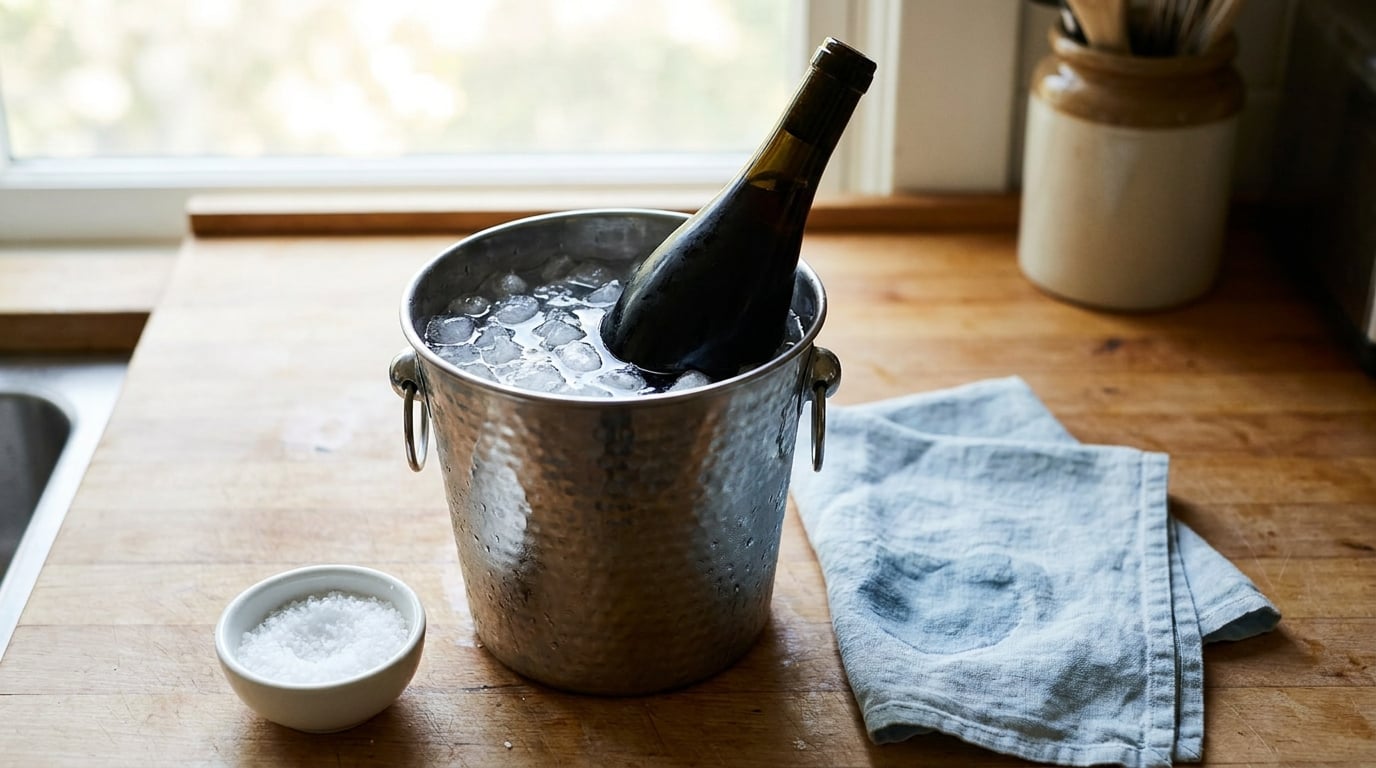
To chill wine quickly, put the bottle in an ice and cold water bath, add half a cup to a cup of coarse salt, and turn the bottle for 5 to 10 minutes. That salted bath is the fastest route from room temperature to drinking temperature, and it beats ice on its own every time.
Most people reach for the fridge, which is reliable but slow. A room-temperature bottle needs 2 to 3 hours there for whites and about 30 minutes for reds, so it works only if you planned ahead. The methods below all use what you already have, and each one tells you how to tell the wine is ready rather than making you guess.
Temperatures matter because warm red wine smells of alcohol and tastes flat, while a white served straight from an ice bucket goes muted and tight. Getting to the right number of degrees quickly is the whole trick.
What You Need
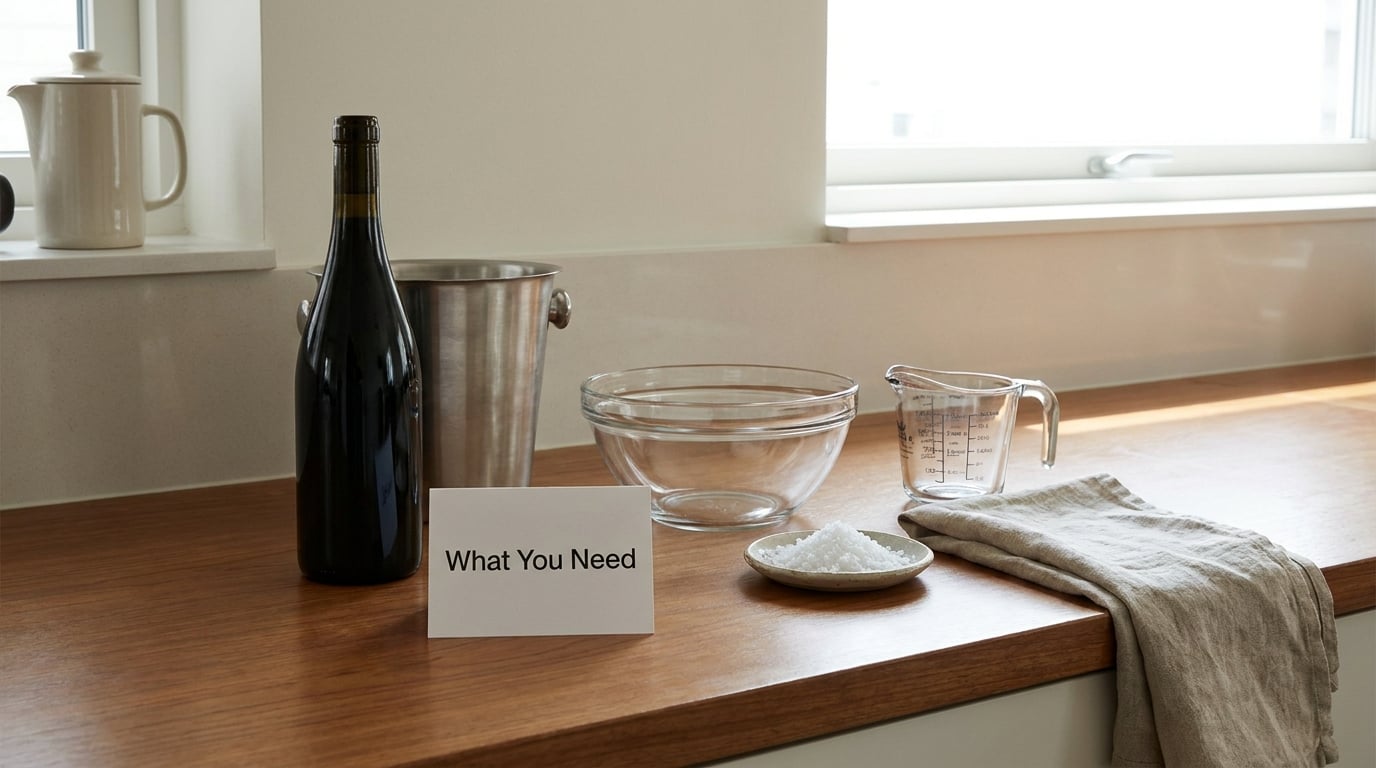
None of this is specialist equipment. Gather it before guests arrive and the second method is ready to go.
- An ice bucket, large bowl or stock pot — big enough that the bottle sits down in it and the water comes up to the neck. A wide shallow tub holds more ice around the glass than a narrow vase, so it chills faster.
- Ice and cold tap water — equal parts by volume. You need both, not just cubes.
- Coarse salt — half a cup to a full cup per bottle. Standard table salt or coarse kosher salt both work; a pinch does nothing.
- A damp paper towel or thin dish towel — for the freezer method.
- A zip-top bag — slips over the bottle to save the label from the bath.
- A timer — phone alarm is fine, and the freezer method is not optional without one.
Optional extras: a decanter or two wine glasses, a bag of frozen grapes, or a stainless steel immersion chiller if you want a no-ice option for an outdoor table.
How to Chill Wine Quickly: Step by Step
Run these four methods in order from most convenient to fastest, then hold the bottle cold while you serve it. If you are picking a bottle for dinner, start with how to pair wine with steak for beginners and pick something you know you will want cold.
How to Chill Wine With Ice and Water
An ice and water bath takes a room-temperature bottle to drinkable temperature in about 20 to 30 minutes. It is the method to use for every bottle, every time, because it cannot freeze the wine and it cannot break anything.
Fill the bucket halfway with cold tap water, then add ice to the top. Keep adding ice as it melts — the bath should look like a slurry of ice with water between the cubes, not a pile of dry ice with a puddle underneath. That gap is the whole difference, because water moves heat out of glass far faster than air does.
Slide the bottle in and turn it a quarter rotation every minute or two so a different strip of glass sits against the cold. Give the bottle a gentle swirl every few minutes too, since warm liquid rising off the inside of the bottle and cold liquid sinking back is what actually moves the heat.
You will know it is close when the bottle is cold to the touch all the way around and the neck is foggy. Another 5 minutes in there costs you nothing and removes the guesswork.
How to Chill Wine With Ice, Water, and Salt
Adding salt cuts the time to 5 to 10 minutes, which is the fastest practical way to chill wine quickly. This is the method for the bottle you forgot while the steaks were searing.
Build the same ice and water bath as above, then stir in half a cup of coarse salt. Push it to a full cup if the bottle is large, a heavy Bordeaux or anything you want properly cold rather than just cool. The salt dissolves into the meltwater and drops its freezing point, so the bath keeps pulling heat out of the bottle instead of settling at 32°F and going lazy. That is freezing-point depression, and it is the entire trick.
Submerge the bottle to the neck, set a 10-minute timer, and rotate the bottle steadily the whole time. Agitation matters because it replaces the thin layer of warm wine touching the glass with cold wine from the middle, which can shave several minutes off. Spin it by hand, roll it on the counter, or hold it under the tap and turn it. You do not need a power drill, though plenty of people film themselves doing exactly that.
Stop at 10 minutes and check. The bottle should feel cold through the glass, and the neck will have frost on it. If you have a thermometer, white and sparkling want 40 to 45°F and reds want about 55°F.
How to Chill Wine in the Freezer
The freezer chills wine in 20 to 30 minutes with no water and no bucket, which makes it the easy choice when you cannot spare a tub. Set a timer, because this is the one method that can ruin a bottle.
Wrap the bottle in a damp paper towel or thin dish towel first, then put it in the freezer on its side or standing upright. The damp towel helps for one reason: water conducts heat far better than air, so the wet layer touching the glass pulls warmth out of the bottle across the whole surface. A thick dry towel does the opposite and insulates the bottle, which is the most common version of this trick done wrong.
Never leave glass in the freezer longer than 20 minutes with the cork or screw cap on. As wine gets colder it expands, and the pressure can push the cork out, crack the shoulder or shatter the bottle outright. A frozen bottle that cracks in an overnight freeze has also lost its contents to a mess nobody enjoys cleaning. The 20-minute mark is a hard ceiling, not a suggestion, and a bottle left past it can also dull the wine once the ice crystals have damaged the texture.
How to Chill Wine in About 20 Minutes
For a heavier bottle or a large format, 20 minutes is a realistic target rather than a stretch. Use the freezer method with a damp towel, or run a salted ice bath if you can stand by the tub — the bath is safer and easier to stop on time because you are right there watching.
Set the alarm for 18 minutes rather than 20 so you have a moment to pull it out. After 18 minutes, take the bottle out and run the back of your hand down the glass from shoulder to base. If it is evenly cold rather than cold at the top and warm at the bottom, it is done. Give it two more minutes if there is any warmth left near the base, where most of the liquid sits.
Sparkling wine needs a separate warning. The pressure inside a sealed bottle builds as the liquid contracts toward freezing, and a bottle put in the freezer can go off like a small bomb. Chill sparkling wine in the fridge for 3 to 4 hours or in an ice and water bath for about 20 minutes, and keep the foil or cage on if the bottle is warm.
How to Keep Wine Cold While Serving
A chilled bottle warms fast in a warm room, so plan for the second half of the meal. Fill a serving bucket with ice and add just enough cold water to fill the gaps, about one part water to three parts ice. A dry pile of ice leaves air pockets around the glass and chills far more slowly than a wet slurry.
For two bottles, use a bucket holding roughly 10 to 12 cups of ice. For four bottles, go bigger — a clean plastic tub or a cooler with a drain plug handles a dinner party and takes up counter space you probably need more. Keep a couple of spare bottles in the fridge and swap them in as the first ones empty.
If you are serving outside in summer, fill a bucket two-thirds with ice and bury the bottles up to their shoulders. Without a fridge nearby, that bucket is your only cold storage, and a shade cover or a damp towel over the rim keeps the light out and the meltwater in. If the meal is built around white or sparkling, our white wine pairing basics for home cooks guide has the temperature range worth aiming for.
Minutes Needed by Method and Wine Type
This is the table most people are really after, because the honest answer depends on both the method and the style of wine. Times assume a room-temperature bottle of standard 750ml weight.
| Method | White | Rosé | Light red | Full red | Sparkling |
|---|---|---|---|---|---|
| Salted ice and water bath | 5-10 min | 5-8 min | 6-10 min | 8-12 min | 10-15 min |
| Ice and water, no salt | 20-25 min | 20-25 min | 25-30 min | 30-35 min | 25-30 min |
| Freezer, damp towel | 20-30 min | 20-25 min | 25-30 min | 30 min | Not recommended |
| Pour into glasses, set in ice | 8-10 min | 8-10 min | 10-12 min | 12-15 min | 5-8 min |
| Frozen grapes in the glass | 5 min per pour | 5 min per pour | Not suitable | Not suitable | 5 min per pour |
| Refrigerator, planned ahead | 2-3 hrs | 2-3 hrs | 1 hr | 30-40 min | 3-4 hrs |
Pouring into smaller vessels works because cooling is a surface process. More glass surface touching more cold liquid means more heat leaving per minute, so a glass chills in minutes while the same wine in a bottle takes half an hour. A carafe or decanter is a good middle ground if you want the whole bottle at once, and a guide to beginner wine and steak pairings usually has you opening two bottles at once, which makes the second method worth setting up in advance.
Frozen grapes are the community favourite for a single glass. They cool the pour without diluting it the way ice cubes do, and they are the fastest option for someone who has already poured and is standing there holding a warm glass.
Common Mistakes
Nearly every slow or ruined bottle traces back to one of these. Each has a simple fix.
- Using ice with no water. Cubes alone leave air gaps, and air is a poor conductor. Keep the slurry wet top to bottom and top up the water as it melts.
- Leaving a bottle in the freezer too long. Expansion can push the cork out or crack the glass. Twenty minutes, then out, always with a timer set.
- Wrapping in a thick dry towel. It insulates rather than conducts. Dampen a paper towel or thin dish towel instead, and skip the second layer.
- Forgetting to close the bottle. An open bottle off-gasses in an ice bath and picks up smells from the kitchen. Re-cork or screw the cap back on before it goes in.
- Over-chilling and then having no way back. A white wine dropped to 40°F tastes tight for an hour. Take it out at 45°F and stop.
- Soaking the paper label. It goes soggy, peels and floats off. Slip the bottle into a zip-top bag first — it costs nothing and the paper survives.
- Pouring too much water into the bath. A bucket brimmed with water has less ice, so it holds less total cold. Equal parts, and no more.
One more worth naming: a thin bottle sitting in a bath that only reaches halfway up the glass. The shoulder and base hold most of the liquid, so both need to be under water. Turn the bottle as well, and a bottle that has been sitting in one position in a bath stays warmer on the side facing air.
Frequently Asked Questions
What is the 20-minute rule for wine?
It is a safety limit, not a serving guideline: never leave a wine bottle in the freezer for more than 20 minutes. As the liquid cools it expands, and pressure builds until the cork is pushed out, the shoulder cracks or the bottle shatters. Set a phone alarm and take it out at the 18-minute mark. The same ceiling applies to a wet-towel wrap, which chills the bottle faster than a bare one.
Can you chill wine and then unchill it?
Yes, but slowly, and not to the same temperature twice. Once bottle and glass are cold, warming them back up takes far longer than cooling them down, and red wine that has been warm and is now cold will taste muted. If a white is too cold, stand it upright in a warm room for 20 to 30 minutes. Red wine that has gone warm in a hot room is better put in the fridge for half an hour than warmed by the oven.
Can I use a wet paper towel to chill wine quickly?
It genuinely works, and the wet part is the reason. Water conducts heat far faster than air, so a damp layer against the glass keeps pulling warmth out across the bottle’s whole surface. Wrap a damp paper towel or thin dish towel around the bottle and put it in the freezer for up to 20 minutes. A thick dry towel does the opposite and slows the process down.
Should I chill wine in the fridge or the freezer?
Fridge for anything you can plan. It needs 2 to 3 hours for white and sparkling, about 1 hour for a light red and 30 to 40 minutes for a full red, and it is the only method with zero risk. Freezer for the last minute, capped at 20 minutes and ideally with a damp towel wrap. Ice and water is faster than both and far more forgiving than the freezer.
How long does it take to chill wine in ice water?
A room-temperature bottle takes 20 to 25 minutes in a plain ice and water bath, and 25 to 30 minutes for a full-bodied red. Add half a cup to a cup of coarse salt and the same bottle lands in 5 to 10 minutes. The bath must be equal parts ice and water with the water level up to the neck, and turning the bottle every minute makes a real difference.
What temperature do you serve ice wine at?
Ice wine and other dessert wines are usually served around 45 to 50°F, which is noticeably colder than a dessert wine at room temperature but well above a frozen pour. If your ice wine is slushy straight from the bottle, let it sit until the texture turns silky and the sweetness reads cleanly. A stick or spoon in the bottle for a minute is enough to take the edge off.
Conclusion
When guests are already on the way, the salted ice bath is the move: equal parts ice and cold water, half a cup to a cup of coarse salt, bottle submerged to the neck, and ten minutes of steady rotation. For an ordinary dinner, ice and water alone at 20 to 30 minutes is the method you can repeat without thinking.
Whichever route you take, decide first: put the bucket together now, or set a freezer alarm for 18 minutes. The bottles that turn out badly are the ones nobody gave a timer.