
Cooking seasonally on a tight budget means planning meals around the fruits and vegetables that are abundant and at their lowest price in your area right now, then stretching them across the week with batch cooking and smart storage. The system takes about twenty minutes of planning and one batch-cooking session, and the hardest part is giving yourself permission to drop an out-of-season favorite for a week.
I built my own weekly rhythm this way after noticing my grocery bill was mostly made up of a handful of items I bought on habit rather than on price. Nothing here requires a garden, a special membership, or a big freezer. It requires that you decide what to cook after you look at what is cheap, not before.
Table of Contents
- What You Need to Cook Seasonally on a Tight Budget
- Step-by-Step
- Common Mistakes
- Frequently Asked Questions
- What does cooking seasonally mean on a tight budget?
- Are seasonal vegetables always cheaper at farmers markets?
- Is buying frozen produce a budget-friendly option?
- How long should I store cooked leftovers before eating them?
- Can this method work for vegetarian or plant-based meals?
- Do I need to plan every meal for the entire week?
- Conclusion
What You Need to Cook Seasonally on a Tight Budget
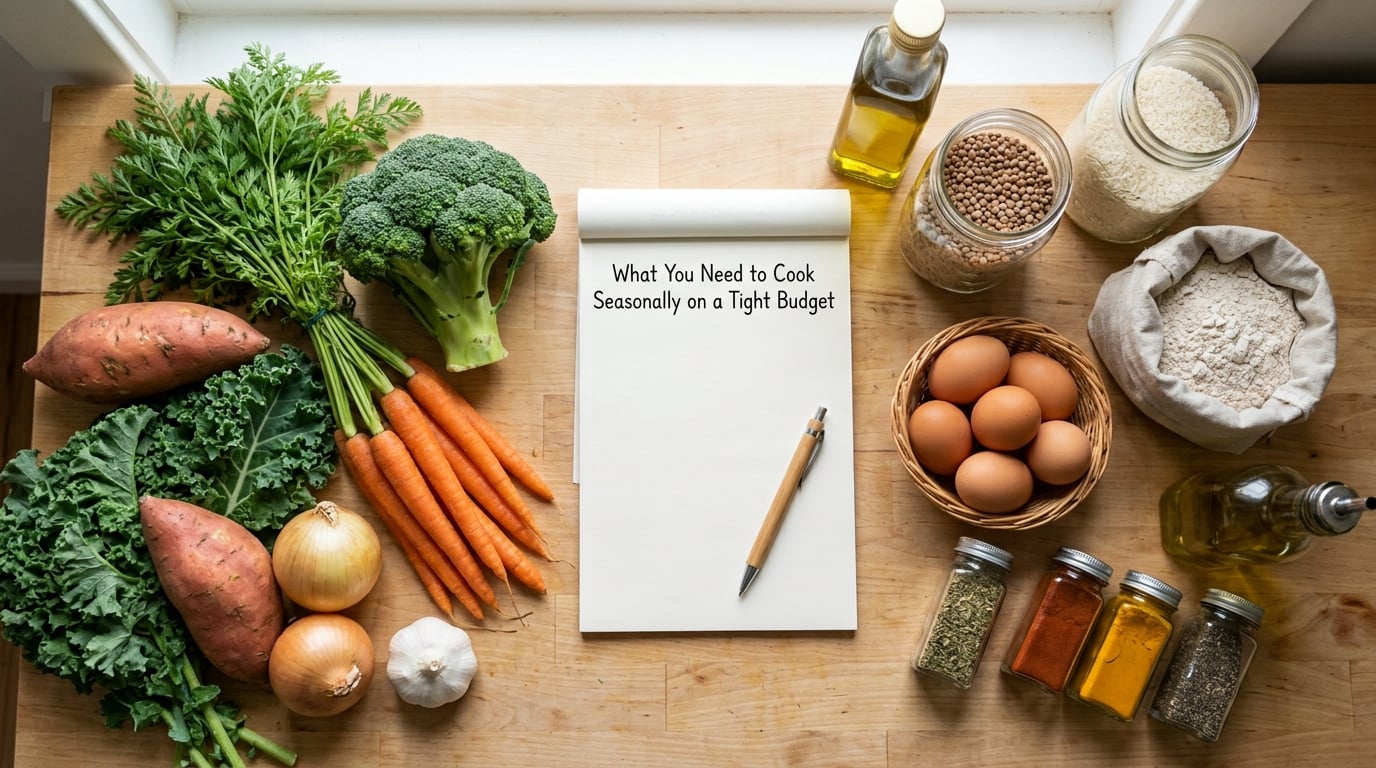
You need four things, and all four of them are free or already in your kitchen. A reusable list you can write on, a base of flexible pantry ingredients, a way to batch cook, and somewhere cold enough to store the result.
The flexible pantry is what makes weekly produce go further. Keep rice, dried or canned beans and lentils, pasta, eggs, canned tomatoes, canned broth, onions, garlic, a neutral oil, vinegar, and a small spice shelf on hand. Every one of those items turns into a different meal once you add whatever vegetable is cheap that week, which means you are never forced to buy something just to use up a jar.
Tools: one sheet pan, a large pot, a knife, and a container that seals well enough for the freezer. That is the whole list. A slow cooker helps if you have one, but it is not the difference between working and not working.
Step-by-Step
How to cook seasonally on a tight budget by planning the week
Start at the store, not the recipe website. Glance at the produce section and note which items are marked down, sitting in a bulk bin, or stacked high because there is more than anyone can use. In most regions that tells you the peak of the season for those crops better than any printed calendar does.
Then pick two or three anchor ingredients from what you found cheap. Squash, green beans, corn, tomatoes, apples, whatever it is. Build a loose seven-day plan around those anchors and around what is already in your pantry, and leave the rest open. A loose plan stops you from throwing out food, because you have not committed a specific meal to a specific vegetable before you knew how it would look.
Write the plan on the list you keep. Seven dinners, three lunches you can eat the same way, and breakfasts you do not need to think about is a realistic week for most people.
Build a flexible grocery list
Split the list into four columns so you can see gaps. Pantry is the shelf staples. Protein is whatever cheap anchor you are buying, usually beans, eggs, canned fish, or a value pack of skinless chicken thighs. Produce is your seasonal anchors plus the two or three things you genuinely cannot cook without. Frozen is the safety net, and it belongs on the same list rather than in a separate panic trip.
Set a firm total for the whole trip before you leave the house, then subtract what you already have. Write the number at the top of the list and shop against it. The most useful habit in this whole method is knowing your ceiling before the first item goes in the basket, because it is very hard to cut back once the total has already happened.
Shop at the best seasonal value
Supermarkets are usually the practical default because they stock everything year-round, but their prices on seasonal items are competitive only when those items are genuinely abundant. Read the price per pound or per kilo on the shelf tag, not the headline number, and compare two stores before assuming the first one is the cheap option.
Farmers markets are fresher and often more interesting, but they are not automatically cheaper. Small farms have less volume, and convenience often shows up in the price. What a market does give you is access to seconds and surplus produce at a discount, which is the cheapest produce in the building if you ask. Ask before you assume, and go early when the selection is widest.
Discount grocers and ethnic grocery stores are where the real savings live. Buyers on r/Frugal repeatedly describe switching from small supermarket bags of rice to large bags from Asian grocery stores, which cuts the per-pound cost on the single most-used pantry item in the house. Bulk bins of grains and beans work the same way. Imperfect produce is a markdown category, not a lesser category.
Community-supported agriculture shares are useful when you cook nearly every vegetable you receive, and a poor fit when you do not. You are buying a farm, not a grocery list, and skipping weeks does not pause the billing.
Store produce for longer freshness
Most spoiled produce is stored wrong rather than bought wrong. Keep potatoes, onions, garlic, apples, and firm tomatoes in a cool, dark place outside the refrigerator. Refrigerate leafy greens, carrots, celery, broccoli, and berries, and keep greens in a bag with a dry paper towel so the moisture has somewhere to go. Bananas ripen everything near them because of the ethylene they release, so keep them away from the rest of the fruit if you want to slow the ripening.
Freeze the surplus. Berries, corn, peas, greens, and grated or sliced squash all freeze well after a quick blanch, and freezing at peak season is how a cheap week becomes four cheap weeks. If you are unsure whether freezing suits the vegetable, freezing is nearly always better than watching it turn soft in the crisper.
Revive rather than discard. Wilted greens and celery sit in ice water for ten or fifteen minutes and come back firm enough to use. Sturdy stems from broccoli and celery go into the pot for soup rather than the bin.
Cook a low-cost base batch
Cook one base that can become four or five meals. Good candidates are a pot of beans, brown rice, a sheet pan of roasted vegetables, a pot of soup, or a plain tomato sauce with onions and garlic. Spend twenty minutes on it and you have taken a single grocery purchase and spread it across half the week.
If you buy meat for the week, the protein side of that batch is the part worth planning around, and how to batch cook proteins for the week covers the timing so nothing sits raw waiting for its turn.
Handle the leftovers with real care, because the money is only saved if you eat it. Cool cooked food in shallow containers within two hours, refrigerate at 40F or below, and use cooked leftovers within three to four days. Reheat to 165F before eating. When you cook poultry, ground meat, whole cuts, or fish, hit the safe minimum internal temperature: 165F for poultry, 160F for ground meat, and 145F for whole cuts and fish. Freeze anything you will not eat inside that window, in single portions, while it is still at its best.
Turn the base into several meals
One base, several finishes. Rice plus beans plus roasted squash becomes a grain bowl with salsa, and it becomes stuffed squash with the same filling. Tomato sauce becomes pasta tonight and a soup when you add broth and wilted vegetables. Beans become chili with a can of tomatoes, and a thick soup with broth and whatever the crisper drawer is surrendering.
Rice is the workhorse of this method, and having a pot method that does not need a dedicated appliance makes it easier to keep a big batch on hand. How to cook rice on the stove without a rice cooker is worth bookmarking for that reason.
Finish fast with a skillet: a can of beans, a spoon of salsa or pesto, and a handful of greens or chopped vegetables turns into a dinner in the time it takes the rice to steam.
Use leftovers before they expire
Cook more than you need and eat the extras first, before the fresh batch. Put the first cooked item at the front of the fridge, not the back, and plan the next two dinners around what is already cooked. That single habit of eating back through the fridge is what stops a good grocery week from turning into a wasted one.
When the three-to-four-day window is running out, freeze rather than toss. Frozen cooked rice, sauce, soup, and chili reheat straight from the freezer in a covered pot, and they make the slow week after a busy one much easier.
Common Mistakes
Buying produce with no plan attached. This is the single most common complaint on r/Frugal threads about food budgets: vegetables bought for later rot in the crisper. The fix is to only buy what has a meal or a batch attached to it, and to put the first night on the calendar before you check out.
Assuming farmers markets are always cheaper. They are not, and treating them as the budget default can backfire. The fix is to compare price per pound with the supermarket, and to ask about seconds and surplus, which is where the real discounts are.
Overbuying specialty ingredients. That jar of preserves, the specialty vinegar, the spice blend for one dish. The fix is a one-in-one-out rule: nothing new enters the pantry until something older is used up.
Storing produce as though the fridge is one climate. Greens, roots, and fruit have different needs, and one damp drawer makes leafy greens rot while firm roots go soft. The fix is the counter-refrigerate-freezer split described above, and separating the ethylene fruit from everything else.
Tossing food that is still perfectly good. Soft greens, brown bananas, and tired carrots all have a use. The fix is a weekly ten-minute rescue: wilted greens into the soup pot, banana skins into the next batch of homemade sauce, stems into broth.
Committing to a rigid seven-day recipe plan. The most detailed plans break the moment a sale appears or someone changes plans. The fix is the loose version: two or three anchor ingredients, four or five fixed dinners, and open slots for whatever is cheapest that day.
Frequently Asked Questions
What does cooking seasonally mean on a tight budget?
It means planning your meals around the produce that is plentiful and cheapest in your area right now, then stretching it with batch cooking, freezing, and correct storage. When a crop is at peak season, supply is high and it does not need to be shipped long distances, so the price per pound drops. The savings come from a lower sticker price and a smaller produce bin, not from eating less or eating differently.
Are seasonal vegetables always cheaper at farmers markets?
No. Small farms sell less volume, and that convenience often shows up in the price, so a market tomato can cost more than a supermarket one. What a market does offer is seconds and surplus produce at a discount, and it is worth asking for them. The real savings at a market come from cooking everything you take home and buying enough to preserve, not from the headline price per pound.
Is buying frozen produce a budget-friendly option?
Usually, yes, and it is the most overlooked corner of a seasonal budget. Frozen vegetables are picked and frozen near peak, so they hold their texture and nutrients while costing less per serving than fresh out-of-season imports. Use them for soups, curries, stir-fries, and sauces where they cook into a dish rather than sitting alone on a plate. Buy fresh for things you will eat raw, and frozen for everything else.
How long should I store cooked leftovers before eating them?
Cooked leftovers are safe in the refrigerator for three to four days, kept at 40F or below. Cool them in shallow containers within two hours of cooking so they do not sit warm in the middle of the pot. Reheat to 165F before eating, and freeze anything you will not get to in that window, in single portions, while it is still at its best quality.
Can this method work for vegetarian or plant-based meals?
It works well, and it is arguably easier without a protein anchor to buy. Beans, lentils, eggs, tofu, and canned fish are the flexible anchors, and any one of them turns a tray of seasonal vegetables into a complete meal. The planning system does not change: two or three cheap vegetables, one base batch, and open slots for whatever is cheapest that week.
Do I need to plan every meal for the entire week?
No, and trying to is why most plans fail. Two or three fixed dinners are enough to stop impulse buying, and the rest can stay open. A loose plan is more useful anyway, because it lets you add a markdown find at the store and cook it the same night instead of saving it for a meal that already has something else planned for it.
Conclusion
Cooking seasonally on a tight budget is a weekly rhythm, not a diet. Look at what is cheap, anchor two or three of those items, cook one batch, and eat back through the fridge before the window closes.
Start tonight: check your pantry, then pick one or two vegetables that are in season and on sale where you shop. That is the whole method, and it starts working from the next meal.