
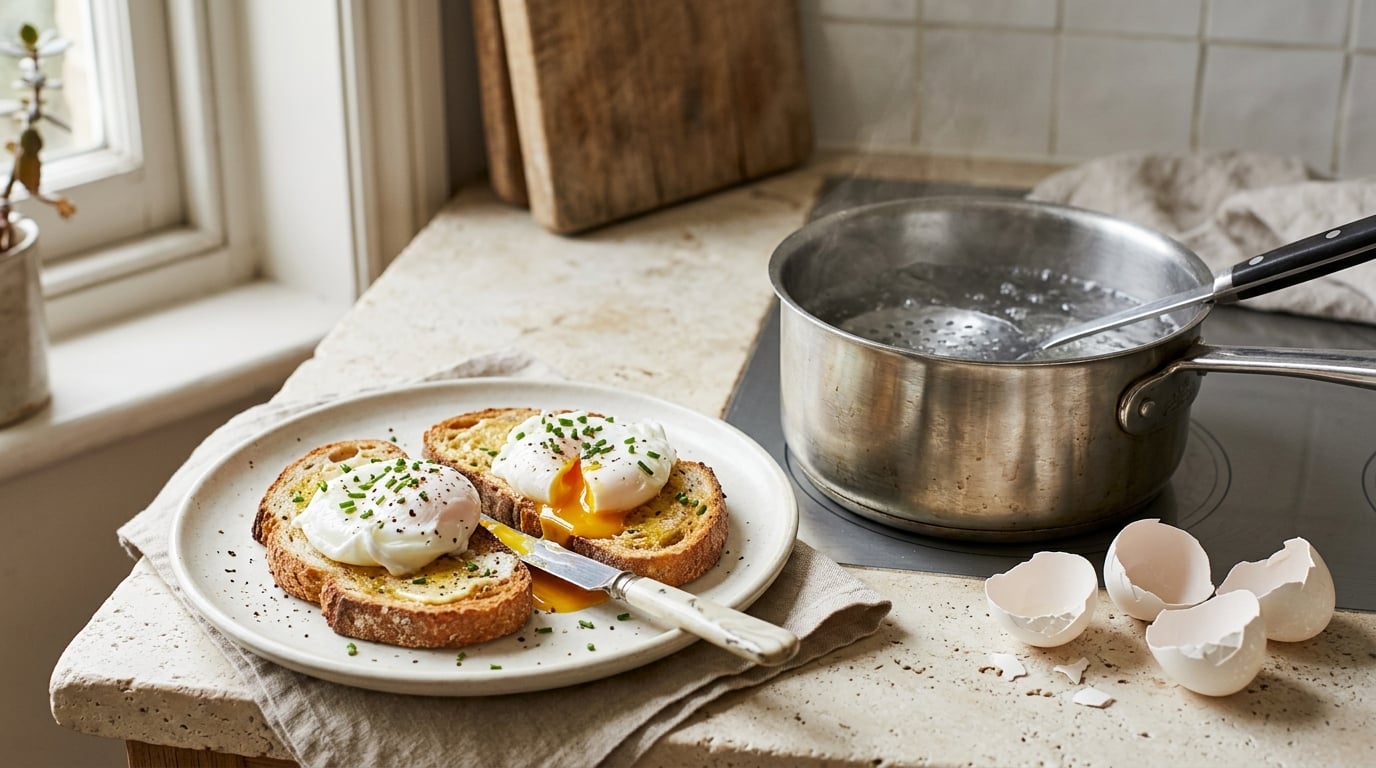
Poaching an egg without frying it takes about five minutes and needs nothing more than a saucepan, water and a slotted spoon. Heat the water until small bubbles rise, add a tablespoon of white wine vinegar, stir a gentle whirlpool, slide a cracked egg in from a cup, cook it for three minutes and lift it out. The white sets, the yolk stays runny.
The reason beginners struggle is almost never the egg. It is the water. Boiling water shreds the thin raw white into floating strands, and water that has gone cool lets the egg spread flat before it sets. Get the simmer right and the rest is a timer.
What You Need
You do not need a special poacher. Every reputable recipe source agrees the molded cups sold as poachers cook the egg for so long that the white turns rubbery, and they cost you control over the texture. A normal saucepan is better.
- A saucepan or small frying pan with at least 5 cm (2 in) of water and enough room for the egg to move without touching the sides.
- One egg per person, plus one spare in case a yolk breaks. Room-temperature eggs cook more evenly; straight-from-the-fridge eggs are fine but need about 30 extra seconds.
- White wine vinegar or distilled white vinegar — one tablespoon per 3 to 4 litres of water. Skip balsamic and malt, which will darken the egg and taste of it.
- A slotted spoon for lifting, and a tea towel or paper towel laid out on a plate first.
- A small bowl or cup to crack each egg into before it goes near the hot water.
- A timer, because two minutes is the difference between a jammy yolk and a firm one.
For food safety, treat the egg as raw until the white is fully set, and keep it in the refrigerator if you are cooking ahead.
Step-by-Step: How to Poach Eggs Perfectly for Beginners
1. Bring the water to a gentle simmer
Fill the pan with water and add the vinegar before you turn on the heat. Wait until you see small bubbles forming on the bottom and breaking the surface, with steam just starting to rise. That is a simmer. A rolling boil is a different thing entirely, and it is where most first attempts go wrong.
If you are unsure, turn the heat down one notch after the first bubble. You want a lazy movement, not a churn.
2. Crack and check the egg
Crack the egg into a small cup or bowl rather than letting it fall from the shell over the water. Fish out any shell with a piece of shell or your fingertip, and check that the yolk is intact and centred. If it has broken, discard it and start again — a broken yolk disperses and cannot be poached into shape.
3. Lower the egg gently into the water
Stir the water once with a spoon to start a whirlpool, then let go. Slide the egg in from the cup, close to the surface and as near the centre of the pan as you can reach. The moving water folds the white around the yolk instead of letting it spread in a flat disc.
Do not stir again after the egg goes in. The vortex has done its job, and a second stir tears the forming white.
4. Cook until the white is set
Set the timer and leave the egg alone. Timing below assumes a gentle simmer and room-temperature eggs.
- 3 minutes — white set, yolk still very runny. It will run across the plate.
- 4 minutes — jammy yolk, thick and spoonable but not liquid. This is the most forgiving result and the one to aim for first.
- 5 minutes — yolk firm all the way through, similar to a soft-boiled egg.
From the fridge, add about 30 seconds. If the water is bubbling harder than a gentle simmer, subtract a minute, because the egg is taking heat from moving water rather than sitting in it.
5. Remove and drain the egg
Slide the slotted spoon under the egg and lift it slowly, letting the water drain off for a moment before moving it. Set it on the tea towel you laid out at the start. Season with salt and pepper and eat straight away, or hold it for no more than a minute or two while you finish the rest of the plate.
Common Mistakes and How to Fix Them
Almost every failed poached egg falls into one of these six buckets. Work down the list and check the one that matches what you saw.
- Wispy white with floating strands. The water was boiling, or the egg sat too long before entering it. Bring the heat down until the bubbles are small and spread the cooking time evenly.
- Yolk broke on the way in. You dropped the egg from the shell, or the water was moving too violently. Crack into a cup, check the yolk, and slide the egg in rather than dropping it.
- Egg came out flat. The water was not moving and the egg sat still. Stir a whirlpool before lowering it in, and use a deeper pan so the egg has room to be surrounded.
- White is firm and rubbery. You cooked it too long or the water was too hot. Take 30 seconds off the time and check the simmer again.
- Egg tastes sharply of vinegar. You added too much. One tablespoon per 3 to 4 litres is enough; restaurant kitchens use a lot more because they poach hundreds of eggs in the same water.
- White spread into a thin film around the yolk. The egg sat on the bottom of the pan, or the water was too shallow. Add water so it sits at least 5 cm deep and stir once before the egg goes in.
One more thing: do not salt the water. Salt breaks the white up into exactly the wispy strands people are trying to avoid. Season the finished egg instead.
Tips for Poaching Eggs Reliably
Do you actually need vinegar?
No, but it makes the job easier. Egg white is mostly protein, and protein sets when it gets hot. A little acid tightens that setting so the white grips the yolk faster and holds a neater shape. You can leave it out and the egg will still cook, with a slightly looser white and a few stray threads.
If you skip the vinegar, a squeeze of lemon juice does the same job. Some cooks poach in heavy cream or olive oil, where the fat holds the shape, and a fancier version swaps the water for red wine to make oeuf meurette, or poaches the eggs in yoghurt the Turkish way.
Add whatever acid you choose before the water heats up, not after the egg goes in.
What the restaurants and chefs do
Professional kitchens cook at a lower, calmer temperature than most home recipes suggest, and they judge doneness by lifting the egg rather than by the clock. If the egg holds its rounded shape on the spoon, it is done; if it flattens, it needs another half-minute.
Tom Kerridge’s trick is to roll the egg still in its shell in boiling water for about ten seconds first, which sets the outer white and lets the egg survive a rougher pot. Heston Blumenthal goes the other way and treats vinegar as unnecessary. A Melbourne cafe poaching around 700 eggs a week uses a deep pot, a generous amount of vinegar and a strict two-minute cook, which tells you how forgiving a gentle method can be once you control the temperature.
How to poach eggs for a crowd
Bring a large pot of water to the simmer and make sure it is at least 5 cm deep before you start, since you will not want to wait midway. Cook one egg at a time, timing from when it enters the water, and move each finished egg to a plate lined with a tea towel. Season them as you go. A gentle simmer is more important than speed here, because crowding drops the water temperature and everything takes longer.
Sous vide cooks are poaching at 75°C (167F) in a sealed bag, which is the most forgiving method of all — and the most expensive equipment you can buy for the job.
Gadgets, pans and what to do with the water
Skip the silicone cups and the countertop egg boilers. They lengthen the cook and give you a rubbery white with no way to adjust the texture. A saucepan, a deep frying pan or even a small cup of hot water in a mug will get you a better egg.
The used water is fine for a soup or a batch of pasta. Just let it cool before pouring it down the drain, and give the pot a scrub afterwards, because acid plus egg protein leaves a stubborn film.
Frequently Asked Questions
Do you really need vinegar to poach eggs?
No, it is not essential, but it is the single easiest thing that makes a beginner egg look professional. Acid tightens the setting of the egg white so it grips the yolk and holds a neat teardrop instead of spreading. Skip it and the egg still cooks, just with a slightly looser white and a few stray strands. A squeeze of lemon juice works the same way.
When should I add the vinegar to the water?
Add it before you turn on the heat, alongside the cold water, so it is mixed in and warmed from the start. Adding it to already-boiling water means it hits the egg in one concentrated spot and can taste sharp. One tablespoon of white wine or distilled white vinegar per 3 to 4 litres of water is plenty. Avoid balsamic and malt, which will discolour the egg.
How long do I poach an egg for a runny yolk?
Three minutes in a gentle simmer gives you a set white and a runny yolk that runs across the plate. Four minutes is jammy, thick and spoonable, and it is the safest result for a first attempt. Five minutes cooks the yolk through like a soft-boiled egg. Eggs straight from the fridge need roughly 30 extra seconds.
Should the water be boiling when I add the egg?
No. Wait for a gentle simmer, which shows as small bubbles forming on the bottom of the pan and breaking the surface. A rolling boil agitates the raw white so violently that it sets into wispy floating strands instead of wrapping around the yolk. If you are not sure, turn the heat down one notch after the first bubble appears.
Why does my poached egg white turn stringy and wispy?
Stringy white means the water was boiling, the egg sat too long before going in, or the water was salted. Salt is the one people miss, because it breaks the egg white up into exactly the strands you are trying to avoid, so season the finished egg instead. Cooking straight from a boil is the other cause, and cooking it for more than a few minutes makes it worse rather than better.
What is the 5-5-5 rule for eggs?
The 5-5-5 rule is about hard-boiling eggs in the shell, not poaching them: five minutes in the water, five minutes in an ice bath to stop the cooking, and five minutes for the shells to loosen so they peel cleanly. It has nothing to do with a poached egg, which is cooked without its shell and timed in minutes rather than by the 5-5-5 method.
Conclusion
Do one thing for your first egg: hold the water at a gentle simmer, start the whirlpool, and give it four minutes. Four minutes lands you a jammy yolk even if the timing is a little off, which makes it far harder to ruin than chasing a runny three-minute yolk.
Once that one works, you already know the technique. Adjust the time for how you like your yolk, and the rest is just repetition. Updated for 2026.