
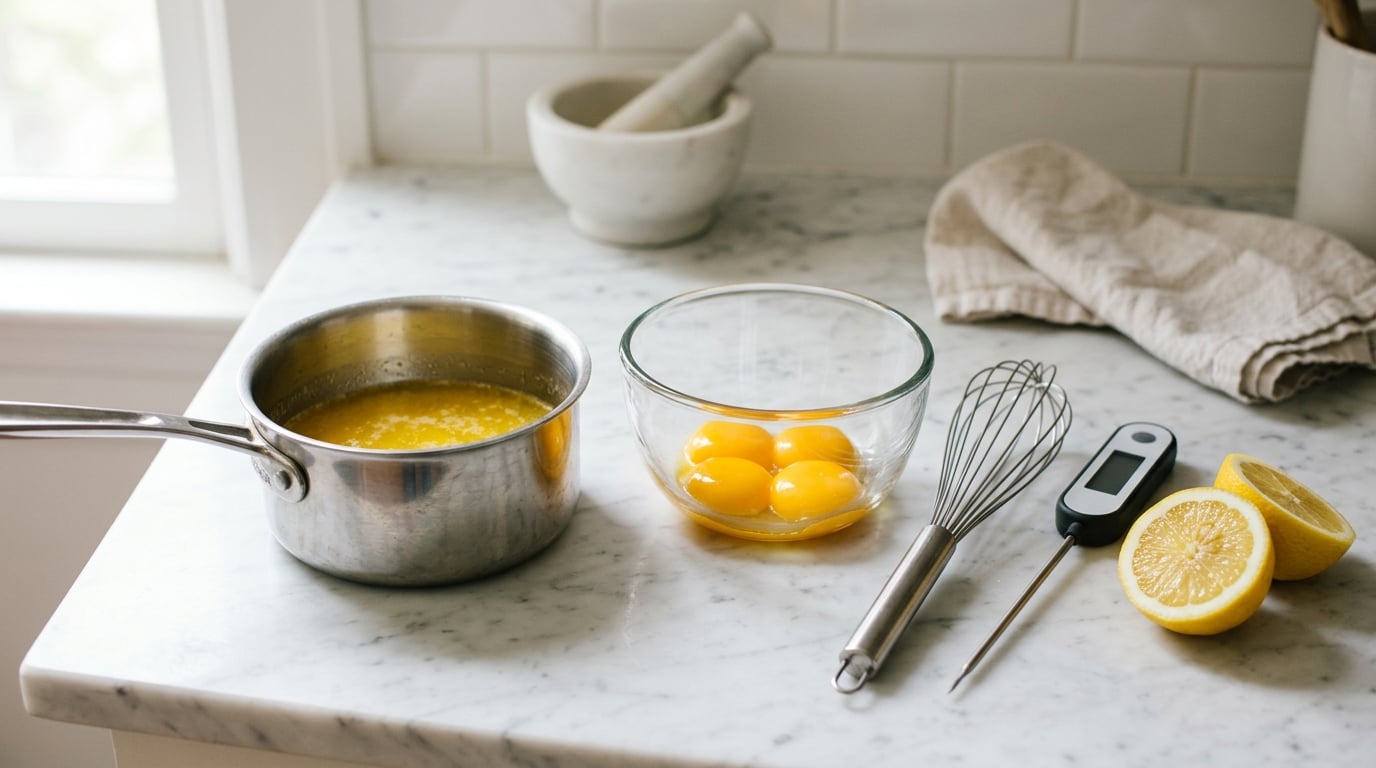
How to make hollandaise sauce that does not break comes down to three things: keep the yolk base between 130-140F (55-60C), pour the melted butter in a slow thin steady stream, and whisk constantly so the fat never pools. Get those right and the sauce stays glossy and coats a spoon like cream. You need about 15 minutes and a double boiler or a heatproof bowl.
I have broken more hollandaise than I care to admit, usually by getting impatient with the butter and dumping in a quarter-cup at once. Once that happens the fat droplets coalesce, the water phase gives up holding them, and you are left with something that looks like melted butter floating on egg water. The good news is that a split sauce is almost always recoverable, and this guide covers both halves of the problem: making one that holds together, and putting one back together when it doesn’t.
What You Need
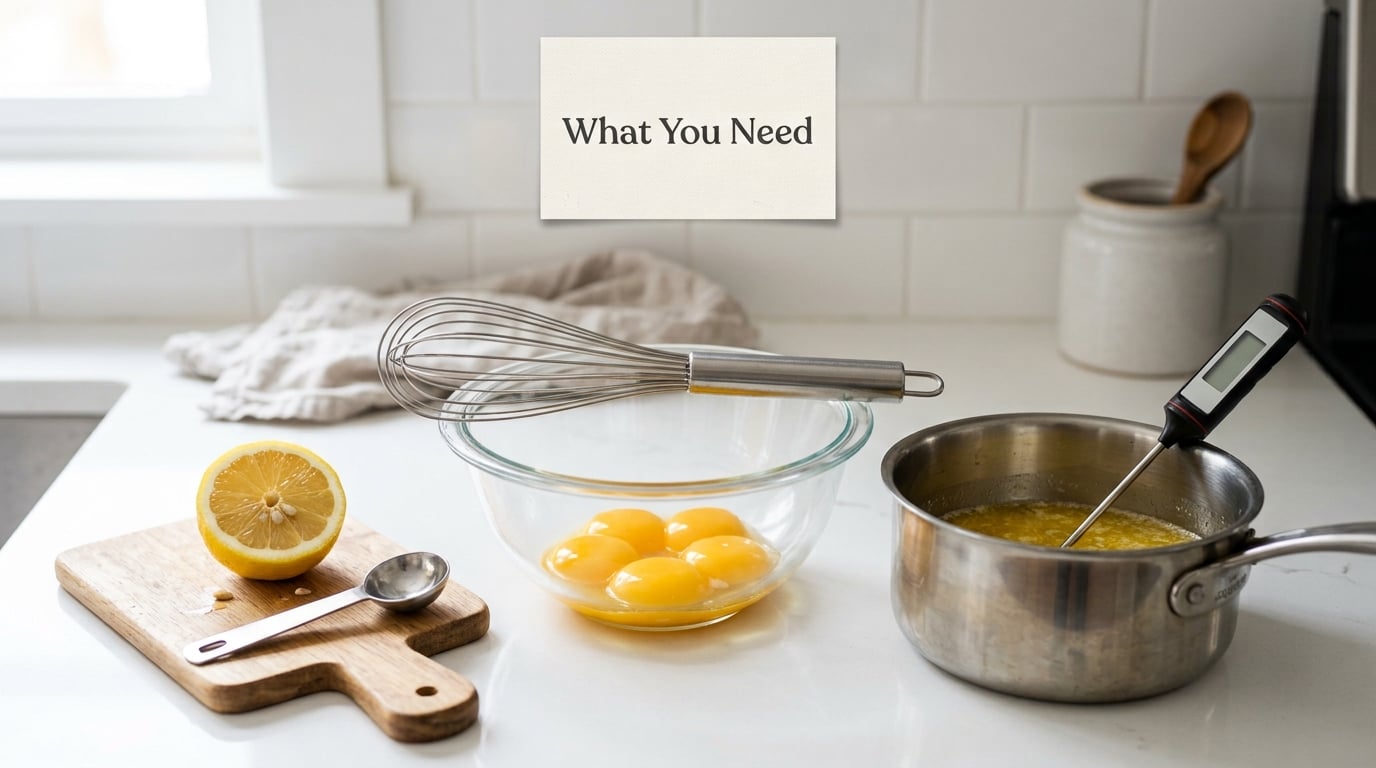
Hollandaise is four ingredients in two roles: an emulsified base and a fat. For four servings you want 4 egg yolks, 1 stick of unsalted butter (113g, about 8 tablespoons), 2 tablespoons of lemon juice, 1 tablespoon of water, a pinch of salt, and optional Dijon mustard and cayenne. The water is not optional decoration. It is what gives the continuous water phase something to hold onto, and skipping it is one of the four things that break hollandaise.
Use pasteurized eggs if you are cooking for anyone pregnant, elderly, or immunocompromised, and treat cooked hollandaise as a perishable egg dish. Two hours is the ceiling for room-temperature holding, one hour if the kitchen is above 90F (32C).
On the tool side, you need a wire whisk, a heatproof bowl that sits on a saucepan rim without touching the water, a rubber spatula for scraping, and an instant-read thermometer if you take the numbers seriously. The thermometer is the single most useful purchase here. Guessing at “low heat” is why the same recipe works on Monday and fails on Saturday.
How many egg yolks per stick of butter
Roughly one yolk per 2 tablespoons of butter is the working ratio, and a single yolk holds about 4 ounces of added butter before it gives out. Scale the yolks, not the lemon, when you cook for a group. Making hollandaise for twelve with the same four yolks is why so many brunches end up with an oily puddle on the plate.
| Butter | Egg yolks | Liquid (lemon plus water) | Good for |
|---|---|---|---|
| 4 tbsp (60g) | 2 | 1 tbsp lemon, 1 tsp water | 2 poached eggs |
| 8 tbsp (113g) | 4 | 2 tbsp lemon, 1 tbsp water | 4 to 6 servings |
| 12 tbsp (170g) | 6 | 3 tbsp lemon, 2 tbsp water | 8 servings |
| 16 tbsp (226g) | 8 | 1/2 cup lemon, 1/4 cup water | Eggs Benedict for ten |
Clarifying the butter is optional and no longer considered essential. Melting it slowly and spooning off the white foam leaves you with clearer butter and a slightly cleaner flavor. If you skip that step, just melt it slowly enough that the milk solids do not scorch, and skim anything foamy off the top.
Why Hollandaise Breaks
Hollandaise is an emulsion: melted butterfat suspended in a thin water phase of egg yolk and acid. Lecithin in the yolk coats each fat droplet so the droplets stay separate instead of merging. Break the coating, push the fat too hard, or cook the water phase out, and the droplets join, the fat rises, and the sauce splits.
So why does a hollandaise sauce break? In practice it is one of four causes, and they are easy to separate from what you see in the bowl:
- Too much heat. Above about 160F (71C) the yolk proteins coagulate into curds, and the emulsifier they were providing goes with them. You get scrambled egg, not sauce.
- Too little heat. Below roughly 130F (57C) the butterfat starts to crystallize and the sauce turns stiff, dull, and grainy. It will not thicken properly no matter how long you whisk.
- Butter added too fast. This is the most common mistake by a wide margin. A heavy pour floods the base with more fat than the yolk can coat, and the excess fat pools on the surface.
- Not enough water in the base. A yolk base with no added liquid has no continuous water phase to suspend the fat, so it seizes the first serious pour.
Whisking too hard, chilling the sauce, and adding a cold splash of butter at the wrong moment all push you toward the same place. Cheftalk cooks name rapid temperature swings and adding too much butter too quickly as the usual culprits.
Step-by-Step: The Method That Does Not Break
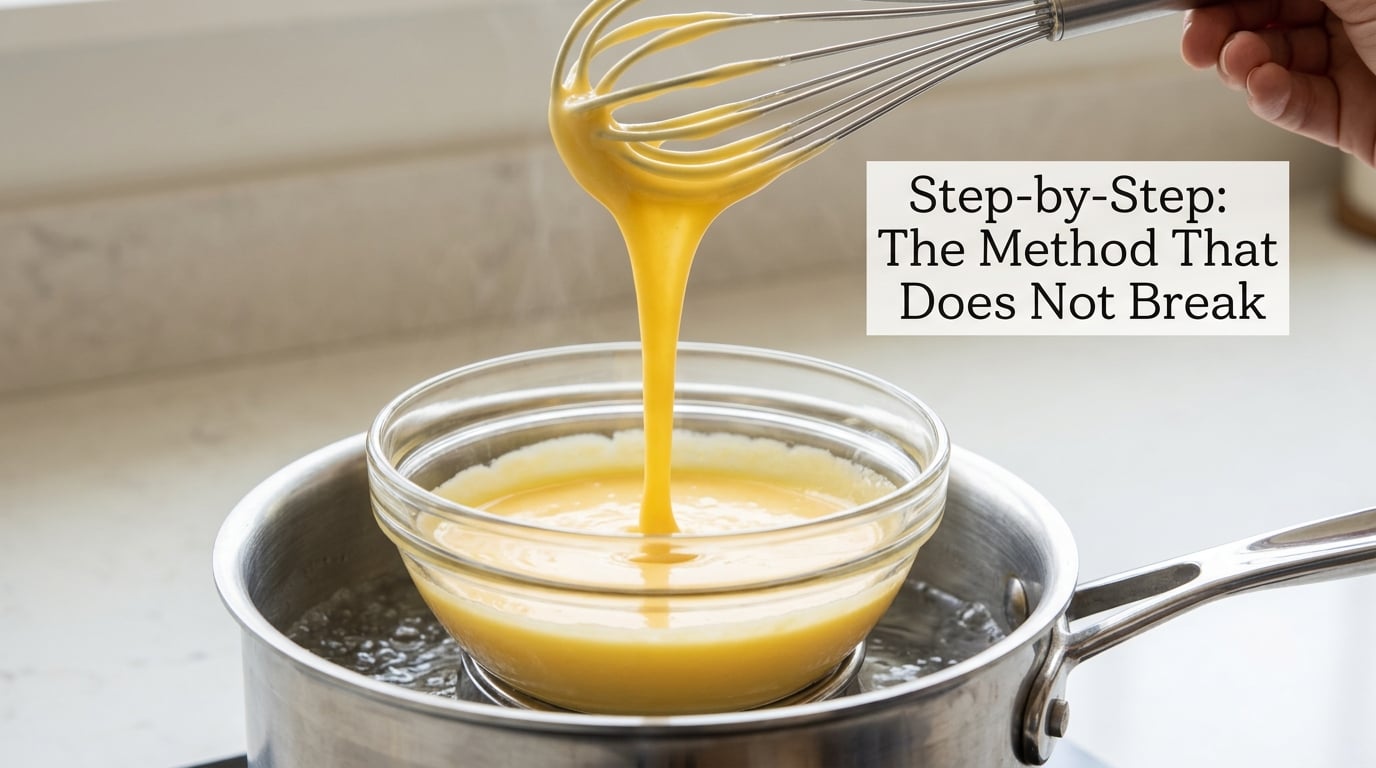
Heat the butter, whisk the yolks, and add the butter in a thread-thin stream while the yolks sit in a 130-140F water bath. Five steps, and every one of them has a visual cue you can check without a thermometer if you have to.
Step 1: Whisk the Egg Yolks
Whisk the yolks with the lemon juice, the water, the salt, and a teaspoon of Dijon if you have it, until pale, slightly foamy, and thick enough that a line stays visible on the surface for a second. Dijon helps. Its mustard protein gives the emulsion extra emulsifying power, and readers on the Downshiftology thread report good results with dry mustard in place of Dijon and lemon concentrate in place of fresh juice.
Do not add the butter yet. The base at this stage should look like thin custard, not like scrambled eggs.
Step 2: Melt the Butter Without Burning It
Melt the butter over medium-low heat until it is completely liquid and no solid pieces remain. For the classic method, that means hot enough to run freely, around 180-190F (82-88C), but not browned and not smoking. Any milk solids that scorch will taste bitter in the finished sauce, and they also carry proteins that can encourage clumping.
If you want to use the immersion blender or countertop blender method later, this is where the target changes: the butter goes to about 220F (105C), hot enough to shimmer. That method reverses the classic order, pouring very hot butter into cool yolks under mechanical shear.
Step 3: Temper the Yolks Gently
Set the bowl over barely simmering water and whisk steadily, keeping the base between 130F and 140F (55-60C). Hold it there until the yolks thicken to the ribbon stage: when you lift the whisk, a ribbon of sauce falls and does not immediately disappear into the surface. That ribbon is your signal that the yolks have enough structure to hold fat.
Below 130F the butterfat crystallizes and the sauce gets stiff and grainy. Above 140F you are climbing toward the 160F (71C) point where the proteins set and you have curds. If the sauce is heading up too fast, pull the bowl off the water and keep whisking; motion alone adds heat.
| Temperature | What is happening | What to do |
|---|---|---|
| Under 130F (54C) | Butterfat crystallizing; sauce stiff, dull, grainy | Keep whisking over the water bath to bring it up |
| 130-140F (55-60C) | Safe band: lecithin is coating the fat droplets | Hold here and start the butter stream |
| 140-160F (60-71C) | Proteins thinning out, sauce loosening, gloss going dull | Pull the bowl off the heat and keep whisking |
| Over 160F (71C) | Proteins coagulate; you have scrambled egg curds | Stir in a tablespoon of cool water to stop it, then strain |
| About 220F (105C) | Target for butter in the blender and immersion blender methods | Only for those methods, and pour in stages |
That table is the whole technique in one place. The 130-140F band is where you live for the entire butter addition, and every rescue decision later comes back to it.
Step 4: Add the Butter Slowly
Add the butter in a thin steady stream while whisking constantly, one or two tablespoons at a time. Then wait. Give it a few seconds to thicken and thicken before you add more. A home cook pouring too fast is nearly always pouring the next addition before the previous one has been absorbed.
Pause and drop the temperature if you see the sauce turn glossy and thick, then suddenly get shiny in a different way and loose. That is the thick-and-shiny pre-split cue, and it means too much fat arrived at once. Stop pouring, add a tablespoon of hot water, and whisk hard for fifteen seconds before you resume.
Keep the stream thin enough that you can still see the individual threads of butter hitting the surface. A pour you can hear splashing is a pour that is too fast.
Step 5: Adjust the Finished Sauce
Strain the finished sauce through a fine sieve into a serving vessel, or pass it through a mesh strainer if you want the smoothest possible texture for eggs Benedict. Season with salt, a squeeze of lemon for brightness, and a pinch of cayenne.
To thin it, whisk in warm water one tablespoon at a time until it runs off the spoon in a slow sheet. To thicken it, set the bowl back over barely simmering water and whisk for another minute. Hold the sauce between 130F and 140F and serve within an hour. It cannot be cooled and reheated, so plan the portion instead of banking the rest.
Common Mistakes and What They Look Like
A runny sauce is not always a broken sauce, and telling those two apart saves you from ruining a bowl that was nearly fine. If the sauce is uniform, glossy, and simply thinner than you expected, it is under-thickened rather than split. If you can see distinct pools of yellow fat and a thinner liquid underneath, it has separated.
| What you see | Cause | Fix |
|---|---|---|
| Uniform but thin, no oil pools | Ribs never reached the ribbon stage, or the sauce got too coldBack over the bain-marie, whisk to 130-140F until it thickens to a ribbon | |
| Yellow fat floating on top, thin liquid below | Butter added too fast, or too much butter for the yolk count | Rescue ladder below, starting with warm water |
| Grainy, dull, clumped, unclumpable | Sauce dropped below 130F and butterfat crystallized | Warm it back over the water bath with a splash of hot water and whisk hard |
| Visible egg curds or scrambled texture | Yolks went past 160F (71C) | Whisk in a tablespoon of cool water, then pass through a sieve. Often not fully recoverable |
| Too thick to pour, gluey | Cooked down or over-reduced | Whisk in hot water a tablespoon at a time until it nappes |
| Looks perfect, splits on the plate | Held too cool or reheated after sitting | Hold it in a water bath, never refrigerate and reheat |
One instinct to unlearn: never try to fix a split sauce by adding more butter or more fat. It makes the imbalance worse and you will end up with a larger, more separated mess. Rescue means adding liquid or a fresh yolk, not more butter.
Tips for Keeping Hollandaise Smooth
Hold the sauce in a bain-marie at 130-140F, or in a pre-warmed insulated flask, and stir it every ten minutes or so. One cook on the Downshiftology comment thread keeps finished hollandaise in a hydro flask and reports it stays warm and holds its consistency well. That works because the temperature never swings, and temperature swings are what break it.
Keep the whole kitchen side of the equation at a similar temperature. A cold pan, a cold bowl, or a spoon straight from the rinse rack can drop the base fast enough to grain it. Wipe condensation out of the bain-marie before it drips back in, and never let the bowl bottom touch the water; a water dunk thins the sauce and can shock the emulsion.
Taste for salt at the end rather than the start. If you used salted butter, skip the added salt, which is another thing readers flag in that same thread.
For a group brunch, make it in two smaller batches rather than one big one. A large batch takes longer to bring back to temperature, and the bottom of a deep bowl holds a cooler pocket that can grain the sauce while the top stays hot.
How to Fix Hollandaise Sauce If It Breaks
Work up this ladder in order and stop as soon as the sauce comes back. Most splits are fixed at step one; the later steps exist for the ones that are not.
- Add warm water. Whisk in 1 to 2 tablespoons of hot water, a little at a time, with vigorous whisking. The water restores the continuous water phase that the fat displaced, and in most cases the sauce pulls together within seconds. This is also the fix for a sauce that is too thick and split.
- Drop an ice cube. If the sauce is hot and breaking at once, one small ice cube cools it fast enough to stop the fat from pooling. Whisk hard and wait for it to melt completely before judging the result. A r/Cooking thread on holding sauces points to warm holding and a little added liquid as the standard answer.
- Build a fresh yolk base. In a second bowl, whisk one fresh yolk with a tablespoon of warm water to the ribbon stage. Then whisk the broken sauce into this new base a spoonful at a time. The fresh lecithin re-coats the loose fat droplets. Once the sauce is whole, whisk in a little more melted butter to bring it back to your intended richness.
- Use an immersion blender. Put the broken sauce in a narrow jar and blend for 15 to 20 seconds. The shear forces the droplets apart and re-disperses them. This is the last resort that still works, and it is the same mechanical action as the blender method, just applied after the failure.
There is a clear point to stop. If the sauce contains visible cooked egg curds, the yolks have coagulated and no amount of water will bring it back; strain out the curds and use the sauce as a dressing, or start over. Curds mean you were over 160F, and that damage is done to the protein rather than to the emulsion.
Frequently Asked Questions
Why does my hollandaise sauce keep splitting?
Almost always one of four things: butter added faster than the yolk can coat it, heat above 160F (71C) which coagulates the yolk proteins, heat below 130F (57C) which crystallizes the butterfat, or a base with no added water to act as the continuous phase. Keep the yolks between 130-140F, pour the butter in a thin steady stream, and whisk without stopping. If it splits anyway, the split itself is fixable with warm water.
What temperature should hollandaise sauce reach without scrambling?
Stay between 130F and 140F (55-60C) for the whole butter addition. That band thickens the yolks to the ribbon stage without cooking them. Past 140F the emulsion starts loosening and going dull, and by 160F (71C) the proteins coagulate and you have scrambled egg curds instead of sauce. An instant-read thermometer on the bowl is the cheapest way to stay in the band.
Can I make hollandaise sauce in a blender?
Yes, and it is more forgiving than the stovetop method because the blades supply the shear your wrist would otherwise provide. The technique is reversed: put the cool yolks, lemon, and mustard in the blender first, then pour in butter melted to about 220F (105C) with the motor running. Some people have to stop and pour the butter in stages. Expect some sauce to stick to the blades and lose a little of the batch.
How do I fix hollandaise sauce that has already broken?
Whisk in one or two tablespoons of hot water first and keep whisking hard; this restores the water phase and fixes most splits. If that fails, chill a broken sauce with one ice cube, then build a fresh yolk base with a yolk and a tablespoon of warm water and whisk the broken sauce into it a spoonful at a time. An immersion blender for 15 to 20 seconds is the last option. Never add more butter to a broken sauce.
How long can hollandaise sauce stay warm?
Hold it between 130F and 140F (55-60C) for up to an hour, in a bain-marie or a pre-warmed insulated flask, stirring every ten minutes. Do not let it sit above 160F or fall below 130F, and do not refrigerate and reheat it later. A reheat creates hot spots that scramble the egg while the rest of the sauce stays cold. Make extra batches in small pans instead of trying to bank leftovers.
Can I use whole eggs instead of egg yolks?
You can, but the whites make the sauce thinner and less stable because they contain no lecithin, and they contribute more water. If you use whole eggs, add an extra yolk or two beyond the usual ratio and expect a looser result that needs more reduction. Yolks are what make the emulsion, so the yolk-only method is the one that holds. If you do use whole eggs, cook them enough to thicken properly or the sauce will stay thin.
Conclusion
If you do one thing differently, do this: park your whisk in a 130-140F water bath and stay there for the whole butter addition. Temperature control is what makes the rest possible, because a steady base can absorb butter slowly without either scrambling or graining. Once the yolks are at the ribbon stage, add the butter one or two tablespoons at a time, in a stream you can hear, and wait for each addition to thicken in before the next.
Know your rescue too. A tablespoon of hot water fixes most splits in under a minute, and a fresh yolk base fixes most of the rest. Break it once, learn where the band feels, and the second batch will usually be the one you serve. The technique has not changed since the sauce was invented; only the thermometer is new.