
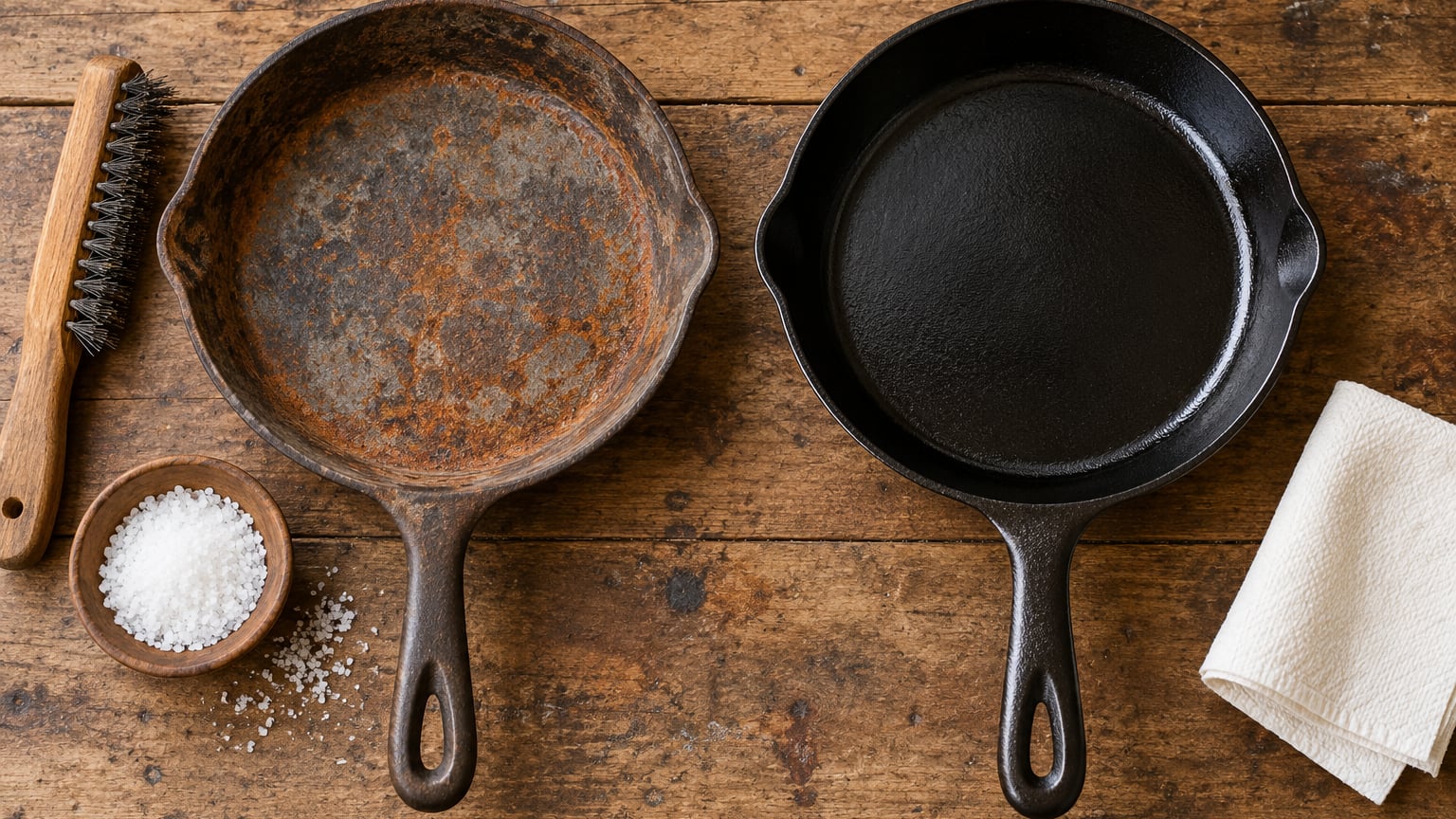
Rust on cast iron comes off with a short vinegar bath, a stiff scrub, and a hot oven dry. Most rusty skillets are worth saving, and the whole job takes about an hour including two or three thin seasoning layers. Here is how to remove rust from a cast iron skillet without stripping the pan more than you have to.
Two things decide how the job goes. How dry the pan is when you are done, and how thin the oil layer is that goes on before it heats. Get those right and the rust does not come back. Skip them and you can end up with a worse pan than you started with.
Table of Contents
- What You Need
- How to Remove Rust from a Cast Iron Skillet, Step by Step
- 1. Inspect the skillet and see how bad the rust is
- 2. Remove the loose rust from cast iron first
- 3. Use a vinegar bath for stubborn or heavy rust
- 4. Skip the steel wool on a fragile seasoning
- 5. Wash and dry the skillet completely
- 6. Apply a thin layer of seasoning oil
- 7. Heat and season the skillet
- 8. Keep it from rusting again
- Common Mistakes That Damage a Rusty Skillet
- Frequently Asked Questions
- Can you cook on a cast iron skillet that still has rust?
- Is baking soda safe for removing rust from cast iron?
- What is the best way to remove stubborn rust from cast iron?
- Should I use vinegar to remove rust from a cast iron skillet?
- How long should I bake a cast iron skillet after removing rust?
- How do I keep cast iron from rusting again?
- Conclusion
What You Need
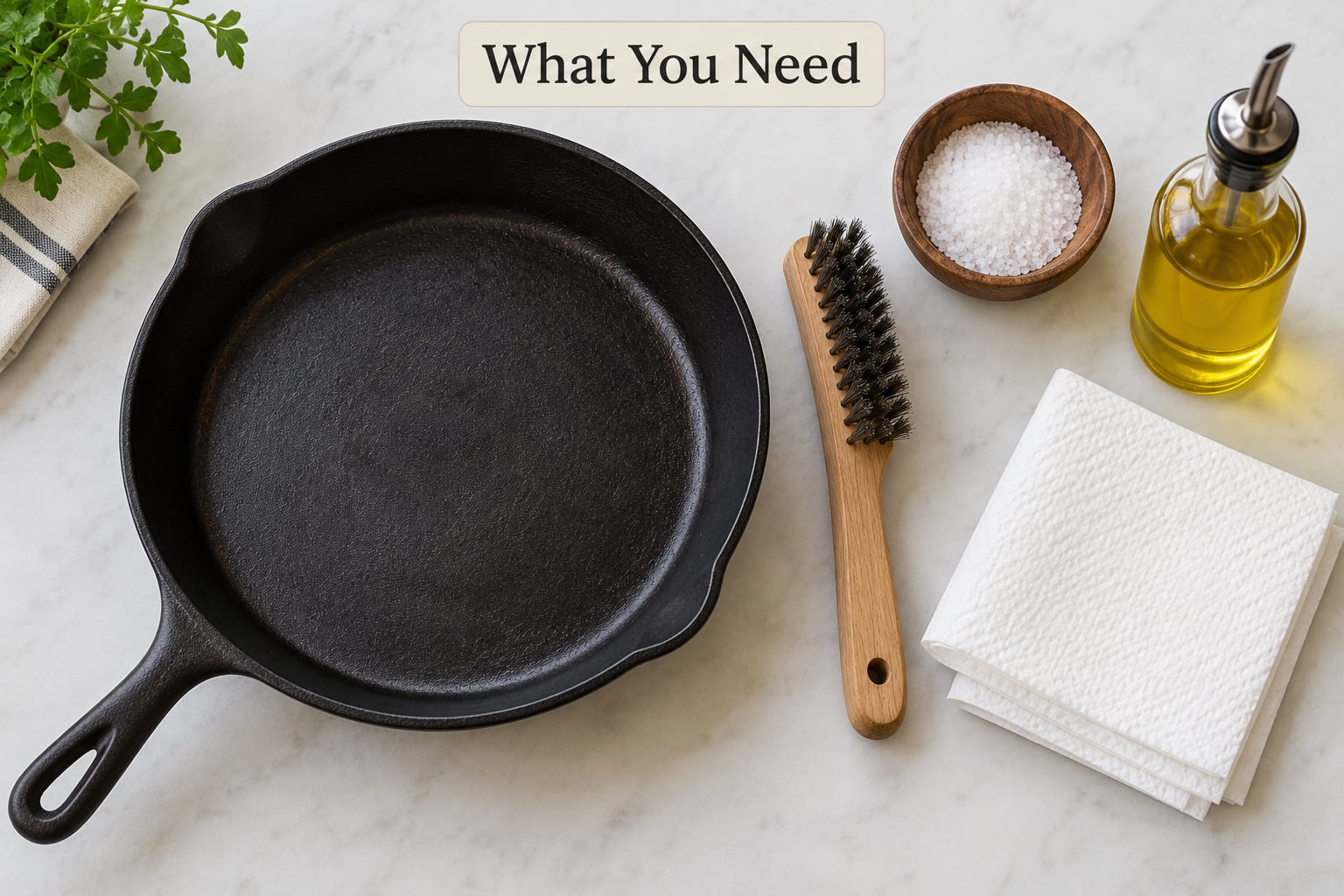
None of this is special equipment. Everything on the list is something most kitchens already have, plus one oil with a high smoke point.
- Stiff bristle brush or chainmail scrubber. The brush is the gentler option and enough for flaky surface rust. A chainmail scrubber, which looks like a loosely knit steel mesh ball, reaches into the pits of an older pan without taking the seasoning off everywhere. A stiff nylon-bristle brush is fine too.
- Coarse salt and a little oil, or a concentrated rust eraser. Salt makes a cheap paste for stubborn spots. A dedicated cast iron rust eraser, a pumice block loaded with soap, is faster on a yard-sale find.
- White vinegar. This is not optional. It dissolves the iron oxide so you are not scrubbing at rust that is chemically bonded to the metal.
- Hot water and a small amount of dish soap. A pan that has been through a decade of bacon is greasy, and grease holds on to rust.
- A high smoke point oil. Canola, grapeseed, avocado, or a dedicated seasoning oil all work. Olive oil is fine but burns at the temperature you want for seasoning, so it is not my pick for the oven.
- Paper towels or a lint-free cloth. For wiping the oil on and for drying before the pan heats.
- Heat source. A stovetop burner for drying, and an oven if you are seasoning indoors.
- Baking sheet. Catches the oil that drips when the pan sits upside down in the oven. A sheet of aluminum foil works the same way.
How to Remove Rust from a Cast Iron Skillet, Step by Step
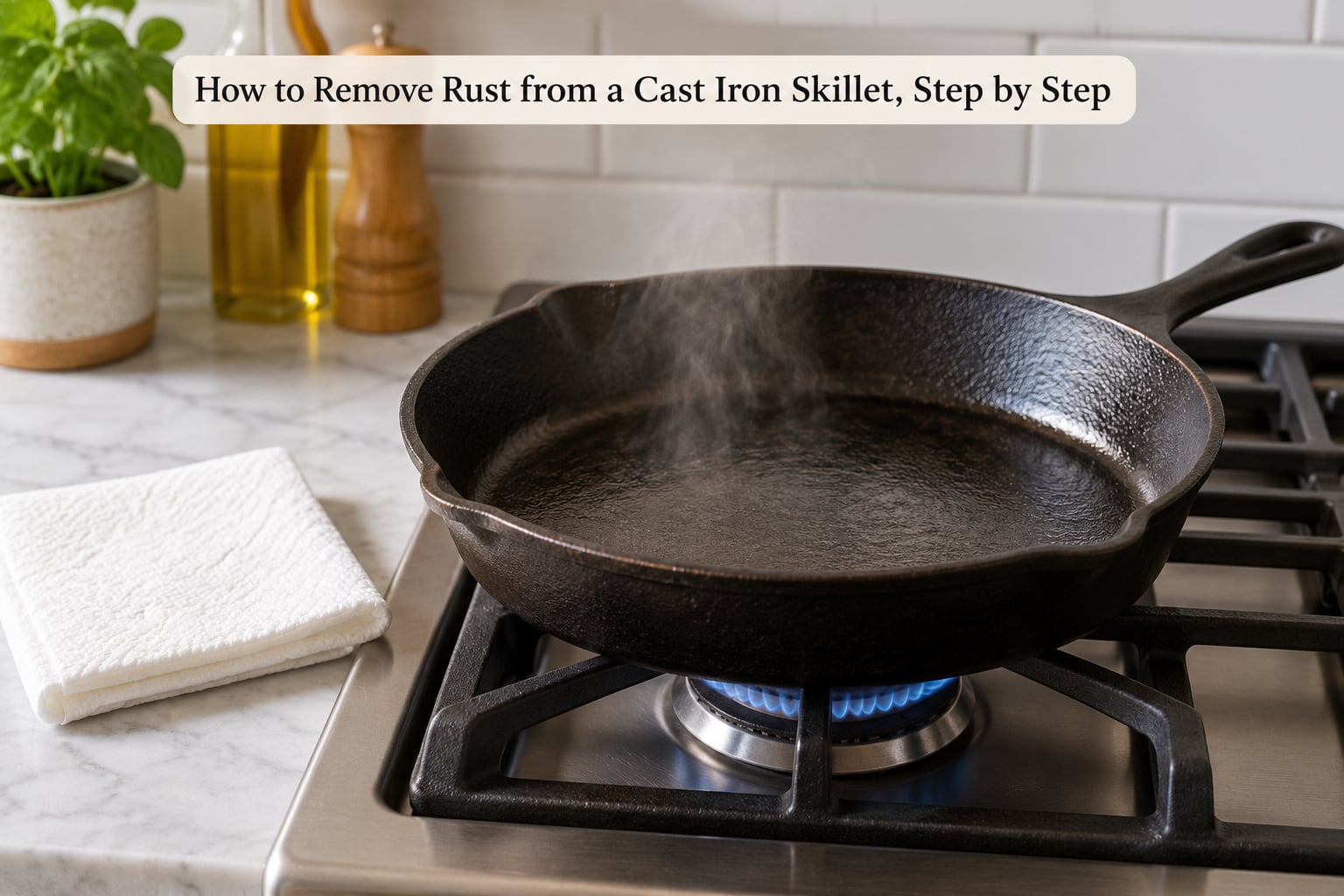
The whole process has three phases: take the rust off, get the pan bone dry, then lay down a new seasoning layer. Rushing the middle phase is what makes rust come back.
1. Inspect the skillet and see how bad the rust is
Surface rust is orange or reddish-brown, powdery or flaky, and it wipes or scrubs away. That is the good case, and most pans are in it.
Deep pitting looks different. You can feel small divots with a fingernail, and they stay put no matter how long you soak or scrub. Pitting corrosion eats into the iron permanently, though you can still cook on a pitted pan. A crack running through the pan, or iron flaking away in chunks, means stop and replace it.
2. Remove the loose rust from cast iron first
Take the pan outside or set it in the sink with a folded towel underneath, because rust dust is messy and it will stain a countertop.
- Loosen: Scrub the rusty areas with a stiff bristle brush or chainmail scrubber. Use short circular strokes and let the tool do the work rather than leaning on it.
- Watch what comes off: Stop as soon as the loose dust stops coming away. Everything that releases easily is surface rust, and what remains is bonded to the iron.
3. Use a vinegar bath for stubborn or heavy rust
Fill a container with an even mix of white vinegar and water, enough to cover the rusty spots. Set the pan in it for 30 minutes. An hour is fine for a badly rusted pan. Several hours is where you start causing damage, because the acid will etch the iron.
Rinse with plain water and scrub again while the metal is still wet. People who do this regularly will tell you the plain water rinse matters as much as the soak: it carries the acid away and stops the reaction. Then dry immediately. Do not set a soaking pan aside to think about.
For spots that survived the bath, make a paste of coarse salt and a few drops of oil and rub it in with a paper towel or your fingertips. The salt does the grinding, the oil keeps it from turning into paste grit. Wipe it off, then rinse.
4. Skip the steel wool on a fragile seasoning
Steel wool works well on bare, stripped metal, and it is overkill on a pan whose seasoning is still thin and patchy. It also scratches deeply enough to leave pits that catch moisture later. If your pan has seasoning left on it, a chainmail scrubber or a rust eraser removes the rust with far less collateral damage.
Skip bleach and oven cleaner entirely. Both leave a residue on the iron that has to come out before seasoning will bond, and neither is needed for ordinary surface rust.
5. Wash and dry the skillet completely
This is where most people lose the pan.
- Wash: Hot water, a drop of soap, and a sponge or brush. Five minutes of soaking in the sink is fine. Soaking overnight is not, because water sitting on iron is exactly how rust forms.
- Towel dry: Wipe it with a paper towel or cloth while it is still warm.
- Heat dry: Set it on a burner over low heat for two or three minutes until it is hot enough to evaporate the last of the moisture, or put it in a warm oven for 15 minutes. Bare iron that has been scrubbed clean will start picking up rust within hours if you put it away wet.
6. Apply a thin layer of seasoning oil
While the pan is still hot, pour a small amount of oil onto a paper towel and wipe it over the entire cooking surface, the sides, and the handle. Then wipe it again with a clean dry paper towel. What you want is the faintest sheen, the kind you can barely see. A puddle of oil bakes into a gummy, sticky patch that never cures.
7. Heat and season the skillet
Set the pan upside down on a baking sheet on a middle oven rack, with a foil or sheet underneath to catch drips. Heat the oven to 450 to 500 degrees F. Bake for one hour, then turn the oven off and let the pan cool inside it, with the door shut, so it cools slowly without a draft hitting hot bare metal.
Once you can touch it, run a thin second coat and repeat the hour. Two or three coats give you seasoning thick enough to block moisture. You can cook on it after the first layer if you are in a hurry, and top it up later.
A well-seasoned skillet feels slightly slick and evenly dark, and water beads up and rolls instead of soaking in. Dark brown, black, and grey are all normal seasoning colors. Uneven color is not a failed pan.
From here, treat the seasoning like paint on a car. Once you have your sear down, how to cook a steak in a cast iron skillet is worth a read, and if you want to compare the pan against stainless for searing, take a look at cast iron versus stainless steel for searing.
8. Keep it from rusting again
- Dry it every time. Warm water, soap, towel, two minutes on the burner. It becomes automatic after a week.
- Oil it thin, not wet. A light coat on the food surface after it cools is enough. Wipe off anything that beads up.
- Store it dry and uncovered. No lid, no plastic bag, no damp basement shelf. If you must stack pans, put a paper towel between them.
- Keep it out of the dishwasher. The detergent strips the seasoning, and the long wet cycle does the rest.
- Cook something fatty now and then. Regular use is the best maintenance there is.
Eggs are the one food that reliably strips seasoning, so if your pan lives on the breakfast stove, read how to clean a cast iron skillet after cooking eggs before you scrub it down.
Common Mistakes That Damage a Rusty Skillet
- Soaking it in the sink while you do other things. Cast iron can stand a five-minute wash soak. It cannot stand being wet for hours, and that is how a lightly rusted pan turns into a heavily rusted one.
- Using bleach or oven cleaner. Unnecessary, and the residue interferes with seasoning.
- Putting a scrubbed pan away wet. This is the single most common way people end up worse off than when they started. Flash rust, the fast orange oxidation that forms on clean wet iron, can appear within hours.
- Applying a heavy coat of oil. Thick oil bakes gummy and sticky. Thin, wiped twice, every time.
- Cooking on a pan with visible rust flakes. Light surface rust is mostly a taste and seasoning problem. Rust that is actively flaking into the pan is a sign to fix it before the next meal, and definitely before making something acidic like tomato sauce.
- Reading uneven color as failure. Blotchy brown, black, and grey seasoning is normal seasoning. You are looking for a continuous non-stick layer, not a uniform color.
- Vinegar baths with no timer. Thirty minutes to an hour is de-rusting. Several hours is etching the iron, and it leaves pitting you cannot undo.
- Scrubbing much harder than the rust requires. You will grind away good seasoning and rough up the surface, which then holds moisture. Do the vinegar bath first so the scrubbing has less to do.
Frequently Asked Questions
Can you cook on a cast iron skillet that still has rust?
Light surface rust is not a health emergency. Small amounts of iron oxide are not generally considered harmful, but rust tastes metallic, flakes into food, and keeps the seasoning from doing its job. Scrub the rust off, rinse, dry, and put a thin coat of oil on before cooking again. Skip it if the rust is heavy, flaky, or the food you are cooking is acidic.
Is baking soda safe for removing rust from cast iron?
Baking soda is gentler than vinegar and works as a mild abrasive when you make a paste with water and scrub it. It is a good choice for someone who does not want to soak cast iron in acid at all. Just remember the same rule as with any method: scrub, rinse, dry fully, and oil immediately. Baking soda will not strip a healthy seasoning layer the way steel wool can.
What is the best way to remove stubborn rust from cast iron?
Soak the rusty spots in a 50/50 mix of white vinegar and water for 30 minutes, then rinse with plain water and scrub while the metal is wet. A chainmail scrubber or stiff brush finishes what the acid loosened. Dry the pan over low heat immediately, then apply a very thin oil layer and bake at 450 to 500 degrees F for one hour. The drying and oiling matter as much as the scrubbing.
Should I use vinegar to remove rust from a cast iron skillet?
Vinegar is the standard tool for this job because acid dissolves iron oxide, so the rust releases instead of grinding off. Use straight white vinegar diluted with an equal part of water, soak 30 minutes to an hour, and rinse with plain water while you scrub. Do not go past a few hours. Long soaks attack the bare iron itself and can leave permanent etching and pitting.
How long should I bake a cast iron skillet after removing rust?
One hour at 450 to 500 degrees F is the standard bake, with the pan upside down on a baking sheet so oil drips away from the cooking surface. Then turn the oven off and let the pan cool inside with the door closed. Repeat once or twice more for a durable layer. One coat is enough to cook on, and extra coats take under an hour each.
How do I keep cast iron from rusting again?
Dry the pan after every use, then put a light coat of oil on while it is still slightly warm. Store it uncovered and away from damp spaces, never in the dishwasher, and do not let it sit wet in a sink. A thin paper towel between stacked pans helps in humid conditions. Regular cooking keeps the seasoning in good shape better than any storage trick.
Conclusion
Start by loosening the rust, not by scrubbing harder. Five minutes in a 50/50 vinegar and water bath, a chainmail scrubber or a salt paste, and a rinse in plain water will take care of most surface rust on a cast iron skillet.
Then do the part people skip: heat the pan dry, wipe on the thinnest coat of oil you can manage, and bake it upside down at 450 to 500 degrees F for an hour. Two or three thin coats, and that rusty skillet goes back on the stove instead of in the trash.