
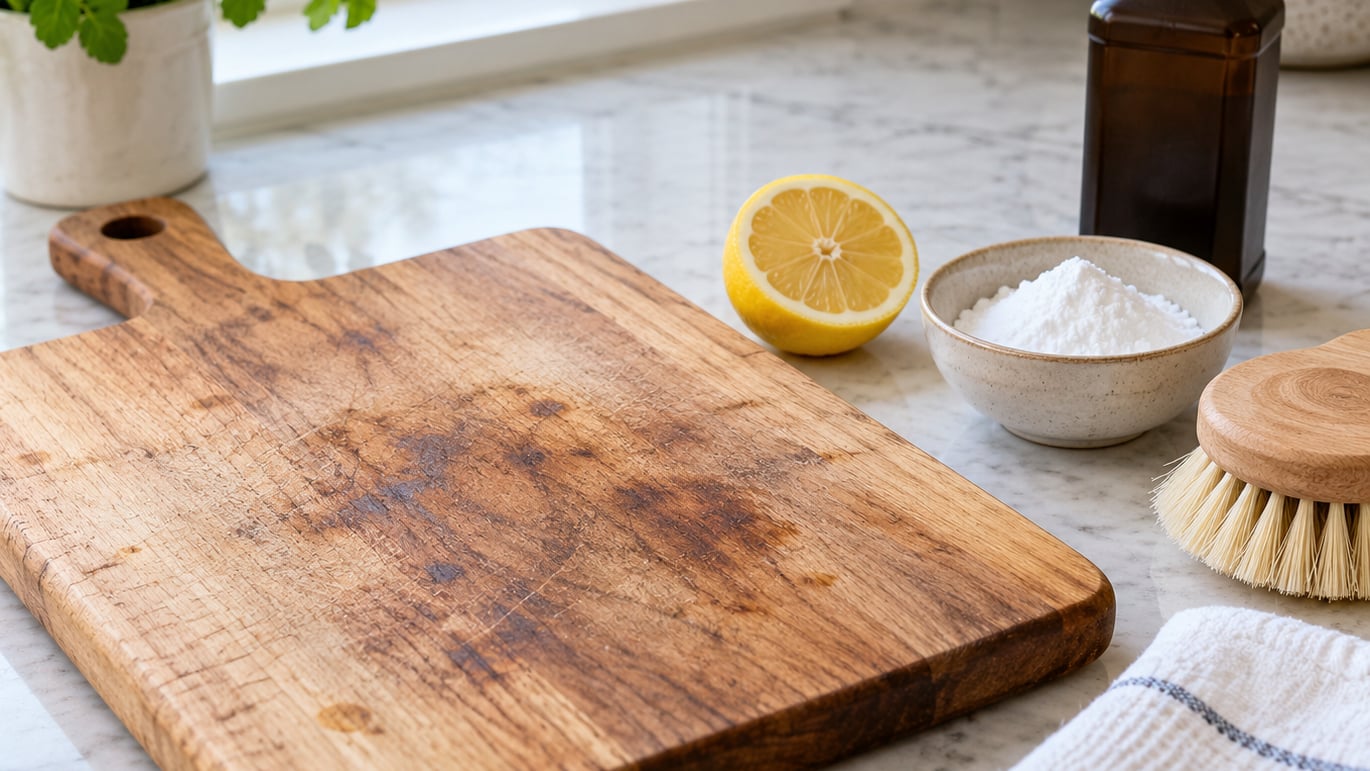
Stains on a cutting board come out with an acid plus a mild abrasive: scrub coarse salt and lemon juice over a wood board, or spread a hydrogen peroxide paste on plastic and let it sit. The method that works depends on what the board is made of, how deep the stain has settled, and whether you are dealing with pigment from food or with mold.
Most stains are cosmetic rather than dangerous. But a board with deep knife grooves, black speckling, or a smell that will not leave holds residue that soap alone will not remove, and that is worth knowing before you scrub anything.
Here is the process I use, the ratios I go by, and the mistakes that turn a stained board into a ruined one. Allow 15 minutes for a light stain, an hour if the board has been sitting stained for months.
What You Need
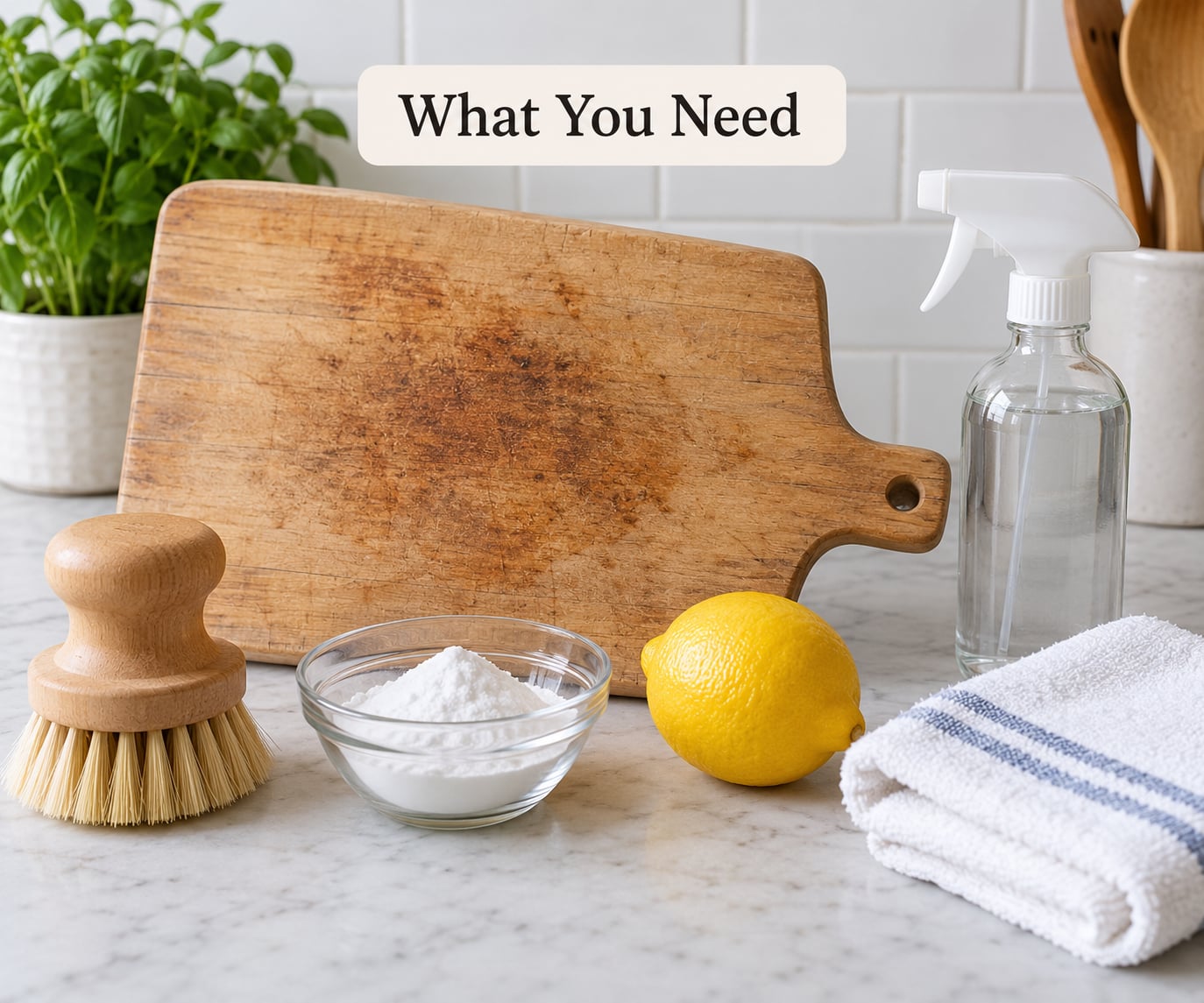
You do not need much, and you almost certainly have all of it already. Gather it before you start so you are not halfway through a treatment with no way to rinse.
- The board itself, and a clear idea of its material. Wood, bamboo, plastic, or glass behave very differently.
- Hot water and dish soap for the first wash. Every other treatment works better on a board that is already free of grease.
- A stiff nylon brush or a nonabrasive sponge. Steel wool and green scrubbers scratch wood permanently.
- Coarse salt and a lemon for the acid-and-abrasive treatment on wood.
- Baking soda for a gentle paste that works on every material.
Add the rest only if your stain needs it: a small dish of 3 percent hydrogen peroxide for stubborn pigment, white vinegar for odors, and a clean towel for drying. For a plastic board with black specks, keep unscented liquid chlorine bleach on hand. For wood, keep food-grade mineral oil nearby, because the board needs re-oiling once the stain is gone.
Step-by-Step
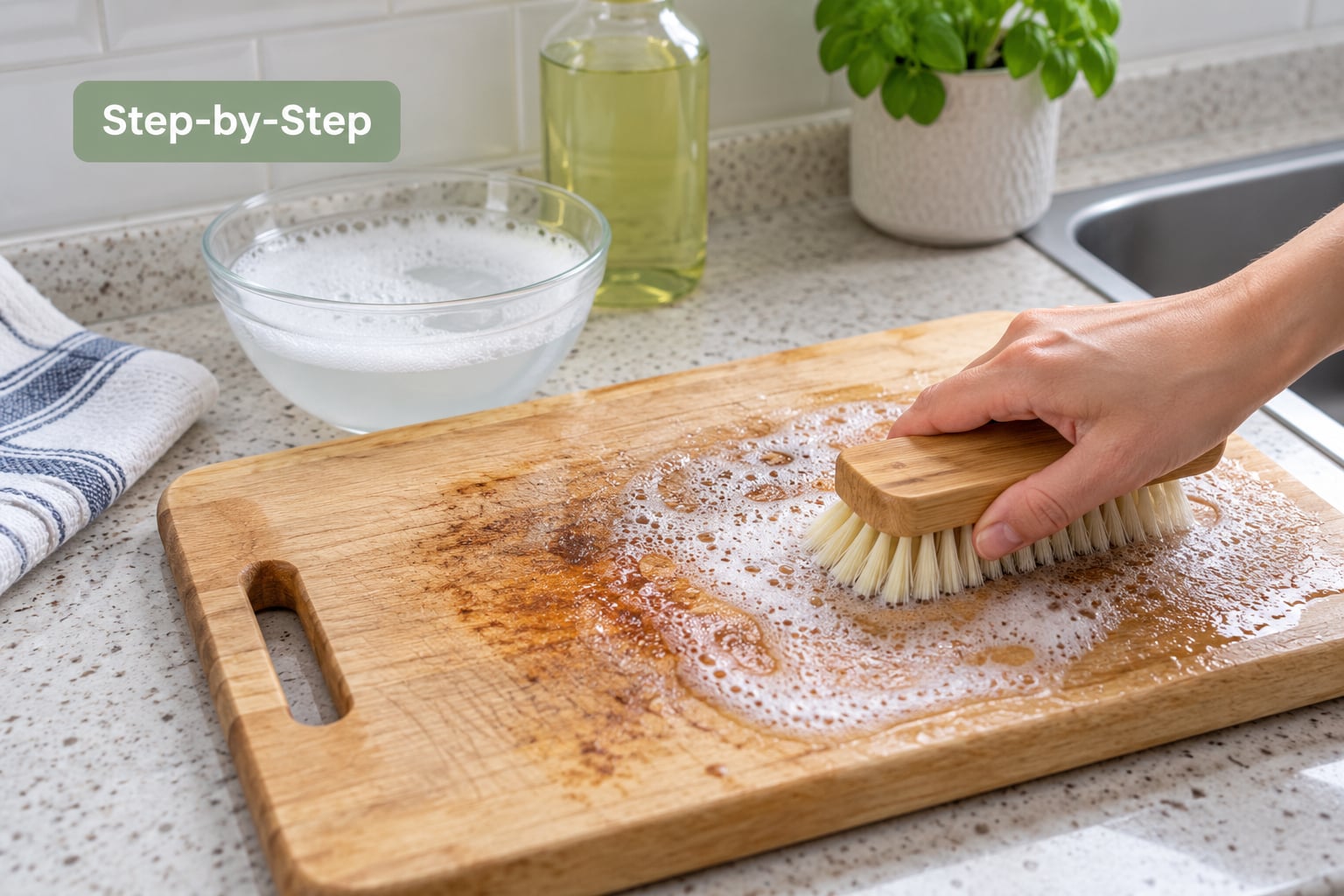
Identify the material first, wash the board, apply the treatment that matches it, scrub, rinse, and dry the board upright. That sequence works every time; only the treatment changes.
Step 1: Identify the material. Wood and bamboo are porous and can swell, crack, or warp with prolonged water. Plastic is nonporous and can take bleach and hot water. Glass tolerates abrasion but not acid, which etches the surface.
Step 2: Wash the board first. Scrub it with hot soapy water and rinse, then pat it dry. Grease and food residue block every treatment you could apply afterward, and you will think the stain refused to lift when it simply never reached the wood.
Step 3: Treat the stain. Choose the method below for your material and let it dwell for the stated time. Rushing the dwell time is the most common reason a home clean fails.
Step 4: Scrub and rinse. Work along the grain with a stiff brush, then rinse under hot running water until the water runs clear.
Step 5: Dry immediately and check. Stand the board upright on edge or in a dish rack, never flat on a counter while damp. Once it is fully dry, look at the stain again in good light. If what is left is dark, soft, or fuzzy rather than a flat discoloration, read the mold section before you use the board.
Wood care follows the same principle as scrubbing a skillet after eggs, which is covered in how to clean a cast iron skillet after cooking eggs: match the method to the surface, and dry it properly afterward.
How to Clean a Cutting Board with Stains on Wood
Coarse salt and lemon juice is the safest strong treatment for wood, and it is what most cooks reach for first. It works because the acid softens the pigment and the salt crystals do the scrubbing.
- Coarse salt scattered over the stain, then squeeze half a lemon and scrub in small circles for 60 to 90 seconds.
- A baking soda slurry of 2 tablespoons baking soda to 1 cup water, applied and left for 5 to 15 minutes before scrubbing. Good for surface stains and safe on anything.
- A hydrogen peroxide paste of 1 tablespoon 3 percent hydrogen peroxide mixed with 1 tablespoon baking soda, spread on the stain and left 10 to 15 minutes. This is the strongest home treatment for turmeric, red wine, and beet.
- Fine sandpaper for what is left. Start at 120 grit, step up to 150, then 220, skipping no numbers, and follow with two coats of food-grade mineral oil.
Rinse with hot water, stand the board upright, and let it dry fully before oiling. Raw wood drinks oil back in, which re-darkens whatever stain you just removed, so skip the oiling step and you will think the stain came back.
End grain boards stain faster than edge grain because the cut faces of the wood are more open and drink pigment straight in. Scrub across the block rather than along it, use less water, and expect to repeat treatment. If the block is commercial HDPE rather than wood, it responds to the plastic method below.
How to Clean a Cutting Board with Stains on Plastic
Plastic boards have no pores to seal, which means stains sit on the surface and can usually be scrubbed off completely. The method that finally works on a blotchy white board is bleach, and most people never try it properly.
- Boiling or very hot water with dish soap and a nonabrasive sponge for ordinary discoloration. Plastic tolerates heat far better than wood.
- A baking soda paste left 10 minutes, then scrubbed, for turmeric and onion stains.
- A 3 percent hydrogen peroxide soak of 10 to 15 minutes for ink, marker, and berry stains.
- For black specks, dilute unscented chlorine bleach at roughly 1 tablespoon per gallon of water, flood the board, and leave it 5 to 10 minutes before scrubbing and rinsing. Check the color on a spare plastic item first if you are unsure.
After working with raw chicken, beef, or pork, wash with hot soapy water, then sanitize with that same diluted bleach solution or a dishwasher sanitize cycle, following the contact time on your product. Rinse and air dry upright.
If black specks appeared before you ever used the board, they are usually factory residue or a mold that formed in the packaging. Scrubbing handles the residue; the mold section handles the rest.
How to Clean a Cutting Board with Stains on Bamboo
Bamboo is harder and less porous than hardwood, so it resists staining and also punishes rough treatment. Bamboo boards go wrong from too much water and too much heat, not from too little scrubbing.
- Warm rather than boiling water, with dish soap and a nonabrasive sponge. No soaking.
- A baking soda paste for discoloration, left 5 to 10 minutes and wiped rather than scrubbed hard.
- A diluted vinegar and water solution of 1 part vinegar to 4 parts water, for odors and light surface staining.
- Immediate drying, upright, before the board is put away.
Skip the dishwasher, the overnight soaks, and the peroxide paste. Bamboo laminates can delaminate, glue can loosen, and a board that swells at the edges no longer sits flat. Lemon and salt works on bamboo, but go gently.
Common Mistakes
Almost every ruined cutting board I have seen was damaged by one of four things, and none of them were the stain itself.
- Soaking wood or bamboo. Prolonged water exposure swells the fibers and causes warping and cracking. Clean it fast and dry it fast instead.
- Bleach on porous wood. Chlorine strips the surface and leaves pale blotches that never come back. Plastic and glass only.
- Scrubbing too hard. Aggressive pressure and steel wool gouge the surface, which makes the next stain deeper. Use a stiff nylon brush and let the chemistry do the work.
- Leaving the board flat and damp. Trapped moisture encourages mold and warps the board. Stand it up every time.
One safety point deserves its own emphasis: never mix bleach with vinegar, with ammonia-based glass cleaner, or with hydrogen peroxide. The first two combinations release a toxic gas, and bleach with vinegar simply cancels the sanitizing power while leaving you with a stinky sink and no clean surface. Use one agent per cleaning session, and rinse thoroughly between treatments.
Odor is a separate problem from staining. Garlic and onion smells sit in the pores of wood and transfer into food, so if you plan to bake cookies or cut a melon after chopping onions, dedicate a board to produce. Baking soda paste left on the surface for an hour, or a damp towel containing a squeezed lemon draped over the board, absorbs most smells before they set.
Frequently Asked Questions
What gets stains out of cutting boards?
Coarse salt scrubbed with lemon juice works on wood, a baking soda paste of 2 tablespoons to 1 cup of water works on every material, and a hydrogen peroxide paste handles the worst pigment on wood or plastic. Give each one 5 to 15 minutes to work, scrub with a stiff nylon brush, rinse under hot water, and dry the board upright.
Can I use vinegar to clean my cutting board?
Yes, diluted vinegar is one of the safest options. Mix 1 part white vinegar with 4 parts water, apply it, and let it sit for 5 to 10 minutes before rinsing. Vinegar kills odor-causing bacteria and light surface residue well. It is not a disinfectant, so after raw meat you still need hot soapy water plus a bleach dilution or sanitizer cycle.
Does hydrogen peroxide clean cutting boards?
Yes, and it is the strongest home treatment for deep pigment stains like turmeric, beet, and red wine. Mix 1 tablespoon of 3 percent hydrogen peroxide with 1 tablespoon of baking soda into a paste, spread it on the stain, and leave it for 10 to 15 minutes. Never combine peroxide with bleach, and do not leave it sitting longer than that on wood.
Is Dawn dish soap safe for wood cutting boards?
Yes. Standard dish soap, including Dawn, is fine for washing wood cutting boards, and the surfactant is what lifts grease. The problem is never the soap, it is the rinsing and drying. Rinse until the water runs clear with no suds, then stand the board upright. Any soap left behind will feed the odor and discoloration you are trying to remove.
How do I get the onion smell out of a wooden cutting board?
Baking soda is the reliable answer. Make a paste with water, spread it over the surface, leave it for an hour, then rinse and dry upright. For stubborn smells, drape a damp towel over the board with a squeezed lemon slice on top for several hours. If the smell survives that, the board has permanently absorbed it and needs sanding or replacing.
When should I throw out a wooden cutting board?
Throw it out when it cannot be cleaned rather than when it looks dirty. Replace a board with cracks that go through the grain, deep knife grooves you cannot scrub, a warped surface that will not sit flat, dark fuzzy mold that returns after treatment, or a smell that persists through sanding. Cosmetic discoloration alone is not a reason to retire a board.
Keep Your Cutting Board Clean and Usable
Start tonight with the simplest thing that could work: hot soapy water, a stiff brush, and a rinse, then stand the board on its edge to dry. Most stains lighten or disappear with that alone, and you will know whether the light marks left behind are cosmetic or something deeper.
After that, the routine matters more than any treatment. Wash and dry the board upright after every use, give it a baking soda scrub once a week, and oil wooden boards when the surface looks dry or pale, usually every few months. A board that dries fast and gets oiled does not develop the deep discoloration that sends people searching for a way to save it in the first place.
Replace a board when it has cracks through the grain, grooves too deep to scrub, a smell that survives a sanding, or a surface that will not sit flat. Dark patches that stay put after a treatment are usually just pigment, and those boards keep working fine.
When you are shopping for a replacement, pick the material around how you actually cook: plastic for raw meat and busy nights, wood for produce and serving, and a second board for garlic and onions. Our guide to how to grocery shop with a meal plan covers the prep side of that setup.