
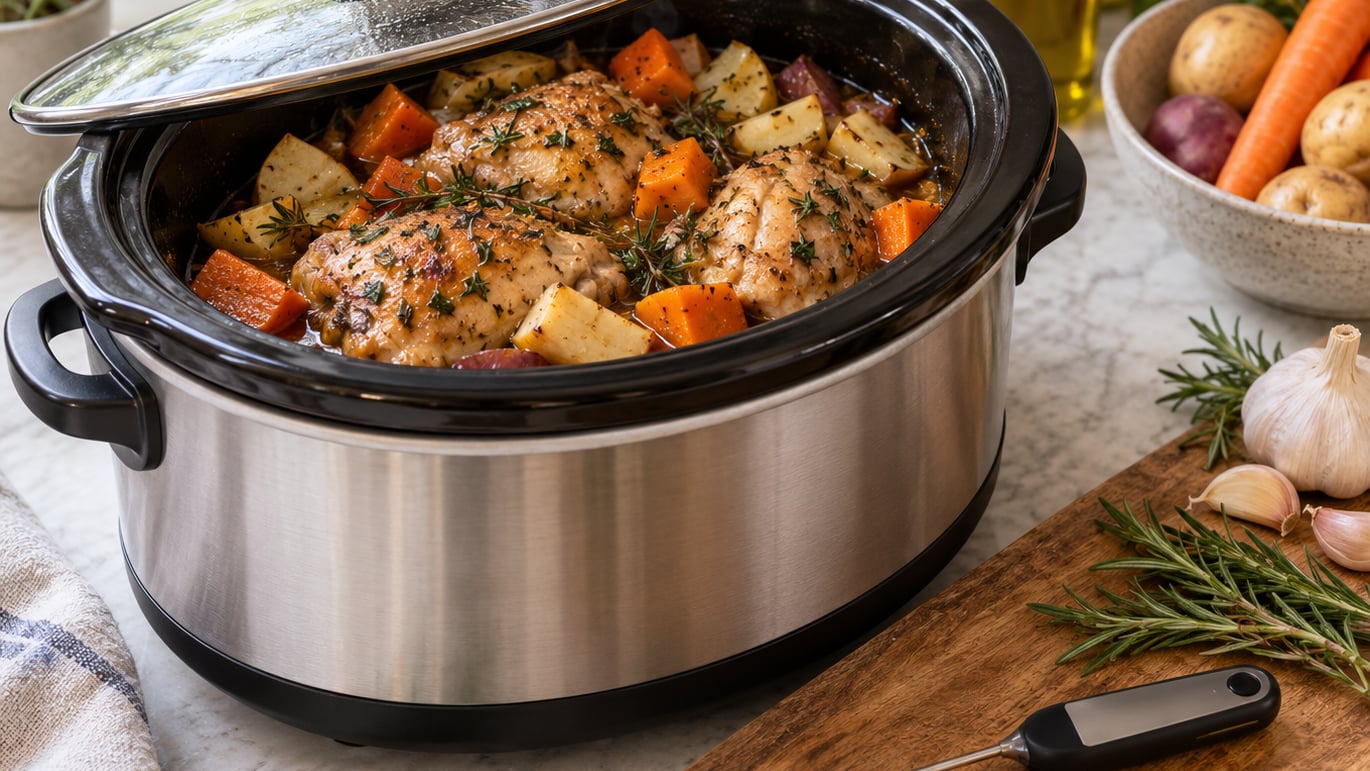
Most slow cooker overcooking comes down to three things: too much time for the cut you chose, too much liquid, or a pot that stayed on heat for hours after the food was done. Learn how to use a slow cooker without overcooking by controlling heat, liquid, layering, and timing, and you get meat that pulls apart with a fork instead of turning chalky. Most of this takes less than ten minutes of setup, but the thermometer you use afterward is what decides whether dinner works.
Here is the honest version: a slow cooker is a warm oven with a tight lid, not a magic pot. It will hold food in a moist heat for a long time, and it will happily turn a beautiful chicken breast into something you’d rather not eat. Treat time as a range, not a promise, and check early.
What You Need Before You Start
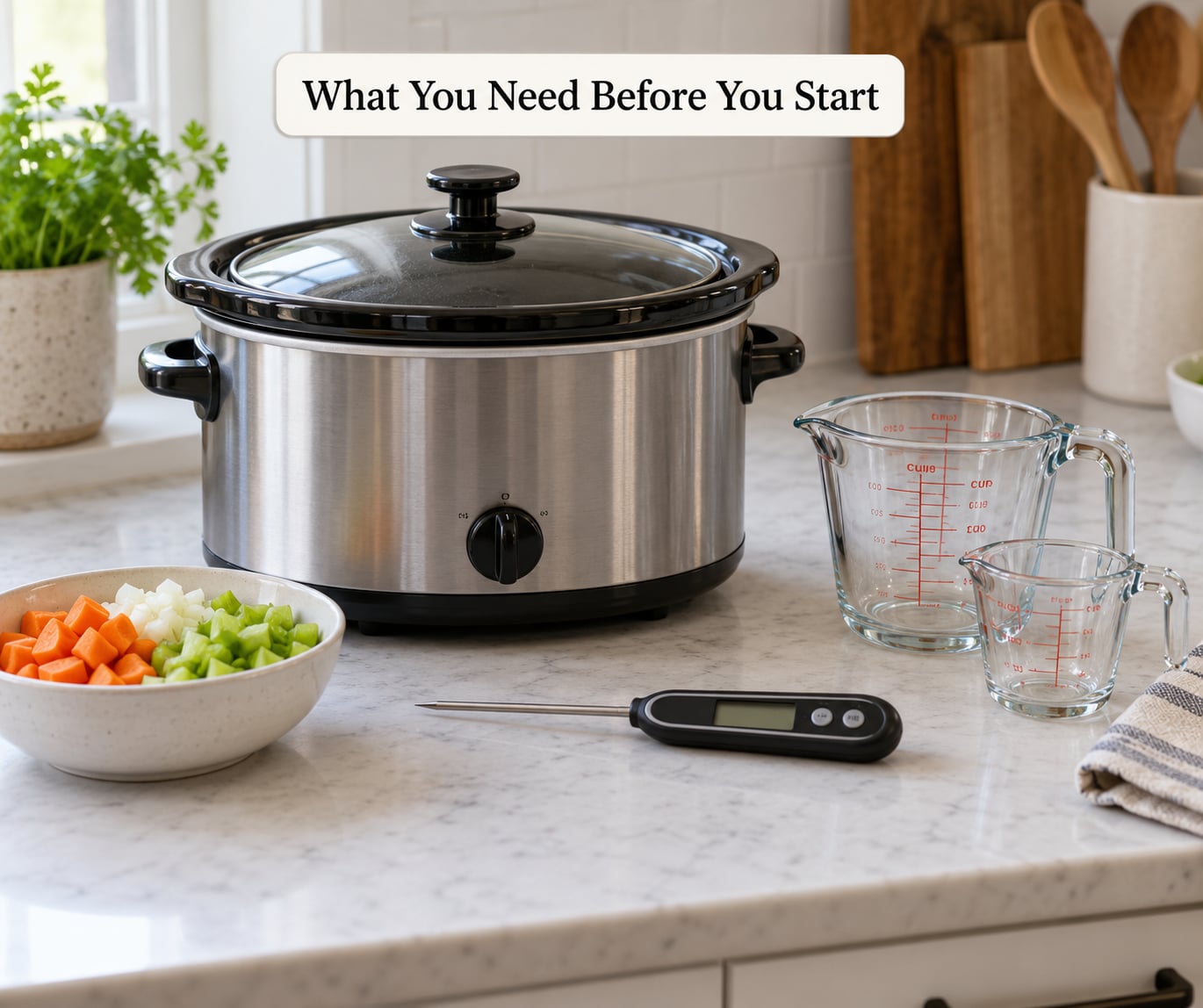
The gear list is short. Most people already own everything except the thermometer, and that one item changes dinner more than any other trick in this guide.
- An instant-read thermometer. A cheap one works. It is the only reliable way to know when a chicken thigh or a pork shoulder is actually done rather than guessing from the clock.
- A slow cooker with a glass lid and a working seal. Steam escapes through a cracked or wrong-fitting lid, and that escaping moisture is what dries out your food.
- A skillet for searing. Browning takes eight minutes and adds a layer of flavor that the slow cooker cannot create on its own.
- Measuring cups and a kitchen scale. Liquid is the number one cause of watery sauces and dry meat, and it is nearly impossible to eyeball.
- A recipe with a time range, not a single time. A stated time of 6 to 8 hours tells you to start checking at 5.
How to Use a Slow Cooker Without Overcooking: Step by Step
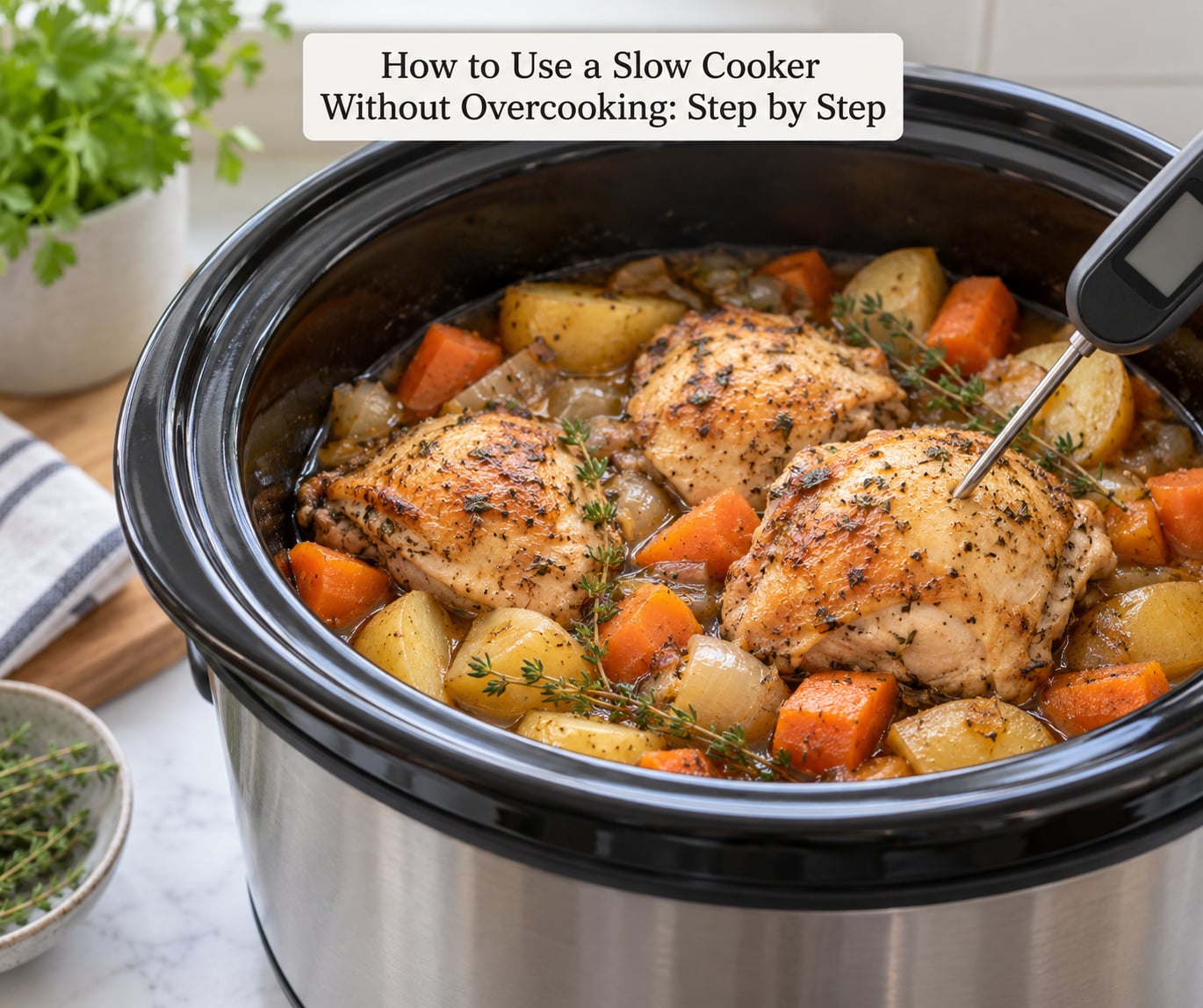
Work through these seven steps in order and you will keep the slow cooker on low, at the right fill level, and on a timer that switches itself off before anything turns dry.
Pick the right cut and the right size
Collagen is what turns over hours into tenderness. Lean cuts like chicken breast and pork loin have very little of it, so they tolerate slow cooking badly. Choose chicken thighs over breasts, and pork shoulder or beef chuck over loin and tenderloin.
Size matters just as much. Keep the pot between half and two-thirds full. Too full and heat cannot move around the food, so the center cooks unevenly while the edges dry out. Too empty and the liquid reduces too fast. If your recipe makes more than the pot can hold properly, cook two batches.
Brown the meat first
Sear each side in a hot skillet for a couple of minutes until you see color, then transfer it to the pot. This is not about flavor alone. A seared surface holds moisture in, and unseared meat slowly bleeds juices into the cooking liquid, which is part of why slow cooker meat so often ends up dry and its sauce watery at the same time.
Get the liquid amount right
A sealed lid traps steam, so most recipes written for a stovetop pot ask for far more liquid than a slow cooker needs. As a starting point, use about one cup of liquid for a four to six pound batch of meat, and half a cup for one to two pounds. If you are using a jarred sauce, cut the added liquid by a third. If you are using a packet mix, use about a third less water than the box says.
Meat should sit partly submerged, not floating. Vegetables can go on top and steam in the moisture rising from below.
Layer ingredients in the right order
Bottom layer gets dense items that need the most cooking: meat, root vegetables, dried beans, lentils. Middle layer gets harder vegetables like potatoes and carrots. Top layer gets anything delicate: zucchini, peppers, mushrooms, spinach, dairy, and most fresh herbs. Dried herbs and spices go in at the start, fresh ones in the last half hour.
This single habit prevents more mush than anything else on this list. A head of broccoli added at the start of an eight hour cook is a head of gray sludge by dinner, no matter what the recipe says.
Choose LOW whenever you can
LOW runs about 175 to 200 degrees Fahrenheit, HIGH runs about 250 to 300, and WARM sits near 165. Four hours on HIGH is not the same as eight hours on LOW. HIGH brings liquid to a boil, cooks the outside of larger cuts aggressively, and then sits there for the rest of the cook doing damage while the center catches up.
Use HIGH only to get through a cold start or a defrosted frozen roast. Once the pot has been at a steady simmer for an hour, drop to LOW. Forum cooks on r/slowcooking describe the same thing from the other side: undercooked tough cuts get blamed on overcooking, and most chuck roasts and briskets need eight to ten hours or more at LOW to break down properly.
Set the timer so the pot stops itself
This is where a programmable slow cooker earns its counter space. Program the cook to end, and let it switch to WARM. Leaving a finished roast on WARM overnight is a habit that shows up constantly in slow cooking forums, and the result is always the same: a dry, leathery piece of meat that had to be thrown out.
WARM is a holding temperature, not a cooking temperature. It keeps food above the danger zone of 40 to 140 degrees for a few hours, and that is all it is meant to do. If you want to serve dinner three hours late, turn the dial to OFF and reheat in a pan when you are ready. There is more on that in how to reheat leftovers without drying them out.
Start checking early with a thermometer
Every time estimate in every recipe is a guess based on an average pot and an average cut. Yours is faster or slower. Begin checking earlier than feels sensible and stop as soon as the food is tender, because everything past that point is a slow slide into overcooked.
For most chicken, the safe internal temperature is 165 degrees Fahrenheit, and users on r/slowcooking commonly report checking boneless chicken at the three hour mark because it can be dry by four and a half. Warm the pot on LOW or switch to WARM and probe the thickest piece.
| Food | Time on LOW | Time on HIGH | Overcook risk |
|---|---|---|---|
| Chicken thighs, bone in | 4 to 5 hours | 2 to 3 hours | Low |
| Chicken breast, boneless | 3 to 4 hours | 2 to 2.5 hours | High |
| Pork shoulder | 8 to 10 hours | 5 to 6 hours | Low |
| Beef chuck roast | 8 to 10 hours | 5 to 6 hours | Low |
| Whole chicken | 6 to 7 hours | 4 hours | Medium |
| Ground beef | 4 to 5 hours | 2.5 to 3 hours | Medium |
| Fish or shrimp | 2 to 3 hours | 1 to 1.5 hours | Very high |
Treat these as starting points, not rules. A stuffed chicken cooks faster than a plain one, and a frozen roast thaws at its own pace inside the pot.
Common Mistakes That Cause Overcooking
Almost every overcooked slow cooker meal traces back to one of a handful of habits. Here is each mistake, why it happens, and what to do instead.
Leaving it on WARM for hours
WARM holds food, it does not cook it, but moisture keeps escaping for as long as the lid is off or the food sits. Most overnight-dry-roast stories in the slow cooking community come from this habit. Program the cook to end, or switch to OFF once the food is tender.
Stirring and lifting the lid
Every peek drops the temperature and lets moisture out. People lift the lid to check, see a watery surface, and stir, then extend the cook time. The result is meat that needed eight hours and takes eleven.
There is a better way to check. Listen. A pot at a gentle simmer makes a near-continuous quiet bubbling, while a pot that is merely holding will sound occasional and hollow. Look through the glass lid at condensation, and note how the food sits: chicken thighs slump when done, and a whole cut that slides easily off the bone has gone past ready. Then probe once with the thermometer. If you do need to open it, add a few minutes of cook time afterward.
Using too much liquid
Overfilling is the most cited error among the guides we studied, and reducing liquid is the fastest fix for a thin sauce. A watery stew means the liquid never reduces enough, and meat sitting in that much liquid spends the whole cook gently poached instead of braised.
Adding delicate ingredients too early
Vegetables that need under an hour of cooking go in late, with dairy in the last 30 minutes. Spinach, zucchini, peppers, mushrooms, and fresh herbs are the usual casualties.
Filling the pot too high
Go past two-thirds full and the middle of the pot lags behind the edges. The outside overcooks while the center catches up, and you get a piece of food that is dry and undercooked at the same time.
Cooking frozen meat
Frozen meat spends a long time in the danger zone as the pot warms, and it releases a lot of extra water as it thaws, which is a direct route to a watery sauce. Thaw in the refrigerator overnight instead.
Tough beef mistaken for overcooked beef
This one runs the other way, and it causes a lot of confusion. If a chuck roast is chewy after six hours, it was undercooked, not overcooked. Tough cuts need eight to ten hours or more, and pulling them at the time printed in an old family recipe is why people think their slow cooker is broken.
One related question comes up in the same forum threads: do you lock a slow cooker when cooking? No. The lid locks on some models only to keep it in place during transport. Leave it sealed while cooking and never try to force the latch on the counter.
Rescuing food that is already overcooked
Overcooked does not always mean wasted. The fix depends on what went wrong with the food.
| Problem | What it looks like | Rescue |
|---|---|---|
| Dry meat | Shredded, stringy, chalky chicken | Shred it and stir it back into the sauce with a splash of liquid, or use it as filling for tacos or a pot pie |
| Dry roast | Leathery edges, tough fibers | Slice thin across the grain and simmer in sauce or stock until it softens |
| Thin sauce | Watery, no body | Simmer uncovered, or stir in a cornstarch slurry, gravy granules, or a spoonful of tomato puree |
| Mushy vegetables | Gray, falling apart | Drain well and fold into rice, grain bowls, or a hash, or blend into soup |
| Overcooked meat in a stew | Falling apart but flavorful | Let it be. Pull the meat out at shredding time and add it back in the last 20 minutes |
A few habits make the rest of the week easier. Slow cookers reheat food slowly and unevenly, so a dish that needed eight hours and then sat in the pot for two more will be disappointing on day two. Reheat covered on LOW for 30 to 45 minutes with a splash of liquid, and check before the clock says you should. For a slice of steak or a leftover roast, a quick sear in a hot pan beats a microwave every time, and our guide to how to reheat steak without overcooking it covers the timing for that.
Food safety numbers to keep close
Overcooking is a quality problem. Cooking temperature is a safety problem, and the two are not the same thing. Following USDA guidance, whole cuts of beef, pork, lamb, and fish reach 145 degrees Fahrenheit, ground meat reaches 160, and poultry reaches 165. Keep food above 140 while it sits waiting to cook, and refrigerate within two hours of finishing.
One setting note matters here. The USDA advises against using a slow cooker to reheat food, because a large casserole may spend a long time sitting in the danger zone before the center gets hot. Reheat on the stove or in the microwave instead, then move it back to the warm pot if you need to hold it.
Frequently Asked Questions
Is it possible to overcook in a slow cooker?
Yes. A slow cooker is a moist oven, not a magic pot, and anything can go past tender into dry. Chicken breast, pork loin, fish, and delicate vegetables are the usual casualties. Leave the lid closed, use LOW, set a timer that switches the pot to WARM, and start checking with a thermometer earlier than the recipe suggests.
Is 4 hours on high the same as 8 hours on low?
No. HIGH runs about 250 to 300 degrees Fahrenheit and LOW runs about 175 to 200, so HIGH cooks the outside of a large cut aggressively long before the center is done. Many cooks get the best results by starting on HIGH for an hour to bring everything up to temperature, then dropping to LOW for the rest of the cook.
Is 12 hours too long in a slow cooker?
It depends on the cut. Pork shoulder and beef chuck genuinely need 8 to 10 hours or more on LOW, so 12 is fine if the fat and collagen are still breaking down. Chicken breast at 12 hours is ruined. When in doubt, check the food and pull it the moment it is tender rather than following a number to the end.
Why is my beef still tough after 6 hours?
It is almost certainly undercooked rather than overcooked. Tough cuts are full of collagen that needs sustained moist heat to turn into gelatin, and most chuck roasts and briskets want 8 to 10 hours on LOW. Check that the pot was actually at a steady simmer, that you used enough liquid, and that the cut was no larger than about 3 inches thick.
How much liquid should I use when slow cooking beef?
Start with about one cup for a 4 to 6 pound batch of beef and about half a cup for 1 to 2 pounds. A sealed lid traps far more moisture than a stovetop pot, so most traditional recipes ask for too much. The meat should be partly submerged, and it should not float.
How long can a slow cooker sit on warm safely?
WARM holds food above the danger zone of 40 to 140 degrees Fahrenheit for a few hours, which is what it is designed for. It is not a cooking temperature and it will not improve food over time, and hours of holding let moisture escape. Plan on three to four hours as a practical limit, and switch the pot to OFF if dinner is further away than that.
The Bottom Line
Start with the fix that costs nothing tonight: set your slow cooker to switch itself to WARM, and check the food an hour earlier than the recipe says. From there, keep the pot between half and two-thirds full, use less liquid than the recipe lists, and put your delicate vegetables in at the end. Those four habits solve most overcooked slow cooker meals, and the thermometer takes care of the rest. If you are planning a bigger meal around the same pot, our guide to cooking brunch for a crowd without stress covers the same timing logic at a larger scale.