
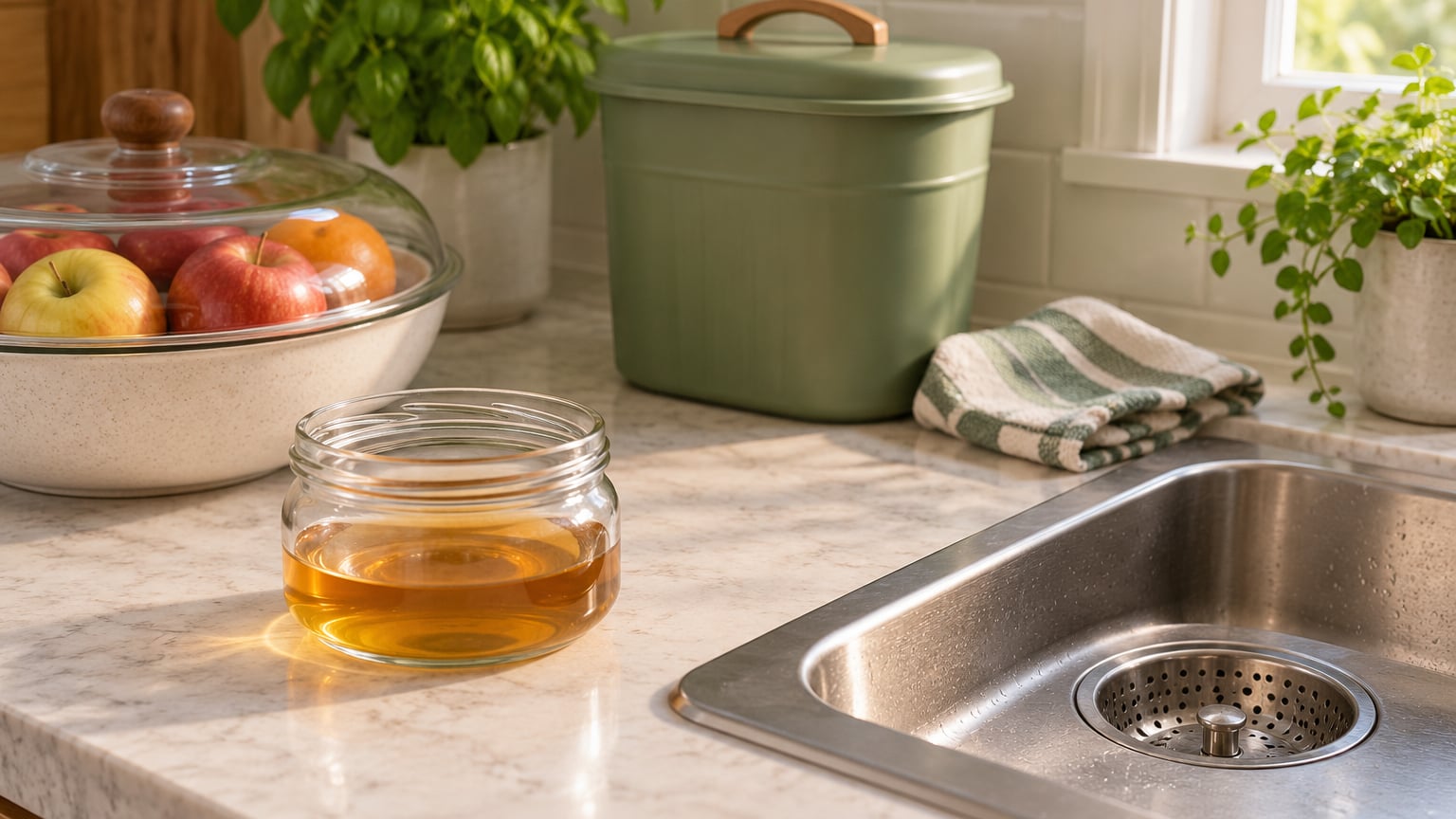
Fruit flies die fast when you cut off their food and breeding sites, and the fastest way to get rid of fruit flies in the kitchen is to remove the source first and trap what is left. Set out a shallow dish of apple cider vinegar with a single drop of dish soap, empty the trash, scrub the sink and garbage disposal, and refrigerate or cover every piece of ripe fruit. Expect two to four weeks to be fly-free, mostly because of the week or two of eggs already laid.
That timeline surprises people. A single female can lay up to 500 eggs, and those eggs can sit inside a drain baffle or under a garbage disposal gasket and survive a cleaning. They hatch roughly a week to two later, so an infestation that looked solved on day three often looks identical on day twelve. The plan below is built to break that cycle instead of chasing individual flies.
Table of Contents
- What You Need
- How to Get Rid of Fruit Flies in the Kitchen: Step-by-Step
- Frequently Asked Questions
- Why is my kitchen suddenly full of fruit flies?
- How long does it take to fully get rid of fruit flies in a kitchen?
- Are these fruit flies or drain flies?
- Can I use white vinegar instead of apple cider vinegar?
- How do I get rid of fruit flies in my sink drain and garbage disposal?
- Are fruit flies harmful to the food in my kitchen?
- Conclusion
What You Need
Nothing exotic. Gather the basics first so you are not improvising at 9 p.m. with an empty jar and a lemon.
- A shallow dish, small bowl or clear jar for the vinegar trap. A wide shallow surface catches more flies than a tall glass because flies hover first and land second.
- Apple cider vinegar, or plain white vinegar if that is all you have. Both work; the flavor matters more than the acidity.
- Dish soap, any kind. One drop is enough. The surfactant is what breaks surface tension.
- A lid or plastic wrap with a few small holes so the trap keeps its smell but not its smell everywhere.
- Sealed trash bags and a compost pail with a tight lid if your kitchen has one.
- A sponge, an old toothbrush and a bottle brush for the disposal gasket, the sink overflow hole and the P-trap.
- A paper funnel or a plastic wrap sheet for the jar-and-funnel trap build.
- Optional: a paper or plastic cup, a piece of bread, an overripe banana peel, and a commercial sticky trap or plug-in light trap if you want something set-and-forget.
The order matters more than the gear. You can only clean, contain and monitor the kitchen effectively if you can reach the trash, the disposal and the back of the sink cabinet in the same session.
How to Get Rid of Fruit Flies in the Kitchen: Step-by-Step
How to get rid of fruit flies at the source
Start by finding out what is actually breeding, because the fruit bowl is only the most obvious suspect. Work this checklist in order and you will usually find the culprit within fifteen minutes.
- Fruit bowl and counter produce. Move anything ripe into the fridge. Peaches, bananas, plums and tomatoes are the usual offenders, and one bruised banana under a bowl is enough to start a family.
- The crisper drawer. Inspect produce you forgot about, especially soft vegetables and anything sitting in a pooled liquid in the bottom of the drawer.
- Sink drains. Look down the drain with a flashlight. Thin brown or gray film on the walls means organic residue, which is both food and a wet breeding surface.
- The garbage disposal, especially the rubber gasket. Food hides in the fold where the disposal flange meets the sink, and you will not see it from above.
- The P-trap under the sink. Unscrew the U-shaped trap slowly over a bucket. If the water inside is cloudy or smells sour, that is a live nursery.
- The garbage can and its rim. A thin ring of dried liquid on the inside wall of the bin works as well as a pile of food scraps.
- Recycling. Rinse bottles, jars and cans before they go in the bin. Sweet residue on an unrecycled container is a nursery that follows you around.
- Compost pail. Even a small one under the sink collects enough moisture to support them. If you compost in an apartment, see our guide to composting kitchen scraps in an apartment for ways to keep the pail from becoming a fly incubator.
- Wine, beer or a forgotten glass. A quarter inch of flat red wine on the counter is a five-star restaurant for a fruit fly.
- Drains in the bathroom and laundry room. If flies appear away from the kitchen, that is a clue, not a coincidence.
Before you treat anything, confirm you have the right pest, because the fix for drain flies is completely different from the fix for fruit flies.
| Pest | How to spot it | Where it breeds |
|---|---|---|
| Fruit fly | About 3 mm, amber or dark, hovering in bursts then dropping onto fruit or the rim of a bowl | Ripe or fermenting produce, trash, compost, a sink overflow |
| Drain fly | Slightly larger, moth-like, weak fluttery flight, rests on walls near the sink | Slime film in the drain, P-trap, garbage disposal, overflow holes |
| Fungus gnat | Slender, dark, with a dangling abdomen, flies up from potting soil | Overwet houseplant soil |
| Phorid fly | Small, dark, fast, hunches and runs on surfaces before taking off | Drains, decayed organic matter, often sewage lines |
If the flies rest on the wall beside your sink and pop out of the drain when you run water, you are dealing with drain flies, and weekly drain treatment is the entire fix. A vinegar bowl trap will not touch them. Plenty of homeowners have learned this the expensive way.
Clean the areas where fruit flies gather
Hot water and dish soap, not a heavy spray bottle of perfumed cleaner. Fruit flies are drawn to fermenting sugar, and scented aerosols add a competing smell without removing anything.
- Counters and the stovetop. Wipe with hot soapy water, then dry. Sugar films are nearly invisible and stick to bare hands and warm surfaces for days.
- Fruit bowls. Wash the bowl itself in hot soapy water. A rinsed-but-greasy ceramic bowl is a recurring source.
- Dishwasher. Pull out the bottom rack and wipe the door gasket and the filter area. Leftover rice and sauce in that fold is common and forgotten.
- Sink and backsplash. Scrub the basin, the drain stopper and the overflow hole, then dry the metal around them.
- Garbage can. Take the bin outside, scrub the inside walls and the rim, dry it, and line it with a new bag.
- Compost pail and the cabinet floor under it. Wipe both, and check the cabinet wall for a sticky bloom of condensation and crumbs.
- Floors around the sink and the stove. Sugar falls and stays.
Drying is the step people skip. A wet, soapy film keeps the surface attractive to the same females that were already in the room, so scrub and then dry with a towel rather than leaving the surface to air-damp.
For the drain and garbage disposal, do this once a day for a week, then weekly for several weeks. Switch off the disposal, lift the rubber gasket out of the collar, scrape the trapped food out of the fold with an old toothbrush, plug the drain, fill the basin with soapy water, and run the disposal for a few seconds to flush the loosened residue.
That gasket step is what actually ends a disposal infestation, and it is the one most people skip. It comes up again and again on cleaning forums for good reason.
Then flush the kitchen drain itself with very hot water for a full minute, and clean the P-trap if you have not done it in months.
Use a bait or trap after removing the food sources
Traps work best once the fruit is in the fridge, because a bowl of vinegar competing with a banana bowl is a losing proposition. Build the trap after the cleanup, not before. A lot of people want to know how to get rid of fruit flies in the kitchen overnight, and the honest answer is that a trap only handles the adults you can see while the real work happens in the drain and the trash.
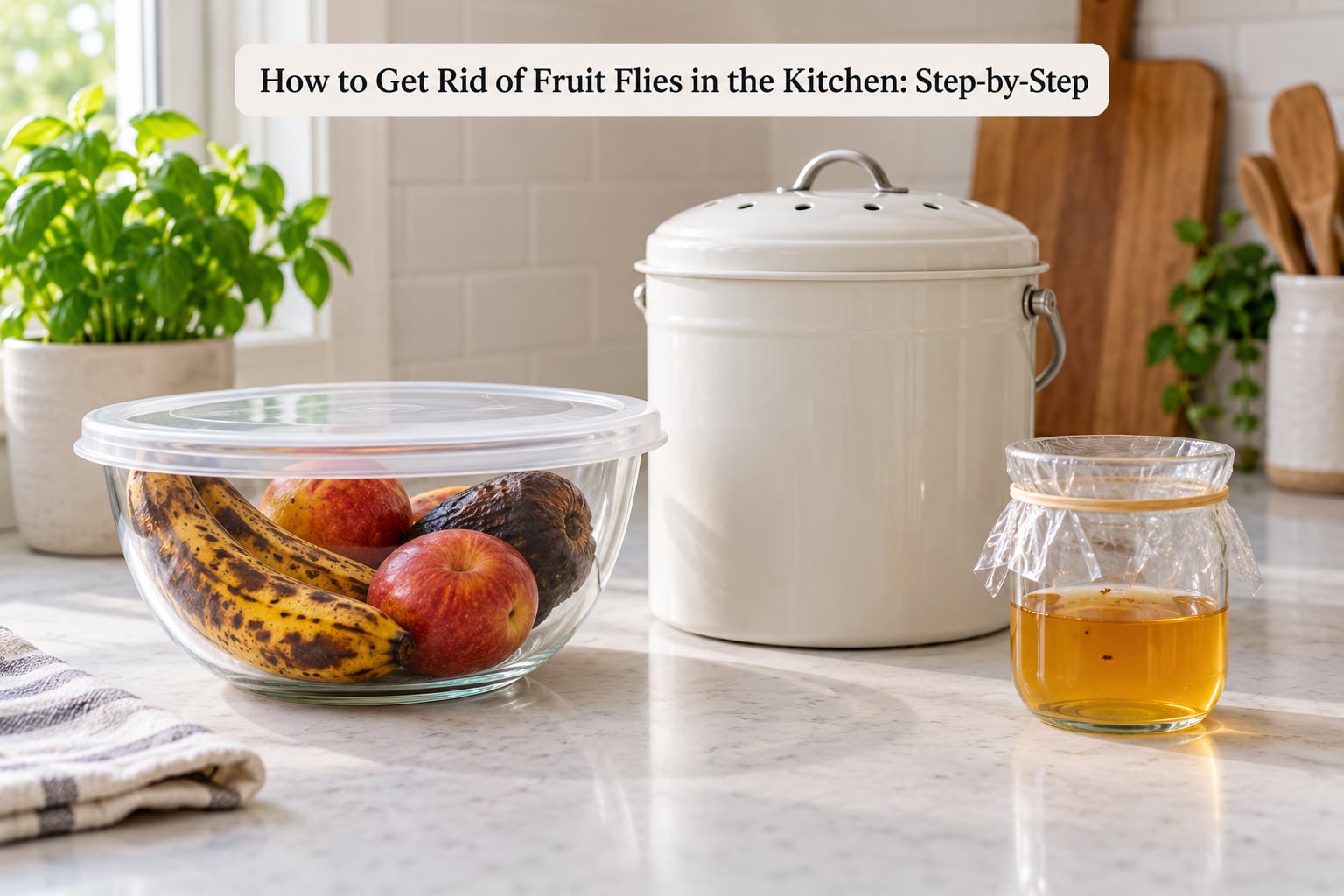
The vinegar bowl trap. Pour about half a cup of apple cider vinegar into a shallow dish or the bottom third of a clear jar. Add one single drop of dish soap and stir once. Cover with plastic wrap or a lid and poke five or six pencil-size holes. Set it near the fruit bowl, not on the prep surface you eat off.
The mechanism is simple and worth understanding. Fruit flies are drawn to the fermenting smell, and they detect that they are about to land on a liquid through their feet. Dish soap is a surfactant: it breaks the surface tension, so the liquid no longer supports the fly and it sinks and drowns instead of walking back off. One drop is plenty. More just makes a soapy mess on your counter.
The jar and paper funnel trap. Cut a paper funnel that fits the mouth of a jar, pour an inch of apple cider vinegar and a drop of soap into the bottom, and push the funnel in with its point down. Flies enter through the gap between the funnel and the jar rim and cannot find their way back out. This one is neater than an open dish and works well in a restaurant kitchen where a bowl of bait would be a health-code problem.
No vinegar at all. A small piece of overripe banana peel or a spoonful of berry compote in a cup, with a splash of water and a drop of soap, works. Home pest forums are full of people who cleared a kitchen with a banana shell and a small piece of bread or mushroom at the bottom of a container. Some prefer the catch-and-release version: put the peel in a zip-top bag, leave a small opening, carry the bag outside and release them away from the door.
Commercial options. If several weeks of traps and cleaning change nothing, a commercial lure with a pheromone-style attractant can outperform homemade vinegar traps, and that is what growers report after home remedies stall. Sticky traps and plug-in light traps are good for catching adults in a large open kitchen. Treat any of them as a supplement, never the plan.
Empty traps every day or two. A trap with a thick layer of dead flies in it stops catching, and that is exactly the smell you were trying to get rid of.
Keep bait and traps out of reach of children and pets, away from the stove, and off any surface where food is prepared. Vinegar and dish soap are food-safe in the sense that nobody is going to be harmed by a fly trap, but concentrated essential oils and any aerosol insecticide are a different story and have no business near an open bowl of food.
Prevent new fruit flies from entering
Prevention is the whole game, because fruit flies are not seeking your kitchen. They are seeking fermenting organic matter, and your kitchen is simply where you keep it. Anyone learning how to get rid of fruit flies in the kitchen finds out fast that the trap is cleanup, not a cure, and this section is the part that keeps them gone.
- Refrigerate ripe produce or cover it. A bowl with a mesh cover or a cake dome does the same job as the crisper for a day or two. Fruit stored where you can see it gets used before it turns, which is the real fix. If your storage setup needs work, start with organizing your pantry so fruit stays visible and sealed.
- Take the trash out daily. In late summer and early fall, when stone fruit is everywhere, every other day is not fast enough.
- Rinse recyclables before they go in. A quick water swish inside the bottle is enough.
- Wash dishes and cookware instead of stacking them wet overnight. Standing water in a sink or a cup is a breeding site.
- Wipe up every spill, including sugar and juice, right away.
- Keep screens or doors closed in warm months and check the gap under the door, which is a common entry route in older buildings.
- Do the kitchen at night. Run the disposal briefly, empty the sink, take the trash out, and wipe the counters before bed. A kitchen that is clean and dry overnight is a kitchen with nowhere to breed.
About herbs: basil, peppermint, eucalyptus, lavender, clove and lemongrass have been suggested as deterrents, and a pot of basil on the counter does no harm. But treat that as a pleasant side effect, not a control method. Nobody has run the trial where a jar of cloves emptied a kitchen of flies.
Common Mistakes
Spraying the flies you can see. Aerosol insecticide kills adults and leaves residue on your prep surface. It does nothing to a larva in a drain, and it can land on food. Fix: trap instead, and treat the source.
Leaving fruit out in a bowl. A covered bowl is fine. An open one is an open invitation, and one overripe banana can seed a whole kitchen. Fix: refrigerate anything ripe, and use up soft fruit before it bruises.
Cleaning without drying. A soapy film left damp is sweet and wet, which is the two things fruit flies need. Fix: towel-dry the counters, sink and can after scrubbing.
Relying on fragrance sprays or scented candles. A heavily scented kitchen does not remove food, and fragrance-heavy aerosol sprays near food are a bad trade. Fix: soapy water and a dry surface.
Putting an open bowl of bait on the counter where you prep food. It works and it also puts fly-sickness material in your salad prep zone. Fix: use the covered jar-and-funnel build, or put the dish somewhere out of traffic and empty it daily.
Giving up after four quiet days. This is the mistake that makes people conclude their plan failed. Eggs laid before your cleanup hatch one to two weeks later. Fix: keep the drain and disposal protocol running weekly for at least a month before you call it clear.
Frequently Asked Questions
Why is my kitchen suddenly full of fruit flies?
Fruit flies are almost never new. Females have been laying eggs in a place you have not looked yet, usually a sink drain, the rubber gasket under the garbage disposal, the garbage can rim, a compost pail, or overripe produce in the crisper. Populations build fast: a female can lay up to 500 eggs, and eggs to adult takes about a week. A sudden appearance usually means a new food source, warmer weather, or a cleaning routine that slipped.
How long does it take to fully get rid of fruit flies in a kitchen?
Two to four weeks from the day you remove the breeding source, provided you keep cleaning the drains and disposal weekly. The long tail is the eggs already laid, which take one to two weeks to hatch. You will notice fewer adults within a few days, but the meaningful signal is four consecutive weeks with no new flies. If you see the same number of flies three weeks after a serious cleanup, the source is somewhere you have not cleaned yet.
Are these fruit flies or drain flies?
Watch where they sit. Fruit flies hover in short bursts and land on fruit, trash and counter surfaces. Drain flies have a weak fluttery flight, rest on walls near the sink, and pop out of the drain when you run water. Drain flies come from slime film in the pipe, the P-trap and the disposal, and a vinegar bowl trap will not touch them. If you see them, focus entirely on weekly drain and disposal cleaning.
Can I use white vinegar instead of apple cider vinegar?
Yes. Plain white vinegar works, and for a small trap the difference is minor. Apple cider vinegar tends to hold its smell a little longer and the smell itself is the attractant, not the acid. What matters more is the ratio, roughly one part vinegar to one part water, and adding one drop of dish soap so the surface tension breaks and the fly drowns on contact rather than walking back out.
How do I get rid of fruit flies in my sink drain and garbage disposal?
Do this daily for a week, then weekly for a month. Switch off the disposal, lift the rubber gasket out of the collar, scrape out the trapped food with an old toothbrush, plug the drain, fill the sink with soapy water and run the disposal briefly. Then flush the drain with very hot water for a full minute and clean the P-trap under the sink if you have not recently. Skipping the gasket is why most attempts fail.
Are fruit flies harmful to the food in my kitchen?
Fruit flies do not bite and they do not sting, but they do carry bacteria on their bodies and can walk across uncovered food, so the practical advice is simple: discard anything they have touched, keep food covered, and do not spray anything near dishes or prep surfaces. Clean your counters and dishes as you normally would with hot soapy water. The risk is contamination of exposed food, not the flies themselves.
Conclusion
Start with the most obvious breeding source today, not with the trap. Put the fruit in the fridge, take the trash out, scrub the counters and pull the gasket out from under the garbage disposal. If you only do one thing today about how to get rid of fruit flies in the kitchen, do that.
Set the vinegar and dish soap trap once the kitchen is clean, keep it covered and out of the way, and empty it every day or two. Then stay with the weekly drain and disposal routine for a month, because eggs laid before your cleanup hatch one to two weeks later. That is what a finished kitchen looks like in 2026: dry counters, sealed waste, covered produce, and nothing to ferment.
And if you would rather not waste a good banana on a trap, we have a whole guide to keeping a fruit salad from browning, which is really a guide to using fruit up before it goes soft.