
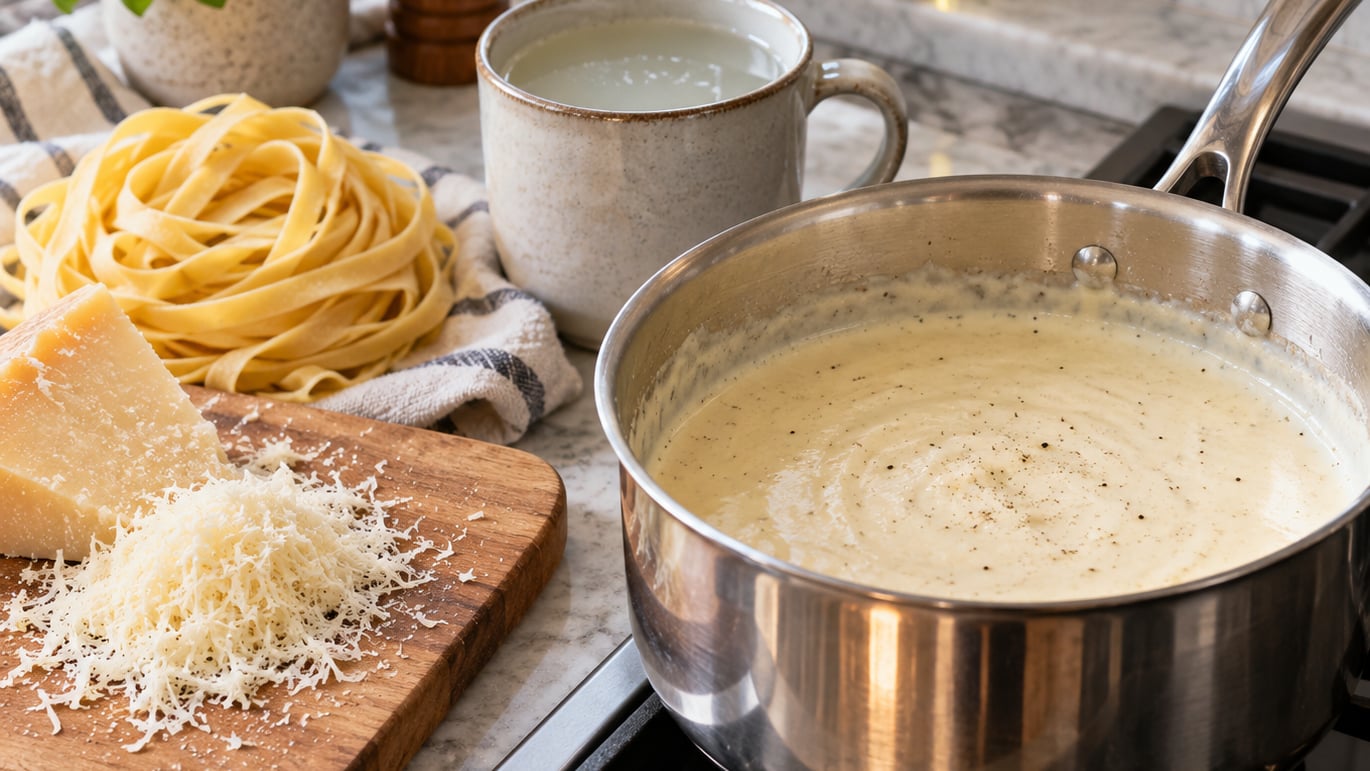
Alfredo sauce separates when the fat and the liquid stop holding together, and that happens for three reasons almost every time: too much heat, Parmesan dumped in rather than added gradually, and cheese that came from a bag instead of a grater. To make alfredo sauce that does not separate, keep the pan on medium-low heat, take it off the burner while you temper in finely grated Parmesan, and loosen everything with starchy pasta water rather than more cream. Fifteen minutes, one pan, and a sauce that coats every strand.
It took me a few ruined pans to work out the pattern. The times it turned grainy, I had the burner up too high. The times it went thin and oily, I had added the cheese while the sauce was still boiling. Once I moved to low heat and off-heat cheese, the same recipe stopped breaking.
The good news is that a split sauce is usually fixable, and a split sauce you have not made yet is entirely avoidable. Here is the equipment and the method that get you there.
Table of Contents
- What You Need
- Step-by-Step
- Common Mistakes
- Frequently Asked Questions
- Can I make alfredo sauce without cream?
- What is the best way to keep alfredo sauce from separating?
- Can I use milk instead of heavy cream in alfredo sauce?
- How do I reheat alfredo sauce without it breaking?
- Should I add Parmesan before or after the cream?
- How thick should alfredo sauce be before tossing it with pasta?
- Conclusion
What You Need
Nothing here is exotic. The list matters because a few swaps change how stable the sauce is, and you can feel the difference the first time you make it.
- Heavy cream — at least 36% milk fat. Fat is the structure of the sauce; a leaner cream gives you less margin before it breaks. Half-and-half works, whole milk is a last resort.
- Parmesan, grated by hand moments before it goes in — buy the wedge, not the bag. Pre-shredded cheese carries cellulose or potato starch to stop clumping in the bag, and that coating is exactly what leaves your sauce grainy.
- Unsalted butter — about half the weight of the cream for the richer version. It adds body and carries flavor, and it is the entire fat in the cream-free Roman method.
- One garlic clove, minced — optional. Cook it in the fat until it smells sweet, never until it browns.
- Reserved pasta water — at least a full cup. Cloudy, salty, starch-heavy water is the most useful liquid in this whole method.
- A flat-bottomed pan or a medium saucepan — wide pans give you fast, even heat and a bigger surface for whisking.
- A whisk — better than a spoon. If the emulsion starts to slip, an immersion blender on low is the fastest recovery.
- A microplane or fine box grater — the finer the grate, the faster the cheese melts into the sauce.
A microplane and a whisk are the two tools that earn their space. Everything else is a pantry staple you likely have on hand, and the technique does the rest. If you want the science behind why any of this works, our guide on how to make a simple vinaigrette that emulsifies explains the same principle with oil and vinegar.
Step-by-Step
Six steps, in order, and the order is the whole trick. You are building an emulsion: droplets of fat held in liquid by motion and starch, kept stable by temperature. Each step below manages one of those three things.
Cook the pasta and reserve the pasta water
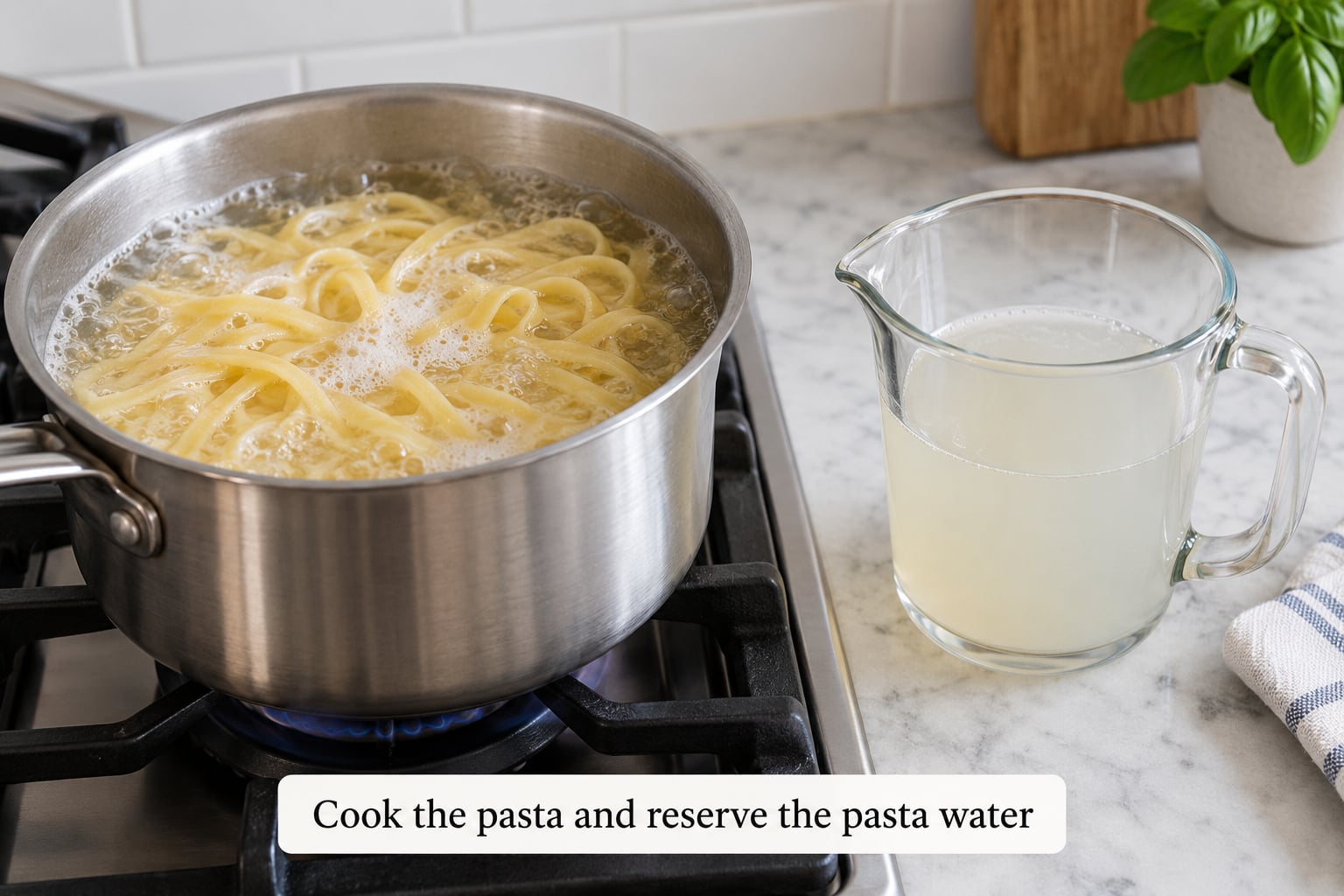
Start the water for your pasta and salt it well. Cook the pasta until it is about one minute short of the package time, because it finishes in the sauce.
Before you drain, scoop out a mug or two of the cloudy water. This is the part people skip and then wonder why their sauce needs more cream. The starch in that water is what later re-binds a sauce that starts to split.
Do not rinse the pasta. Rinsing washes the starch off the surface, and that surface starch is half of what makes the sauce cling. If you want to know more about that, we wrote about why pasta sauce does not stick to noodles and five ways to fix it.
How you know it worked: the pasta still has a firm core and the water in the pot looks milky rather than clear.
Melt the fat and cook the garlic gently
Put the butter in the pan over medium-low heat and let it melt without foaming or browning. Add the minced garlic and stir for about 30 seconds, just until it loses its raw edge and smells sweet.
Golden garlic is bitter, and bitter flavors in a dairy sauce taste worse than in a tomato one. If the garlic starts to color, wipe the pan and start over; the butter is usually recoverable, the garlic is not.
How you know it worked: the butter is liquid and quiet, and the pan smells like garlic rather than char.
Add the dairy gradually and keep the heat low
Pour in a third of the cream first, whisk, then another third, then the rest. Whisk steadily between each addition so the fat disperses instead of pooling.
Bring it just to the edge of a simmer, around 180°F, and hold it there. You want the occasional lazy bubble at the bottom of the pan, not a rolling boil. Boiling dairy is the single most common reason a sauce splits: the proteins holding the emulsion together unravel, and the fat floats free.
Give it two or three minutes to reduce slightly. You are looking for a sauce that coats the whisk and falls off slowly.
How you know it worked: the surface shimmers and thickens slightly, and nothing is aggressively bubbling.
Temper in the Parmesan
Here is how to make alfredo sauce that does not separate at the step most people rush. Take the pan off the heat entirely and wait about a minute for the residual warmth to drop.
Residual heat is the warmth still in the pan and the sauce after the burner is off, and it is exactly enough to melt Parmesan without cooking it. Add the cheese in three or four additions, whisking hard between each one. Let each addition melt mostly before the next goes in.
Grate it right at the pan if you can. Cheese that sits grated for twenty minutes clumps and dries on the surface, which is where the gritty texture comes from. A hundred grams of Parmesan for a cup and a half of cream is the ratio I use; too much cheese makes the sauce heavy and rubbery rather than silky.
How you know it worked: the sauce looks glossy and moves like loose cream, with no visible shreds.
Loosen and finish the sauce with pasta water
Add reserved pasta water one spoonful at a time, whisking after each. Stop when the sauce falls off the whisk in a slow, continuous ribbon rather than in globs.
Thinner than feels right at this point. The pasta will drink a surprising amount of it when you toss, and it is much easier to add than to remove. A splash of cold cream at the very end is fine too if you are out of pasta water.
Season only now. Salt, a lot of freshly cracked black pepper, and a small pinch of nutmeg go in after the sauce has reached its final thickness, since reducing it further concentrates the salt.
How you know it worked: glossy, smooth, and one shade looser than you think it should be.
Toss the pasta immediately
Drain the pasta, then add it directly to the pan with a splash more pasta water. Toss over medium-low heat for 60 to 90 seconds, using tongs or a wooden spoon, until every strand is evenly coated.
Tossing in the pan away from a boil is what many restaurant cooks do, and it is why home versions coat better. The pasta and sauce finish together, and the surface starch on the noodles thickens the sauce around them.
Taste for seasoning one final time. If it tastes flat, more Parmesan is usually the answer, added off the heat. Serve immediately from the pan.
How you know it worked: the sauce clings in a thin layer to the pasta instead of pooling at the bottom of the bowl.
Common Mistakes
Two different failures get called “separated.” Curdled means the milk proteins have coagulated from heat, which gives you grainy curds and a slightly eggy taste. Split means the fat has simply come apart from the liquid, which gives you an oily, watery sauce that still tastes fine. The fixes are not the same.
| Symptom | Cause | Fix |
|---|---|---|
| Grainy or curdled | Sauce boiled, or Parmesan added too fast over high heat | Off the heat, whisk in cold cream or pasta water a spoonful at a time until smooth |
| Oily with liquid underneath | Emulsion broke from heat, chilling, or a cold pan | Warm over low heat and whisk in starchy pasta water; blend briefly if needed |
| Too thick, clings hard | Reduced too long or too much cheese | Add pasta water one spoonful at a time, whisking, until it ribbons |
| Too thin, runs off pasta | Not enough reduction, or not enough cheese | Simmer gently 2 to 3 minutes, then add Parmesan off the heat |
| Clumpy shreds | Coarse grate, cold sauce, or pre-shredded bagged cheese | Grate fine, add in small amounts to warm sauce, whisk constantly |
| Gritty or sandy | Anti-caking agents such as cellulose or potato starch in bagged cheese | Use a wedge grated fresh |
| Bland after serving | Sauce seasoned before it finished reducing | Season at the end with salt, pepper, and more Parmesan |
| Splits every time it is reheated | Microwave or high heat; cold fat has no mobility | Reheat on the stove over low with a splash of water or cream, whisking, never boiling |
Why does my alfredo sauce break or become grainy?
Heat is the usual culprit, in one of two forms. A rolling boil unravels the milk proteins that hold fat in suspension, and a hot pan cooks Parmesan as it melts, which is where the grainy curd texture comes from. Cool the pan first, then whisk in cold cream or a spoonful of pasta water.
The motion matters as much as the temperature. An emulsion holds because fat droplets stay dispersed while something is moving them. Twenty seconds of steady whisking does more for a grainy sauce than another minute on the burner.
If the sauce has already curdled badly, the texture may not fully return, but it will taste good again. Start a fresh small batch and fold the thickened one in at the end.
Why does my alfredo sauce look oily instead of creamy?
That is a split emulsion, not a rendering problem. The fat has gathered into droplets and risen, leaving watery liquid underneath. It usually follows a boiling episode, a trip to the fridge, or a cold pan hitting hot sauce.
Put it back over low heat and whisk in warm starchy pasta water a spoonful at a time. The starch reassembles the emulsion, and you will watch the streaks disappear within seconds. An immersion blender on low for about fifteen seconds does the same thing faster if you own one.
Why is my alfredo sauce too thick or too watery?
Both are consistency problems, not emulsion problems, and both are quick to fix. Thick sauce takes pasta water; thin sauce takes time and cheese. Make changes one at a time so you know what worked, and never correct a thin sauce with a ladle of cold cream all at once, because that drops the temperature and undoes the reduction.
The test is simple. Lift the whisk: the sauce should fall in a continuous ribbon and leave a thin coating behind, not in globs and not in a fast stream.
Why does the sauce clump when I add Parmesan?
Three things cause it. The grate is too coarse, the sauce is too cold to melt the cheese quickly, or the cheese was grated in advance and has dried out. Grate it fine, add it in four small amounts to warm (not hot) sauce, and whisk hard after each.
Bagged pre-shredded Parmesan is the hidden cause in most cases. The cellulose or potato starch that keeps it from sticking in the bag also keeps it from melting into anything else, so it ends up sitting in the sauce as fine grit.
Why does my alfredo sauce taste bland after the pasta is mixed in?
Because the pasta water dilutes it, and because the starch coats your tongue and mutes the seasoning. Taste after the toss rather than before, and correct in that order: salt first, then more Parmesan off the heat, then black pepper.
A small pinch of grated nutmeg is the classic finishing note. It is easy to overdo, so start with a pinch for four servings and taste again.
Frequently Asked Questions
Can I make alfredo sauce without cream?
Yes, and it is the most stable version you can make. This is the original Roman method: butter, finely grated Parmesan, and pasta water, with no dairy at all. Melt the butter, whisk in the grated Parmesan off the heat, then loosen with starchy pasta water until glossy. It behaves differently on the palate, more savory than rich, and it does not curdle because there is no milk protein to coagulate.
What is the best way to keep alfredo sauce from separating?
Keep the heat medium-low so the sauce never reaches a rolling boil, and take the pan off the burner before adding Parmesan so residual heat melts the cheese without cooking it. Add the cheese in small amounts, whisking between each, grate it fresh from a wedge, and keep starchy pasta water on hand to loosen and re-bind the sauce.
Can I use milk instead of heavy cream in alfredo sauce?
You can, but expect a thinner and less forgiving sauce. Milk has roughly half the fat of heavy cream and more milk protein, so it tightens into curds sooner. Use whole milk, simmer gently and never boil, add the Parmesan off the heat, and lean on pasta water for body. Half-and-half sits in between and is the better swap if you have it.
How do I reheat alfredo sauce without it breaking?
Reheat on the stove over low heat, never in a microwave at full power. Add a splash of water or cream first, then whisk constantly and stop as soon as it is hot. Microwaving heats unevenly and often pushes the sauce past a boil in spots, which is why leftovers so often split. Stirring in cold cream and a spoonful of pasta water as it warms also helps.
Should I add Parmesan before or after the cream?
After. Warm the cream first, take the pan off the heat, then add the grated Parmesan in small whisking increments. Parmesan added into cold or boiling liquid clumps instead of melting, and any cheese that hits a boil will turn grainy almost immediately. If you want the cheese to melt smoothly, the sauce should be warm and moving, not hot.
How thick should alfredo sauce be before tossing it with pasta?
Looser than looks right. Before the toss it should fall off a whisk in a slow, continuous ribbon and coat the whisk thinly. The pasta drinks a noticeable amount as it finishes in the pan, so a sauce that looks perfect beforehand will turn pasty by the time it hits the plate. Add reserved pasta water one spoonful at a time until it ribbons.
Conclusion
Start with heat. Medium-low, a lazy simmer at most, no rolling boil, and the pan off the burner before the Parmesan goes in. Whisk continuously while you add the cheese in small amounts, grate it fresh, and keep a mug of starchy pasta water within reach for the last adjustment.
That is the whole method, and it takes about the same time as the version that breaks. If your sauce has already split, warm it gently and whisk in pasta water a spoonful at a time; the sauce comes back together faster than most people expect.
If it splits repeatedly no matter what, try the cream-free Roman version. Butter, Parmesan, and pasta water have no milk protein to coagulate, so they are considerably harder to break. Our guide to how to make hollandaise sauce that does not break uses the same heat discipline if you want the underlying idea in another sauce.