
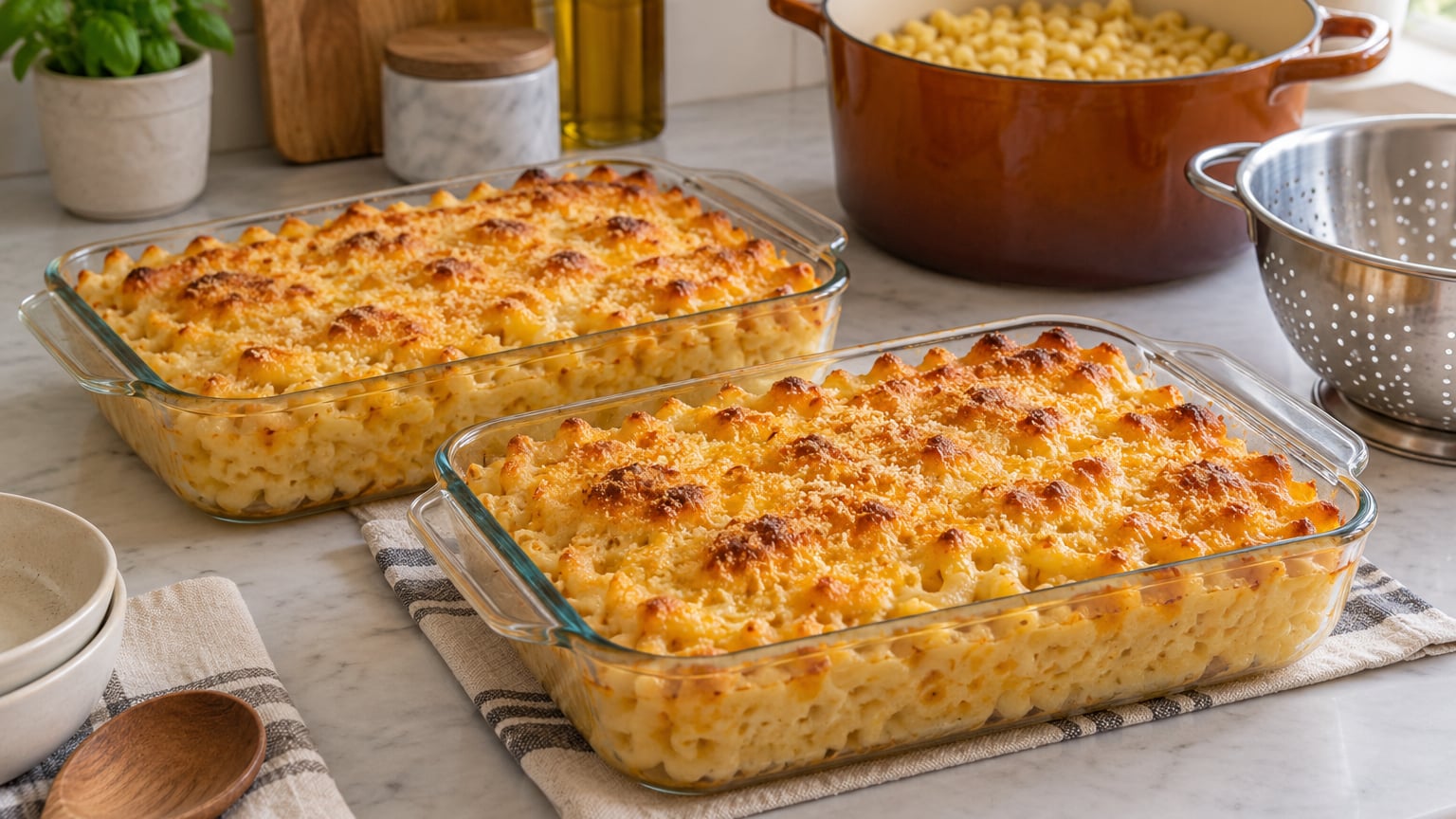
Here is the short version: one pound of dry elbow macaroni plus a full batch of cheese sauce fills a 9×13-inch pan and feeds about 10 to 12 people, so you double everything for roughly 20. Knowing how to make mac and cheese for a crowd is mostly arithmetic plus oven space, not a different recipe. Once you have the pan count and the pounds in front of you, the actual cooking is the same method you already know, done with more attention to heat and timing.
The part that trips people up is that a crowd batch fails on logistics rather than flavor. The pasta finishes cooking while the oven is still preheating, the sauce tightens as it sits, and one deep overloaded casserole sets unevenly from edge to center. A large batch behaves predictably once you cook the pasta short, split the mixture across more pans than feels necessary, and give it room in the oven.
Budget about an hour of hands-on time for a 20-serving batch, plus oven time that grows with the number of pans. The method below covers 12 servings as the base and scales up in one step to 20, 30, and 50.
Table of Contents
- What You Need
- Step-by-Step: How to Make Mac and Cheese for a Crowd
- Common Mistakes
- Frequently Asked Questions
- How much mac and cheese should I make for 20 people?
- Should I bake mac and cheese in one pan or two?
- What is the best cheese for a large batch of mac and cheese?
- Can I make mac and cheese ahead of time for a party?
- How do I keep mac and cheese creamy when reheating it?
- Can I make mac and cheese without milk for a crowd?
- Conclusion
What You Need
The base batch below makes about 12 servings, which fits one 9×13-inch dish or two shallower ones. Every quantity scales cleanly, so this doubles as your base for the table at the end of this section.
- Pasta: 1 pound (16 ounces) elbow macaroni, or 6 cups of another short shape such as cavatappi or shells
- Butter: 6 tablespoons (85 grams), divided
- Flour: 6 tablespoons (45 grams) all-purpose flour
- Dairy: 3 cups whole milk plus 1 cup half-and-half
- Cheese: 6 cups (about 24 ounces / 1.5 pounds) thick-shredded sharp cheddar, plus 1 cup for topping
- Seasoning: 1 1/2 teaspoons salt, 1 teaspoon black pepper, 1 teaspoon dry mustard or 2 teaspoons paprika
- Topping (optional): 1 cup coarse breadcrumbs or crushed croutons, tossed with 2 tablespoons melted butter
Shred your own cheese from blocks if you can. Pre-shredded cheese contains added starch and anti-cake powder, and it is the single biggest reason a big pan of macaroni turns grainy and dull instead of glossy. If you want to read the mechanics behind that, our post on why homemade mac and cheese turns grainy explains it in detail.
Equipment that matters at scale
- A 12-quart stockpot for the pasta, or two 8-quart pots if you are going past 3 pounds
- A large colander, plus a second colander or the lid of the pot if you drain in stages
- A heavy whisk and a flat wooden spoon; at volume, the whisk is what keeps the roux smooth
- Measuring cups and spoons, because scaling a crowd batch by eye is how recipes drift
- Two 3-quart glass or ceramic baking dishes (the 9×13-inch size) for 20 to 24 servings
A full-size sheet pan holds roughly the same volume but only about 1 inch deep, so it only works for a stovetop-finished version that never goes in the oven. For a baked dish with a browned top, two shallower 9×13-inch dishes cook far more evenly than one deep roasting pan crammed to the rim. If you are planning a full holiday table, our guide to how to make stuffing that is not soggy covers the same large-batch timing problem from a different dish.
How much to make: head count to pan count
These numbers treat mac and cheese as a main dish. As a holiday side, drop the pasta by about 25 percent, since people take smaller seconds. Caterers generally land between 8 and 12 pounds of dry pasta per 100 guests depending on shape and whether it is a side, which matches the table below.
| Head count | Dry macaroni | Shredded cheddar | Dairy total | Baking dishes |
|---|---|---|---|---|
| 10-12 | 1 lb | 6 cups (1.5 lb) | 4 cups | 1-2 x 9×13-inch |
| 20-24 | 2 lb | 12 cups (3 lb) | 8 cups | 2-3 x 9×13-inch |
| 30-36 | 3 lb | 18 cups (4.5 lb) | 12 cups | 3-4 x 9×13-inch |
| 45-50 | 5 lb | 30 cups (7.5 lb) | 20 cups | 5-6 x 9×13-inch |
| 90-100 | 8-10 lb | 48-60 cups (12-15 lb) | 32-40 cups | 9-10 dishes, baked in shifts |
Butter and flour scale at 6 tablespoons each per pound of pasta. A 1-pound box of macaroni comfortably feeds 10 to 12 as a main, or about 16 as a side, and that single box is the unit most people actually buy.
Step-by-Step: How to Make Mac and Cheese for a Crowd
1. Calculate the batch and choose the right pans
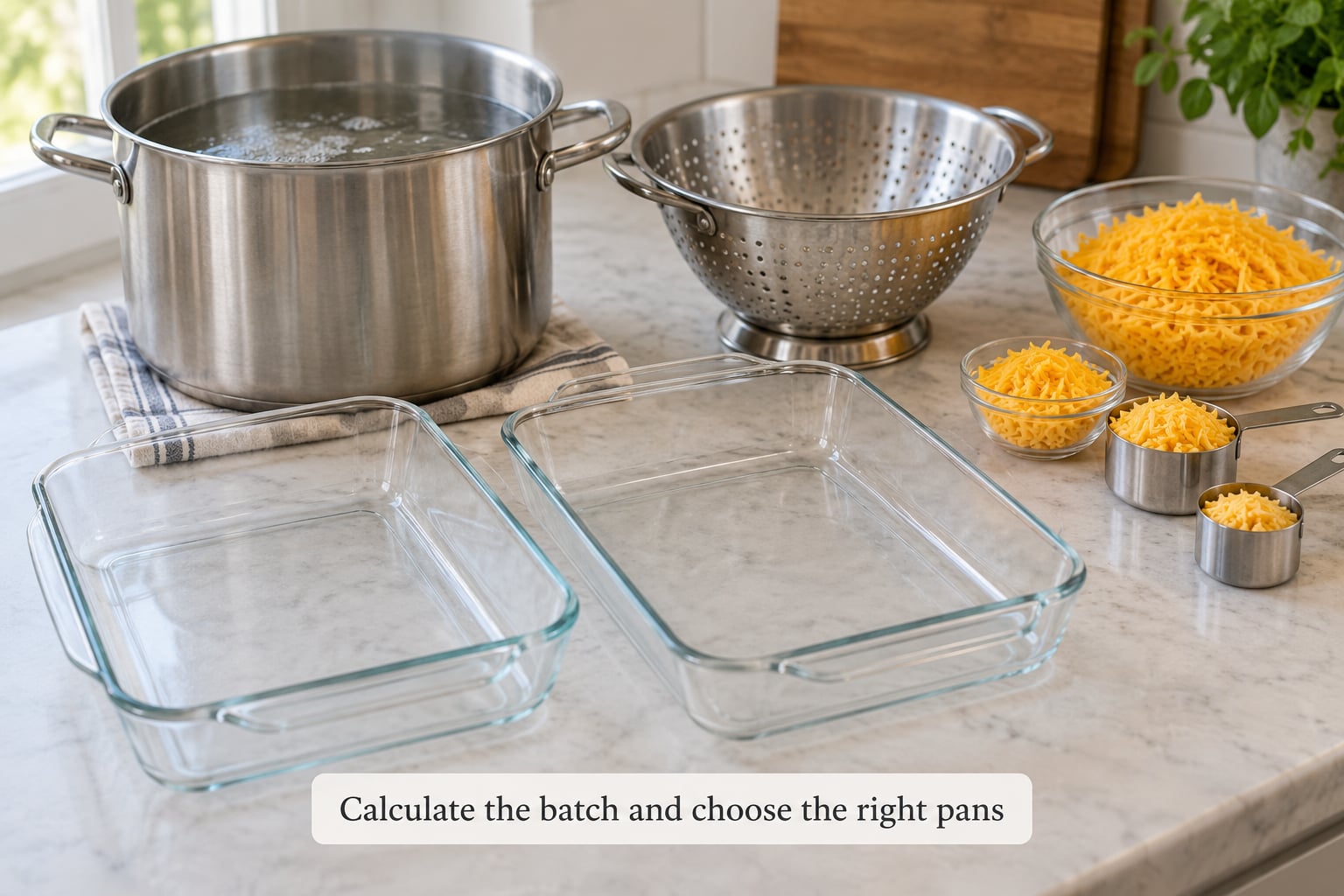
Pick your row in the table above before you start cooking, then set out one dish per 10 to 12 servings. For 20 people that means 2 pounds of pasta and two 9×13-inch dishes. Dividing the mixture across more pans than feels necessary is the whole trick: a shallow layer heats through in the oven instead of staying cool in the middle for an extra 20 minutes.
Also check that your pot is big enough that the pasta has room to move. Most home cooks who overcook a crowd batch are fighting a crowded pot, where noodles sit on the bottom and turn to paste before the ones at the top soften.
2. Cook the pasta until just underdone
Fill the pot about two-thirds full of water, bring it to a full boil, and salt it until it tastes like a mild soup, roughly 2 tablespoons of kosher salt per gallon. Add the pasta and stir immediately so nothing sticks to the pot.
Cook it 2 minutes less than the package directions, then taste one noodle at the end. You want the elbow tender but still slightly firm in the center with no raw or chalky taste at its core. That firmness is not a mistake; it is the buffer that carries the pasta through the oven without turning to mush. At bulk scale, cooking pasta two minutes short is standard practice precisely because the extra oven time keeps cooking it.
3. Make a smooth cheese sauce in batches
Melt 4 tablespoons of the butter in your largest pot over medium heat. Sprinkle in the flour and whisk constantly for 2 full minutes, until it smells toasty rather than raw and the color shifts to a pale blond. Cooked flour is what keeps a big sauce from tasting pasty, and a large batch needs the full two minutes of contact with heat.
Pour in the milk and half-and-half while whisking, and let it come to a low simmer. Once it thickens enough to coat the back of a spoon, turn the heat down and add the cheese a handful at a time, stirring until each addition melts before the next goes in. Adding 6 cups of cheese at once is what produces the oil-slicked, broken texture people complain about.
For volumes past 2 pounds, build the roux in two rounds in two pots and combine them, rather than trying to whisk 12 tablespoons of flour in one vessel while the burner is on. A little more butter at the end of each batch makes up for the sauce being held briefly. Season with the salt, pepper, and mustard or paprika, then taste: at 12 servings the full 1 1/2 teaspoons of salt is right, and at 24 servings you are seasoning twice as much food, so salt by taste rather than by formula.
4. Combine the pasta and sauce carefully
Before draining, scoop out a cup of the cloudy pasta water. That starchy water is what keeps a large batch loose and glossy instead of tight and gluey. Drain the pasta in the colander, let it drip for a full minute, then fold it into the sauce in the pot rather than pouring sauce over pasta in the pan.
Folding keeps the coating even and lets you see the consistency. You are done when the sauce looks glossy and cohesive, with no dry patches of noodle showing and a loose sauce that settles slowly rather than standing stiff. If it looks tight, add pasta water a quarter cup at a time until it loosens.
5. Add the topping and bake evenly
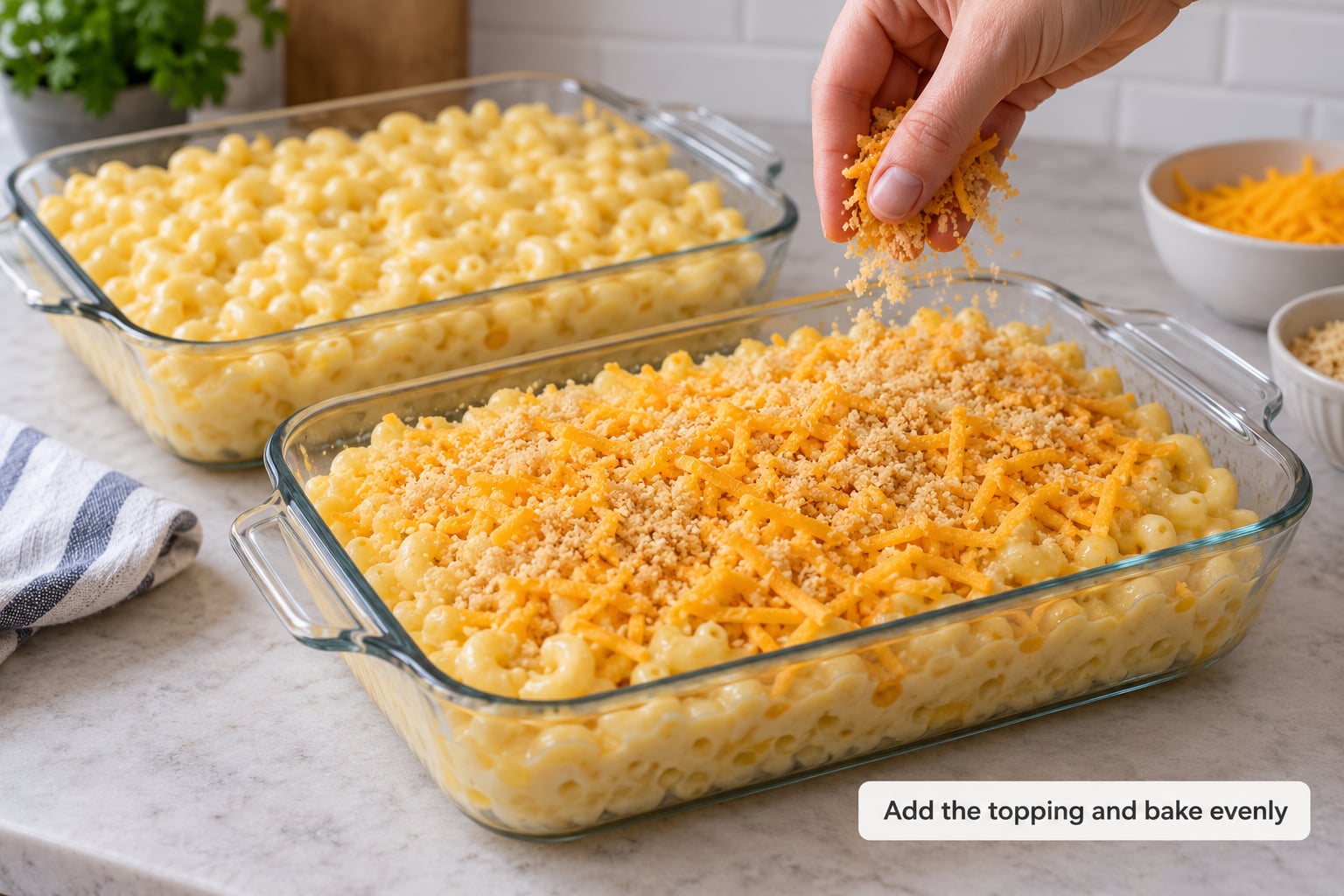
Spread the mixture into the pans and press it into an even layer about 2 inches deep. Scatter the extra cup of cheese over the top, then the buttered breadcrumbs if you want crunch. Two thin layers of topping brown better than one thick blanket, which steams instead of toasting.
Bake at 375°F (190°C) for 25 to 30 minutes per 9×13-inch dish. With three or more pans, use two oven racks and rotate the dishes halfway through, since most home ovens cook the front and back of the rack differently. Pull the first dish when the edges are bubbling and the top is bronze with a few darker spots; the center should look creamy, not set.
If your pans are more than about 2 inches deep, add 10 minutes and tent loosely with foil for the first 20. An overfilled pan traps steam and bakes unevenly, which is why two shallower dishes beat one deep roasting pan.
6. Rest, hold, and serve the crowd-size dish
Let each dish sit 10 to 15 minutes after it comes out. The sauce is still setting, and serving straight from the oven gives you a runny first portion that looks looser than the rest of the pan.
Scoop with a large serving spoon into a warmed platter rather than trying to cut it into squares; a crowd-size dish is usually looser than a small casserole. If you must hold it before serving, keep it at 140°F (60°C) or higher, covered loosely, and check it every 30 minutes or so. The covering matters: a tight wrap traps steam and softens the browned top into a pale skin. A loose foil tent protects the surface without ruining the crust.
Buffet lines are the hardest case, because the first tray sits out for 20 to 30 minutes before anyone reaches it. A small splash of warm milk stirred into the edge of the tray a few minutes before service brings it back to creamy without reheating the whole pan.
7. Make it ahead when needed
You can assemble this a day ahead. Cool the pans loosely covered in the refrigerator within 2 hours of cooking, then refrigerate for up to 3 to 4 days. Add the topping but leave it unbrowned, and cover the pans so the surface does not dry out.
To reheat, cover each dish with foil and put it in a 300°F (150°C) oven for 20 to 25 minutes. Stir gently in a spoonful of warm milk first if the sauce looks tight, and take the foil off for the last 5 minutes to re-crisp the top. You can also freeze unbaked portions in sealed dishes for 2 to 3 months and bake from frozen, adding 10 minutes to the bake time.
If your party is a morning affair or you are juggling several dishes, our post on how to make brunch for a crowd without stress lays out a similar do-ahead timeline you can borrow.
Common Mistakes
The biggest failures at scale all have the same cause: too much time between the pasta hitting hot water and the dish reaching the table. These are the problems I see most often, with the fix for each.
| Problem | What caused it | Fix |
|---|---|---|
| Pasta turns mushy in the oven | Pasta cooked to full package time | Pull it 2 minutes early and taste one noodle before draining |
| Sauce looks grainy or oily | Cheese added all at once, or pre-shredded bagged cheese | Shred from blocks and melt in handfuls over low heat |
| Sauce is too thick in the pan | Not enough pasta water reserved, or too long in the oven | Stir in warm pasta water a quarter cup at a time |
| Sauce is loose and puddle-y | Too much pasta water or dairy for the pasta weight | Simmer 3 to 5 minutes over low heat, stirring often |
| Lumpy sauce | Roux whisked too fast or not cooked long enough | Whisk steadily for a full 2 minutes after adding the flour |
| One pan cooked unevenly | A single deep dish, or more pans than the oven can fit | Split into more shallow dishes and bake in shifts |
| Top pale and rubbery | Foil left on too long, or a heavy blanket of topping | Uncover for the final 5 to 10 minutes of baking |
On cheese, use one sharp or two mild. Very sharp cheddar alone can turn grainy in a large sauce because of how tightly the proteins bind as it cools, so a blend is the safer crowd choice. Milk versus half-and-half is a richness call rather than a correctness one: whole milk alone is lighter, half-and-half alone is richer, and equal parts of both is the middle that most big batches land on.
Give yourself room in the oven before you start, and think about who carries what to the table. A dish that sits 30 minutes after baking still tastes good, but it will not have a crisp top, so plan to bake the last batch closest to serving when the oven is busy with a roast and a pie.
Frequently Asked Questions
How much mac and cheese should I make for 20 people?
For 20 people as a main dish, plan on 2 pounds of dry elbow macaroni, about 12 cups (3 pounds) of shredded cheddar, 8 cups of milk and half-and-half combined, 12 tablespoons of butter, 12 tablespoons of flour, and two 9×13-inch baking dishes. As a holiday side, drop to 1.5 pounds of pasta, since people take smaller seconds of a side dish.
Should I bake mac and cheese in one pan or two?
Use two. Two 9×13-inch dishes hold about the same food as one very deep casserole, but the shallower layer heats evenly, the center stays creamy, and the top browns before the edges dry out. A single overloaded pan is the most common reason a crowd batch has cold spots in the middle and a browned rim.
What is the best cheese for a large batch of mac and cheese?
One sharp cheddar plus one mild cheddar, about 6 cups per pound of pasta. Very sharp alone gets grainy as a large sauce cools, and very mild on its own tastes flat. Shred from blocks if you can, since pre-shredded bagged cheese has anti-cake powder in it that keeps the strands apart and dulls the sauce.
Can I make mac and cheese ahead of time for a party?
Yes. Assemble the dish up to a day ahead, cool it loosely covered in the refrigerator within 2 hours, and keep it for up to 3 to 4 days. Add the topping but leave it unbrowned. Reheat covered in foil at 300°F for 20 to 25 minutes, then uncover for 5 minutes so the top crisps again.
How do I keep mac and cheese creamy when reheating it?
Reheat slowly, covered, and add liquid. A splash of warm milk or reserved pasta water stirred in before reheating loosens a sauce that tightened in the fridge. Keep the oven at 300°F rather than 350°F, stir once halfway through, and take the foil off at the end so the top does not turn rubbery or weep oil.
Can I make mac and cheese without milk for a crowd?
Yes, and evaporated milk is the easiest swap at scale. Replace each cup of milk with two-thirds of a cup of evaporated milk plus one-third of a cup of water, using the same total liquid volume as the recipe. A no-dairy version made with unsweetened plant milk and vegan cheese works too, but add the cheese off the heat so it does not split.
Conclusion
Start with the arithmetic: 1 pound of dry macaroni and a full batch of cheese sauce feeds about 12 people, so double it for 20 and triple it for 30. Divide the finished mixture across two 9×13-inch dishes rather than one deep pan, cook the pasta 2 minutes short of the box directions, melt the cheese in handfuls over low heat, and let the pans rest 10 minutes before serving. Those four habits are the difference between a crowd dish that stays creamy and one that arrives with a cold center and a rubbery top.