
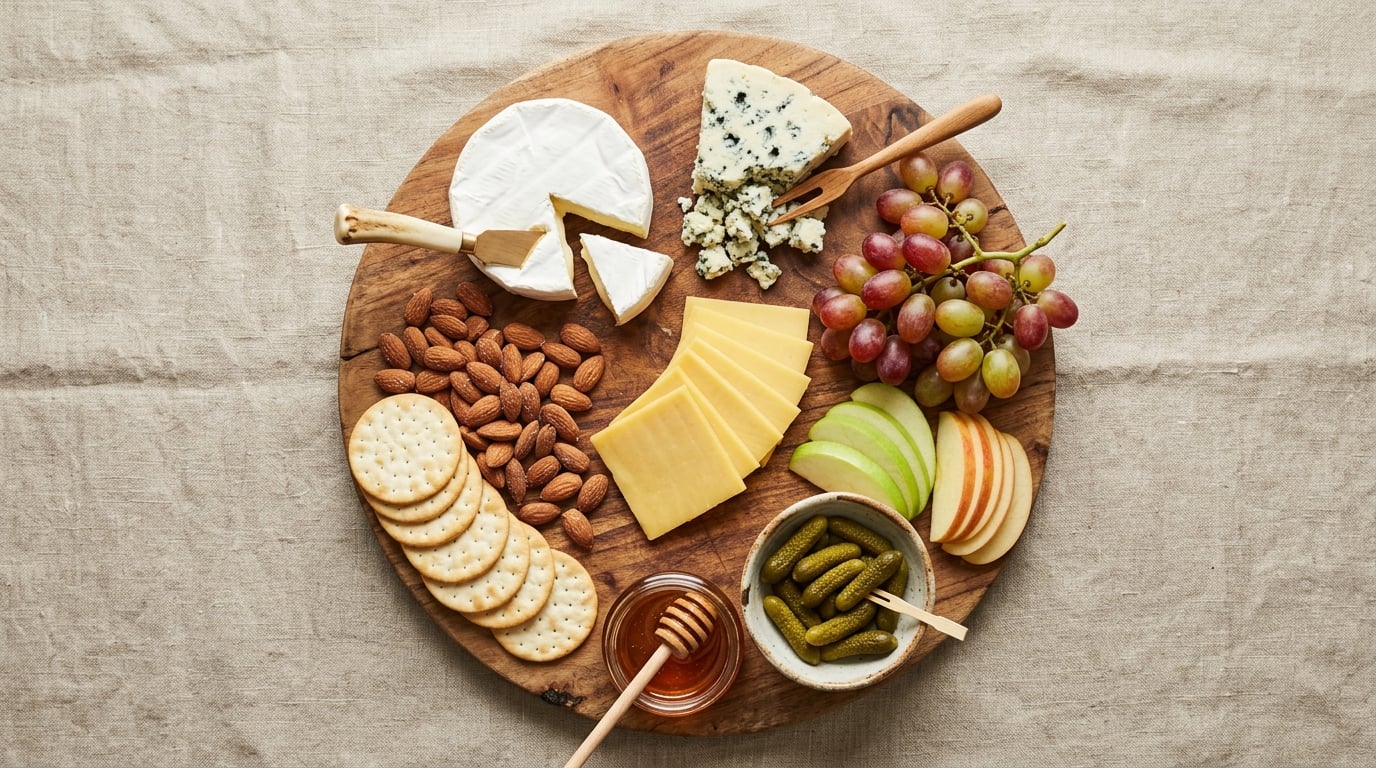
Learning how to make a cheese board for beginners is mostly a shopping and arranging job, not a cooking one. Pick three cheeses in contrasting categories, choose three sweet or salty accompaniments, give the whole thing three colors, and spend about twenty minutes arranging it before guests arrive. No special equipment, no knife skills, and nothing that needs reheating.
The mistake almost every first-timer makes is buying too much. A board that looks impressive but overwhelms the guests wastes food and buries the good stuff. Three cheeses beats nine, every time, and you can always send people back for seconds.
Here is the fast version before the details:
- Pick your ingredients. Three cheeses, two kinds of crackers or bread, one fruit, one savory extra, and one sweet spread. The shopping list below has amounts per guest.
- Assemble the board. Place the small bowls first, then the cheeses, then crackers and meats, then fill the gaps with fruit, nuts, and something green.
What You Need to Make a Cheese Board for Beginners
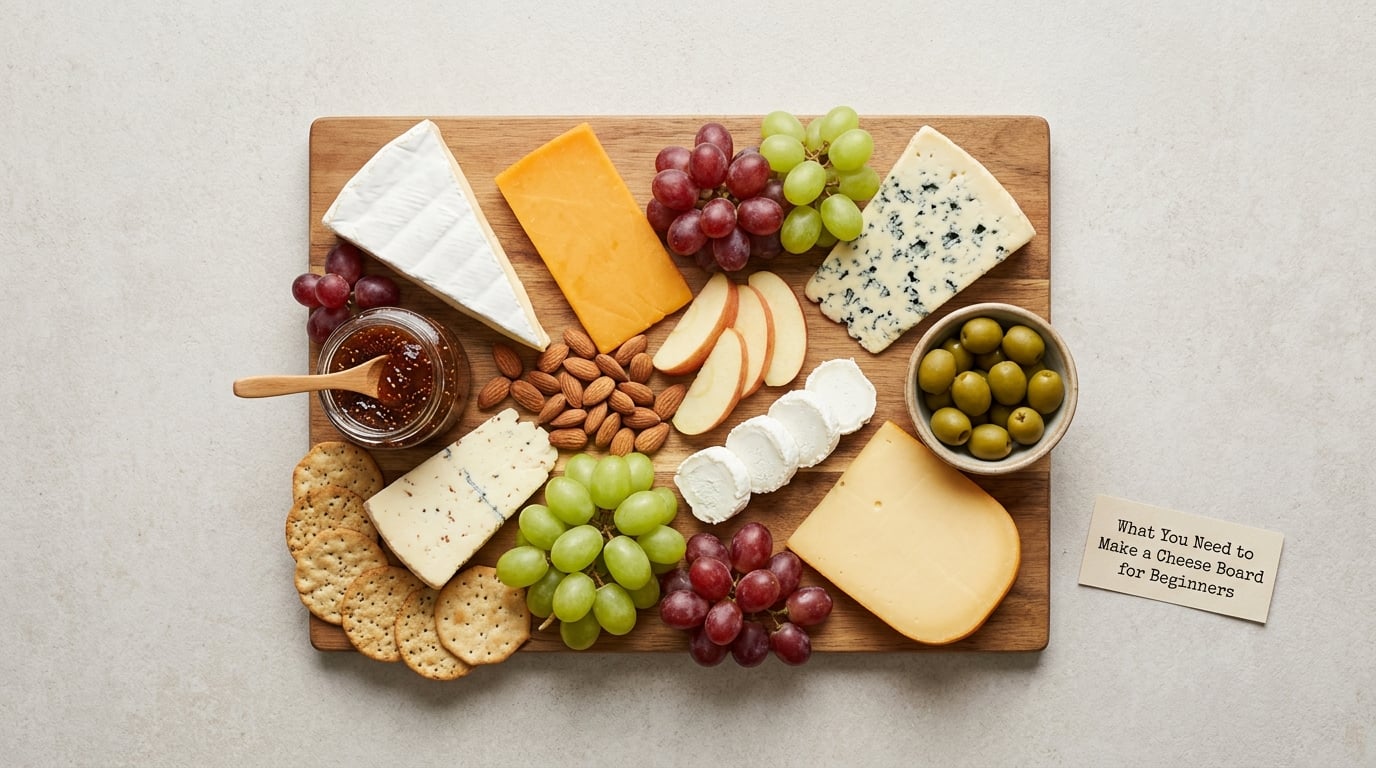
You need far less than the specialty cheese websites imply. A wooden cutting board, a platter, even a large plate works. The gear people think is required — slate, cheese forks, a special wire cutter — is optional, and beginners who buy all of it tend to use it exactly once.
Three things you actually need
A flat surface with a lip if you can find one, one sharp kitchen knife, and two or three small bowls or ramekins. That is the whole kit. Bowls matter more than most people expect because anything that rolls — grapes, olives, cornichons — ends up on the floor otherwise.
What to buy, by category
- Cheese (3 varieties): one soft and bloomy like brie or camembert, one semi-firm like cheddar, gouda, or manchego, and one sharp or blue like parmigiano reggiano, gorgonzola, or roquefort.
- Crackers or bread (2 kinds): a sturdy variety that will not shatter, plus a softer one like a sliced baguette or flatbread crisps.
- Fruit (1 to 2): grapes, apple or pear slices, figs, or berries.
- Savory extra (1): cornichons, olives, roasted chickpeas, or a few slices of salami or prosciutto.
- Sweet spread (1): honey, fig jam, or a tart cherry jam in a small jar.
- Greenery (optional): a few sprigs of rosemary, thyme, or arugula to fill bare wood.
How much cheese per person
Plan on two to three ounces per person for an appetizer spread, and four to five ounces if the board is standing in for dinner. That is the whole calculation — guests x ounces, split across your three cheeses, not per cheese.
| Guests | Cheese for an appetizer (2-3 oz each) | Cheese as the main (4-5 oz each) | What that looks like |
|---|---|---|---|
| 4 | 8-12 oz | 16-20 oz | 3 cheeses, one small block each |
| 6 | 12-18 oz | 24-30 oz | 3 cheeses, one medium block each |
| 8 | 16-24 oz | 32-40 oz | 3 cheeses plus a fourth if you like |
| 10 | 20-30 oz | 40-50 oz | 3 cheeses in larger blocks, or 4 |
| 20 | 40-60 oz | 80-100 oz | 5 cheeses, two large blocks each |
| 30 | 60-90 oz | 120-150 oz | 5-6 cheeses, sliced thin |
Thirty people is the number most people get wrong. Sixty to ninety ounces sounds like a lot until you spread it across a table, and thin slices mean one block goes a long way.
The 3-3-3 rule
The community shorthand is three cheeses, three accompaniments, three colors. It is the single most useful thing to know before you shop, and it keeps a beginner board from turning into a catering tray.
| Three of these | What it means | Examples |
|---|---|---|
| Cheeses | Three categories, not three of the same | Brie, sharp cheddar, gorgonzola |
| Accompaniments | Sweet, savory, and crunchy | Fig jam, cornichons, Marcona almonds |
| Colors | Warm, pale, and green or red | Amber cheddar, white brie, grapes |
The same rule works once you add meat. Two to four slices of salami or prosciutto per person is plenty; a board only becomes a charcuterie board once cured meat is on it, so calling a cheese-only board a charcuterie board is the one technical mistake beginners make.
Step-by-Step
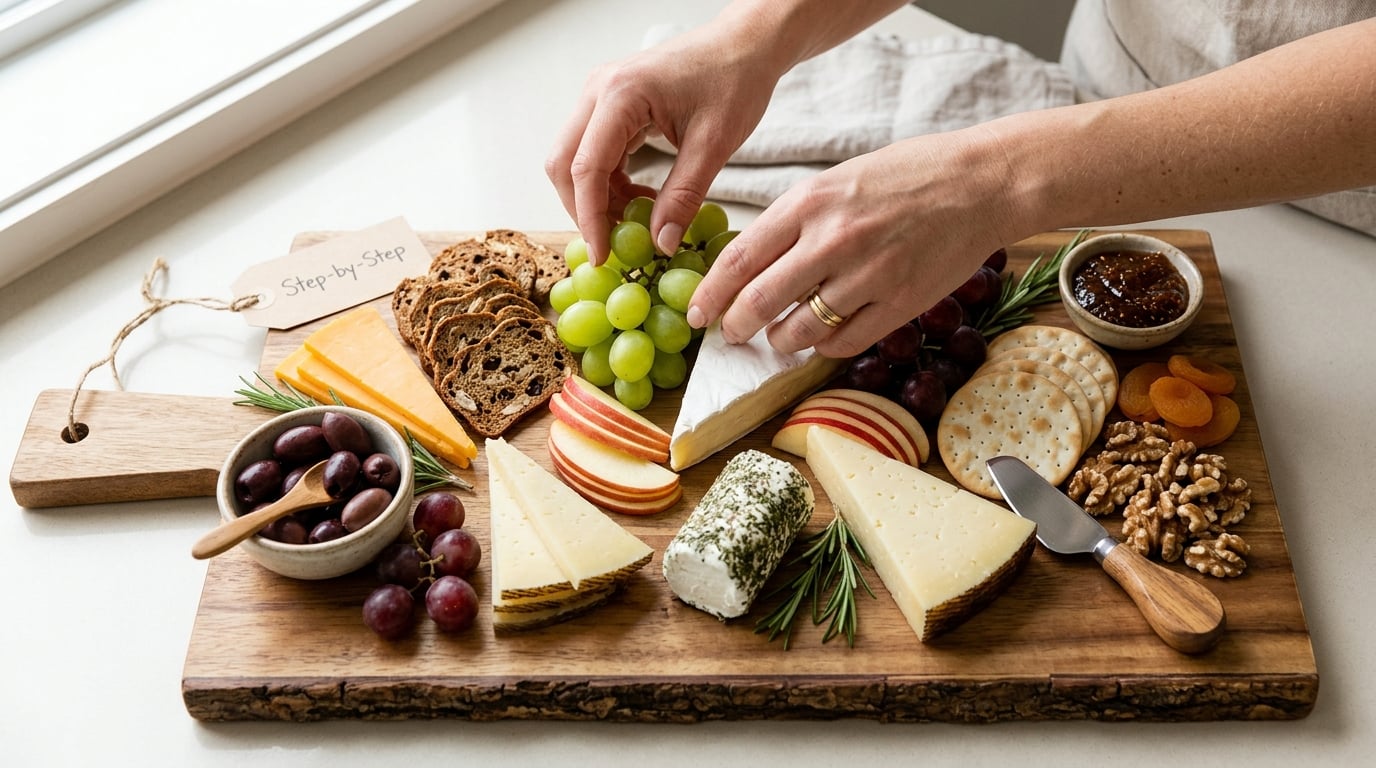
Work in a fixed order. The reason is simple: large and anchor items go down first, and everything else fills in around them. Skip the order and you will be moving piles of crackers around a board that is already full.
How to choose cheeses when you make a cheese board for beginners
Choose for contrast, not for prestige. Pick one soft and bloomy (brie, camembert), one semi-firm (cheddar, gouda, manchego), and one with real bite (parmigiano reggiano, an aged cheddar, or a blue like gorgonzola). That trio covers creamy, buttery, and sharp, which is enough range for almost any group.
Then think about your actual guests. If nobody at the table eats blue regularly, swap it for something with age in it rather than serving a cheese nobody touches. A useful habit is asking the cheese counter at the grocery store what is good that week — they will hand you something new and good rather than a supermarket block that has been sitting since spring.
For dietary needs, most swaps are easy. Skip nuts for roasted chickpeas or pretzel pieces, choose rice crackers or gluten-free crispbread for anyone avoiding wheat, and keep the meat on a separate small plate so a vegetarian board is one plate moved, not a rebuild.
How to prepare the cheese board before serving
Take every cheese out of the fridge 30 to 60 minutes before guests arrive. Cheese served straight from the cold is hard, chalky, and tastes like almost nothing — this is the single biggest improvement a beginner can make, and it costs nothing.
Leave soft cheeses wrapped or covered so they do not dry out and go rubbery on the surface. While you wait, wash and dry your fruit, slice any apple or pear, and toss those slices with a squeeze of lemon juice to keep them from browning. Do the same for the crackers — leave them in the box until the last minute so they stay crisp.
Brie and other bloomy-rind cheeses are the ones that suffer most from being served cold. Take them out with everything else, leave them wrapped or loosely covered so the rind does not dry and go rubbery, and park a small spreader beside the wheel. Pair a wedge with baguette or water crackers and a drizzle of honey, and it behaves like the centerpiece it is supposed to be.
Set out your bowls, one knife per guest or a couple of spreaders for the soft cheeses, and a small plate or napkin stack for scraps. Once food is out, guests will not go looking for utensils.
How to arrange cheese without overcrowding the board
Group rather than scatter. Put each cheese in its own loose cluster, and leave visible board between the clusters — gaps are what make a board read as elegant instead of packed. If you cannot see wood, you have filled too much.
Vary the shapes. Slice the firm cheeses thin, cut a wedge from the soft round, crumble the blue, and leave one whole small round sitting on the board if it fits. Height helps too: a bowl of olives breaks up a flat plane of cheese in a way slices never can.
Aim to fill the middle first and stop before the edges. Edge-to-edge piles are the most common beginner look, and they leave nowhere for a guest to set down their plate or reach for a cracker without knocking something over.
How to add crackers, fruit, and extras
Balance richness with something sharp. Each creamy or pungent cheese wants a cracker with enough body to carry it, plus an acidic or sweet counterweight — cornichons, a sharp apple, a drizzle of honey.
Fill the remaining gaps with fruit, nuts, and folded slices of meat rather than another cracker. Variety in shape and color does more for the look than volume, and it gives people something to reach for that is not just cheese. Tuck a little greenery into any space that still looks bare, right before you carry the board out.
How to label and serve the finished cheese board
Small cards or folded index cards with a few words each — brie, aged cheddar, gorgonzola — are enough. You do not need cheese names, regions, or tasting notes, and guests will not read them anyway. The real purpose is telling anyone with an allergy what is in front of them, and that means also flagging the nuts and the cured meat.
Put a separate small knife or spreader next to each soft cheese so nobody digs in with their fingers and mangles the whole wheel. For a long party, hold back the crackers and extra fruit in the kitchen and refill in waves around the one-hour mark, so the board still looks full at hour three without you buying twice as much in the first place.
Common Mistakes
Buying too many cheeses. Eight varieties on a board for six people means four of them never get touched, and the leftovers spoil. Three is the right number; four works if one of them is a large block everyone can share.
Filling every inch. When there is no visible board between items, the arrangement looks crowded rather than abundant. Pull one item out and you will usually find the space you needed.
Serving cheese straight from the fridge. Cold suppresses flavor and firms up texture. Thirty to sixty minutes out of the fridge fixes both, and you do it before guests arrive so it costs no attention at all.
Serving only one texture. Soft, firm, and crumbly in the same bite is what makes a board interesting. If everything is soft, add a hard cheese; if everything is hard, add a wedge of brie.
Putting wet fruit directly on the wood. Cut apples and pears leave juice, and juice turns a clean board into a sticky mess within an hour. Pat fruit dry, keep it in its own section, and use a lemon or lime juice rinse on the slices.
No utensils on the board. Small spreaders for soft cheese and a couple of small plates or folded napkins is the fix. Without them, guests pick up wedges with their hands and the soft cheeses fall apart.
Fragile crackers. Thin, brittle crackers shatter the moment someone puts a wedge on them, and you end up sweeping crumbs before anyone has had a drink. Choose sturdy water crackers, crispbread, or a sliced baguette for anything soft.
Stacking instead of spacing. Meat folded on top of meat, crackers piled on crackers, fruit heaped in one spot — it all reads as clutter. Fan, scatter, and space instead.
Frequently Asked Questions
What is the 3-3-3 rule for a cheese board?
The 3-3-3 rule means three cheeses, three accompaniments, and three colors. Pick cheeses from contrasting categories (soft and bloomy, semi-firm, sharp or blue), then add one sweet, one savory, and one crunchy extra, and aim for a mix of warm, pale, and green or red tones. It is a simple guardrail that keeps a first board from becoming a catering tray.
Can I prepare a cheese board the night before?
Yes for the firm parts: whole blocks of cheese, sealed bowls of jam and olives, and crackers kept in their box all hold up overnight in the fridge. No for the fragile parts — cut fruit browns and goes soft, nuts go soft, and greenery wilts. Assemble the fruit, nuts, and greens in the last ten minutes, and take the cheese out 30 to 60 minutes before serving.
How do I cut cheese for a cheese board?
Hard and semi-firm cheeses like cheddar, manchego, and parmigiano are cut thin slices or batons with a sharp knife, and they can be cut hours ahead. Soft cheeses like brie and camembert are served as a wedge or a whole small round with a spreader, so they stay intact and the rind stays intact. Crumble blue by hand. Varying the shapes across the three cheeses is most of what makes a board look considered.
How much cheese per person do I need?
Budget two to three ounces per person for an appetizer spread with plenty of crackers, fruit, and spreads. If the board is the main event rather than a snack before dinner, plan on four to five ounces each. Multiply your guest count by that amount and divide the total across three cheeses, buying larger blocks rather than more varieties. Thirty guests needs roughly 60 to 90 ounces.
How long can a cheese board sit out?
As a rule, do not leave dairy or cured meat at room temperature for more than two hours, or one hour if the room is hot, which is the standard food-safety guidance. Set the board out as guests arrive rather than at the start of a long afternoon, and put the leftovers in the fridge within that window. Crackers and sealed jars can stay out much longer than the cheese can.
A Simple Board to Make First
Your first move is small. Buy three cheeses you already know people eat — one soft, one semi-firm, one sharp. Add two kinds of sturdy crackers, one fruit, and one sweet spread, and that is genuinely enough for six people.
Then arrange them in separate sections rather than one pile: cheeses first, crackers next to them, fruit in its own spot, spread in a small bowl. Leave gaps. Let everything sit out for half an hour before anyone walks in, and put a fork or spreader next to the soft cheese.
Once that board works, you can add a fourth cheese or some sliced salami next time. That is how most people end up with a good board for twenty people a year later, without ever having bought a single piece of specialty equipment.
Updated for September 2026.