
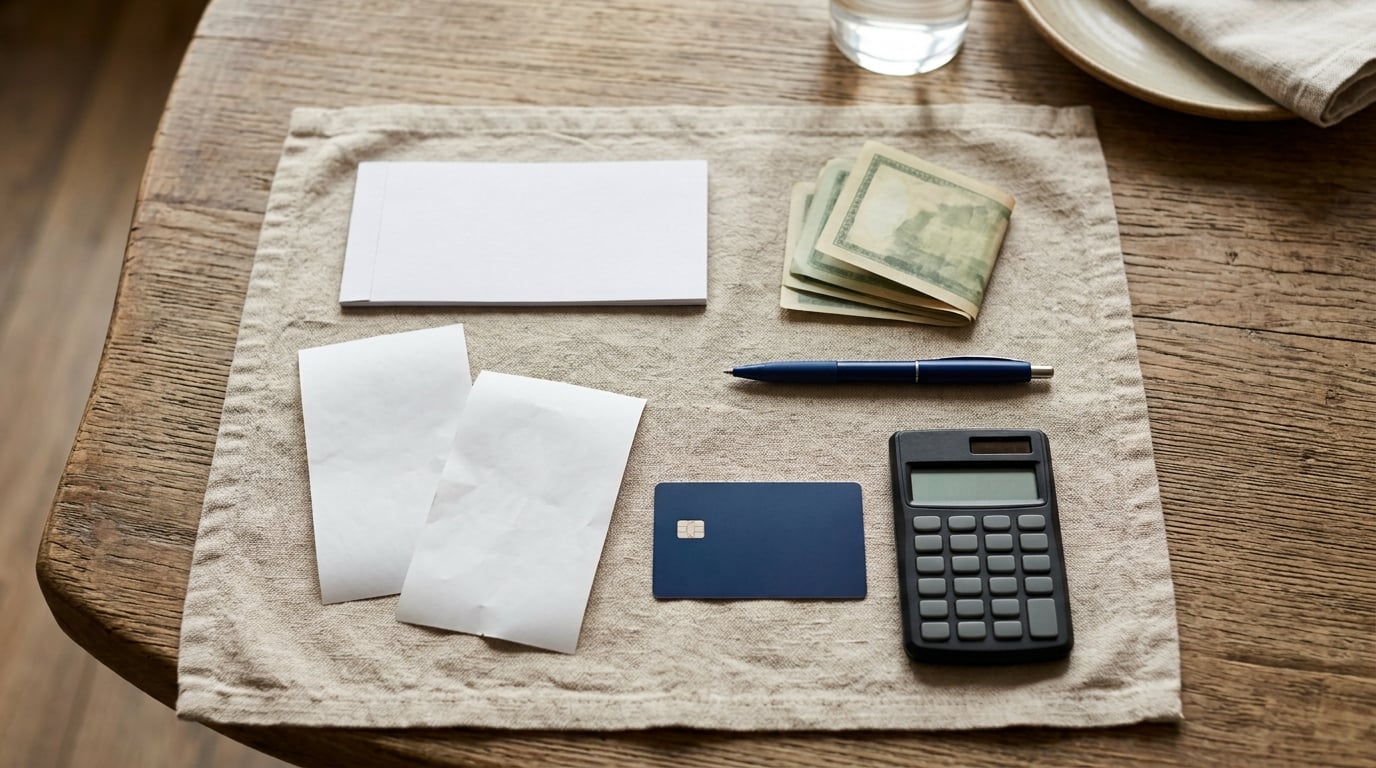
To split a check with a group, agree on the method before anyone reaches for the check: divide the total evenly, split it by what each person ordered, or have one person pay the full bill and collect from the group afterward. Tell your server which method you want when you sit down, not after the plates are cleared. Then divide the tax and tip across the same shares, confirm each amount out loud, and settle up.
Most of the awkwardness has nothing to do with money. It comes from a group deciding how to divide a bill in the last ninety seconds, when everyone is tired and pretending to look at their phone. Move that decision to the beginning of the meal and the rest is arithmetic.
You also need less than you think. No app is required, and most group dinners can be settled with a paper check, a phone calculator, and a decision everybody heard. A dinner where someone orders a ribeye and three beers next to a salad is where the method really gets tested.
What You Need
Four things, and three of them are decisions rather than tools.
- The itemized check. Ask for it as you settle up. Without line items you cannot split by what anyone ordered, no matter how well you remember the order.
- A clear list of who ordered what. Write it down at the table, before dessert. Memory is unreliable after a long meal, especially when drinks are involved.
- An agreed tipping plan. Decide whether the tip is a percentage of the whole bill or of each person’s share. Settle this before the server asks, not after.
- A payment method everyone can see. One card, several cards, or a mix of cards and cash. Whichever it is, say it out loud so the table is not surprised at the register.
That is the whole kit. A phone calculator helps, and a bill-splitting app helps more once the group is bigger than six, but neither is mandatory for a normal table.
Step-by-Step: How to Split a Check With a Group
Six steps, in order. The first three happen before the check exists, and that is where most of the work is done.
1. Decide Whether Everyone Is Splitting the Check Equally
An even split is the simplest option and often the right one, provided everyone ordered roughly the same. It works when the table is even in appetite, and it is the default expectation when nobody voiced a preference.
It stops being fair when the spread is wide. A ribeye and a bottle of wine next to a house salad is not an even dinner, and asking to pay only your own food is a reasonable request rather than a rude one. The tell is simple: if you would be uncomfortable being asked to cover a third of someone else’s entree, say something early.
Do this decision at the table, out loud, before ordering. Compare plans over drinks rather than over a printed bill.
2. Separate Personal Items and Shared Items
Sort every line into two buckets. Personal items are the entrees, individual drinks, and desserts a specific person asked for. Shared items are the appetizers, sides, and bottles that went in the middle for everyone.
Personal items go to the person who ordered them. Shared items get split evenly among the number of people at the table, including anyone who only had water. That last part matters: someone who abstained from alcohol still ate the wings.
Say the division out loud as you work through it. “The wings were for the table, so that nine dollars each is on everyone” prevents the person who ordered nothing from feeling nickel-and-dimed later.
3. Add Tax and Tip Before Calculating Each Share
Split the total the group will actually pay, which means tax and tip are already in it. Dividing the pre-tax food total and then adding a tip at the register is the most common source of confusion at the table.
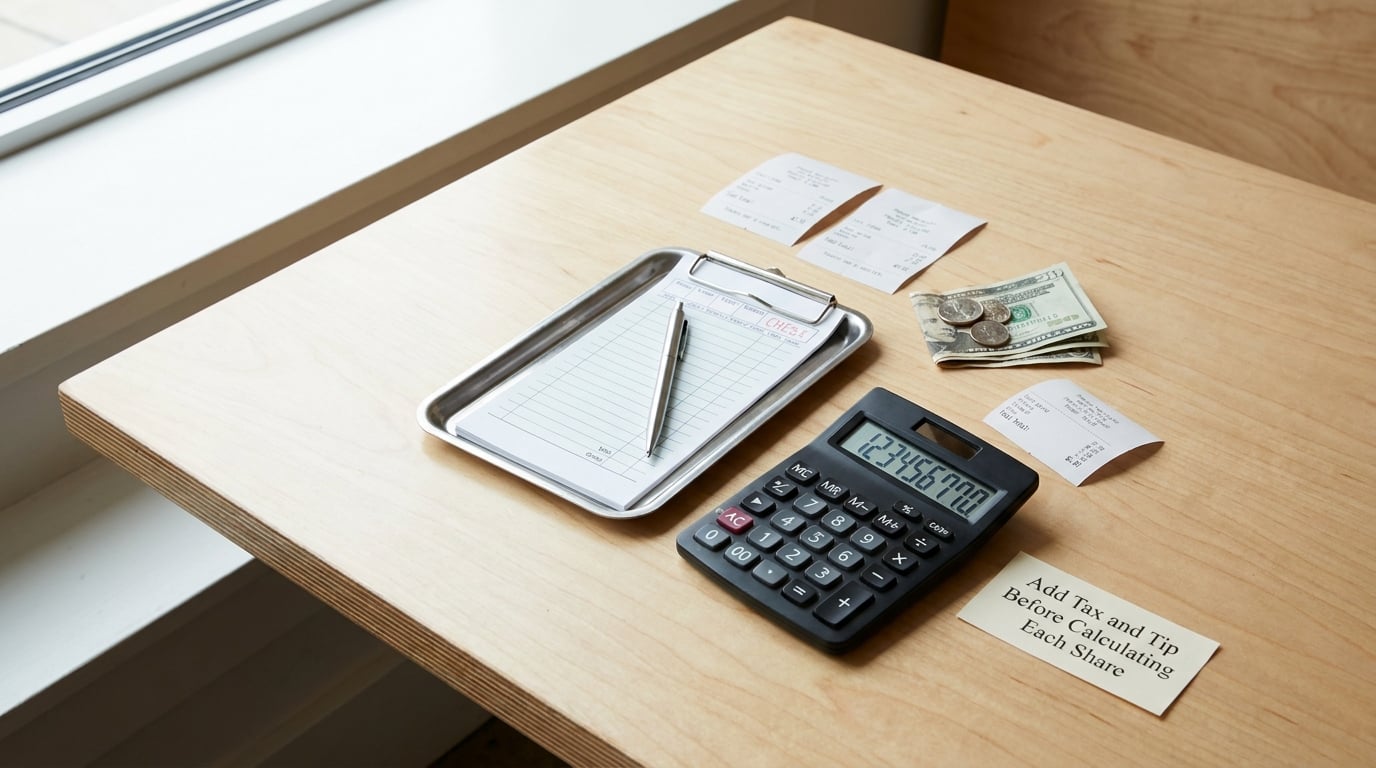
The cleanest method is a multiplier. Add the tax and tip to the subtotal, divide that combined figure by the subtotal, and apply the resulting multiplier to each person’s share. One multiplier keeps every line honest.
For a tip, 18 to 20 percent of the pre-tax subtotal is the usual range for table service. Some groups prefer a flat amount per person, which is easier to say out loud and produces the same result. A large group with a printed receipt in front of them usually appreciates someone volunteering to calculate it rather than leaving it to the server.
4. Round Each Share or Settle the Exact Total
There are two honest ways to handle the last few cents. You can settle the exact total, giving each person their share down to the penny, which is precise but adds a small arithmetic task for everyone. Or you can round each person’s share up to the nearest quarter or dollar, which is easier to hand over and leaves a small surplus.
If you round up, say who absorbs the remainder. The simplest arrangement is that the person who rounded most generously covers the leftover, or that the host who organized the meal absorbs it. Announcing this takes one sentence and prevents a group of friends from arguing over two dollars.
A worked example makes the whole sequence concrete. Five friends share a check with 165.00 in personal items and 45.00 in shared items, a 210.00 subtotal. Add 18.64 in tax and a 20 percent tip of 42.00, and the total is 270.64.
An even split gives each person 54.13. Splitting by item with the 45.00 in shared plates divided five ways adds 9.00 to each personal total, then applies a combined tax and tip multiplier of about 1.29. The result: 78.61, 39.96, 60.57, 38.66, and 52.84. The person who ordered the ribeye and two beers pays roughly 24 more than an even split would have charged them, and the person with the sandwich and a soda pays about 14 less.
Note the one-cent rounding on the second share. That is normal. Total what you hand out, and if the amounts add to a cent more than the check, one person covers it.
5. Choose the Easiest Payment Method
Four options cover almost every group dinner, and they are not equal in how much friction they create.
- One shared card. Fastest at the table. The person paying collects from the others afterward by cash or a payment app. Best for small groups and groups who trust each other to settle up.
- Multiple cards on one check. Most restaurants can ring several cards to a single check. Ask before the total is finalized so the amounts are set correctly. Best for mixed payment types.
- Separate checks. Each guest gets an itemized bill with their own food, tax, and tip. Most servers prefer to know in advance, ideally when the table is seated.
- Mobile payment. Tap to pay at the terminal or send money to the person covering the bill. Convenient, though not every server can add a tip after the check is closed.
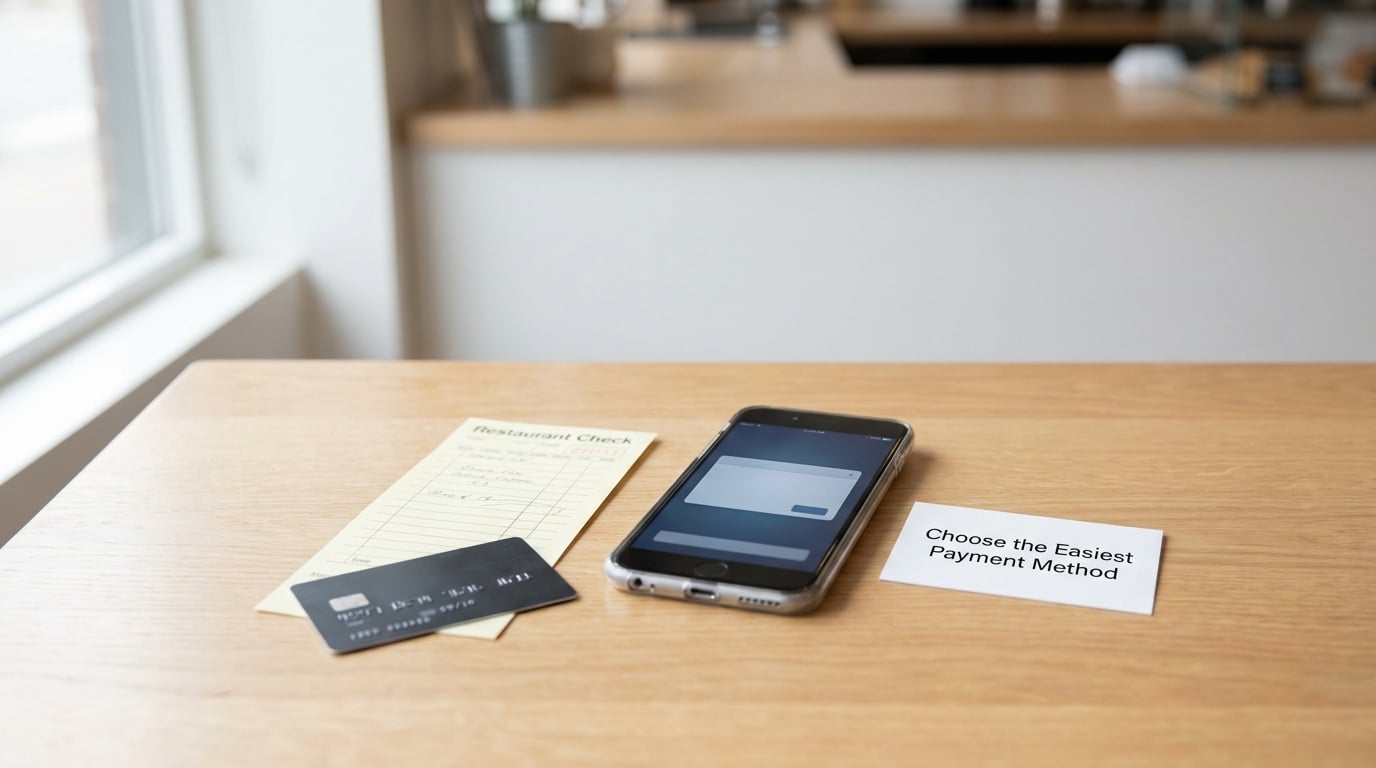
One shared card usually produces the smoothest table. Separate checks are the politest option for the server when the number of people is small, because each check arrives already balanced.
There is a limit worth knowing. Many point-of-sale systems cap the number of checks a single order can be split into, and some restaurants have a house rule against splitting a single ticket at all. Ask when you sit down rather than after the meal, and if separate checks are refused, the one-shared-card route still works fine.
6. Confirm the Amount Before Anyone Pays
Read the amounts out loud before the first card goes into the terminal. A simple check, five names and five numbers, takes fifteen seconds and catches the one line that got assigned to the wrong person.
Confirm three things: that the shared items were divided by the full headcount, that tax and tip are included rather than added afterward, and that the amounts add up to the printed total. Then pay.
Keep the receipt until the money has moved. It is the only reference anyone has if a card payment fails or a payment app transfer does not land.
Common Mistakes
Most bill disputes are process failures rather than bad intentions. These are the ones that cause the most friction.
- Dividing the pre-tax total. Add tax and tip to the figure you are splitting, or the shares will not match the check anyone actually sees.
- Forgetting shared dishes. The appetizer nobody ordered individually is the single most common source of a feeling that the bill was unfair.
- Deciding at the register. A group that starts negotiating in front of the server turns a private disagreement into a public performance.
- Arguing over cents. Decide the rounding rule before you start dividing, and say who covers any remainder. Two dollars is not worth a vote.
- Handing the server an unsorted list. If two people ordered the same dish, the server cannot know who had the fries. Mark the list yourself.
- Tipping after payment with no plan. If the plan was to tip on the total, it has to happen before the card is run. After that it is a separate transaction everyone has to remember.
- Letting the host’s generosity turn into an expectation. If one person is treating, say so plainly before ordering, not after the total appears.
One habit prevents most of the above: decide the method at the table, in front of everyone, in a sentence. “Let’s just split it evenly tonight” or “I’m good for my own food” takes two seconds and settles the question before anyone is tired.
On larger tables, keep the number of checks low. Consolidating everyone paying cash onto a single ticket keeps the server’s job simple and the wait short.
Frequently Asked Questions
Is it rude to ask for separate checks at a restaurant?
No. Asking for separate checks is a routine request that servers handle several times a shift. What matters is timing and tone: tell your server when the table is seated, not after the plates are cleared, and phrase it as information rather than a complaint. A polite line is we may need to pay separately, can you set that up? The version that lands badly is announcing it as the check arrives, which is the moment the whole room is watching.
What is the best way to split a bill at a restaurant?
The best method is the one you agree on before the meal. Split evenly when everyone ordered something comparable, split by item when orders differ a lot or someone drank less, and have one person cover the total when the group prefers to settle up afterward rather than at the table. Whichever you pick, tell your server early, divide the tax and tip on the same basis as the food, and say any rounding rule out loud before the first payment.
Should the tip be split evenly?
It depends on how the food was split. If everyone pays the same share of the meal, an equal tip makes sense. If one person fronted an expensive bottle, tipping on that person’s larger share is fairer and easy to arrange by taking a percentage of each individual total instead of a percentage of the whole bill. What you want to avoid is a tip added to the check after the shares were already calculated, because then nobody can verify it.
What is the 30/30/30 rule for restaurants?
It is an informal rule some groups use to divide a mixed check that mixes food, drinks, and a service charge, rather than treating every line the same. The percentages are not a standard and restaurants do not use them, so treat the phrase as a group convention rather than an accounting method. If your table wants to use it, agree on the three categories out loud and apply them before tax and tip are added.
Can a restaurant refuse to split a check?
Yes. Many restaurants have house rules against splitting a single ticket, and point-of-sale systems often cap the number of checks one order can become, commonly somewhere around four to six. Asking at the start of the meal is the way to find out before it matters. If the answer is no, the fallback is simple: one person pays the full total with a card, and the group reimburses them at the table by cash or a payment app.
How do I politely say I only want to pay for what I ordered?
Keep it short and say it before the order goes in, or at least before the check. Something like I am trying to keep to a budget tonight, so I will just cover my own items works well because it gives a reason without apologizing. Frame it as your plan, not as a comment on what anyone else spent. If the table pushes for an even split, offer to absorb a share of the shared appetizers so the difference comes from your own order only.
Conclusion
Start by saying which method the group is using, out loud, before the order goes in. Once the check arrives, sort shared items from personal ones, add tax and tip to the total you are dividing, and apply one consistent rule across every share.
Then settle it quickly. Read the amounts out, choose one payment method for the table, and let the server move on to the next party. The math is trivial; the calm is the part that people remember.
Once a group has sorted the bill, the rest of the evening is easier when the table has a plan for what to drink next. Our guide to pairing beer with food covers the basics, and pairing wine with steak works well when a table orders a few heavier plates together.