
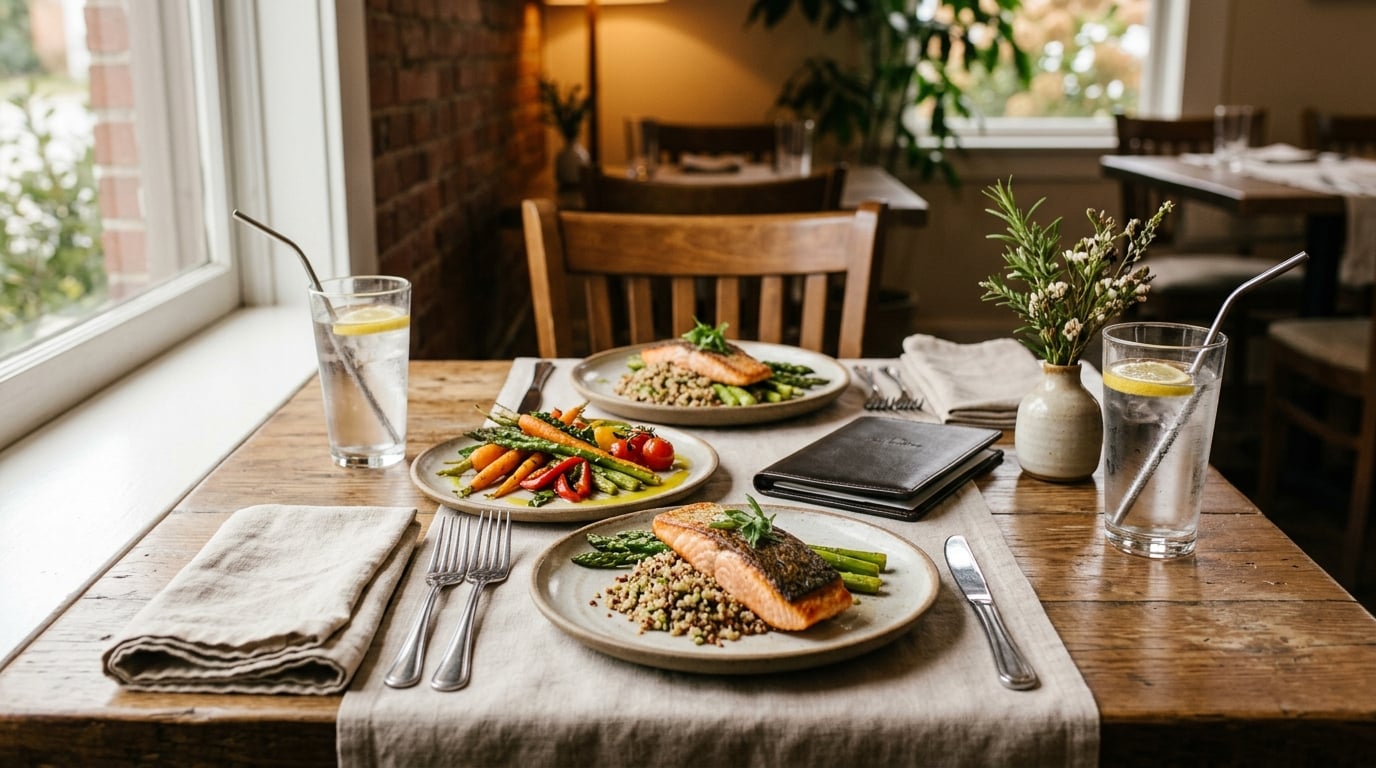
You can eat out on a budget without feeling cheap by setting your limit before you look at any menu, ordering one thing you genuinely want, and saving your money for the meals you will actually remember. The system takes about ten minutes of planning and one honest number, and it works whether you are feeding two people on a Tuesday or a table of ten on a Saturday.
The reason most budget diners feel bad is not the bill. It is the guessing. You pick a restaurant without knowing the prices, order a drink because everyone else is ordering one, add an appetizer nobody finishes, and then the check lands and you resent the whole evening. Fix the guessing and the feeling usually goes with it.
Below is the four-part system: set a limit, pick the moment and venue, order with intent, and control the extras. Each part is short on its own, and together they cover most of what people spend on restaurants in a year. Updated for October 2026.
Table of Contents
- How to Eat Out on a Budget Without Feeling Cheap
- Set a spending limit before you choose the restaurant
- Use your restaurant budget without ordering like a bargain hunter
- Choose restaurants that deliver more value for your money
- Take advantage of perks that do not change what you order
- Control drinks, parking, and other hidden costs
- Keep your restaurant choices feeling generous and enjoyable
- A simple budget-friendly restaurant night checklist
- Frequently Asked Questions
- How can I eat out cheaply and still enjoy the experience?
- Is it rude to tell a restaurant that you are on a budget?
- Should I skip appetizers and dessert to save money?
- Are prix fixe menus actually cheaper than ordering a la carte?
- How much should I tip at a restaurant when I want to save?
- What is the best budget-friendly date-night restaurant idea?
- Take the first step tonight
How to Eat Out on a Budget Without Feeling Cheap
Value dining and penny-pinching look almost identical from the outside, and that is where most people get stuck. The difference is intent. A person on a value dinner decided beforehand what the evening was worth and ordered to that. A person pinching is reacting to the menu in the moment, feeling the sticker price of every item, and trying not to be seen noticing.
Four habits carry the whole method. First, set a number before you choose a restaurant, not after. Second, choose the moment, not just the place, because the same kitchen charges very different amounts at 1pm and 8pm. Third, order one thing properly instead of five things apologetically. Fourth, know which extras lower the total and which ones quietly add to it.
None of this requires good taste to be sacrificed. In fact, the well-planned meal is usually the more interesting one, because you end up with a plate you are actually paying attention to.
Set a spending limit before you choose the restaurant
Pick your limit first, in dollars, per meal or per month, and write it down. Browsing restaurants with an open-ended budget is how a quick lunch becomes a hundred-dollar evening without a single surprise.
Start from your take-home pay rather than your gross income, since taxes and deductions are not spendable. For orientation only, budget guides commonly place casual restaurant spending somewhere between five and fifteen percent of take-home money, and the honest number for most households is nearer the low end. Personal finance rules and averages vary by country, state and household, so treat this as a starting frame rather than a target to hit.
How to calculate a realistic per-meal number
Take your monthly dining-out amount and divide by the number of meals you actually plan to eat out, including coffee and takeout. Most households underestimate this count badly, so track a normal month before setting a limit.
Then split the meal into three buckets instead of one. Food is the entree and sides. Drinks and gratuity together often add as much as the food itself, and transport or parking can quietly double the cost of a free dinner. Knowing which bucket is about to grow is how you stay inside the number without feeling it.
People who keep a dining card or a separate envelope for restaurants tend to overspend less, mostly because the boundary is visible before the order is placed. The same people report that the limit has to be flexible enough to be worth keeping, which is why a monthly cap usually works better than a rigid per-meal rule.
Use your restaurant budget without ordering like a bargain hunter
Look at the menu before you go, choose the one entree you want, and let the rest of the evening take care of itself. Bargain-hunting menus is the most tiring way to eat out and the one that most reliably ends with a mediocre meal.
Preview the menu, then commit to one entree
Most restaurants post their menu online, and reading it at home takes five minutes. Walk in knowing the price range of what you want, and the check stops being a surprise. Ordering is then a decision rather than a negotiation.
Pick lunch, early bird, or a set menu when you can
The same dish often costs a good deal less at lunch or before the evening rush, because the kitchen is running on volume instead of turnover. Prix fixe and set lunch menus are the strongest version of this, since the price is fixed and every course is already decided for you.
Share one considered dish instead of ordering around it
Sharing works when the table agrees on one dish to divide, not when four people each order an entree and add a shared appetizer nobody finishes. Ask the server what a single portion feeds.
Skip the extra courses without apologizing for it
Not ordering dessert is a preference, not a confession. Say nothing about it, enjoy the drink or the coffee that follows, and the table will not think about it at all. If you are eating out on a budget without feeling cheap, this is the single easiest habit to keep, because it costs nothing socially.
Learning how to eat out on a budget without feeling cheap is mostly a matter of making those quiet decisions privately, in advance, instead of visibly at the table.
Choose restaurants that deliver more value for your money
Judge a restaurant by what the full meal costs, not by its headline prices. A place with expensive entrees and generous portions may be better value than one with cheap entrees and thin sides, and the only way to know is to look at portions, ingredients and the rest of the bill.
Neighborhood dining rooms, lunch counters, bakeries with tables, family-style places, hotel dining rooms and tasting events all deliver different things. Some are fast and generous with bread, some give you a table for two hours, some are worth the trip once a year.
Five things predict whether a restaurant is good value, and they are all visible before you sit down.
- Portion size. Restaurants that serve a family-style entree or a salad big enough to share give you more food per dollar than a single plated portion.
- Ingredients. Seasonal, simple menus tend to cost less to make, which is part of why a set lunch is often fresher and cheaper than a long a la carte list.
- Service. Counter service and lunch counters cut labor costs, and that saving reaches you as a lower check rather than a worse evening.
- Atmosphere. A room you like is part of the value. You are paying for an hour away from your kitchen, and the setting is part of what you bought.
- Total expected cost. Add the entree, the drink you will actually order, tax, tip and parking before comparing two places.
Local knowledge beats any app. Half-price nights, a set lunch regulars only know about, or a bakery that seats twelve people after 2pm are the details that generic deal sites never list. Ask the person who works near you, or the neighbor who has been eating there for a decade.
If you enjoy cooking, our guide to making brunch for a crowd without stress covers the other side of the same coin, because feeding a group at home is often the best-value meal of the month.
Take advantage of perks that do not change what you order
The best discounts are the ones that arrive before you decide anything. Happy hours, set menus, weekday specials, tasting menus, bar snacks, kids’ menus, newsletters, loyalty programs and discounted gift cards all reduce the effective cost of the same meal.
Perks that genuinely lower the total
- Happy hour and aperitivo hours. Often a third off drinks and bar snacks, and the food is meant to be shared, so two people can build a whole evening from it.
- Set lunch and prix fixe menus. A fixed price for several courses is the most reliable discount in restaurants, and the value is usually better than ordering the same dishes a la carte.
- Weekday and early-bird specials. Tuesday or Wednesday pricing, and pre-5pm reductions, reward flexibility more than loyalty.
- Chef’s tasting or counter menus. Shorter, fixed menus on quiet nights, frequently offered at a lower price than the main dining room.
- Newsletters, email lists and social accounts. Most restaurants send a first-visit offer, a birthday perk, or an occasional discount, and the first one is usually the best.
- Loyalty programs and restaurant apps. Free side on a visit, points toward a meal, or a birthday reward. Worth joining the four or five places you visit most, not twenty.
- Kids’ menus and kids-eat-free nights. Real savings for families, since one free child takes a meaningful bite out of a four-person check.
- Discounted prepaid gift cards. Buying a card slightly below face value and treating it like a gift budget turns a lump sum into several planned meals.
Perks worth ignoring
Coupon clubs, daily deal sites and cashback offers are usually small percentages on top of an unchanged total, and they add steps to every visit. A 10 percent discount on a meal you were already budgeting for is not a saving in any meaningful sense. Take the deal when it appears, but do not order more to qualify for it.
Split checks and reservation timing sit in the same category. Splitting a check costs nothing, and booking the earliest or latest available table is often how you get a quieter room and a better meal at the same price.
Control drinks, parking, and other hidden costs
Drinks, tax, tip and getting there are where the real money goes, and they are the parts people forget. A dinner that felt reasonable can lose a third of its value by the time you park.
Budget for the drink deliberately
Water with a slice of lemon is a legitimate order, and nobody at the table will notice or care. If you do drink, decide before you sit down, and consider one drink rather than a round that keeps growing. A mixed drink often costs more than the entree, which is why wine by the glass and tap water are the two biggest levers in most menus.
Count the invisible lines on the check
- Tax. Usually somewhere around seven to ten percent, higher in a few cities. It is a fixed cost of the evening, not an optional extra.
- Gratuity. Eighteen to twenty percent is the standard for table service, more for larger groups. Check the menu for an added service charge before assuming it is included.
- Delivery and pickup fees. Fees, small-order minimums and surge pricing can turn a takeout meal into a dine-in one. Ordering directly from the restaurant is usually cheaper and tastes the same.
- Parking and transit. A valet fee can exceed the entree. A restaurant two stops away on the train is a better-value dinner than one with free parking across town.
- Minimums and auto-gratuities on large parties, which are worth checking before you invite eight people to a steakhouse.
Asking for a water glass and taking the train are not ways of looking thrifty. They are simply decisions, and nobody is keeping score.
Keep your restaurant choices feeling generous and enjoyable
Generosity toward the people you are with is what removes the feeling of cheapness, and it costs nothing to fake. It is attention, not spending, that makes a meal feel abundant.
Order confidently, at any price point
People read hesitation as uncertainty, not frugality. Decide in the first two minutes what you are having, ask the server one real question about the food, and order it. A person who knows what they want is more pleasant company than one apologizing over a menu.
Let someone else pick, sometimes
On birthdays and occasions that matter, put the venue in someone else’s hands and stop watching the total. Everyone should get a few meals a year that are not optimized. That is the whole idea behind strategic splurging: be ordinary on Tuesday so you can be generous on the night that counts.
Split without making a production of it
When the bill is uneven, separate checks or pay your own share without narrating it. The words that work are short and dull, which is exactly why they work: I have an early start, I am covering my own, send me your half and I will settle up. Apologizing is what makes it awkward, not the split itself.
Talk about the food, not the bill
Never comment on whether a place is expensive in front of the table, and never say you are on a budget. Nobody needs to know your number. Praise the dish, ask about the sauce, pass the bread. Silence about money is polite, and the meal keeps its tone.
Deciding what the evening is for
Two hours of conversation, a birthday, a catch-up, a week that went badly. Whatever it is, an evening with a purpose is worth paying for and easy to justify inside a limit, because the money bought something specific rather than nothing in particular.
A simple budget-friendly restaurant night checklist
Run this list before, during and after, and it takes less time than reading the menu twice. It is the version that works on a weeknight when you are tired and not thinking straight.
Before you leave
- Decide your limit for this meal, in a number, before choosing anywhere.
- Check the menu online and confirm the main dishes and drinks fit that number.
- Compare the full expected cost, including tax, tip and getting there, not just the entrees.
- Book the earliest or latest table if a quieter room matters to you.
- Check for a set menu, a weekday special, or a first-visit offer in the restaurant’s emails.
While you are there
- Decide on your entree in the first two minutes and order it without commentary.
- Choose one entree and one drink, plus one thing the table shares if you want it.
- Pick water or one drink, decided in advance rather than in the moment.
- Share one considered dish rather than ordering around an appetizer.
- Choose your one indulgence, and let it be the thing you talk about all night.
After the bill
- Check the math: food, tax, tip, drinks, parking. Note anything unexpected while you are still there.
- Log it in whatever you use to track spending, the same day.
- Move anything still needed for the next meal onto your list, and check the balance of the month’s budget.
Frequently Asked Questions
How can I eat out cheaply and still enjoy the experience?
Spend on the meal itself and cut the add-ons. Choose a restaurant with a set menu or a generous portion, order one entree and one drink, and share a single dish instead of ordering around an appetizer. Sitting somewhere you like and being present is the part that makes a meal feel like an occasion, and it costs nothing extra.
Is it rude to tell a restaurant that you are on a budget?
It is unnecessary, and you should skip it. Servers are not judging your check, and mentioning money tends to lower the tone of the table. The exception is a genuine allergy or a real service issue, where you should always say so plainly. If a set menu is what you want, order it and describe the dishes rather than quoting a number.
Should I skip appetizers and dessert to save money?
Skip them silently rather than announcing it. Most of the saving comes from the drinks that arrive alongside an appetizer, not from the food itself. If the table is ordering starters, you can have one and eat half, which is usually the easiest way to join in without paying for a whole extra course. A coffee or a small glass afterward satisfies the finish at a fraction of the cost.
Are prix fixe menus actually cheaper than ordering a la carte?
Almost always, and that is the point of them. A fixed-price menu gives you several courses for one set price, while the same dishes ordered separately cost considerably more, especially once drinks are added. Prix fixe menus are most common at lunch, where the kitchen is running on volume. They are the easiest way to eat well out on a regular basis without doing any arithmetic at the table.
How much should I tip at a restaurant when I want to save?
Tip eighteen to twenty percent of the pre-tax total for table service, which is the US convention, and check the menu first in case a service charge is already added. Tipping is part of the cost of dining out and should be budgeted as one of your three buckets, not treated as an optional extra. Counter service and takeout generally are not tipped, though a small amount is appreciated.
What is the best budget-friendly date-night restaurant idea?
Pick a place with a happy hour or a bar menu, where two people can share two or three small plates and one drink each, and stay longer than a sit-down dinner allows. A set menu at lunch is the other reliable option, and it is quiet enough for conversation. The best budget date nights are early and unhurried, not cheap ones, so reserve the first table and stay for a second coffee.
Take the first step tonight
Decide your number for the next month, pick two nights you will eat out, and browse a menu for one of them right now. When you find a place where the whole meal fits the number, book it and stop thinking about it.
Then run the four parts. Set the limit before you choose, pick the moment and venue, order one thing properly, and keep an eye on drinks, tax, tip and parking. Spend big on the two or three meals a year that are genuinely worth remembering, and stop optimizing the rest. That is how to eat out on a budget without feeling cheap: the limit is a decision you made once, and the evening is a good time.