
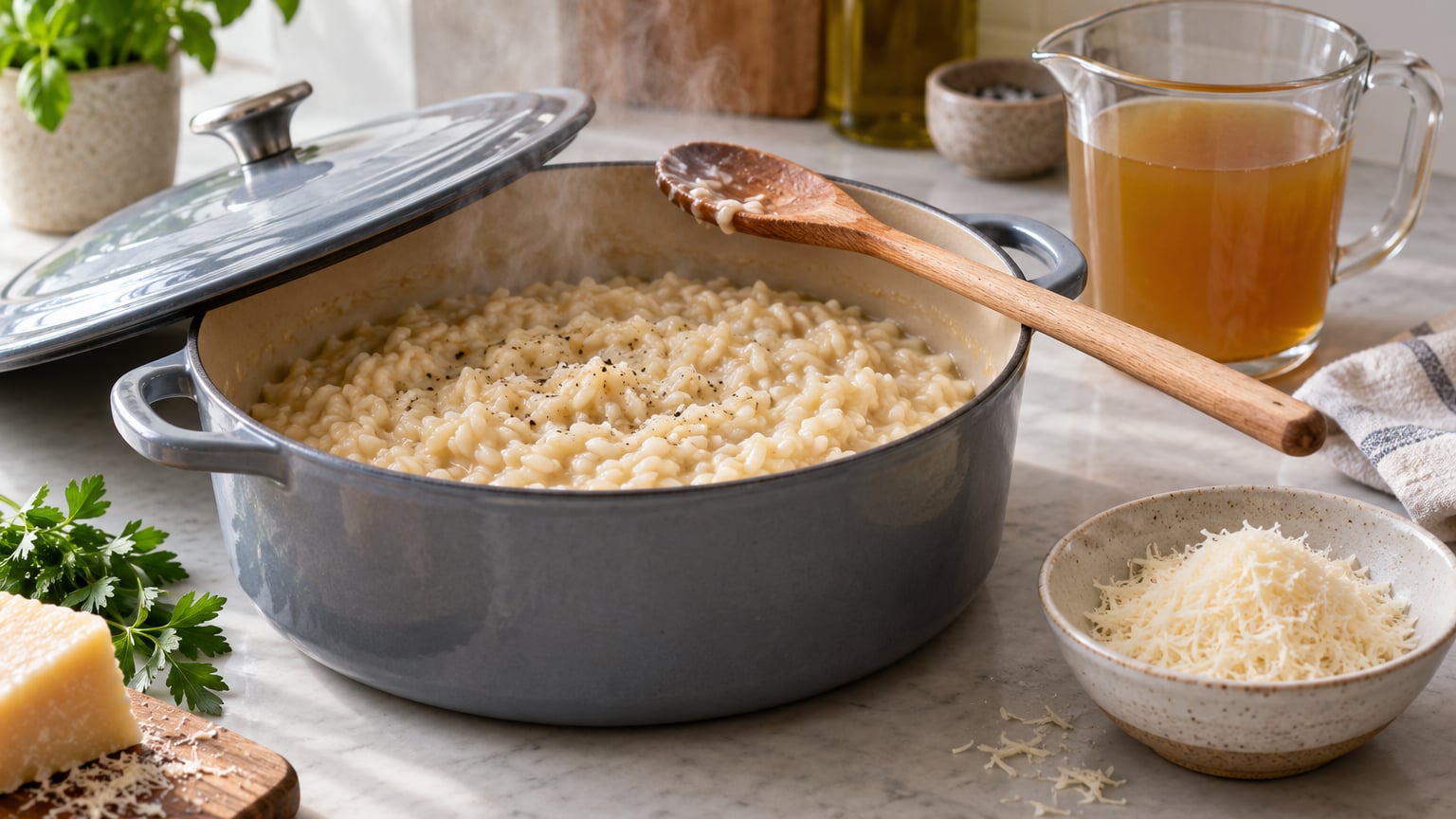
Yes, you can make risotto without constant stirring. Toast the rice, pour in all the warm broth at once, bring it back to a bare simmer, then cover the pan and cook on your lowest heat, stirring only two or three times across the whole cook. Hands-on time drops to about three minutes. Total time is still 35 to 45 minutes, because the rice needs that long to soften.
The stirring reputation is the single biggest reason people skip risotto at home. Constant stirring costs you 20 to 30 minutes of unbroken attention and a sore wrist, and you cannot leave the kitchen, prep a salad, or answer the door. Covering the pan changes the physics of the cook: trapped steam keeps hydrating the grains between interventions, which is what a spoon was really doing all along.
Do You Really Have to Stir Risotto Constantly?
No. You have to stir occasionally, and the difference matters more than most recipes admit.
Here is what the stirring actually does. Short-grain rice such as arborio or carnaroli has a starchy core wrapped in a thin shell. Rubbing grains against each other grinds off amylopectin, the waxy starch on the surface, and that starch suspended in the cooking liquid is what reads as creaminess on the plate. There is no dairy in the pan. This is why a risotto that never touched butter still tastes rich.
A lid substitutes for the spoon. Steam stays in the pan, condenses on the inside of the lid, and drips back down, so the rice keeps absorbing liquid without you agitating it. What the lid cannot do is stop a dry patch from forming on the bottom of the pan, and that is the one job your spoon still has.
Over-stirring is a real failure mode too, not just an unnecessary habit. Vigorous, frequent stirring breaks the grains down, and the extra starch turns the pan gluey rather than creamy. Home cooks describe risotto as nice and sticky but too dense, and they usually blame their stirring. In practice it is almost always the broth ratio, the pan size, or the heat setting.
Plenty of cooks have made this work at home already. On r/Cooking the consensus is blunt about it: measure out the right amount of broth, gently toast the rice in the fat, then dump it all in. Other readers report that stopping to chop vegetables for two minutes made no difference at all.
What You Need
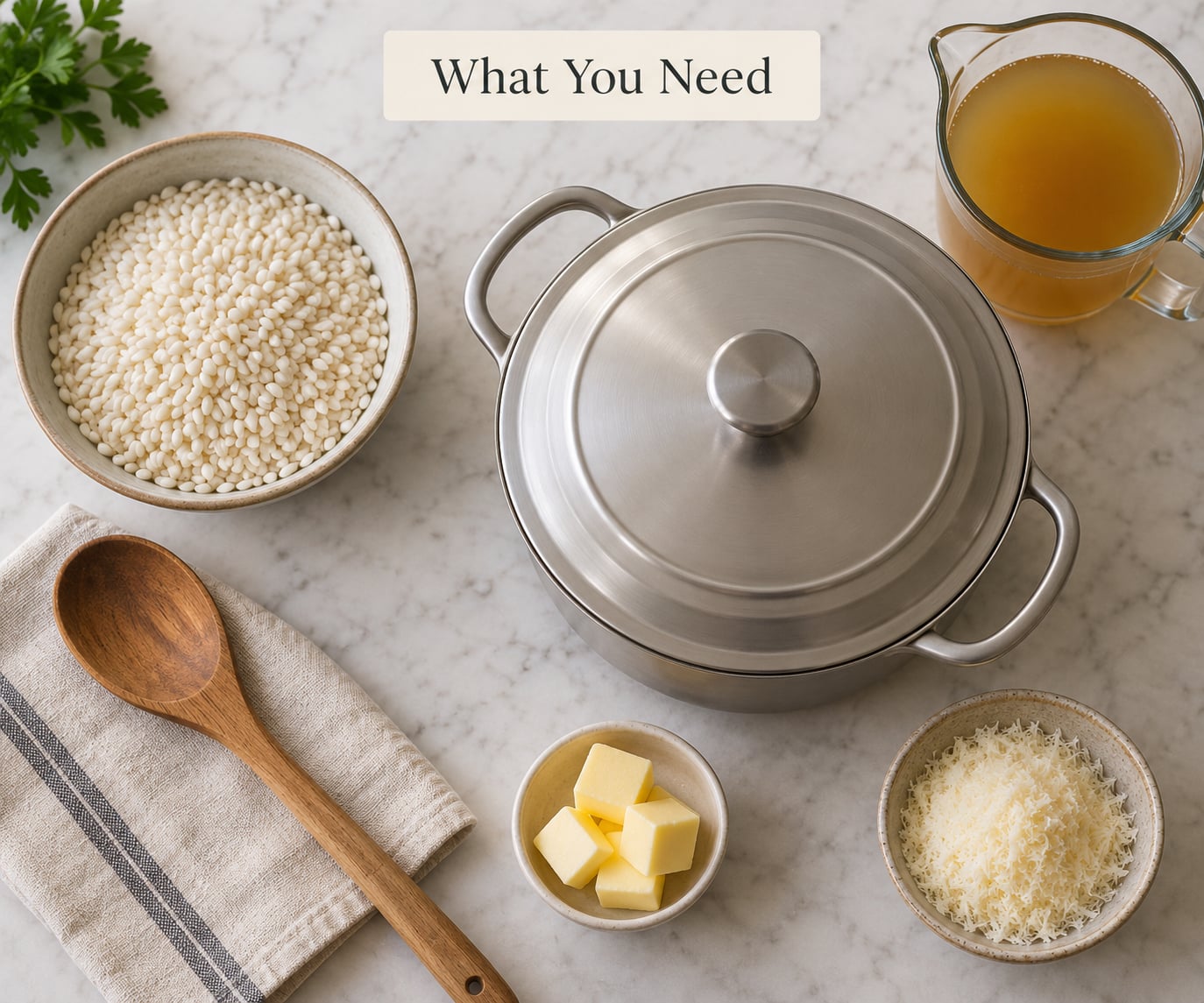
Rice. Carnaroli is the best fit for a low-stir method. The grains are larger and firmer than arborio, so they take on liquid slowly and evenly while you are not touching them, and they hold an al dente bite through the covered phase. Arborio works everywhere and is easier to find, but it releases starch faster, so it needs slightly more attention. Vialone nano is the premium pick, smaller and starchier, and it tolerates a long covered cook better than anything else. Short-grain is the family these all come from. Avoid long-grain and jasmine entirely.
Broth. Warm broth, not cold, because a cold pour drops the pan temperature and stalls the cook. Low-sodium is the safer choice since you season at the end and Parmesan adds plenty of salt. Chicken or vegetable broth both work. Home-made is better, store-bought is fine. Keep it at a bare simmer in a side pot, or crumble a bouillon cube into the pan with the rice and use just-boiled water from the kettle, which removes the second pan entirely. If you are building a pasta dish alongside, our guide to cacio e pepe without clumping covers the same warm-water-and-starch principle.
Pan. A wide, heavy saucepan with a lid that fits flat on top, ideally 12 inches across for four servings. The pan-to-burner match is the real substitute for stirring. If your pan is much wider than your burner, the edges cook while the center dries out. Too narrow and the rice stacks and scorches. Nothing sticks as badly as a heavy pot with an even base, so spend your effort there rather than on a better spoon.
Utensils. A wooden spoon or a silicone spatula for the few interventions, plus a fine-mesh strainer if you rinse the rice.
Finishing. Cold butter, cut into cubes, and finely grated Parmigiano Reggiano. Cold matters. Straight-from-the-fridge butter melts into the starch instead of splitting it, and pre-grated cheese clumps.
Optional. A splash of dry white wine, a shallot and garlic, olive oil for the toast, and whatever seasonal flavor you want folded in at the end.
Step-by-Step: How to Make Risotto Without Constant Stirring
1. Soak and Rinse the Rice (Optional)
Rinsing under cold water for 30 seconds until the water runs nearly clear washes off the loose surface powder, which is exactly the starch that makes the finished risotto gluey if you leave it on. Soaking for 10 or 15 minutes in cool water lets the grains take on water evenly, so they finish cooking at the same rate under the lid. Workable cues: the water stops clouding, and the grains look uniformly pale rather than chalky white with a white core.
2. Toast the Rice Without Crowding the Pan (Tostatura)
Melt a tablespoon of butter with a drizzle of olive oil over medium heat. Add the drained rice and spread it into a single layer. Toast for 2 to 3 minutes, stirring twice, until the grains smell nutty and the edges look translucent with a tiny white pearl still at the centre. That translucent edge is your cue that the starch has moved to the surface and is ready to release.
Crowding the pan drops the temperature and steams the rice instead of toasting it. If your rice sits in a thick layer, toast in two batches. Add a finely diced shallot for the last minute and a pinch of salt.
3. Deglaze With Wine (Sfumatura)
Pour in 150 ml of dry white wine and let it bubble away until the pan looks dry, about 2 minutes. That is the sfumatura, and the wine has to go all the way or the dish tastes sharp and raw. No wine is fine; substitute the same amount of broth and give it the same two minutes to reduce. Once the pan is dry, add all the warm broth at once, plus the rice, and stir gently for 30 seconds to loosen everything from the bottom.
4. Add the Broth and Cook It Covered
Bring the pan back to a bare simmer with the lid on, then drop the heat to the lowest setting your stove has. Cook covered for 10 minutes completely undisturbed. The steam is hydrating the rice while you go do something else.
At the 10-minute mark, lift the lid, stir once from the bottom, and shake the pan firmly to redistribute the grains. That shake is what stops the top from drying out and the bottom from forming a crust. Put the lid back on for another 8 to 10 minutes.
Lift the lid and drag a spoon or spatula across the surface. If the gap fills slowly, the starch has thickened enough and the rice is close. If the gap fills instantly and the liquid pools, it needs more time. Taste one grain: firm at the centre means another few minutes, no resistance at all means stop now. Overcooked grains turn to paste, and no amount of butter fixes that.
5. Loosen and Finish Off the Heat (Mantecatura)
Take the pan off the burner. Wait a minute, then beat in 50 g of cold butter and 60 g of grated Parmesan with a wooden spoon, moving briskly so it emulsifies rather than sits in streaks. If the risotto holds its shape and looks tight, loosen it with a splash of warm broth, a tablespoon at a time, until it flows.
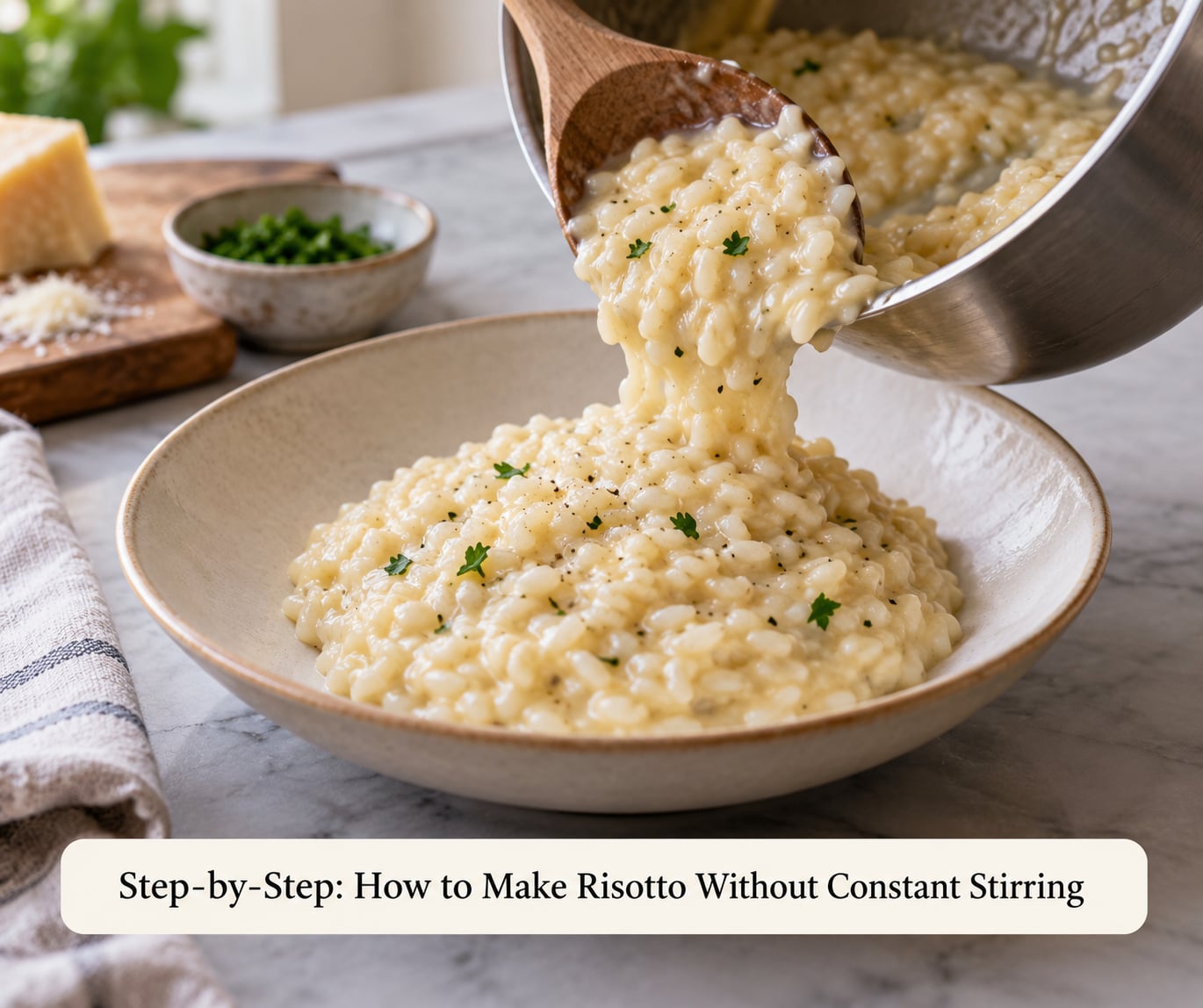
The test Italians call all’onda: tip a spoonful onto a warm plate and it should spread slowly in a wave, not sit in a dome and not flood outward. Cover the pan and let it rest for 2 minutes before serving, so the butter and cheese settle in. Serve in warm shallow bowls within a few minutes. Spooning works better than spreading, and it goes further.
How Often to Stir: A Phase-by-Phase Schedule
| Phase | Time | What you do |
|---|---|---|
| Tostatura | 2 to 3 min | Two stirs to keep the rice toasting evenly |
| Sfumatura | 2 min | No stirring once the wine is in |
| Broth added | 30 sec | One gentle stir to combine and unstick |
| Covered, first | 10 min | Nothing. Leave the pan completely alone |
| Covered, second | 8 to 10 min | One stir and a hard shake of the pan |
| Mantecatura | 2 min | Beat in butter and Parmesan off the heat, then rest covered |
That is three stirs across the entire cook, and zero of them constant. If you want the absolute minimum, skip the shake at ten minutes and just check the pan at 20; the results are close and the effort is near zero. For comparison, our guide to creamy soup without heavy cream uses the same starchy-thickening logic on a different timeline.
No-Stir Risotto in the Oven and Pressure Cooker
The oven is the most forgiving version. Toast the rice on the stove, deglaze, then transfer everything to a Dutch oven with the broth. Cover tightly, tuck foil under the lid to seal the steam, and bake at 200°C (400°F) for 15 to 25 minutes. Stir once halfway if the oven runs hot. Guests call it crowd-pleasing rather than restaurant-grade, which is fair.
An Instant Pot or pressure cooker does it in about 8 minutes on high pressure, natural release, with no stirring at all. A microwave needs covered broth and rice at high for 15 to 17 minutes, stopped and stirred once, then a further 2 minutes. Both trade away some grain texture for the convenience.
Common Mistakes and How to Fix Them
The bottom scorched. Nearly always a heat problem, not a stirring problem. Move the pan to a smaller burner or lower the flame, and use a diffuser if you have one. A heavy pan with an aluminium or copper base spreads heat far better than a thin one.
The risotto is watery and won’t thicken. Simmer it uncovered over medium heat for 3 to 5 minutes, stirring, until the liquid reduces. If it is still loose, you used too much broth; let it keep reducing. You cannot add starch back in.
The risotto is dense, sticky or pasty. Too much liquid or too much surface starch, almost never too much stirring. Loosen it off the heat with warm broth, a spoonful at a time, and beat hard with the butter. Next time rinse the rice properly and cut the broth by half a cup. This is the most common complaint in r/AskCulinary and the fix is nearly always the ratio.
The grains are hard in the centre. Undercooked, or the heat was too low and the cook ran long before you noticed. Add 100 ml of hot broth, cover, and give it 5 more minutes. Check earlier next time: the covered cook is usually done at 18 to 20 minutes, not the 25 to 30 many recipes claim.
It tastes salty. You seasoned early and the broth reduced. Dilute with a splash of unsalted broth or water and add more Parmesan, which brings salt and depth together.
The risotto stiffens in the bowl. Expected. Risotto continues absorbing as it sits, and that fast spread on the plate is the point. Serve it immediately, in warm bowls, and loosen leftovers with broth on the reheating.
Storing and Reheating Safely
Cool leftover risotto fast and get it into the fridge within two hours, in a shallow container, and eat it within three to four days. Cooked rice keeps growing Bacillus cereus bacteria as it sits, and reheating kills the bacteria but not always the toxins, so reheating thoroughly in a covered pan with a splash of broth matters more than usual here.
Variations That Cost No Extra Work
Fold in cooked mushrooms, a spoonful of pumpkin puree, lemon zest and chopped parsley, or a few saffron threads bloomed in a tablespoon of warm broth. Add vegetables and hard cheese off the heat with the butter. For a meatless plate that still has weight, our method for a filling meatless dinner pairs well with the finished bowl.
Frequently Asked Questions
Do you really need to stir risotto constantly?
No. Toast the rice, add all the warm broth at once, bring it to a bare simmer, then cover and cook on the lowest heat for 10 minutes. Stir once, shake the pan, cover again for 8 to 10 minutes. That is three stirs across the whole cook. Over-stirring breaks grains down and makes the texture gluey, not creamier.
What is the best broth for risotto?
Warm, low-sodium chicken or vegetable broth, kept at a bare simmer in a side pot. Cold broth stalls the cook and uneven temperature is the main cause of a patchy finish. You can skip the side pot entirely by crumbling a bouillon cube into the toasted rice and pouring on just-boiled water from the kettle.
How do I fix too much liquid in risotto?
Move the pan to medium heat with the lid off and let it simmer for 3 to 5 minutes, stirring, until the liquid reduces and the surface turns matte. Keep tasting the grain. You cannot add starch back to thin rice, so reduction is the only repair. Next time measure carefully and remember you may not use every last ladle.
Can you make risotto without wine?
Yes. Replace the wine with the same amount of broth and let it reduce for the full 2 minutes so the pan is dry before the rest of the broth goes in. The wine adds acidity and depth rather than structure, so the dish is very slightly flatter without it but still creamy. Stock cubes and vegetable versions were built this way anyway.
Do I have to wash arborio rice before making risotto?
Rinse it for about 30 seconds until the water runs nearly clear. That washes off the loose surface powder, which is the starch that turns a no-stir risotto gluey if you leave it on. A 10 to 15 minute soak is optional but helps the grains cook at an even rate under the lid. If your rice is sold pre-rinsed, you can skip both.
How long does risotto take if you do not stir it?
Plan on 35 to 45 minutes total, and expect about 18 to 20 minutes of covered cooking time after the broth goes in. The rice needs the same time to soften whether or not you stir it. Many recipes claiming 20 minutes are counting the covered phase only, which is why so many people find their risotto still hard.
Start with the two things that make the hands-off method work: measure your broth before you light the burner, and match your pan to the size of the flame. Toast, add all the warm broth at once, cover, go do something else for ten minutes. That is the whole trick.