
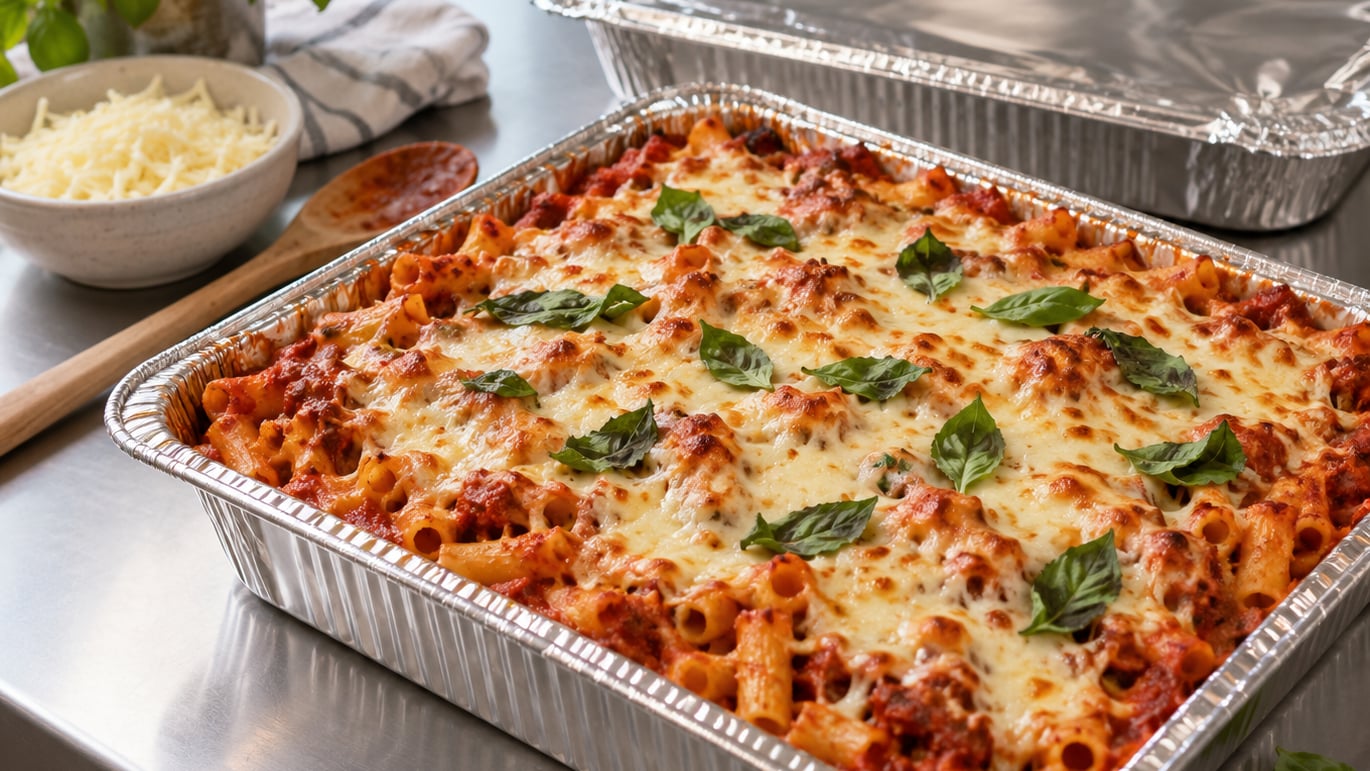
Cooking baked ziti for a crowd comes down to pan count and pacing, not a fancier recipe. Two 9-by-13-inch dishes cover about 16 people, a jumbo casserole serves 12 to 20, a half steam-table pan stretches to 20 servings, and a full steam-table pan feeds roughly 40. Knowing how to make baked ziti for a crowd well comes down to three habits: cook the pasta short of al dente, keep every layer shallow, and bake covered before a short uncovered blast for the browned top.
The whole batch takes 30 to 40 minutes of prep and 45 to 80 minutes of oven time. Scaling up means repeating pans side by side, not pouring everything into one deeper dish, and that single decision is what keeps a 40-serving tray from turning into a wet, cold-center casserole.
Table of Contents
- What You Need
- Step-by-Step
- Common Mistakes
- Frequently Asked Questions
- How many 9×13 pans of baked ziti do I need for 20 people?
- How much pasta do I need to make baked ziti for 40 people?
- Can baked ziti be prepared ahead of time?
- How long does a large tray of baked ziti take to bake?
- How do I keep baked ziti hot for a party?
- How many people does a half steam-table pan of baked ziti serve?
- Conclusion
What You Need
A 9-by-13-inch pan of baked ziti feeds 8 to 10 people as a main dish. That is the number most home recipes assume, and it is why so many hosts underestimate. Everything else in this guide scales from that pan.
Beyond the pan, you want a pot large enough that the pasta moves freely, two or three mixing bowls, a sheet pan to set foil pans on, foil, a wooden spoon, and an instant-read thermometer. The thermometer is not fussy equipment; it is the only reliable way to tell the middle of a 4-inch-deep steam tray is actually hot.
For a crowd, choose pans by the number of people, not by ambition.
| Head count | Pan to use | Pans needed | Total servings | Bake at 375F |
|---|---|---|---|---|
| 6 to 8 | 9-by-13-inch glass or metal dish | 1 | 8 | 25 min covered, 15 min uncovered |
| 10 to 16 | 9-by-13-inch dish | 2 | 16 | 35 min covered, 20 min uncovered |
| 20 | Jumbo casserole dish, or 2 half steam-table pans | 1 or 2 | 12 to 20 | 40 min covered, 25 min uncovered |
| 30 | One full and one half steam-table pan | 2 | 30 | 45 min covered, 25 min uncovered |
| 40 | Full steam-table pans, 4 inch deep | 2 | 40 | 50 min covered, 30 min uncovered |
Plan on about 8 ounces of finished ziti per adult at a buffet and 6 ounces if you are serving sides. That is roughly 3 ounces of dry pasta per person, and it is the multiplier behind every number in the recipe table below.
Baked Ziti Ingredients Scaled for 12, 20, 30 and 40 Servings
Buy sauce in 26-ounce jars. Counting jars is far less error-prone at 40 servings than eyeballing half-cups, and it is the unit most crowd recipes are built on.
| Ingredient | 12 servings | 20 servings | 30 servings | 40 servings |
|---|---|---|---|---|
| Ziti or penne, dry | 2 lb | 3 lb | 4.5 lb | 6 lb |
| Marinara sauce, 26 oz jars | 3 jars | 5 jars | 7 jars | 9 jars |
| Whole milk ricotta | 16 oz | 24 oz | 36 oz | 48 oz |
| Mozzarella, shredded | 16 oz | 24 oz | 36 oz | 48 oz |
| Parmesan, grated | 4 oz | 6 oz | 9 oz | 12 oz |
| Sour cream | 1/2 cup | 3/4 cup | 1 cup | 1 1/4 cups |
| Eggs, for the ricotta binder | 2 | 3 | 4 | 5 |
| Ground beef, optional | 1 lb | 1.5 lb | 2 lb | 2.5 lb |
A few ingredient notes for the largest batches. Shred your own mozzarella if you can; pre-shredded cheese carries anti-caking powder that turns grainy under a long bake. Ricotta mixed with sour cream, one egg and half the parmesan keeps the layers from sliding apart when you cut it. Fresh basil goes on after the oven, never before, because it burns to black within minutes.
For a meatless tray, swap the beef for a pound of mushrooms plus a few cups of baby spinach per 20 servings. For a four-cheese version, provolone replaces half the mozzarella and a little pecorino sharpens the parmesan.
One more piece of equipment matters more than people expect: your oven. Two pans side by side on separate racks bake in the time listed above. Three or four deep trays crowd the oven, block the airflow and can push the time out by 15 to 20 minutes, so stagger the batches instead. Our guide to cooking brunch for a crowd without stress runs through the same oven-capacity logic if you are planning a full meal.
Step-by-Step
The order never changes, whether you make two pans or ten: brown the meat if you are using it, cook the pasta, build the sauce, mix the ricotta, layer, cover and bake, then rest and serve. At scale the only thing that gets harder is keeping your hands moving in the right order, so here is the whole sequence before the delicate parts.
- Heat the oven to 375F. A cold oven delays every pan you planned to bake.
- Brown 1 pound of beef per 12 servings, breaking it up until no pink remains.
- Boil the pasta two minutes short of the package time in heavily salted water.
- Warm the marinara with seasonings in a pot big enough to stir with a wooden spoon.
- Mix ricotta, sour cream, egg and parmesan in a bowl while the water heats.
- Toss the drained pasta with sauce, layer into pans, dot ricotta, top with mozzarella.
- Cover with foil, bake, uncover, and bake again until bubbling and browned.
- Rest 15 to 20 minutes before cutting, and hold above 140F for a buffet.
How to Cook the Ziti Without Making It Mushy
Pasta that finishes tender in the pot turns to paste in the oven, because it keeps drinking moisture for another 40 minutes. Pull it two minutes early and you protect the texture of the finished dish.
Give yourself room. Six pounds of ziti wants roughly 12 gallons of water, so a stockpot or two linked together beats cramming a Dutch oven. Salt it hard, about 1 tablespoon per gallon, since the water seasons the pasta and most of that water ends up in the sauce.
Drain thoroughly and skip the rinse for baked dishes. While the pasta drains, tip it into the warm sauce and stir, or toss it with a thin film of olive oil so it does not weld itself into a solid block while you assemble the rest.
You will know it worked when a broken piece bends without snapping and still shows a pale, firm core in the center. If it already feels soft, it is too far gone for the pan.
How to Build a Creamy Large-Batch Sauce
Use about one 26-ounce jar of sauce per pound of pasta, then add a second jar for every pound after the third. Nine jars for six pounds of pasta is the 40-serving number in the table, and it is what stops a large tray from tasting like tomato water with noodles in it.
Warm the sauce in a pot with minced garlic, a teaspoon of Italian seasoning and a pinch of red pepper flakes. If it thickens while it simmers, loosen it with a splash of water or heavy cream; a sauce that pours rather than sits coats the pasta evenly when you toss them together.
Season after the mix, not before. Pasta water is salted, so a sauce that tastes right in the pot can turn bland once the pasta drains into it. Taste a spoonful of sauce clinging to a noodle after tossing and decide there.
Rising from the pot to the pan, this is where most crowd recipes succeed or fail. Warm sauce and pasta move together; cold sauce sits in the bottom of the dish while the cheese browns on top.
How to Layer Baked Ziti for Even Portions
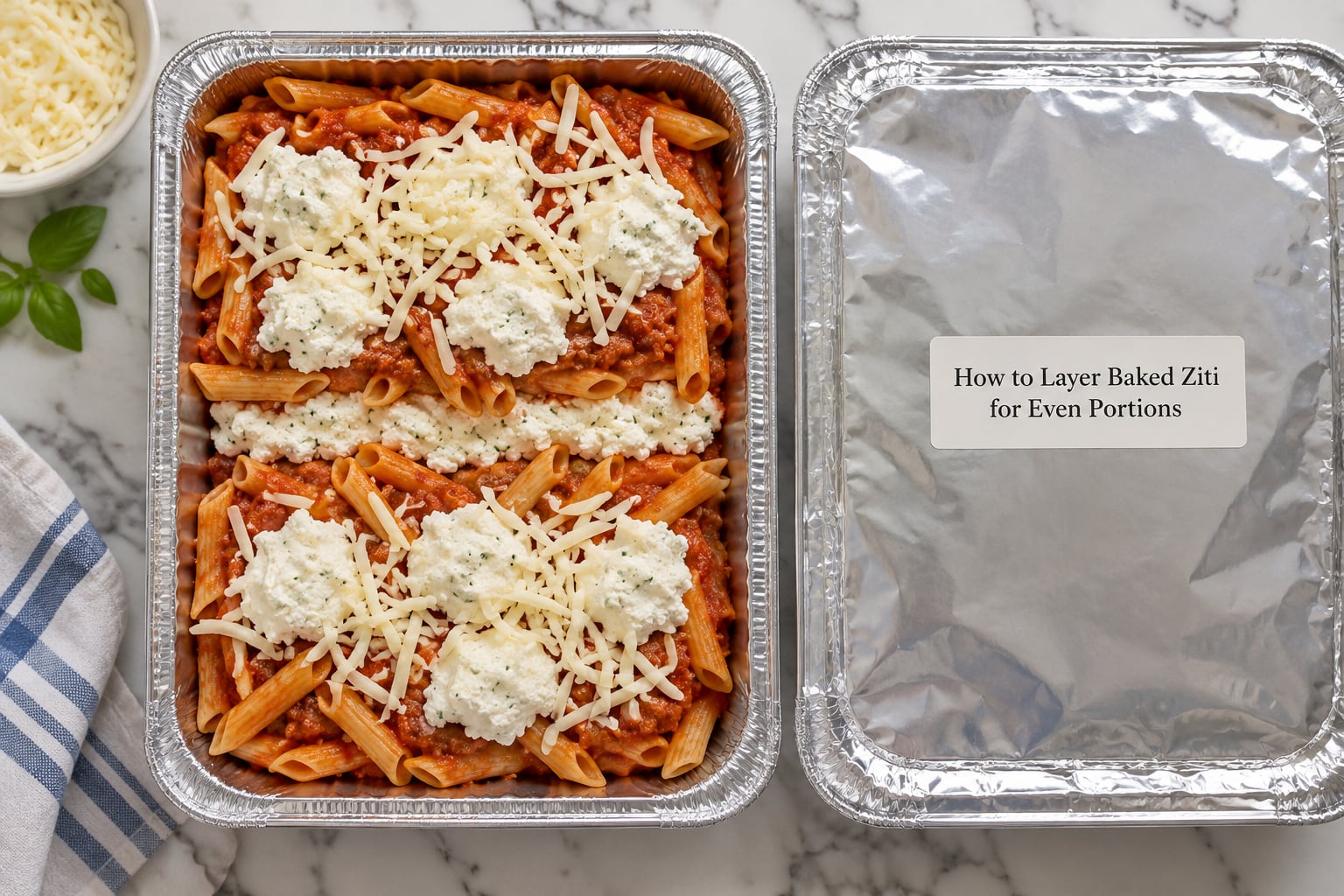
Keep it to two or three layers and no more than 4 inches deep. A taller layer traps steam, so the center stays wet while the edges dry out, and cutting clean equal portions gets harder with every extra inch.
Toss the drained pasta with the warm sauce first, then spread half of it into the pan. Dot spoonfuls of the ricotta mixture across the surface rather than pouring it, so it stays in distinct pockets instead of sliding to the bottom. Scatter mozzarella, then repeat.
Finish with a thin layer of sauce and a full covering of cheese. That top layer is your insulation: it keeps the pasta underneath from drying out during the covered portion of the bake. Press it down gently with the back of the spoon so the pan is level, which is what makes the pieces come out the same size later.
For a buffet line, use penne or penne rigate. Tubes stand up on a plate and are easy to eat while standing, which matters when forty people are serving themselves at once.
How to Bake Baked Ziti Until Bubbly and Golden
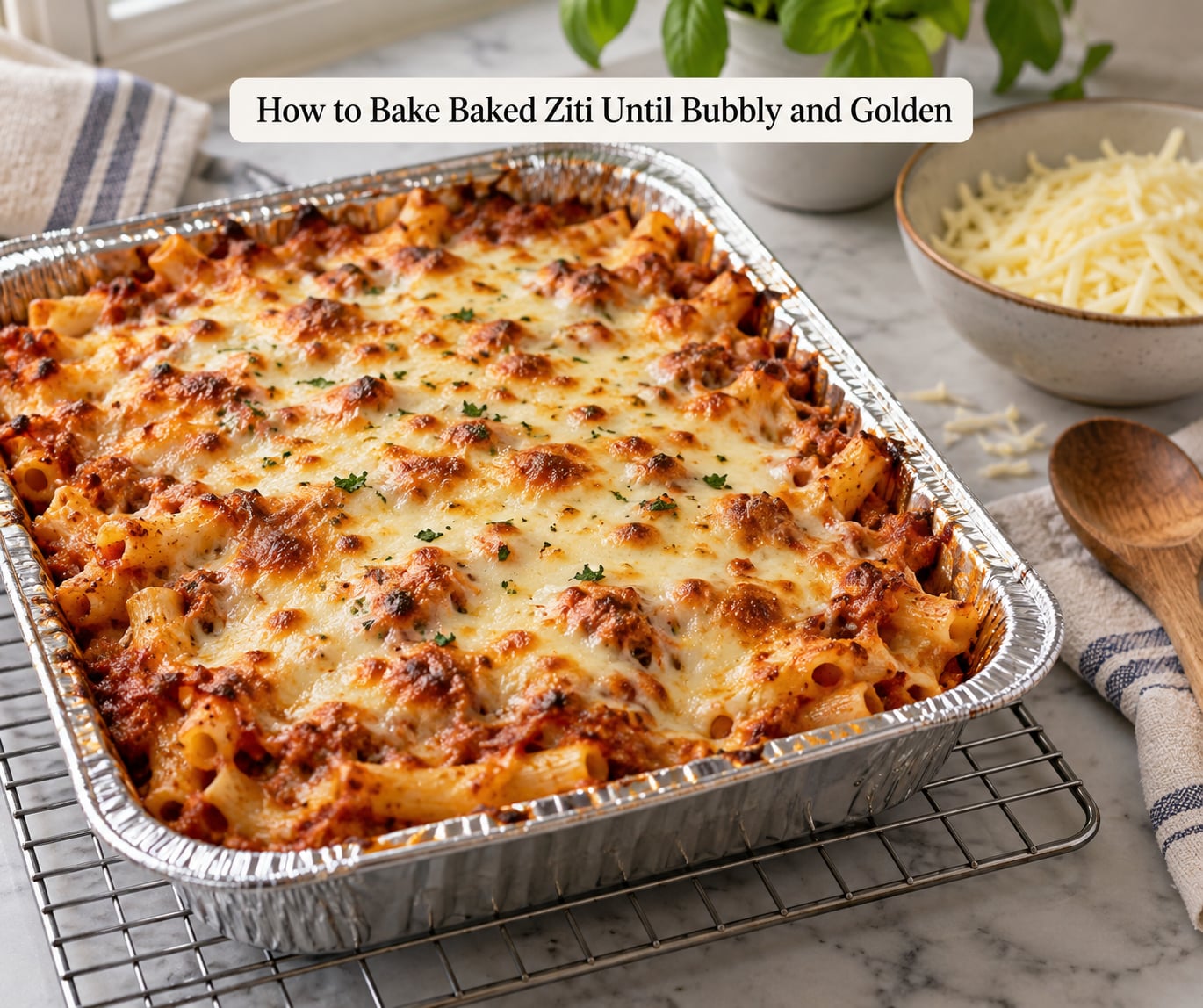
Bake covered at 375F in a conventional oven, then uncovered for the same total time. In a convection oven, drop to 350F and pull 10 minutes off both stages; convection cooks faster only until you load two deep trays, at which point it recovers slowly.
The foil stage steams the pasta and melts the cheese. The uncovered stage is what gives you the browned, bubbly top people picture when they think of baked ziti, so do not skip it even when the cheese looks done underneath.
Look for bubbling around the rim of the pan, a browned cheese crust, and sauce that has thickened to the edges. Push a thermometer into the center of the thickest part: 160F there means the middle of the tray is serving-hot all the way through.
Rest the pans 15 to 20 minutes out of the oven. The sauce sets as it cools, which is the difference between a slice that holds together and one that slides apart onto the serving spoon. Handle foil pans with dry oven mitts and set them on a sheet pan or trivet, since a full steam tray stays hot long after it leaves the oven.
How to Make Baked Ziti Ahead and Reheat It
Assemble up to two days ahead, cover tightly and refrigerate. Bake from cold rather than room temperature, covered, and add 10 to 15 minutes to the covered stage. A refrigerated full steam-table pan is the slowest thing you will cook that day, so give it a full hour and start it before your side dishes.
For longer storage, freeze the casserole unbaked. Cover the pan with two layers of foil, freeze up to three months, then thaw in the refrigerator overnight. Bake covered at 375F for 40 to 45 minutes and uncovered for 20 to 25, exactly as you would from fresh.
Reheating leftovers needs a little care. Cover with foil, add a tablespoon of water or sauce per portion, and warm at 350F until hot all the way through, which means 165F in the center. The splash of liquid keeps dry, tight pasta from turning into cardboard. Loosely covered pasta reheats better with a little steam than without.
Cool leftovers in shallow containers rather than the deep pan, and get them into the refrigerator within two hours of serving. Large hot trays cool painfully slowly in the middle, which is exactly how a big batch picks up bacteria. Refrigerated ziti keeps 3 to 4 days.
Planning the rest of the menu around this one dish? Appetizers you can make ahead take the same low-stress approach, and a simple vinaigrette you make yourself gives you a salad dressing in the time the oven is working.
Common Mistakes
Overcooked pasta is the most common failure at scale, because large batches are boiled while the rest of dinner is finished and the pasta sits. Pull it two minutes early and taste one piece.
Watery sauce comes from too few jars or a pan that was not covered. If the sauce sits in a puddle after mixing, add another jar for deep pans; if the edges look dry, extend the covered stage by 5 minutes.
Uneven layers start with an unlevel pan. Spread each layer to the corners and check the depth at the center with a spoon before you top it. A third layer in a shallow pan is fine; a third layer in a 5-inch tray is not.
Too much cheese turns the top chewy instead of creamy. Use the quantity in the table, and save the last handful of mozzarella for the very top rather than stirring it through every layer.
A pan that is too deep is a scaling error disguised as efficiency. Two 4-inch steam trays beat one 8-inch tray every time: they heat faster, they cut into even portions, and they stack in a cooler.
Seasoning twice happens when the sauce is salted before the pasta water joins it. Taste after the pasta goes in, then adjust once.
Storing the assembled dish warm on the counter for hours is the riskiest habit in this whole guide. Chill it within two hours, or keep serving it above 140F in a chafing dish and discard what sits out longer than two hours at a buffet.
Serving straight from a boiling tray is a comfort-food mistake. Ten to fifteen minutes of rest firms the sauce enough for clean portions.
Frequently Asked Questions
How many 9×13 pans of baked ziti do I need for 20 people?
Plan on three 9-by-13-inch pans for 20 people at a buffet, or two if you are serving substantial sides. Each pan yields about 8 to 10 portions of 8 ounces, so three pans covers a crowd generously and leaves room for seconds. Bake them on two oven racks at 375F for 35 minutes covered and 20 minutes uncovered.
How much pasta do I need to make baked ziti for 40 people?
Six pounds of dry ziti or penne feeds about 40 people at a buffet, which works out to roughly 3 ounces of dry pasta per guest. That figure assumes a full casserole main with sides. For 40 people who are very hungry, or when you want leftovers, move up to 7 pounds and add one more jar of sauce.
Can baked ziti be prepared ahead of time?
Yes, and a crowd batch is better for it. Assemble up to two days ahead, cover tightly and refrigerate, then bake covered at 375F with 10 to 15 minutes added for the cold pan. You can also freeze the unbaked casserole for up to three months and thaw it in the refrigerator overnight before baking.
How long does a large tray of baked ziti take to bake?
A 9-by-13-inch pan takes 25 minutes covered and 15 uncovered at 375F. A jumbo casserole needs about 40 and 25, and a 4-inch-deep steam-table pan needs roughly 50 minutes covered and 30 minutes uncovered. Several deep trays in one oven slow down the recovery, so allow another 15 to 20 minutes and check for 160F in the center.
How do I keep baked ziti hot for a party?
Bake the trays about 15 minutes before you want to serve, let them rest 15 minutes, then set them in chafing dishes or over warm water in a serving tray. Keep the holding temperature above 140F and keep an eye on the water level in warm-water chafers. Discard anything that has sat at room temperature longer than two hours.
How many people does a half steam-table pan of baked ziti serve?
A half steam-table pan, the shallow half-size restaurant tray, serves about 20 people. A full-size steam-table pan that is 4 inches deep serves about 40. If you find pans listed only as full, check the depth: the shallow 2.5-inch version serves closer to 30, and that difference is worth confirming before you buy.
Conclusion
Pick the pan first: two 9-by-13-inch dishes for 16 people, one full steam-table pan for 40, and enough half pans to reach your head count. Boil the pasta two minutes short of done, toss it with warm sauce, and layer no deeper than 4 inches with ricotta dotted rather than poured.
Bake covered at 375F, uncover for the browning stage, and confirm 160F in the center before you call it done. Rest the pans 15 minutes, and start the whole assembly the day before if the crowd is large. Getting those four things right is the difference between baked ziti for a crowd that disappears and one that leaves you with a pan of wet noodles.