
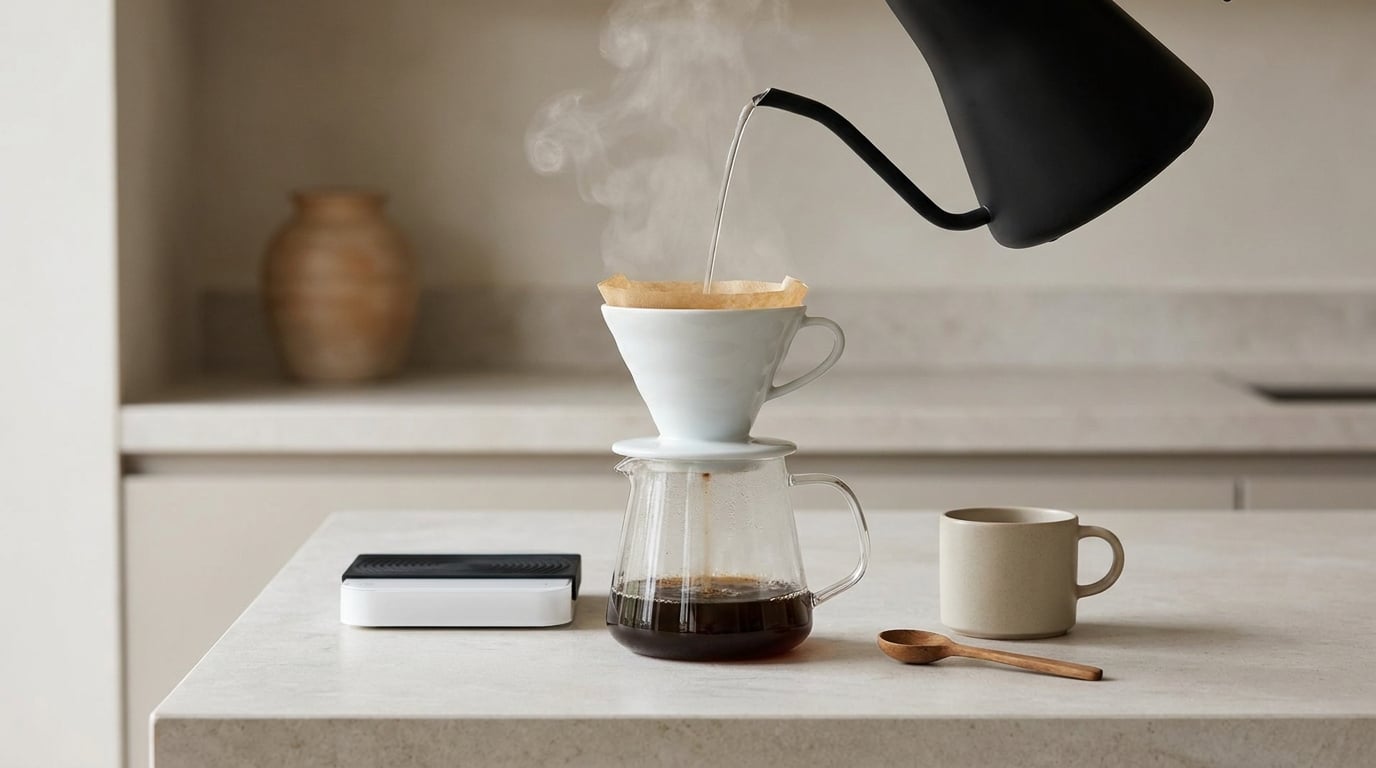
If you want to know how to make coffee taste better at home, start with four numbers: how fine you grind, how much coffee per gram of water, how hot the water is, and how long it sits in contact. Get those right and a bag of grocery-store beans in a basic drip machine will beat a careless pour-over, every time. The whole process takes about ten minutes of attention, most of it before the kettle goes on. Updated for October 2026.
I have adjusted the same home setup dozens of times, and the pattern is consistent: the machine is almost never the problem. Beans that have been sitting open for two months, tap water with a chlorine note, and a scoop instead of a scale will do more damage than any cheap brewer.
Table of Contents
- What You Need
- How to Make Coffee Taste Better at Home: Step-by-Step
- Common Mistakes
- Frequently Asked Questions
- Do I need expensive equipment to make coffee taste better at home?
- Why does my coffee taste bitter, and how can I fix it?
- Why does my coffee taste sour instead of sweet?
- Is filtered water important for better-tasting coffee?
- How long should I store coffee beans after opening the bag?
- Should I buy whole beans or preground coffee?
- The Three Changes to Make First
What You Need
Most people can double the quality of their coffee without buying a single thing. The honest list starts with what you probably already own.
Essential:
- Coffee roasted within the last month, with a roast date on the bag
- Any brewer you enjoy: drip machine, pour-over cone, French press, AeroPress, moka pot, or pod machine
- Filtered water, either from a filter pitcher or a jug labelled for drinking
- A way to measure, ideally a kitchen scale that reads grams
- A kettle you can pour from steadily, and a mug you like drinking from
Worth adding, in order of return:
- A burr grinder. This is the single biggest jump in cup quality, because it produces an even particle size instead of the mix of dust and chunks a blade grinder makes.
- A cheap gooseneck kettle, if your current kettle has a narrow unpredictable spout that makes pouring erratic.
- A paper filter plus a rinse, which removes papery taste from the cup.
- A basic kitchen thermometer, only if you are brewing with a stovetop moka pot and want to stop guessing at the fill line.
Skip the expensive gear for now. Read the steps below first, and see whether your problem is already solved by measurement and technique.
How to Make Coffee Taste Better at Home: Step-by-Step
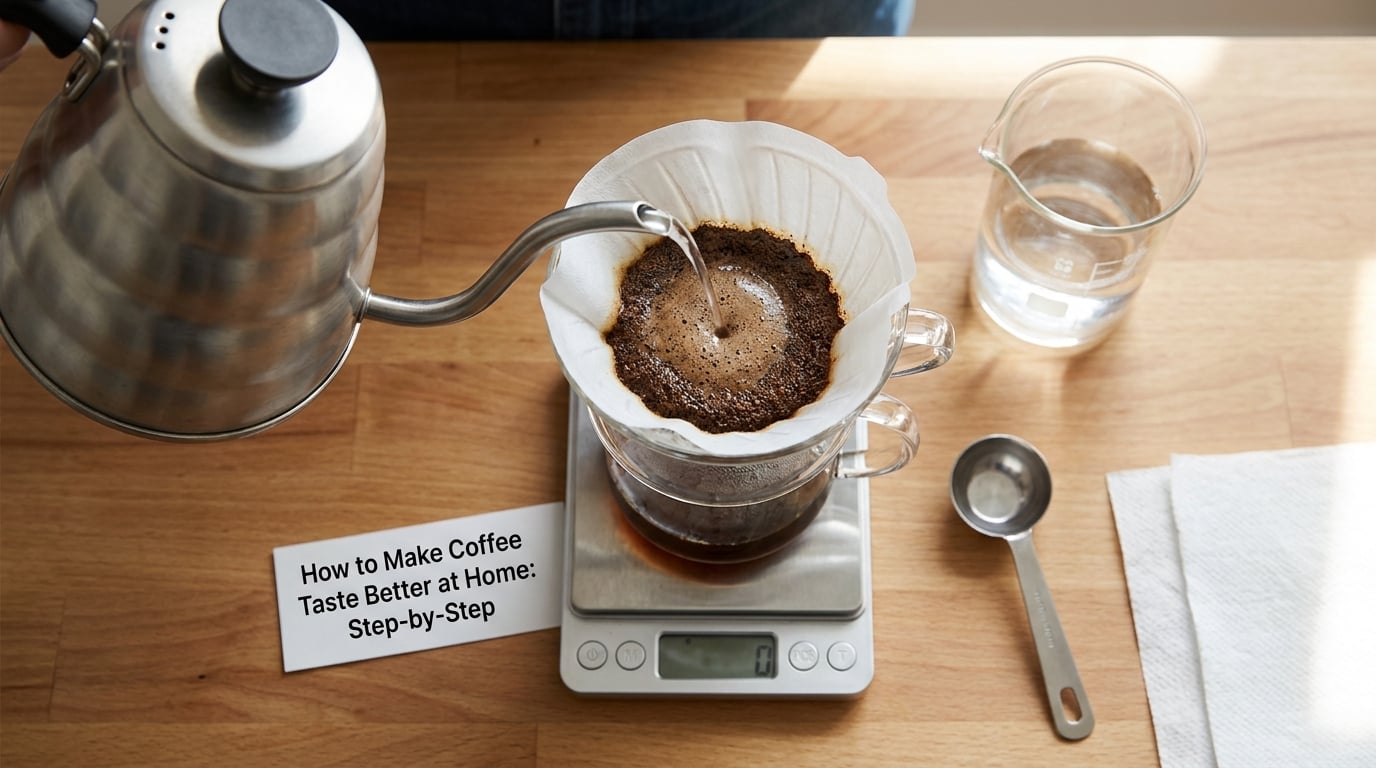
Work through these in order. Each one is worth more than the one after it, and skipping ahead usually means solving the wrong problem.
1. Start With Fresh, High-Quality Coffee Beans
Buy coffee roasted within the last two to six weeks and you are inside what roasters call the peak window, when aroma is at its highest and the sugars have not yet broken down. Beans lose flavour steadily after roasting, whether or not you touch them, which is why a bag opened last month usually tastes like paper more than coffee.
Look for a roast date, not a best-before date. A roaster printing only a best-before date is telling you the coffee was already sitting on a shelf for months before it reached you. Sniff the bag: fresh coffee smells of fruit, chocolate or nuts, while tired coffee smells flat and dusty with almost nothing at all.
Match the roast to your brewer. Dark roasts are more forgiving of a fine grind and hotter water because their bitter compounds mask a bad process, which is why most supermarket dark roast seems hard to ruin. Light roasts are vivid and sweet but punishing when anything goes wrong. If you have a French press, choose a medium roast and stop worrying about technique.
Storage is where most home coffee quietly dies. Keep beans in an airtight opaque container away from light, heat, and the stove, and use them within four to six weeks of opening. Skip the refrigerator and the freezer: condensation and odour are worse than the staleness you were trying to prevent. Freeze only if you bought a very large bag, portion it into small sealed amounts, and thaw a portion at a time without refreezing it.
2. Use Clean, Good-Tasting Water
Coffee is mostly water, and water that tastes like a tap will make coffee that tastes like a tap. If your glass of water is flat and metallic, the pot is too soft and you have nothing to extract with. If it tastes chalky or bitter on its own, it is heavily mineralised and will make every cup harsher.
Filtered water is the easy fix, and it costs a fraction of a bag of beans. A pitcher filter handles chlorine, which is the flavour most people notice. Very hard water needs a different treatment, usually something that softens as well as filters, so taste your water again after filtering it.
Temperature matters more than people expect. Water straight from a boil tastes flat and slightly sour because boiling water has lost the dissolved gases that help aroma lift. Let freshly boiled water sit five to eight minutes, or bring water to a boil and pour it into a cold jug. Aim for the ranges given per method below.
3. Grind the Coffee for Your Brewing Method
Grind size controls how much surface area the water touches, which controls how fast flavour comes out. Too fine and the water cannot get through the bed, so it pulls the harsh compounds. Too coarse and the water races past, and you get a thin, sour cup with no sweetness. Here is the reference I use.
| Method | Grind texture | Rough comparison |
|---|---|---|
| Pour-over cone | Medium, like coarse table salt | Granulated sugar is slightly too fine |
| Pod machine | Pre-ground, use the fill line | Never reuse old grounds from a second brew |
| French press | Coarse, like sea salt | Should feel sandy, never dusty |
| AeroPress | Medium-fine, like table salt | Fine enough to slow the flow slightly |
| Moka pot | Fine, finer than table salt | Clogs if there is powder at the bottom |
| Cold brew | Extra coarse, like cracked pepper | Any finer and the brew turns silty |
| Espresso | Very fine, like flour | Packed tamp, no visible gaps |
A burr grinder crushes beans between two surfaces and gives you an even particle size every time. A blade grinder is a spinning propeller that chops and pulverises at once, so every brew is a different blend of dust and chunks, and that is why blade-ground coffee runs bitter and weak at the same time. If you own a blade grinder, upgrading is worth more than any other purchase on this page.
Adjust the direction, not the amount. Bitter means grind coarser. Sour or thin means grind finer. Change a small step, taste, and change again.
4. Measure the Coffee-to-Water Ratio Precisely
The brew ratio is simply grams of coffee to grams of water, and it is the fastest way to make an average cup taste noticeably better. The common home range runs from 1:15 to 1:17 by weight, which means 15 grams of water for every gram of coffee. A tablespoon is roughly 5 to 7 grams, so two level tablespoons sit close to 12 grams and about 190 millilitres of water.
Use a scale even for one cup. Scoops vary, and the difference between a heaped and a level tablespoon is enough to turn a balanced cup into a bitter one. A cheap scale removes all guesswork, and the ratio is the first thing to change when your coffee is too weak or too strong.
Once a cup tastes right, write the numbers down. From then on, change one thing per brew and you will know exactly which lever moved the flavour.
5. Control Water Temperature and Pouring Technique
Hotter water pulls more out of the grounds, faster. That is useful in moderation and ruinous in excess, and it is why the same beans taste different from your stovetop versus your pour-over.
| Method | Ratio | Water temperature | Contact time |
|---|---|---|---|
| Pour-over | 1:16 | 200-205F (93-96C) | 2:30 to 3:30 total |
| AeroPress | 1:14 | 190-200F (88-93C) | 1 to 2 minutes |
| French press | 1:15 | 200-205F (93-96C) | 4 minutes, then plunge |
| Moka pot | About 1:10 | Boiling, off the heat | Until it gurgles out |
| Pod machine | Use the fill line | 195-205F (90-96C) | Roughly 4 minutes per cup |
| Espresso | 1:2 by weight | About 200F in the cup | 25 to 30 seconds |
For pour-over, the bloom comes first: add just enough water to wet all the grounds, wait 30 to 45 seconds, and you will see the bed rise as trapped carbon dioxide escapes. That gas would otherwise block water contact. Then pour in slow, steady circles, staying off the paper filter wall, and finish by 3:00 to 3:30. A pour-over cone has no lid, so total drawdown should land between 2:30 and 3:30 for a single cup.
Rinse a paper filter with hot water before brewing. It washes off the papery taste and preheats the cone, so the water stays hot while the coffee brews.
For immersion methods, the single most common mistake is leaving the coffee sitting after it has finished. Plunge the French press at four minutes and pour the whole carafe straight away, or press the AeroPress and drink within a minute. Coffee that keeps steeping after the drawdown goes bitter on the counter, and no one can taste the good beans underneath it.
For espresso, tamp level and moderate. Pressing hard does not help, because uneven pressure forces water down one side of the puck and leaves the rest under-extracted, which reads as harshness in the cup. Aim for 18 grams in and 36 grams of espresso out in about 28 seconds, then adjust grind size only.
6. Keep the Brewer and Cup Clean
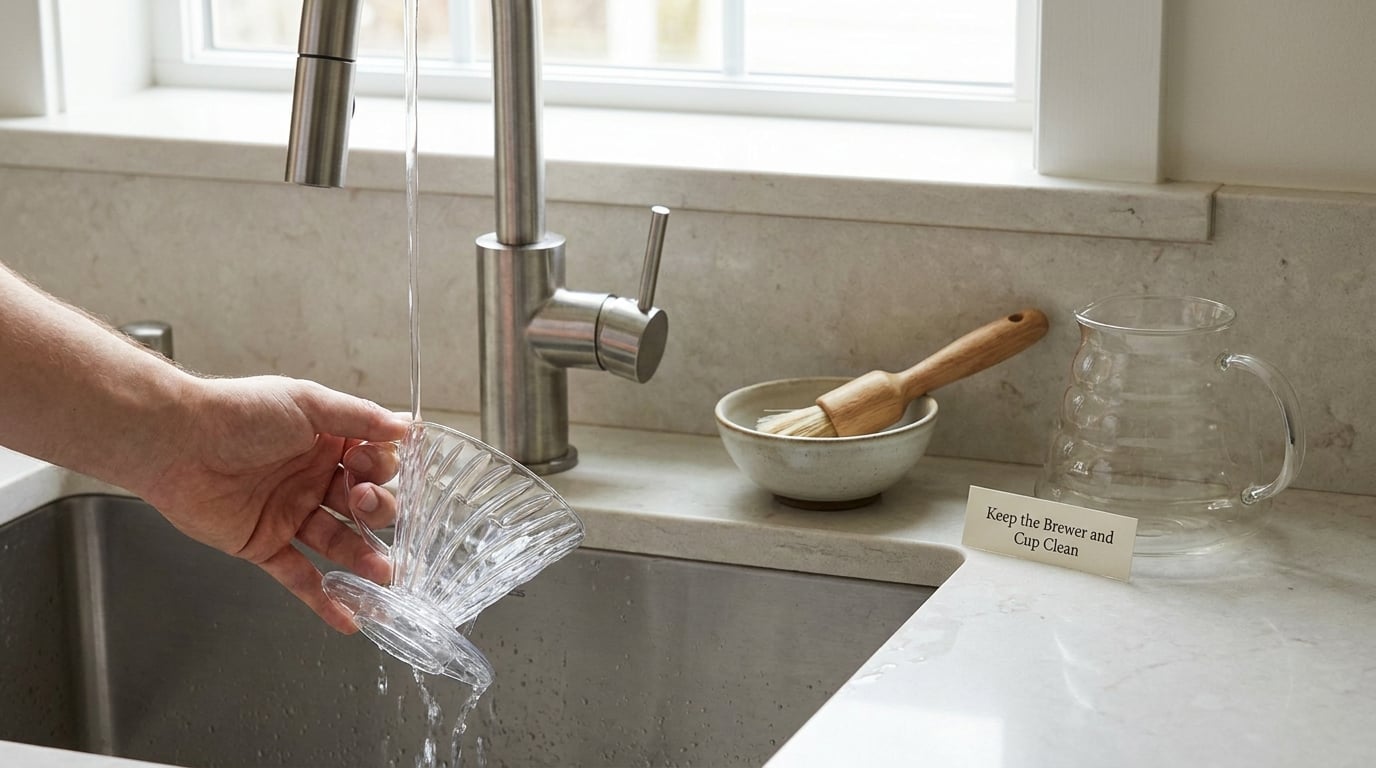
Old coffee oils go rancid and they carry a stale, cardboard taste that a stale bean cannot explain away. Rinse the carafe, the filter basket, and the brew basket with hot water after every use, and wash them properly at the end of the week. Wipe the plate and the water reservoir of a drip machine with a damp cloth, since spilled grounds sit and sour there.
Descale when the machine tells you, or roughly every two months in hard water. Use the solution your machine’s manual recommends, run it through the full cycle, then run two or three cycles of plain water. Pour a cup of plain water into the sink and taste it; if it tastes of anything, there is cleaner still in the machine.
For a pod machine, rinse the brew chamber and run one plain water cycle after the last pod of the day. Old grounds sitting in a chamber that never gets washed is one of the most common reasons people decide they dislike pod coffee.
7. Change One Variable at a Time
When a cup is off, the instinct is to change everything at once, and then you learn nothing. Work in a fixed order, one brew each, and taste before you start the next. This is the sequence that works.
- Bitter or harsh: grind coarser first. If it is still bitter, lower the water temperature by about 5F (3C). If still bitter, use less coffee or shorten contact time.
- Sour or thin: grind finer first. If still sour, raise the water temperature. If still sour, use more coffee or extend contact time.
- Flat, watery, no flavour at all: check freshness before anything else. Old beans taste flat no matter what you do, and the fix is a new bag, not a dial.
- Hollow, like it is missing something: usually a ratio problem. Add 1 or 2 grams of coffee without changing the water.
- Gritty or dusty in the cup: grounds are too fine for the filter, or the brew sat too long and started breaking particles down.
- Sour in cold brew: your grind was too fine. Cold brew wants extra coarse, and it is easy to over-extract it into a sharp, vinegary concentrate.
Two honest limits. No technique rescues coffee that was roasted years ago or roasted badly, and no ratio rescues water with a strong chlorine taste. Fix the ingredient and then tune the process.
One addition worth knowing: a pinch of table salt stirred into the grounds before brewing softens bitterness, because sodium interferes with bitter taste receptors. A splash of whole milk or cream does the same job by binding bitter compounds, which is why a latte tastes rounder than the espresso it came from. Both mask a symptom rather than fix the cause. If you make drinks at home regularly, our simple 1:1 syrup recipe is an easy way to add sweetness without more bitterness.
For summer, cold brew is the same four variables in slow motion. Our cold brew recipe at home covers the ratio, and our guide to the cold brew versus iced coffee difference explains why one tastes smoother than the other.
Common Mistakes
Almost every disappointing cup at home traces back to one of the six mistakes below. Find the row that matches what you taste, make that one change, and taste again before touching anything else.
| What it tastes like | What is happening | First thing to change |
|---|---|---|
| Bitter, dry, harsh finish | Over-extraction: the water pulled too much out of the grounds | Grind coarser, then drop water temperature about 5F |
| Sour, sharp, thin | Under-extraction: not enough flavour was pulled out | Grind finer, then add coffee or extend contact time |
| Watery, no smell, no taste | Coffee is stale, or the dose is far too small | Check the roast date, then weigh the coffee |
| Hollow, missing a middle | Too little coffee for the water, or water too cool | Add 1 to 2 grams of coffee |
| Burnt, ashy, charred | Beans over-roasted, or brew scorched in a dry pot | New beans; stir grounds in a pre-boiled moka pot |
| Grimy, papery, dirty aftertaste | Brewer is dirty, or grounds broke down in the brew | Rinse the carafe and brew chamber after every use |
Two more mistakes that never show up on a list like this. Measuring with a scoop instead of a scale means your ratio changes every single brew, so you can never tell whether a change you made helped. And buying a fancier brewer before fixing measurement, water, and freshness means paying more for the same disappointing cup.
Final tasting tip: taste black, before milk and before sugar, and taste a few minutes after brewing. Milk flattens aroma, and a cup that tastes bad going down is a cup that will taste bad in an hour.
Frequently Asked Questions
Do I need expensive equipment to make coffee taste better at home?
No. Most of the gain comes from things that cost nothing: fresh beans, filtered water, a scale, and measured ratios. A burr grinder is the one purchase worth making, because even ground coffee turns bitter when the particle size is uneven. A gooseneck kettle helps with pour-over but does nothing for a drip machine. Spend on measurement and water first, and only replace the brewer once those are already right.
Why does my coffee taste bitter, and how can I fix it?
Bitter means over-extraction, which is the water pulling out the harsh compounds along with the sweetness. Grind a little coarser and taste again. If it is still bitter, drop the water temperature about 5F, then use slightly less coffee or a shorter brew. Leaving French press or AeroPress coffee sitting after it has finished also causes bitterness, so plunge and pour right away.
Why does my coffee taste sour instead of sweet?
Sour means under-extraction, so you need the opposite fix from bitterness. Grind finer, raise the water temperature a few degrees, add another gram or two of coffee, or let it steep slightly longer. Under-extracted coffee is often blamed on the beans when the real cause is a grind that is too coarse for the brewer.
Is filtered water important for better-tasting coffee?
More than most people expect, since coffee is almost entirely water. Chlorine gives a flat, off note, and heavily mineralised water makes every cup harsher and duller. A basic pitcher filter fixes chlorine cheaply. If your tap water is very hard or tastes chalky, taste it after filtering, and choose something that softens as well as filters.
How long should I store coffee beans after opening the bag?
Four to six weeks in an airtight, opaque container kept somewhere cool and away from light, heat, and the stove. Exposure to air and warmth is what flattens the aroma, and the flavour loss becomes obvious around the two month mark. Avoid the refrigerator, since condensation and food odours are worse than the staleness you were trying to prevent.
Should I buy whole beans or preground coffee?
Whole beans, every time, if you own any kind of grinder. Ground coffee starts losing aroma within days of grinding, while whole beans hold their flavour for weeks. If you have no grinder, pre-ground is still better than old beans from a can on the shelf, and a small burr grinder is the cheapest big upgrade available.
The Three Changes to Make First
If you do nothing else this week, do these three things, in this order. Buy beans roasted within the month and use them inside six weeks of opening. Weigh your coffee instead of scooping it, and target 1:15 to 1:16 by weight. Then adjust your grind one small step at a time until the cup stops being bitter.
That is how to make coffee taste better at home, and it takes about ten minutes of attention for a cup that costs pennies. Once those three are right, the finer points, bloom timing, descaling, and a nicer mug, start to matter. Before that, they will not.