
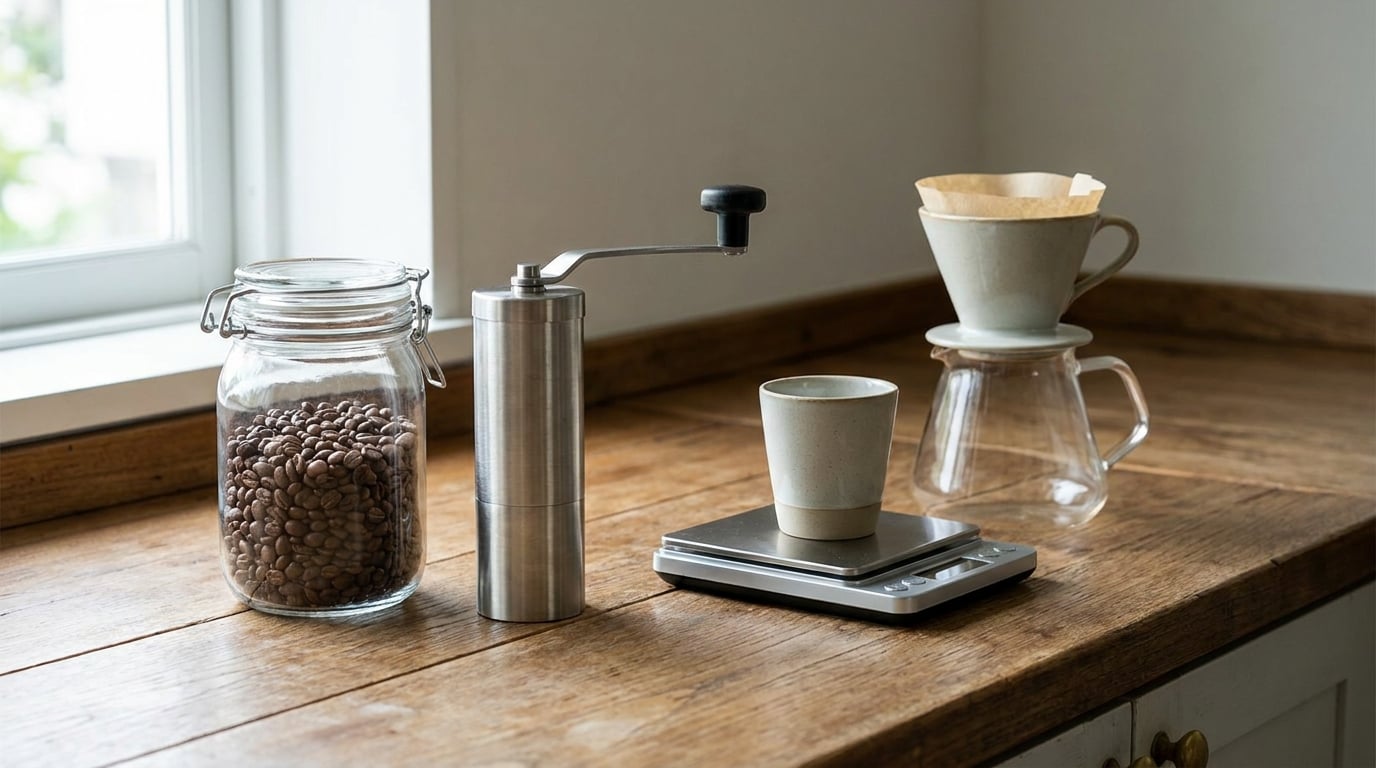
Grinding coffee beans for different brewers comes down to one rule: match the grind to how long the water sits with the grounds. Fine grinds slow water down and pull more flavor, so short-contact methods like espresso and pour over need them. Coarse grinds let water move fast, so slow immersion methods like a French press or cold brew need those. Change the brewer, change the grind.
The rest is a repeatable process, not guesswork. Set your dose by weight, move the grinder in small steps, and use brew time and taste as your feedback. This guide covers what you need, a step-by-step routine for every major brewer, and the fixes for the cups that taste bitter or sour. Last reviewed for 2026.
Table of Contents
- What You Need
- How to Grind Coffee Beans for Different Brewers: Step-by-Step
- 1. Choose Beans and Check Their Condition
- 2. Start With a Medium-Coarse Baseline
- 3. Set the Grind for French Press and Full-Immersion Brewing
- 4. Set the Grind for Pour-Over Coffee
- 5. Set the Grind for Drip and Automatic Brewers
- 6. Set the Grind for Espresso, Moka Pot, and Pressure Brewers
- 7. Set the Grind for Cold Brew, Siphon, and Batch Brewing
- Common Mistakes
- Frequently Asked Questions
- Can I grind coffee beans with a blade grinder?
- How can I tell if coffee is ground fine enough without specialty tools?
- How do I calibrate a grinder without numbered settings?
- Does the roast level change the ideal coffee grind size?
- What can I do when my coffee maker has no grind adjustment?
- Should I adjust the grind size as coffee beans get older?
- Conclusion
What You Need
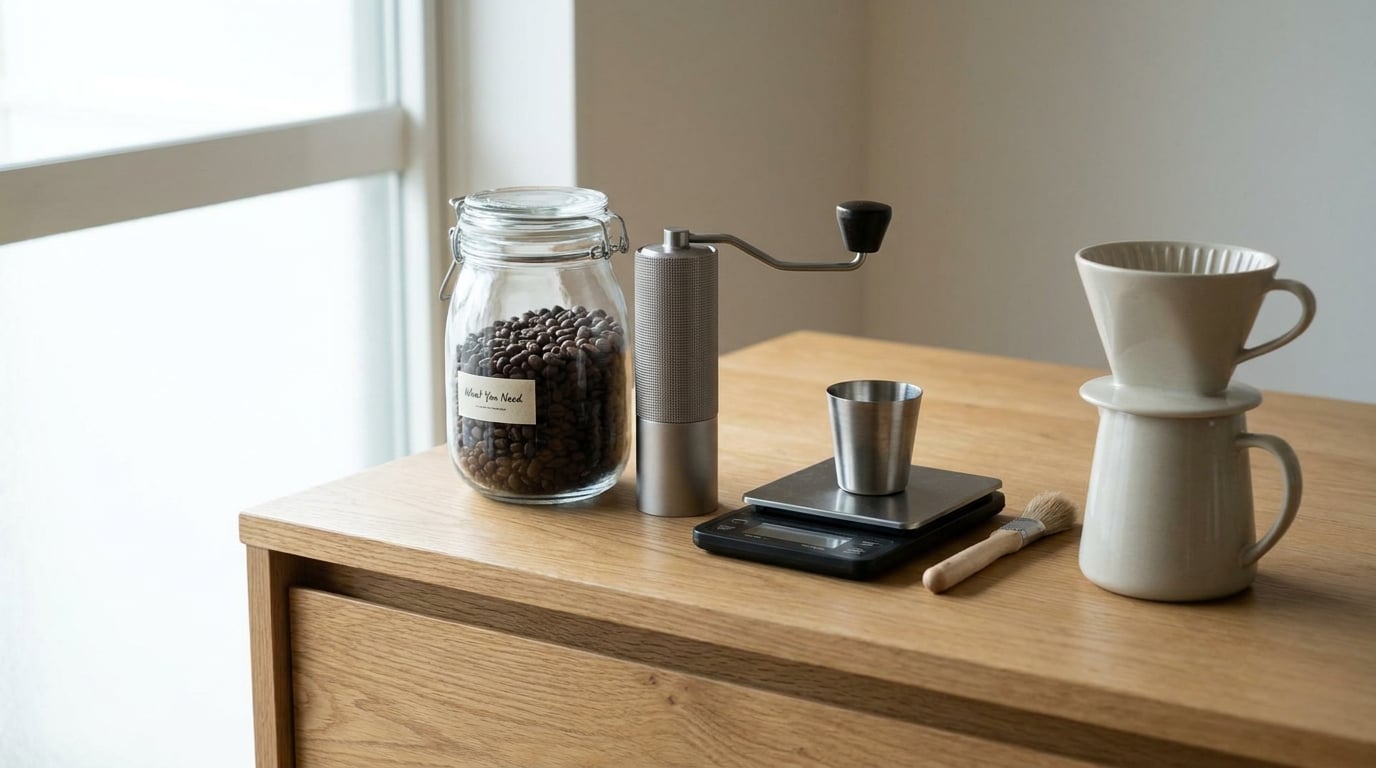
A burr grinder is the one tool that makes this whole process work. Burrs crush beans between two hard surfaces, so particles come out roughly the same size every time. A blade grinder spins a single blade that slices and chops whatever it hits, which produces a mix of dust and chunks in the same batch.
A blade grinder is fine for a French press or cold brew, where every particle gets soaked for hours and small differences wash out. It is a poor match for pour over or anything espresso-adjacent, because the fines clog the filter and the water runs unevenly. If that is all you have, grind in short bursts of two or three seconds, shaking the grinder between pulses, and stop when the texture looks right.
Beyond that, keep it simple:
- Fresh whole beans in an airtight container, kept away from heat, light, and moisture.
- A burr grinder with adjustment range wide enough to cover coarse and fine, ideally stepless so you can creep one click at a time.
- A small scale that reads to one gram, so your dose is the same every morning instead of depending on how full your scoop is.
- A dosing cup or a folded piece of paper to catch the first dusty seconds a burr grinder throws out.
- A soft brush to sweep grounds out of the burrs and off the dosing cup.
You do not need specialty equipment to check a grind. A pinch of grounds between finger and thumb tells you plenty, which is the topic of step two.
How to Grind Coffee Beans for Different Brewers: Step-by-Step
Here is the reference chart. The coffee-to-water ratios and brew times are the community starting points people actually use, and they work as a baseline even when your brewer is a different brand or model.
| Brewer | Grind size | Texture reference | Coffee-to-water ratio | Typical brew time |
|---|---|---|---|---|
| Espresso machine | Fine | Just finer than table sugar | 1:2 (18 g in, 36 g out) | 25 to 30 seconds |
| AeroPress | Medium-fine | Fine table salt | 1:12 | 1 to 2 minutes |
| Moka Pot | Medium-fine, slightly coarser than espresso | Fine sand, with a few larger pieces | 1:10 | 3 to 4 minutes on the stove |
| Hario V60 and other cone pour over | Medium | Table salt | 1:16 (the 4-6 method) | 2:30 to 3:30 |
| Kalita Wave | Medium to medium-coarse | Coarse salt | 1:15 to 1:16 | 3:00 to 3:30 |
| Chemex | Medium-coarse | Kosher salt | 1:16 | 4:00 to 5:00 |
| Clever Dripper | Medium-coarse | Kosher salt | 1:15 | Steep 2 to 3 minutes, drain |
| French press | Coarse | Coarse sand or sea glass | 1:15 (about 60 g per litre) | 4 minutes |
| Automatic drip machine | Medium | Table salt | 1:17 (about 60 g per litre) | 5 to 7 minutes |
| Cold brew concentrate | Coarse | Coarse sand | 1:8 concentrate, dilute to taste | 12 to 18 hours |
| Turkish cezve or ibrik | Extra fine | Powdered sugar, almost dust | 1:10 | 3 to 4 minutes |
| Siphon brewer | Medium | Table salt | 1:7 (about 30 g per litre) | Under 10 minutes |
1. Choose Beans and Check Their Condition
Roast level changes how hard your beans are to grind, which is the part most guides skip. Dark roasts are brittle and break apart easily, so the same burr setting that produced a silky espresso last week may produce dusty powder this week. Light roasts are denser and harder, and they usually need a slightly finer setting to get the sweetness people expect from them.
Process matters too. Natural and anaerobic beans are softer and more fragile, while washed beans come out denser and cleaner. Flavored or flavored-adjacent beans are a bad experiment, because added sugar or oils gum up burrs and change how everything grinds after that.
Buy smaller bags more often. A bag opens stale within weeks because ground coffee oxidizes in minutes and whole beans take days to get there. If your beans were roasted more than a few months ago, expect to grind finer than last time, and expect the flavor to be flatter regardless of what the grinder is doing.
2. Start With a Medium-Coarse Baseline
Put the grinder near the coarse end of its range before you do anything else. Coarse is the most forgiving setting, and it gives you room to move in one direction rather than discovering at the end that your burrs could not go coarser at all.
Grind a small test batch, around 20 grams, and look at it on a flat surface under good light. You are looking for even, visible particles, not dust and boulders together. Then rub a pinch between finger and thumb. Extra fine feels like powdered sugar, fine like table salt, medium like kosher salt, and coarse like coarse sand. If it feels gritty and dusty in the same pinch, your grinder is producing too wide a spread, which is a grinder problem rather than a setting problem.
Grind a little past where you think you need, never short. Burrs leave a little ground coffee behind in the chamber, so a dose of 20 grams weighed after grinding may have started as 23. That leftover grounds, called retention, is why your first small test can taste off, and why a single 18 g espresso dose can behave differently from a 20 g batch of filter.
3. Set the Grind for French Press and Full-Immersion Brewing
Use a coarse grind, visible grains similar to coarse sand or sea glass. Everything sits in the water for four minutes, so fine grounds over-extract, turn silty in the cup, and let the coffee oils break through into a greasy film on the surface.
If the brew is bitter, hollow, or dusty, step coarser. If it finishes thin and sour in four minutes even though you used plenty of coffee, you have two options: go finer a touch, or add thirty seconds. The French press forgives an aggressive grind far better than most people expect, so change one thing at a time and taste again.
For percolators, which are effectively very large French presses, stay at the coarse end. A setting two clicks finer than your press will clog the percolator basket, slow the flow to a crawl, and leave a bitter concentrate in the bottom.
4. Set the Grind for Pour-Over Coffee
Start at medium, a texture like table salt or damp sand, for a cone brewer such as the Hario V60. Go a step coarser for flat-bottom brewers like the Kalita Wave, Chemex, and Clever Dripper, because their wider bases and thicker paper move water more slowly.
Most of the top-ranking guides disagree with each other about whether pour over wants medium or medium-fine. Both are defensible. What decides it is flow: a pour over should finish between about 2:30 and 3:30. If it drains faster than that, grind finer. If it stalls, grind coarser.
Watch for two specific signs. If water pools in the flat bed and the surface looks like wet cement, your grind is too fine and the bed is clogged. If the coffee drains in under two minutes and leaves visible sediment in the carafe, the bed collapsed because grounds were too coarse for a fast brew. Neither is a fault in your technique.
5. Set the Grind for Drip and Automatic Brewers
Medium is the right starting point for a basket machine or a carafe machine, at roughly 60 g of coffee per litre of water. Most people who complain about automatic drip coffee are complaining about pre-ground supermarket coffee that was ground fine and then went stale, not about the setting.
If your machine has a labeled setting for coarse, medium, and fine, the medium position is rarely accurate. Machines make the grounds and the brew in one step, which makes trial and trial expensive. The practical approach is to buy enough of one bean to make several brews, then change the dose rather than the grind. If the machine tastes weak with 60 g per litre, raise it toward 70. If it tastes harsh, drop toward 50. Grind and ratio are separate controls, and the ratio is the one you can change without waiting.
6. Set the Grind for Espresso, Moka Pot, and Pressure Brewers
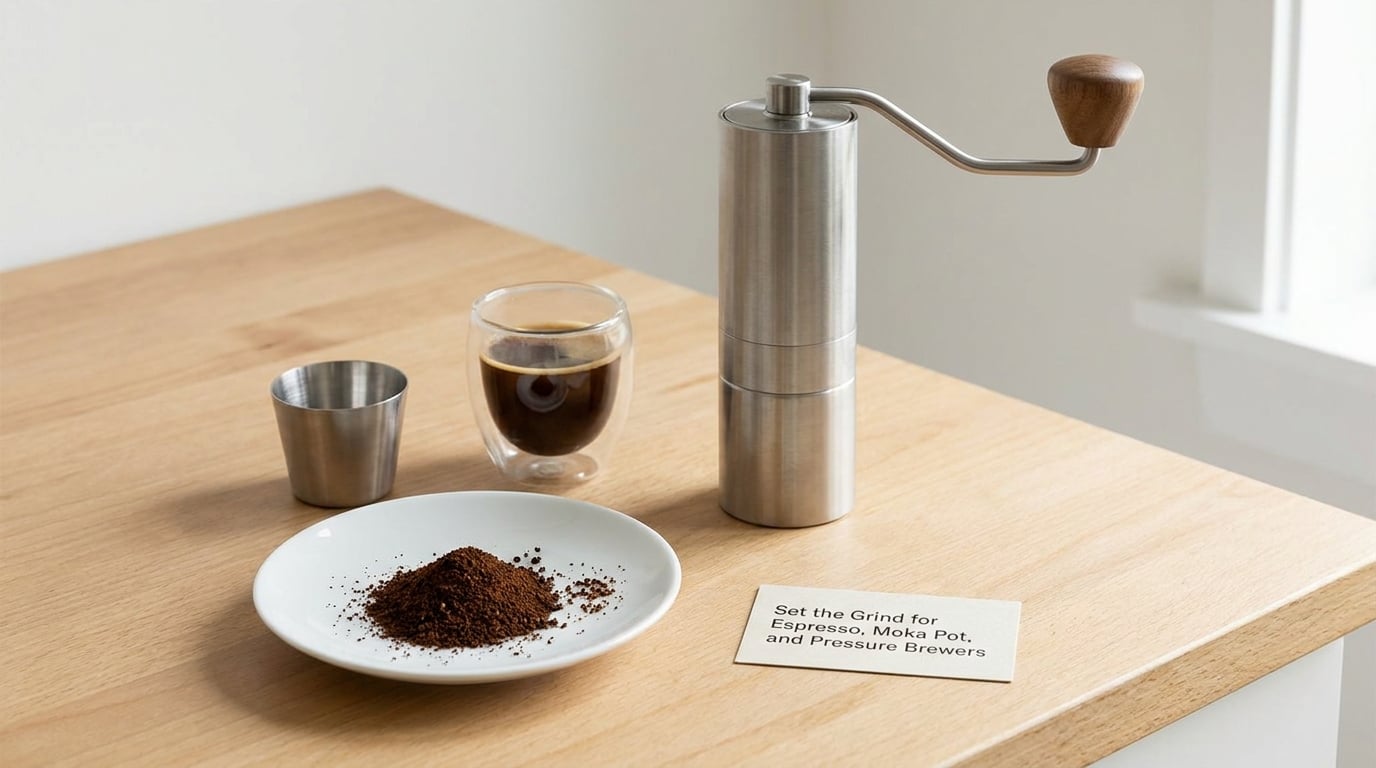
Espresso wants a fine grind, just finer than table sugar. Moka Pot and AeroPress sit one step coarser, at medium-fine, because both keep the water moving with pressure and a little more headroom than an espresso machine. You will often see Moka Pot and AeroPress lumped together with espresso, and you will also see sources calling medium-fine a pour over setting. Neither is wrong, but the taste tells you which one you actually meant.
Judge espresso by three signals, not by a grinder number. The shot should take 25 to 30 seconds and yield roughly twice what went in, the stream should start as dark honey and turn thin and blond, and the puck should come out dry and even rather than wet and gummy. If it gushes in eight seconds, grind finer. If nothing moves, grind coarser. A wet, soupy puck means the grind is too coarse for the dose, not that the beans are bad.
For a Moka Pot, do not fill the basket past its rim and do not pack the grounds down. Fill to the fill line, settle the grounds with a gentle tap, and use medium-fine. Coarser grounds in a Moka Pot come out thin; much finer grounds and you have boiled coffee, because the pressure will not let the water through.
7. Set the Grind for Cold Brew, Siphon, and Batch Brewing
Cold brew is coarse, similar to a French press, and often slightly coarser. Twelve to eighteen hours of contact time with beans fine enough to be a filter grind will produce something harsh and woody no matter how good the beans are. If you are still choosing a method, the cold brew vs iced coffee difference is worth a read first, because the two drinks are not built the same way.
Siphon brewers run somewhere near medium with a ratio nearer 1:7, so the brew leans lighter and brighter than a press. Batch brewers that grind internally sit at medium-coarse, since the machine’s own burrs are usually the least adjustable part of the whole setup.
When you cannot adjust the grind at all, which is the case with most bean-to-cup machines and supermarket pre-ground, work in this order: dose, then water temperature, then brew time, and only then the grind. Time is the most useful proxy for fineness. Pulling a shot in half the expected seconds means too coarse, no matter what the label says. Our cold brew recipe at home uses the coarse end of that range, which is why it steeps overnight without going harsh.
Common Mistakes
Most bad cups are one of these nine things. Each has a fix you can apply on the next brew without buying anything.
- Inconsistent particle size. A blade grinder, an overfilled hopper, or a badly adjusted burr set produces dust and boulders in the same batch. Fix: a burr grinder, fill the hopper only as far as the manufacturer allows, and clean the burrs every few weeks.
- Grinding days ahead. Ground coffee loses aromatics within hours because grinding multiplies the surface area exposed to air. Fix: grind immediately before brewing, and dose only what the brewer needs.
- Grinding too fine for the method. This causes bitterness, clogging, and slow flow. Fix: go visibly coarser. Water passing through a coarse bed extracts less.
- Grinding too coarse for the method. This causes sourness, thinness, and a fast, weak brew. Fix: go one step finer and check the brew time before changing anything else.
- Overfilling the hopper. Beans falling onto fast-moving burrs are thrown around and ground unevenly. Fix: keep beans resting in the throat, which is what the hopper design is for.
- Jumping several settings at once. You learn nothing and change the variables. Fix: one step per brew, then taste.
- Assuming every bag behaves the same. Bean density, moisture, roast level, and age all shift the result. Fix: keep your ratio fixed and adjust only grind between bags.
- Skipping the burr cleaning. Grounds and coffee oils pack the gaps and flatten the adjustment range. Fix: brush out the chamber weekly, and use cleaning tablets for a deeper clean.
- Confusing bitter with strong. Strength is how much coffee per litre; bitterness is over-extraction from too much contact. Fix: bitter and weak at once means go coarser, not add more coffee.
Two habits make the rest easier. Fix your ratio first and move only the grind, which is how most home brewers learn, and it keeps the number of variables down to one. And keep a small note with your beans: the bag, the roast date, the ratio, and what the last change did. Grind size knowledge is worth nothing if it lives only in your head.
Freshness, ratio, water, and grind decide the cup in that order of how much they will hurt you. A mediocre bean ground well and brewed at a sensible ratio beats an expensive bean ground wrong every single time, which is why grind is the cheapest upgrade in a home setup.
Frequently Asked Questions
Can I grind coffee beans with a blade grinder?
Yes, for coarse brews only. Pulse the grinder for two or three seconds at a time and shake it between pulses, since the fines and chunks left by the blade would ruin espresso, pour over, or any immersion method finer than a French press. Check the texture between pulses and stop as soon as the grounds look even. If you brew a lot of filter coffee, a burr grinder is the upgrade that changes the cup most.
How can I tell if coffee is ground fine enough without specialty tools?
Rub a pinch between your thumb and finger. Powdered sugar is espresso and Turkish territory, table salt is pour over, kosher salt is medium-coarse, and visible coarse sand is French press and cold brew. Also watch the brew itself: espresso gushing in seconds is too coarse, a pour over stalling is too fine, and a French press with a dusty film in the cup is far too fine.
How do I calibrate a grinder without numbered settings?
Start at the coarsest setting your grinder reaches and grind 20 grams. Taste through coffee made from that batch, then move the adjustment one small step finer and repeat. Three or four passes will land somewhere in the medium range, and once you know the texture, you can find that point again by feel. On stepless grinders, count the quarter turns so a third pass repeats the second.
Does the roast level change the ideal coffee grind size?
Yes, and usually more than beginners expect. Dark roasts are brittle and break down faster, so they can be ground more coarsely for the same result. Light roasts are denser and harder, and usually need a finer setting to reach the sweetness the roast is known for. A setting that worked on an old bag will often need adjusting within a few weeks on a new one.
What can I do when my coffee maker has no grind adjustment?
Change the dose and the water temperature instead, in that order, since grind is fixed on many bean-to-cup machines. Weak coffee usually means more coffee per litre, moving from 60 g up toward 70 g. Harsh coffee means less, dropping toward 50 g. If the machine grinds its own beans, check whether it offers a coarse or fine switch somewhere in its settings, which many models bury in the setup menu.
Should I adjust the grind size as coffee beans get older?
Older beans dry out and become more brittle, so they typically need a slightly finer setting than fresh beans at the same recipe. Coffee also fades in aroma as it ages, and a finer grind will not bring flavor back. Grinding a little finer is worth a try, but if the bag is well past a few months from its roast date, buying a fresher bag will improve the cup far more than any setting change.
Conclusion
One rule covers every brewer on this page: the longer water sits with the grounds, the coarser the grind, and the shorter the contact, the finer it needs to be. Your French press, cold brew, and percolator live at the coarse end. Pour over, drip, and siphon sit in the middle. Espresso, Moka Pot, AeroPress, and Turkish coffee live at the fine end.
Start at the setting listed for your brewer, brew it, and then change one thing. If the cup is bitter or harsh, go coarser. If it is sour, thin, or watery, go finer. Hold your coffee-to-water ratio steady, taste the result, and repeat until the cup tastes the way you want. That loop takes three or four brewers of practice, and after that you will not need a chart.