
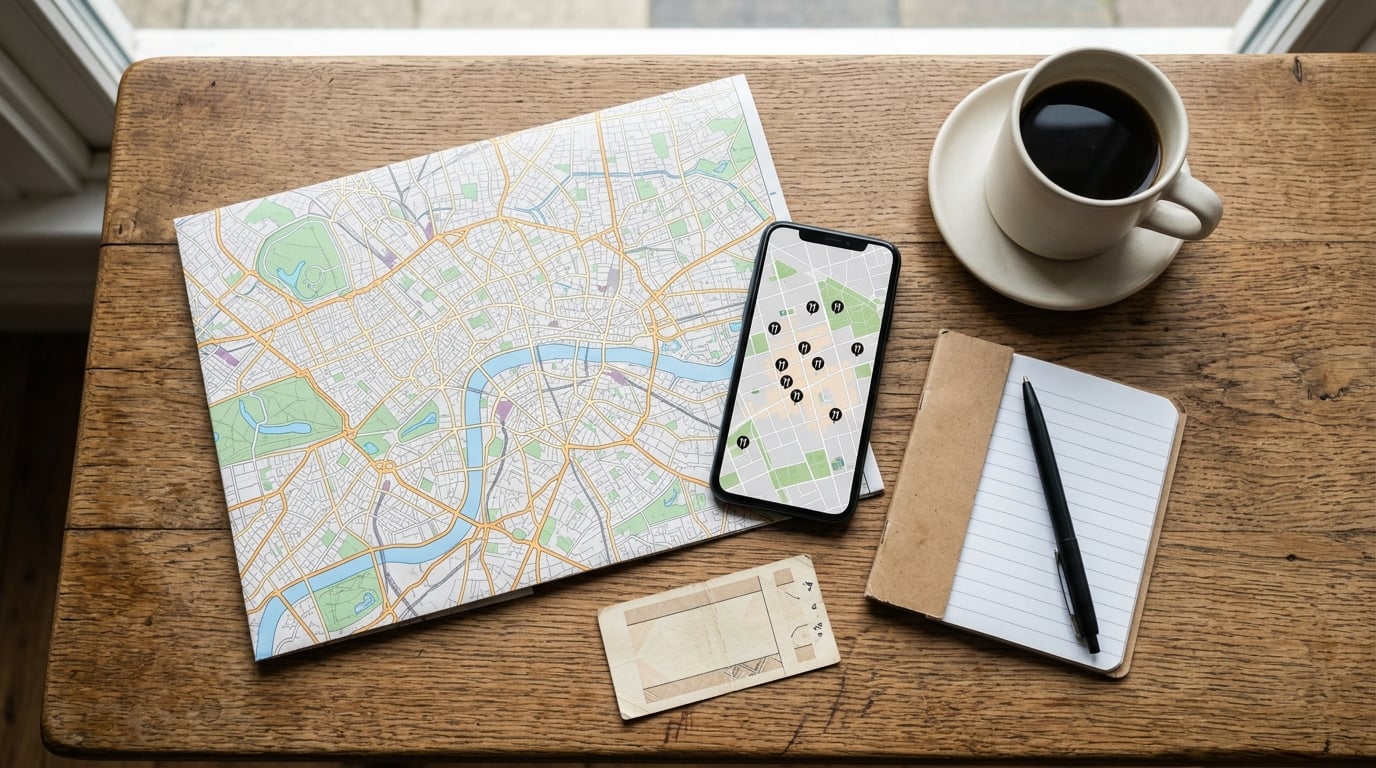
How to find a good restaurant in a new city comes down to a four-part filter: start at least five to ten minutes away from any landmark, look for clusters of restaurants rather than one lone pin, require a high rating together with a high review count, and confirm the room and the reviews look local. Budget about twenty minutes of research per meal, and most of that happens on your phone before you walk anywhere.
Most disappointing meals in an unfamiliar city are not bad luck. They come from picking the first place with a good star rating and a queue out front, which is usually the place the rating is least earned. The method below takes the guesswork out of it, and it works the same whether you are in town for two nights or settling in for a season.
Table of Contents
- What You Need
- How to Find a Good Restaurant in a New City
- Common Mistakes
- Frequently Asked Questions
- What is the best app for finding good restaurants in a new city?
- How can I tell if a restaurant is a tourist trap?
- How do I read restaurant reviews and ratings without getting fooled?
- Should I make a reservation or walk in?
- How do I find good restaurants when I have a dietary restriction?
- How do I find good restaurants when staying for weeks instead of days?
What You Need
None of this needs a subscription or a membership card. You need a handful of ordinary tools and about ten minutes of setup before you start scrolling.
- A map app with live opening hours. Hours shift with holidays and private events, so a saved list from six months ago can be quietly wrong.
- One review source for ratings and one for written reviews. Ratings tell you popularity, prose tells you what the kitchen is actually like. You want both.
- A reservation tool. Most cities rely on one or two booking apps, and a place that refuses bookings is worth knowing about in advance.
- Your transit or walking details. How long is the ride from your hotel or rental, and does the last train back run at a time you would still be out?
- Three written preferences. Cuisine, spending level, and the kind of room you want. Without them you will drift into whatever ranks highest.
- A small notebook or a notes app. Half the useful information arrives while you are walking past a menu board and cannot stop to type.
How to Find a Good Restaurant in a New City

Run the seven steps below in order. Each one cuts the list down, so by the time you reach step five you should be comparing two or three real candidates instead of two hundred pins.
1. Decide What Kind of Meal You Want
Write down the meal before you open a single app. Cuisine, spending level, portion style, room noise, dietary needs, and the occasion in front of you all narrow the field faster than any rating filter.
A quiet date-night dinner with two people is a completely different search from a Saturday brunch with a group of six, and neither of them wants the fast-casual place that tops local lists for a week each spring. If you are eating alone on a Tuesday, add “counter seats” or “counter service” to your criteria, since those places are built for one and rarely make you feel like an interloper.
Group size and time of day matter as much as cuisine. Many excellent small dining rooms simply will not seat six, and a kitchen that shines at lunch will often be finished serving by the time you arrive at nine at night.
Two hours of preparation covers everything: deciding the meal, choosing neighborhoods, and confirming practical details. Add another ten minutes per candidate menu if you are reading in a language you do not know, which is the step most people skip and most regret.
2. Start With the Neighborhoods That Fit Your Stay
Pick two or three neighborhoods near where you are sleeping and ignore everything outside them until you have eaten once. A thirty-minute ride to chase a top rating is a poor trade when you have a good room five minutes away.
Look at how restaurants cluster rather than at individual pins. A dense block of small places sharing a street usually means working kitchens serving regulars, which is the opposite of a row of identical spots facing a landmark. A market district, a university quarter, or a residential street behind a train station tends to reward you more than the main square.
Check the return trip while you are choosing. A brilliant dinner at a venue that closes before your train leaves is a bad bet unless you have a plan for getting home.
3. Build a Shortlist From Multiple Sources
No single app deserves your trust on its own. Mix at least three: your map app for hours and location, a review platform for written comments, and one source that reflects local taste, such as a city subreddit, a neighborhood group, or a local food writer.
Each source fails in a predictable direction, which is exactly why you use more than one. Map apps over-rank places that photograph well and optimize for search traffic. Review aggregators flatten every tier of cooking into the same star scale. Social posts capture what someone loved last Tuesday and say nothing about tonight.
Guides with a physical reputation, such as Michelin or Bib Gourmand, cover the top end of the market well and skip the mid-range almost entirely. That gap is where most people eating out three times a week actually want to be, and it is where the multi-source method does the most work for you.
If you are staying somewhere more than a few nights, spend ten minutes finding a local group, forum, or food writer for the city and read whatever they posted in the last month. You are not looking for a ranked list. You are looking for the name that keeps coming back in conversation.
Read the writing, not just the score. If you find yourself weighing restaurant food against your own cooking this week, it helps to know why restaurant food tastes better than home cooking and what the kitchen is doing that you are not.
4. Read Menus Before Choosing
You can judge most of a restaurant from the menu posted outside, and you should. Read it standing on the pavement before you sit down, because a menu you cannot parse is a menu you will not order from.
Look for a short, seasonal list that names actual dishes. A handwritten board with a few daily specials tells you the kitchen cooks what is fresh that morning. A laminated page offering forty options across six cuisines tells you the kitchen is running a jack-of-all-trades menu, which usually means no particular chef driving it.
A long menu printed in five languages with photographs beside every dish is aimed at people who will choose once and never return. That is a legitimate business, but it is not the meal most people are hoping for.
If you cannot read the language, use the pictures of dishes, not the pictures of plated food, and count how many items you could identify out of ten. If the answer is under six, pick a different place. If you are staying longer, learning the words for the main categories in the local language pays for itself within a week.
5. Look for Consistent Review Patterns
Judge a rating by the volume underneath it, not the number on top. A four-and-a-half from four hundred reviews is a strong signal, while a four-and-a-half from a dozen is an anecdote with a number attached to it.
Then read the recent reviews, not the top ones. Sort by newest and scan twenty. You are looking for repeated sentences, not a single vivid complaint. If four different people in the last month mention slow service at lunch, that is a pattern you can plan around. If one person hated the wine list years ago, that is nothing.
Reviews written in the local language by people who describe the staff by name are worth several points more than a stack of five-star entries from accounts with no other reviews. Be cautious of a profile where every rating is perfect, every visit happened within two weeks of each other, and the writing sounds like copy rather than a person describing a meal.
Ask one specific question of each candidate before choosing: who is actually eating here on a Tuesday evening? A room with a mix of people who look like they live nearby, servers who know regulars by name, and a menu that has not changed since spring is a stronger signal than any score.
The reverse of a good pattern is worth naming too. A room that is half empty at local mealtime, a menu built around the few things this cook does exceptionally well, and staff who do not work the door on a busy night. Specialized, unglamorous, and often the best value in the neighborhood.
6. Check the Practical Details Before You Go
Confirm the boring things that decide whether an evening works. Check hours against the local meal times, because lunch in much of southern Europe runs from one to three and dinner may not start before eight, while in Japan and Singapore the main meal happens at midday and midnight.
Look for a cover charge, a service charge, and a card minimum in the listing or the menu, since each of those changes what a table costs. Note whether the place is cash only, since an ATM nearby solves that problem in about four minutes.
Send dietary needs ahead. A short message naming the allergy, asking whether the kitchen can avoid cross-contact, and requesting written confirmation gets a real answer far more often than mentioning it at the table after ordering. A photo of the allergen information page from the menu, if the kitchen has one, is the most useful thing you can show them.
Check access and parking if it matters for your group, and confirm the last seating time rather than the closing time. A kitchen that stops taking orders well before the door locks has not misled you; it simply stopped feeding people an hour earlier.
7. Make a Backup Plan and Reserve When It Matters

Choose one primary and one backup for every evening, and treat the backup as a real option rather than a disappointment. The best time of day to eat is often the second-best time: one to two hours before peak service, most places are calmer, the kitchen is not behind, and walk-ins are often seated.
Reserve for anything you cannot easily redo. A celebration dinner, a table for six, a Friday night in a city where dinner is the main event, or a place with no walk-in policy all deserve a booking made a few days ahead rather than a gamble at the door.
Reconfirm the details the morning of, then save both addresses offline before you leave. Roaming eats battery, and an address you cannot pull up when the street signs are unfamiliar is a wasted evening. If the primary is full, a good backup is a different cuisine in the same neighborhood rather than a better-known place across town.
Common Mistakes
Relying on the star rating alone. Ratings reward visibility as much as quality. Always pair the score with the review count and read the newest entries before you decide.
Picking the place with the longest queue. A line outside means high demand, not good cooking. It is often the same building serving a different menu to walk-ins than the one you read about.
Choosing only because a restaurant is popular with tourists. Someone has to feed the visitors, and that person is not competing on the same food. Move two streets off the main sight and the competition changes entirely.
Asking the front desk where to eat. Hotel and concierge recommendations often carry a commission. Ask a market vendor, a cab driver, a bartender, or a shopkeeper next door, and you will hear where they actually eat.
Skipping the menu outside. Reading a menu you cannot parse at the table wastes the meal before it starts. Stand on the pavement and decide there.
Forgetting to say what you need before ordering. Saying nothing about an allergy until the food arrives is the most common avoidable failure of an unfamiliar dinner.
Two smaller habits pay off quickly. Save a shortlist before you arrive, so a dead battery or no signal costs you nothing. And learn the local meal times before you plan your day, because missing a two-hour lunch window ruins a perfectly good recommendation.
The simplest field check takes about thirty seconds and covers most of it: a specials board or a short written menu out front, a dining room with local people in it, no one pulling you off the pavement, and a queue of regulars rather than a host scanning for tourists. If three of those four are present, sit down without further research.
One last thing for when you want the food at home rather than out: restaurant-style mashed potatoes made at home come down to technique rather than a secret ingredient, and the same is true of most of the dishes people come home trying to copy.
Frequently Asked Questions
What is the best app for finding good restaurants in a new city?
There is no single winner, and that is the useful part. Use a map app for live hours, a review platform for written comments, and a local source such as a city subreddit for what people eat this week. Anyone trying to learn how to find a good restaurant in a new city from one app alone usually ends up in the most photographed room in town.
How can I tell if a restaurant is a tourist trap?
Look at the location, the menu, and the room at the same time. Warning signs include a menu printed in five languages with photos of every dish, someone grabbing your arm outside, a daily specials board, and reviews written almost entirely in foreign languages. A tourist trap is a business model, not a cooking style, and a spot ten minutes further from the landmark usually fixes it.
How do I read restaurant reviews and ratings without getting fooled?
Pair every rating with its review count, then sort by newest and read twenty recent entries looking for repeated comments. A four-and-a-half from four hundred reviews tells you something real; the same score from a dozen tells you almost nothing. Discount reviews where every rating is perfect, every visit happened within weeks, and the writing reads like advertising rather than a person describing dinner.
Should I make a reservation or walk in?
Walk in for most meals, because many good rooms seat walk-ins and the early evening is often quieter. Reserve for Friday and Saturday dinners, larger groups, celebration meals, and any place with a no-walk-in policy. A useful habit is to check an hour or two before peak service, when the room has not filled and the kitchen is not running behind.
How do I find good restaurants when I have a dietary restriction?
Search by cuisine first, then confirm each venue directly before you go. Send a short message naming the allergy or requirement and asking whether the kitchen can avoid cross-contact, and ask whether they have an allergen information sheet. Show that sheet when you arrive. Menus change often, so a filtered search result from last season is not a reliable answer.
How do I find good restaurants when staying for weeks instead of days?
Switch from ranking to routines. Pick one reliable breakfast spot, one excellent lunch counter near home, and one dinner room you can return to, then look for a second tier you try once a month. Locals notice regulars quickly, and within a few weeks you will get recommendations that no rating page can produce. This is also the point at which learning the language and the meal times starts to matter most.
Start tonight, before you are hungry. Pick two neighborhoods near where you are sleeping, filter for a strong rating with a high review count, and read the menu outside one candidate. Ten minutes of that up front is the whole difference between a memorable meal and a forgettable one.