
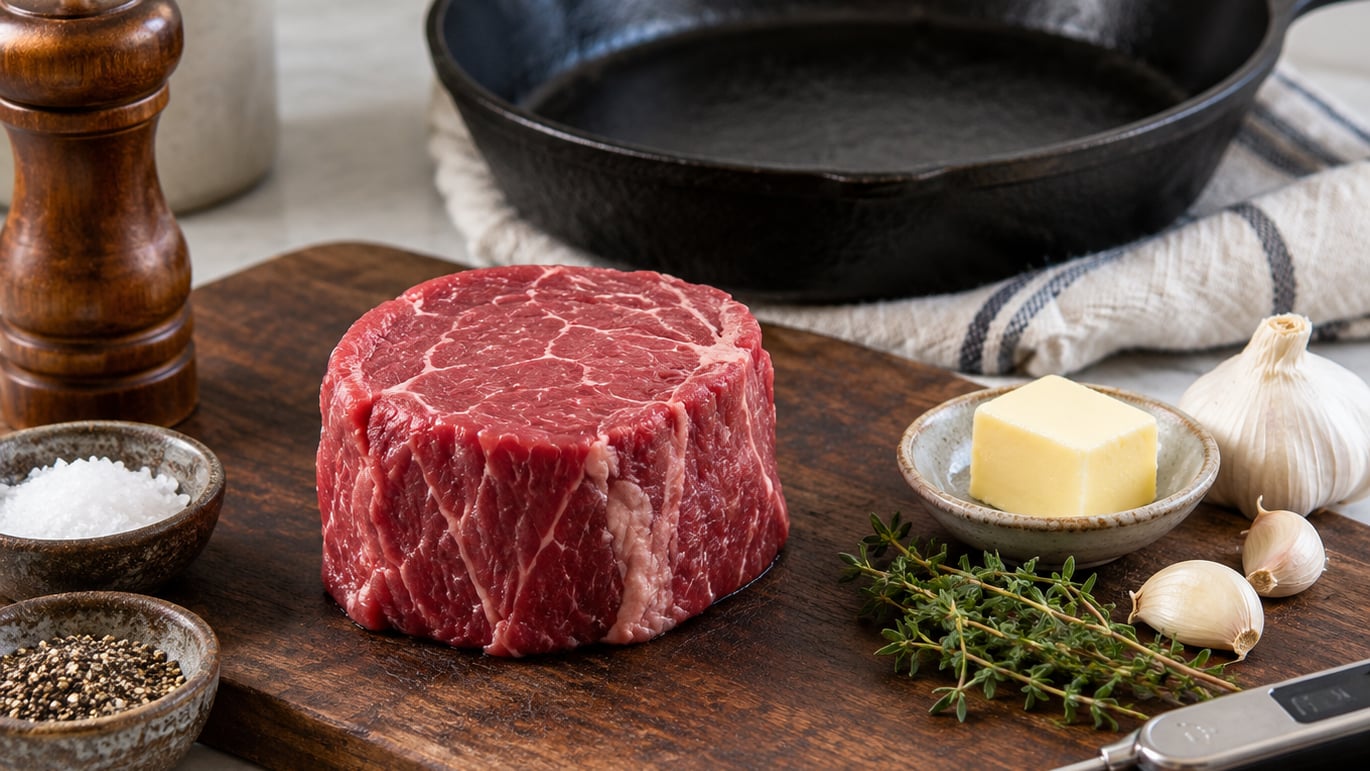
To cook filet mignon at home, season the steak, sear it hard in a very hot oven-safe skillet for about two minutes per side, then move the whole skillet into a 400°F oven until the thickest part hits your target internal temperature. Rest it five to ten minutes, slice it into thick medallions, and serve. The whole thing takes about 25 minutes of active work, and an instant-read thermometer is the one tool that decides whether it lands.
Filet mignon is the tenderloin, the leanest and most tender muscle on the animal. It has almost no connective tissue and very little fat, which is exactly why it deserves careful handling. Cook it long or hot without a thermometer and it turns dry and rubbery, and there is no fixing that afterward.
People ask this question most often around date nights, anniversaries, and holiday meals, when the steak is the point of the whole dinner. If you are planning the rest of the menu, plan a birthday dinner at home the same way you would plan this one: sides first, steak timed last.
Table of Contents
- What You Need
- Step-by-Step: How to Cook Filet Mignon at Home
- Common Mistakes
- Frequently Asked Questions
- How do I cook filet mignon in a cast-iron skillet?
- Should I sear filet mignon before putting it in the oven?
- What temperature should filet mignon reach when cooked at home?
- How long should I let filet mignon rest before slicing?
- Can I cook filet mignon without a cast-iron skillet?
- How do I keep filet mignon from becoming dry or overcooked?
- Conclusion
What You Need
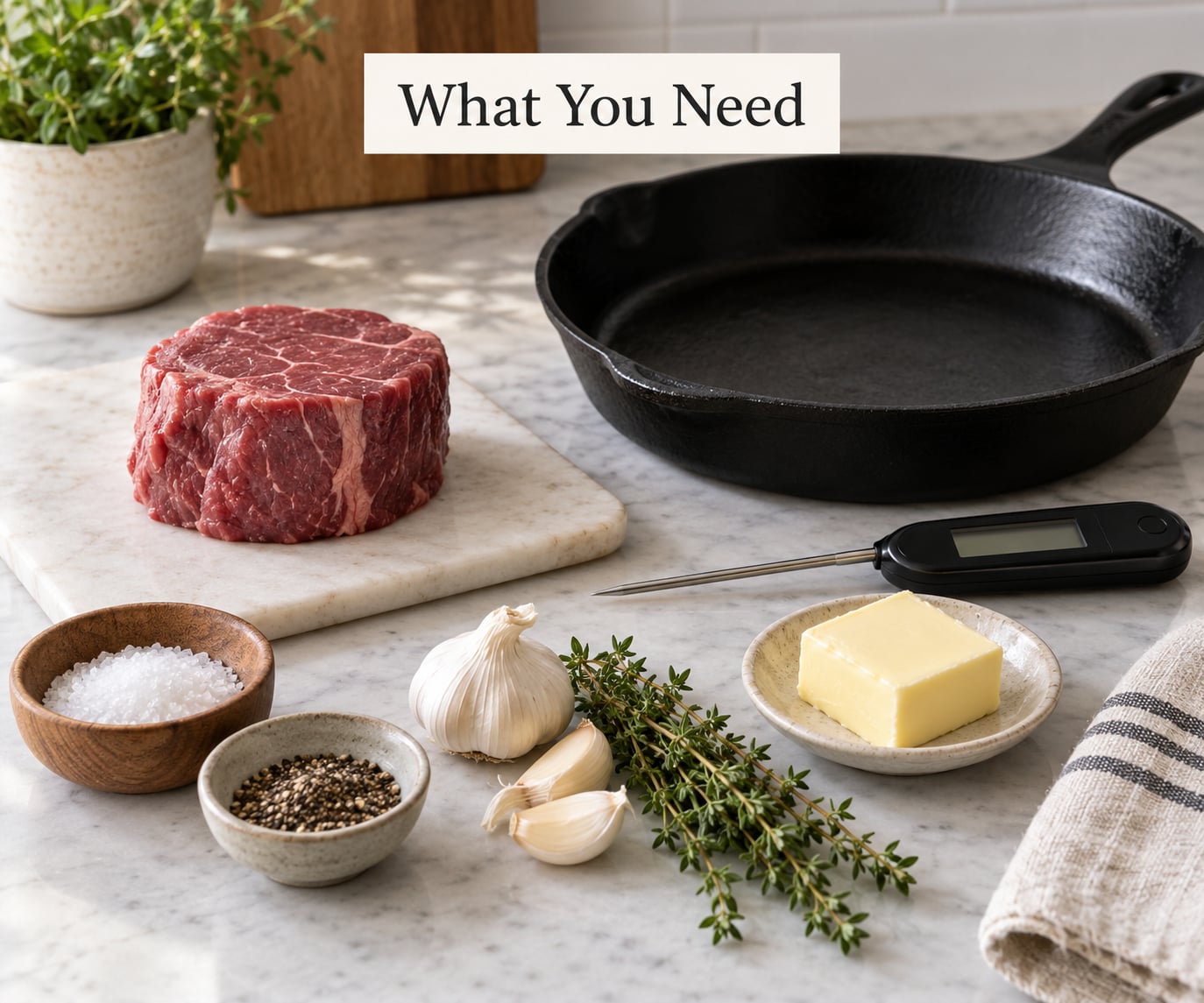
You need very little. Filet mignon needs salt, pepper, butter, and time. Elaborate marinades are wasted on a cut this tender, and most home cooks who try one end up with a salty exterior and nothing underneath.
- Filet mignon steaks — 4 to 10 ounces each, ideally 1.5 inches thick and close in size so they cook at the same rate.
- Kosher salt — coarse or regular, about 1 teaspoon per steak, more than feels right.
- Coarsely ground black pepper — a grinder is worth having, and generous use is fine.
- Unsalted butter — 3 to 4 tablespoons, softened, for the baste.
- Garlic — 2 cloves, lightly crushed.
- Fresh thyme or rosemary — a few sprigs.
- High smoke-point oil — avocado, canola, or grapeseed. Olive oil burns before the steak gets its crust.
For equipment, a heavy skillet with a smooth base is the whole requirement. Cast iron is ideal because it holds heat, but a thick stainless steel pan or a carbon steel pan works nearly as well. Whatever you use has to be oven-safe, since the finish happens in the same pan. If your skillet is not oven-safe, cook the sear on the stove and move the steak to a preheated sheet pan to finish.
An instant-read thermometer is the other piece of equipment worth owning. You can use a leave-in probe, but for a steak this small the instant-read is faster and easier to place correctly. For more on building flavor in layers, see how to season food as you cook.
A sharp chef’s knife matters more than people expect, because tenderloin slices best in thick medallions rather than thin shavings. That is the same principle as cooking a pork chop that is not dry: cut against the grain and keep the pieces big, and the texture takes care of itself.
Step-by-Step: How to Cook Filet Mignon at Home
1. Prepare the Filet Mignon
Take the steaks out of the refrigerator 30 to 45 minutes before cooking so they reach room temperature. A steak straight from the cold will sear unevenly, and the center will lag behind the crust.
Pat both sides thoroughly dry with paper towels. Surface moisture is the enemy of browning, and a wet steak steams in the pan instead of searing.
Season both sides generously with kosher salt and pepper, right up to the moment you cook. Salt applied early draws moisture to the surface and helps it reabsorb, which seasons the deeper layers too.
Trim the steaks to an even 1.5-inch thickness if you bought them uneven. If the steak has a thick band of fat along one side, leave it rather than cutting it off — it renders during the oven finish and bastes the steak from the side. Only trim silver skin, the thin translucent membrane, by sliding a knife under it and cutting away from the blade. If the fat cap is more than a quarter-inch thick or scorches in the pan, take a little more off.
You are ready when the steaks are dry, seasoned, room temperature, and your oven is already at 400°F with the skillet inside heating.
2. Sear the Steak
Heat the oven-safe skillet over high heat for 3 to 4 minutes, until a drop of water skitters across the surface. Add a thin layer of high smoke-point oil and let it shimmer and just begin to smoke.
Lay the steaks in the pan away from you, one at a time, and lay them down rather than dropping them from height. If the oil sputters violently and the smoke turns dark, it is too hot; pull the pan off the heat for a moment.
Leave the steak alone for roughly two minutes per side. Do not flip it early, do not move it, do not press it. One flip is all it needs, and every extra move costs you crust.
You are looking for a deep, even, nut-brown crust that covers the flat face edge to edge. If you see pale grey or raw-looking patches, the steak needs another 15 to 30 seconds on that side.
3. Finish It in the Oven
Move the skillet into the 400°F oven. A heavy cast iron pan at this temperature finishes a 1.5-inch steak in about 4 to 7 minutes, depending on thickness and how well you seared it.
Cook to internal temperature, not to time, and remember carryover: the center keeps rising 3 to 5°F while the steak rests, so pull it earlier than the number you want to read.
| Doneness | Pull at | Rests to | Rest time |
|---|---|---|---|
| Rare | 120°F | 125°F | 5 minutes |
| Medium-rare | 130°F | 135°F | 5 to 8 minutes |
| Medium | 138°F | 143°F | 8 minutes |
| Medium-well | 148°F | 153°F | 10 minutes |
| Well done | 158°F | 163°F | 10 minutes |
Insert the thermometer into the thickest part of the steak, aiming for the center without touching the pan or the fat cap. USDA guidance for whole cuts of beef is 145°F internal temperature with a 3-minute rest; the lower rows in the table sit under that and are a matter of personal preference, not safety.
4. Baste with Garlic Butter
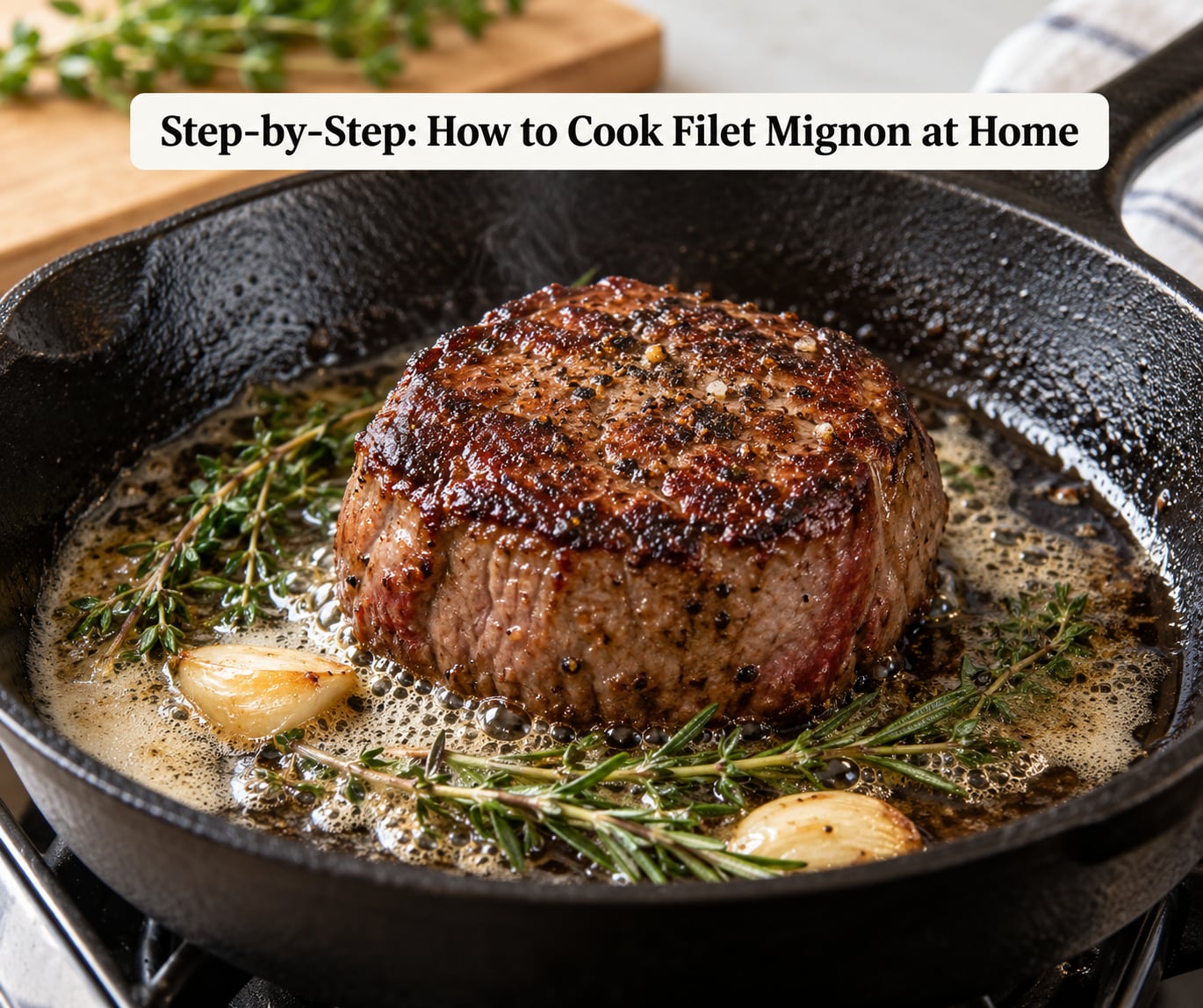
Pull the skillet out for the final two minutes and build the pan butter: drop in the butter, add the crushed garlic and thyme sprigs, and let it foam while you tilt the pan to coat the bottom.
Tip the pan so the butter runs over the top of the steaks, then spoon it back over repeatedly for a minute or two. Watch the color — the butter should foam and turn nut-brown, never dark brown or black. The smell tells you the same thing: nutty is right, acrid means it has gone past.
You are done when the steak is glossy and the garlic smells sweet rather than burnt.
5. Rest, Slice, and Serve
Move the steaks to a warm plate and let them rest 5 to 10 minutes. Skip this and the juice runs out onto the board the moment you cut. During the rest you can finish the pan butter into a sauce with a splash of water and scrape up the browned bits.
Filet mignon runs lengthwise with the grain, and most butchers cut the steaks perpendicular to it. Check the direction on the raw steak: if the fibers run side to side, you cut across them already; if they run end to end, rotate the steak 90 degrees before cutting.
Slice into medallions an inch thick with a sharp knife. Cut one and press the top lightly — a medium-rare steak springs back and pushes a little juice onto the plate, which is the sign of a properly cooked filet. If it does not spring back and looks dry throughout, it went past medium.
Serve with mashed potatoes, roasted vegetables, potatoes au gratin, or a simple green salad. Mashed potatoes are the traditional pairing because they soak up the pan butter.
Common Mistakes
The pan is not hot enough. This is the most common failure and it produces a grey, steamed steak with no crust. Heat the empty pan for several minutes, then add oil and wait for it to shimmer before the steak goes in.
Flipping too many times. Every lift and turn interrupts the Maillard reaction and tears the crust off. One flip per side is enough, and use tongs or a spatula rather than a fork.
Not enough oil, or the wrong oil. Use enough oil to wet the whole face of the pan and stick to a high smoke-point oil like avocado. Olive oil goes bitter and smoky before the steak has browned.
Crowding the skillet. Cook one or two steaks at a time so the pan stays hot. Crowd it and the temperature drops, the steaks steam, and you get grey edges.
Finishing in a cool oven. Put the skillet in the oven while the oven is already at 400°F, not after the steak goes in. An oven heating from cold adds several minutes you did not plan for.
Ignoring carryover cooking. Pulling the steak at 135°F means serving it at 145°F and dry. Pull 3 to 5°F below your target and trust the rest.
Skipping the rest. Those five minutes of downtime are the difference between a juicy steak and a plate of warm juice and dry meat.
Slicing with the grain. This is the one cut where people get confused, because the steak is often already cut across the grain. Look at the fibers before you cut and go across them.
Burning the butter. Baste during the last two minutes, keep the spoon moving, and pull the skillet off the heat the moment the butter smells acrid.
Cooking it past medium. Tenderloin has almost no fat, so well-done filet is a dry filet. Medium-rare is what the cut was built for.
Frequently Asked Questions
How do I cook filet mignon in a cast-iron skillet?
Heat the cast iron over high heat for 3 to 4 minutes, add a thin layer of avocado or canola oil, then lay the dry, seasoned steak down away from you. Sear about 2 minutes per side without moving it, until the crust is deep brown edge to edge. Then move the whole skillet into a 400F oven until a thermometer reads 130F to 135F for medium-rare. The cast iron keeps its heat through the sear and survives the oven finish without warping.
Should I sear filet mignon before putting it in the oven?
Yes, and that sear is not optional. The oven alone will cook the steak evenly but it will not brown it well, so you end up with a pale surface and very little flavor. Sear hard on the stovetop first to build the crust, then use the oven only for the finish. That two-stage approach is how you cook filet mignon at home and get the crust of a restaurant steak with the even center of a gentle roast.
What temperature should filet mignon reach when cooked at home?
For medium-rare, pull it at 130F so it rests up to about 135F. Medium lands near 140F to 143F, and medium-well near 150F. USDA guidance sets 145F as the safe minimum internal temperature for whole cuts of beef, with a 3-minute rest. Because tenderloin is so lean, most cooks stop well short of that. Always check the thickest part with an instant-read thermometer, never the side or the fat cap.
How long should I let filet mignon rest before slicing?
Five to eight minutes for medium-rare, and up to ten for thicker steaks or a larger crowd. This is where carryover cooking finishes the steak, adding another 3 to 5F to the center while the juices move back into the meat. Resting on a warm plate rather than a cutting board keeps it from cooling down too fast. Cutting any earlier sends the juice onto the board and leaves the steak dry.
Can I cook filet mignon without a cast-iron skillet?
Yes. A thick stainless steel or carbon steel pan sears just as well, since cast iron only matters for heat retention. Use any oven-safe skillet, or sear on the stove and transfer the steak to a preheated sheet pan to finish. The two things that do matter are that the pan gets very hot before the steak goes in and that your oil has a high smoke point. A glass or nonstick pan will not give you a crust.
How do I keep filet mignon from becoming dry or overcooked?
Cook it in two short stages instead of one long one, and stop relying on the clock. Pull the steak 3 to 5F below your target temperature and let the carryover finish the job during the rest. Keep the oven at 400F and only go there after the crust is already formed. Also watch the sides: a steak done to medium-well has no fat left to protect it, so anything past that is guaranteed to taste dry.
Conclusion
Start here: set the oven to 400°F, pull the skillet out to heat with it, and take the steaks out of the fridge so they come to room temperature while you do. That order is the whole method — hot pan, dry and seasoned steak, hard sear, oven finish to temperature.
From there, take the temperature out of the guessing column: pull at 130°F for medium-rare, watch for carryover, rest five to eight minutes on a warm plate, then slice into thick medallions across the grain. Do that consistently and 2026 is the year you stop apologizing for the steak at home.