
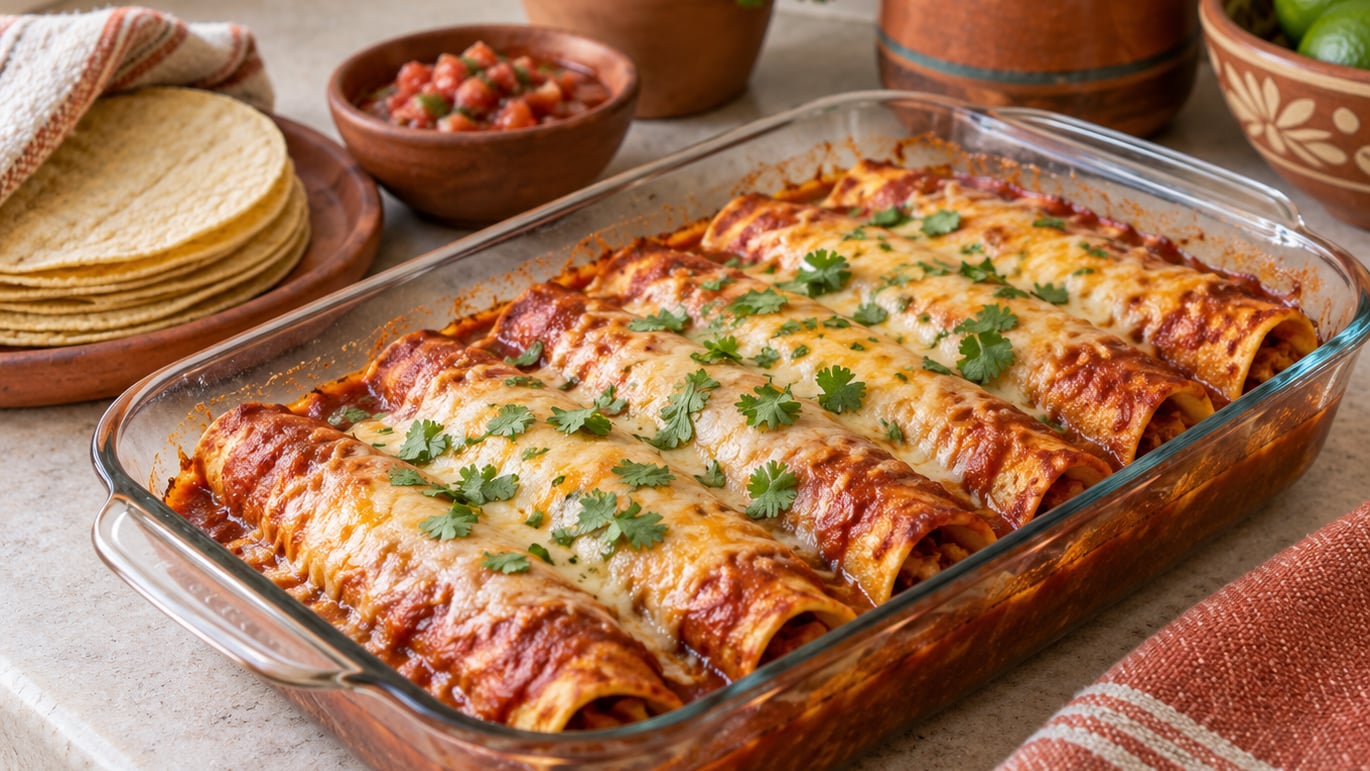
You can make enchiladas ahead of time by rolling them completely, saucing the pan, and covering the dish before it goes into the refrigerator for up to 3 days or the freezer for up to 3 months. Bake at 350°F straight from the fridge, or thaw frozen enchiladas in the refrigerator overnight first. The whole trick is keeping sauce off the tortillas while they wait.
I cook a lot of enchiladas in batches, mostly because a 9×13 pan feeds my family once and leaves nothing for the following week. Making them ahead is what turned that from a two-hour Saturday project into something I can finish before dinner on a Tuesday. Assembly is the slow part, not the baking, so that is exactly the part worth doing early.
This guide covers three routes: fully assembled and refrigerated, frozen unbaked, and components only. Pick based on how far ahead you are cooking and how crisp you want the tortillas on the day.
What You Need to Make Enchiladas Ahead of Time
Nothing exotic. You need a 9×13-inch baking dish, a wide spatula, aluminum foil, plastic wrap, and something to label with. For freezing, add a freezer-safe dish with a lid, or a roll of freezer-safe parchment paper if you want to transfer the batch to a pan you already own.
On ingredients, most recipes scale without much thought:
- Corn or flour tortillas, one per enchilada plus two or three spares
- Enchilada sauce, roughly one 28-ounce can per pan
- Cooked filling: shredded chicken, ground beef, refried beans, or a cheese and potato mix
- Shredded cheese, about 2 cups for a 9×13 pan
- A small amount of oil for the tortillas
Which parts can be done separately? Nearly all of them. The filling can be cooked a day ahead and chilled. The sauce can be made two or three days ahead and kept in a jar. Both travel far better than a rolled tortilla, which is why component-prep is the best option if you are more than three days out.
On tortilla choice, flour tortillas are more forgiving make-ahead: they roll cold without splitting and survive freezing well. Corn tortillas taste better here, but they need to be warm and pliable, and older corn tortillas crack along the edges when rolled straight from the fridge. Buy the freshest corn tortillas you can and warm them right before you roll.
How to Make Enchiladas Ahead of Time, Step by Step
Step 1: Choose Your Make-Ahead Plan
You have three options, and the answer depends on your calendar.
Assemble everything and refrigerate. This is the best route for one to three days ahead and gives you the crispiest result, because the tortillas have not been through a freezer at all. It is also the only route that works well for corn tortillas.
Assemble everything and freeze unbaked. Best from a week to three months out. Freezing sets the tortillas slightly, so give yourself a few extra minutes in the oven, and expect a little softer texture than the fridge version.
Prepare components only. Cook the filling, make the sauce, and refrigerate them separately, then roll and bake on the day. Choose this if you are four days or more ahead, or if you want full control over how much sauce goes on each tortilla.
There is a fourth option people like: bake one pan now and freeze a second pan unbaked for later. Double the filling, sauce and cheese, and get a clean meal tonight plus a pan that is already waiting. Cook one tray, freeze the second before it goes anywhere near the oven.
Step 2: Prepare the Filling and Sauce
Cook the filling fully, then cool it before you roll anything. A hot filling melts the cheese on contact, tears the tortilla seam, and pushes water into the pan.
Spread the cooked filling on a plate or sheet pan and let it chill in the refrigerator for 20 to 30 minutes. Drain excess fat from ground beef, and squeeze out liquid from spinach or other watery greens. Season lightly with salt and cumin. Filling seasoned in the pan gets a second dose of salt from the sauce, and over-seasoned filling is a fast route to a soggy result.
Strain the sauce if it has chunks. A thin, smooth sauce spreads more evenly and soaks into fewer tortillas.
On food safety: cool cooked poultry and meat quickly in shallow containers, and refrigerate it within two hours of cooking. Ground beef and ground turkey need an internal temperature of 160°F (71°C), poultry needs 165°F (74°C), and whole cuts of beef, pork, lamb and fish need 145°F (63°C). Keep the chilled filling at or below 40°F (4°C) until assembly.
If you are prepping components days ahead, this is also a good time to think about which enchiladas freeze best. Shredded chicken and cheese hold up well. Beans and roasted vegetables do too. Creamy cheese-based fillings tend to split and go grainy, so make those the day of.
Step 3: Assemble the Enchiladas Without Soggy Tortillas
Assembly order matters more than anything else you do. Build the pan in this sequence:
- Spread a thin layer of sauce, about a quarter cup, across the bottom of the greased 9×13-inch dish. This keeps the tortillas from welding themselves to the pan.
- Warm the tortillas one at a time in a dry skillet for 15 to 20 seconds per side, or wrap the stack in a damp towel for a minute. They should bend easily without cracking.
- Lightly brush each tortilla with oil before filling. The oil seals the surface, and sealed tortillas hold up through hours of storage and reheating without turning to mush.
- Add about a third of a cup of filling in a tight line down the center. Less is more here. An overfilled tortilla bulges, splits along the seam, and leaks filling into the sauce.
- Roll tightly and place seam side down in the dish, snug against the previous roll so the tortillas support each other.
- Pour the remaining sauce over the top and scatter the cheese to the edges. Spooning sauce into the gaps between the rolls helps the sauce reach the tortillas instead of pooling on the bottom.
Two signs tell you a tortilla is about to split: the edges look dry and pale as you fill it, or the filling mounds higher than the tortilla is wide. Fix either one with a smaller scoop, not more pressure.
Since sauce sitting on top is the number one cause of soggy make-ahead enchiladas, consider a lighter hand on the top layer if you are freezing. Some cooks hold back a cup of sauce and store it separately, then pour it over after the thaw. It is an extra step and it does keep the tortillas firmer.
Step 4: Refrigerate or Freeze the Enchiladas
Cover the dish completely. Press plastic wrap directly onto the surface so it seals to the sides of the dish, then wrap the whole thing tightly in aluminum foil. For a freezer dish with a lid, wrap the rim with foil first so nothing can leak onto the shelf.
A bare pan left uncovered in the refrigerator dries out the exposed tortilla tops and picks up odors within hours. The double seal is what prevents freezer burn on the same surfaces.
| Storage method | How long it keeps | Prep before baking | Bake temperature and time | Best for |
|---|---|---|---|---|
| Refrigerator, fully assembled | 3 to 4 days | None | 350°F (175°C), 25 to 30 minutes | One to three days ahead |
| Freezer, unbaked in the pan | 2 to 3 months | Thaw in the refrigerator 24 hours | 350°F (175°C), 30 to 40 minutes | A week or more ahead |
| Freezer, individually foil-wrapped | 2 to 3 months | Thaw wrapped, in the refrigerator | 350°F (175°C), 20 to 25 minutes | Single portions and gifts |
| Freezer, fully baked | 2 to 3 months | Thaw in the refrigerator | 325°F (163°C), 20 minutes, or reheat a portion | Cooked leftovers and weeknights |
Individual foil wrapping comes up constantly among home cooks, and it is the option most people do not know about. Wrap each enchilada separately, lay them seam side down on a tray, freeze until solid, then transfer to a freezer bag. You can pull out two or three without thawing the whole pan. It is also how you drop a tray of frozen enchiladas on a friend’s doorstep after a baby.
Whatever you store, label it with the date. Freezing from frozen on a thaw is safe, but never thaw on the counter, where the outside warms into the bacterial danger zone before the center defrosts.
If you are cooking for a crowd, do the math before you start. A 9×13-inch pan holds 8 to 10 rolled tortillas, which serves 4 to 6 people. Plan two pans for 10 guests and three for 15, and freeze the extras the day you assemble rather than cooking them from scratch twice. If that same table also needs a make-ahead side, our guide to making stuffing that is not soggy covers the other dish that usually needs the most planning.
Step 5: Bake or Reheat Until Crispy and Hot
From the refrigerator: take the dish out 15 to 20 minutes ahead so it is not oven-cold. Unwrap the foil and plastic wrap, discard them, cover the pan again with fresh foil, and bake at 350°F (175°C) for 25 to 30 minutes. Uncover for the last 5 to 10 minutes so the cheese browns.
From the freezer, unbaked: thaw the pan in the refrigerator for 24 hours. Cover with foil, bake at 350°F (175°C) for 30 to 40 minutes, then uncover for the final 10 minutes.
From the freezer, baked: thaw in the refrigerator, then cover and heat at 325°F (163°C) for about 20 minutes. This is the gentlest path and the one that keeps the filling moist.
You will know they are done when the cheese is fully melted with browned spots and sauce is bubbling around the edges of the pan. The center needs to feel hot, not just warm. If you are using a meat filling, check the thickest part and confirm it has reached the safe internal temperature: 165°F (74°C) for chicken, 160°F (71°C) for ground beef.
For reheating one serving, the oven wins. A 375°F (190°C) oven for 12 to 15 minutes keeps the tortilla from drying out. The microwave works in about 90 seconds, but the tortilla turns rubbery and the cheese gets stringy, so use it only when you are in a hurry. An air fryer at 375°F (190°C) for 8 to 10 minutes gives you the crispiest single portion without reheating the whole pan.
Common Mistakes When Making Enchiladas Ahead
Watery filling is the most common problem. Drain the fat, cook off moisture, and cool the filling before it goes in. The tortilla should not be damp when you pick it up.
Too much sauce on top steams the tortillas during storage. Use a moderate amount in the pan, and consider holding some back to add after reheating.
Rolling cold tortillas causes cracks and leaks. Warm them first, and always brush with oil, which is the single best defense against both cracking and sogginess.
Skipping the double wrap dries out the tops. Plastic wrap on the surface plus foil around the dish keeps air off entirely.
Reheating cooked enchiladas too hot dries them out. Bake at 325°F (163°C) with foil on rather than blasting at 350°F (175°C).
Thawing on the counter is the one mistake with real consequences. Move the pan to the refrigerator a full day before you plan to bake.
Two habits fix most problems before they start. Chill every component before assembly, and keep the double wrap until the moment of baking. Between the two, sogginess stops being an issue.
Frequently Asked Questions
How far ahead can I make enchiladas?
Fully assembled enchiladas keep 3 to 4 days in the refrigerator and stay good for 2 to 3 months in the freezer. For anything longer, cook the filling and make the sauce separately and refrigerate them, then roll and bake on the day you plan to serve. Freezing cooked enchiladas works too, and reheating them gently at 325°F keeps the filling moist.
Can I freeze enchiladas before baking?
Yes, freezing unbaked is the most common make-ahead method. Assemble the pan, cover it tightly with plastic wrap and foil, and freeze for up to 2 to 3 months. Thaw in the refrigerator for 24 hours before baking covered at 350°F (175°C) for 30 to 40 minutes, then uncover for the last 10 minutes to brown the cheese.
How long do refrigerated enchiladas last?
An assembled pan of enchiladas keeps safely in the refrigerator for 3 to 4 days when covered and kept at or below 40°F (4°C). Beyond that, the tortillas get soft and the surface can pick up refrigerator odors. Freeze it instead if you need more time, and always label the dish with the date you stored it.
What is the best way to reheat enchiladas without getting soggy?
The oven gives the best result. Cover the pan with foil and heat at 350°F (175°C) for 25 to 30 minutes, uncovering for the final 5 to 10 minutes to crisp the cheese. For one serving, 375°F (190°C) for 12 to 15 minutes works well. The microwave is fastest but turns tortillas rubbery, so save it for emergencies.
Should I bake refrigerated enchiladas covered or uncovered?
Bake them covered for most of the time, then uncovered at the end. The foil traps steam so the filling heats through without drying out, and the last 5 to 10 minutes uncovered melts and browns the cheese. Baking uncovered the whole time dries the tortillas at the edges before the center gets hot.
Which fillings are best for making enchiladas ahead?
Shredded chicken, ground beef, black or refried beans, and cheese with roasted vegetables all hold up well after refrigerating or freezing. Creamy cheese-based fillings and very wet vegetables tend to split or release water, so roll those the day you serve. Always cool the filling and drain excess fat before assembling.
Breakfast enchiladas follow the same rules but reward a different plan. Cook the sausage and eggs, cool them fully, and refrigerate them overnight; bake the pan the next morning. The same make-ahead logic works for a layered enchilada casserole, which is easier to freeze in one piece than rolled tortillas. If you are building a big brunch spread, our guide to making a breakfast casserole ahead of time covers the same timeline in more detail. And if the same week calls for a cold side dish, our notes on how to make potato salad ahead of time are worth a read.
Conclusion
Start with the timeline. Three days or less, assemble the pan, press plastic wrap onto the surface, cover with foil, and bake at 350°F (175°C) for about 30 minutes while it heats. A week or more out, assemble and freeze unbaked, then thaw in the refrigerator for 24 hours before baking. Further out than that, chill the filling and make the sauce separately, then roll the day you serve.
Whatever route you pick, keep the filling and sauce cold until assembly, brush the tortillas with oil, and leave them sealed until baking time. That is the difference between enchiladas that hold together on a busy weeknight and a pan you reheat twice.