
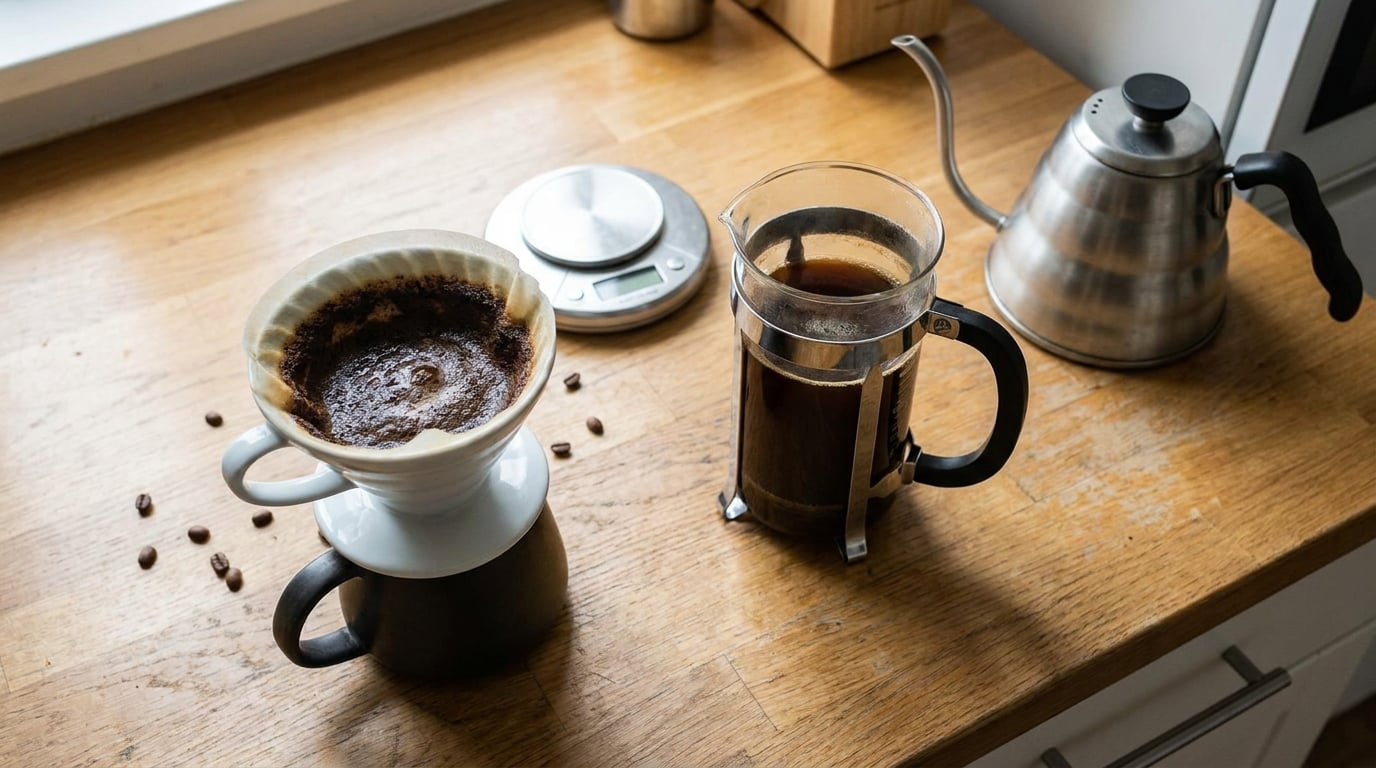
Pour over vs french press coffee comes down to one thing: the filter. A French press submerges coarse grounds in hot water for about four minutes, then presses them down with a metal mesh, so coffee oils and fine sediment stay in the cup and the result tastes heavy and rounded. Pour over sends water through a paper filter in stages, which pulls the oils and grit out and leaves a clean, bright cup that shows off where the beans came from.
Pick pour over if you want precision, clarity, and a single carefully built cup. Pick a French press if you want a full pot in about five minutes, forgiving technique, and a forgiving clean-up. Plenty of people own both, and after brewing the same bag both ways, the difference is far more obvious than the word counts suggest.
Table of Contents
- Pour Over vs French Press Coffee at a Glance
- How Pour Over and French Press Coffee Taste
- Which Method Is Easier to Use?
- How Consistently Do They Brew?
- Pour Over vs French Press Coffee: Which Is Cheaper?
- How Each Brewing Method Works
- Pour Over Brewing Technique
- French Press Brewing Technique
- Which Should You Choose?
- Frequently Asked Questions
- Is pour over coffee healthier than French press coffee?
- What are the downsides of using a French press?
- What are the disadvantages of pour-over coffee?
- What makes the best coffee, pour over or French press?
- Is French press stronger than pour over?
- Can you use the same beans for a French press and pour over?
- The Bottom Line
Pour Over vs French Press Coffee at a Glance
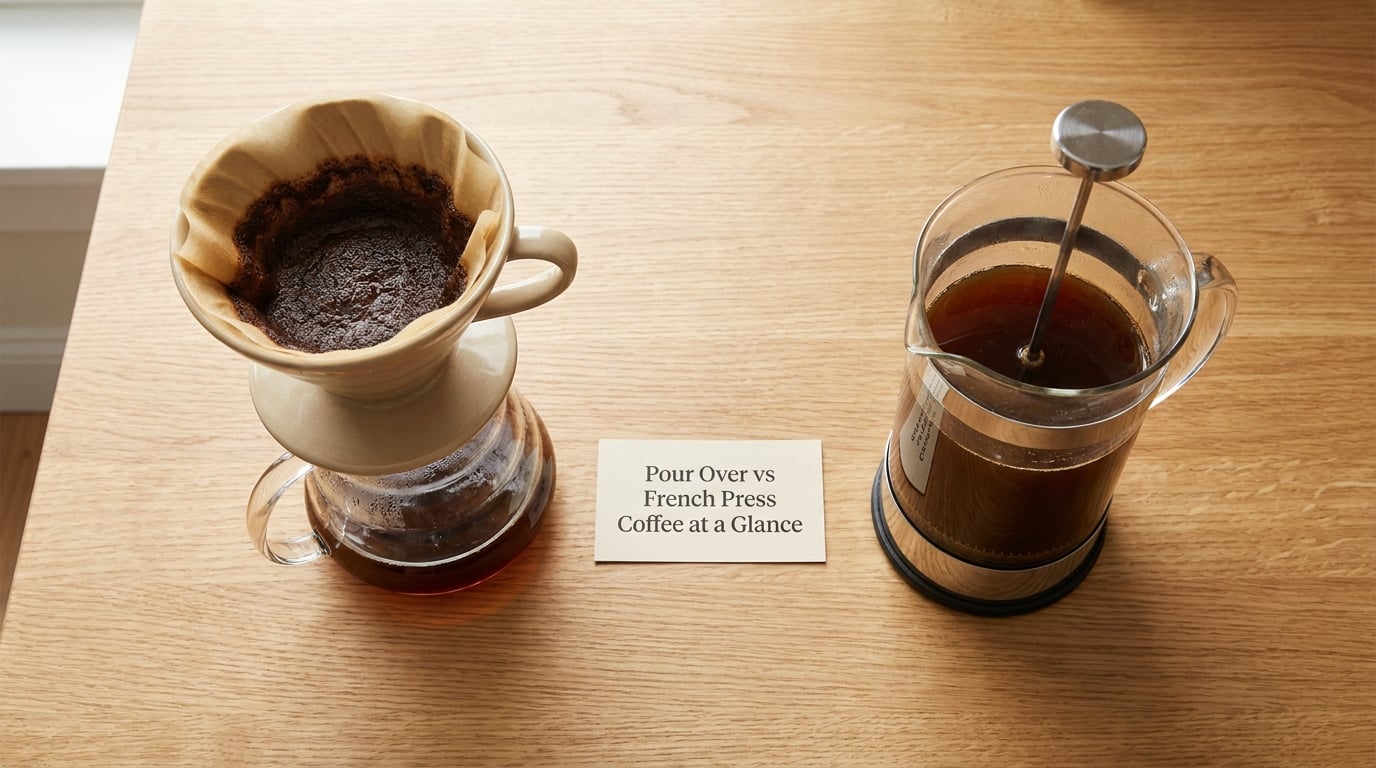
Pour over trades a little effort and equipment for a clean, precise cup. A French press trades clarity for speed and forgiveness. Here is how the two stack up on the things people actually notice.
| Criterion | Pour over | French press |
|---|---|---|
| Body | Light to medium, almost tea-like | Thick and syrupy, rounds off acidity |
| Sediment | None; the paper filter traps particles | A layer of sludge in the bottom of the mug |
| Clarity | High; origin and floral notes separate | Low; flavors blend into one rounded mass |
| Filter | Paper cone | Metal mesh plunger |
| Grind size | Medium to medium-fine | Coarse, roughly like sea salt |
| Brew time | 2 minutes 30 seconds to 4 minutes, including the bloom | 4 minutes, plus a minute for the grounds to settle |
| Ratio | About 1:16, such as 22 g of coffee to 350 ml of water | About 1:15, such as 30 g of coffee to 450 ml of water |
| Water temperature | 200 to 207 °F | 195 to 205 °F |
| Active attention | Continuous, controlled pouring | One stir, then wait |
| Serving size | One to four cups | Two to eight cups |
| Cleaning | Rinse the cone, bin the filter, wipe the carafe | Decant, soak the carafe, scrub the plunger and mesh |
| Skill level | Moderate; a scale and a timer pay off fast | Low; a recipe and a four-minute wait do most of the work |
How Pour Over and French Press Coffee Taste
Pour over tastes lighter, brighter, and cleaner, while French press coffee tastes fuller, rounder, and more bitter as it cools. Both start with the same beans and the same water, so the difference is entirely mechanical.
Why the paper filter makes pour over taste cleaner
Water moves through the bed in stages under gravity, and the paper filter is a very fine sieve. It holds back coffee oils, which are the aromatic compounds that carry sweetness and body, along with nearly all of the fine particles.
What you lose in weight, you gain in definition. A washed Ethiopian or a light roast tastes floral and bright, and you can actually pick out stone fruit, jasmine, or berry notes in the cup. The texture is thinner and closer to tea, which is why many drinkers reach for milk in an afternoon cup but drink pour over black in the morning.
Why the metal mesh makes French press taste heavier
Everything steeps submerged for four minutes, so the grounds and water interact across the whole surface with no filter paper in between. The metal mesh stops the coarse bed but lets fine sediment and a good share of the oils through, and the plunging action stirs up the fines that were resting at the bottom.
That material is what gives a French press its weight on the tongue. It also means the cup keeps changing as it sits. Hot, it reads smooth and chocolatey. Twenty minutes later the bitterness that was muted in the warmth has come forward, which is one of the most common complaints people have with the method.
Tasting pour over vs french press coffee side by side
Reading about the difference is much weaker than tasting it, and you can run the test at home for the price of one bag of beans. Brew 22 g of the same coffee as a pour over at a 1:16 ratio, then brew 22 g of that same coffee in a French press at 1:15, and use the same water for both.
Let both cool to about room temperature, because French press bitterness hides in the heat. Pour each into identical small cups, swap the cups back and forth, and taste black before adding anything. Note three things: the weight on the tongue, how sharp the acidity is, and how the finish changes as the cup cools. That is the whole difference in a form you can trust, and it takes about fifteen minutes of active work plus cooling time.
Which roast works with which method
Pair the method to the bean and neither one has to hide. Dark and chocolatey roasts, anything nutty and caramel-sweet, sit naturally in a French press because the immersion softens their edges. Light roasts and washed single origins need the paper filter of pour over, since the mesh lets their acidity and any astringency come through unsoftened.
One practical rule: if the bag lists tasting notes you cannot taste in the cup, that is a grind, temperature, or time problem rather than a method problem. Over-extracted French press coffee buries light roasts, and badly poured pour over flattens them.
Which Method Is Easier to Use?
A French press is easier for a first cup. You add coffee, add water, stir, wait four minutes, press, and pour. Pour over asks more of you: grind, weigh, bloom, and pour in a controlled spiral while the water drains.
What a first-timer actually has to learn
Most first-time pour over mistakes are pouring mistakes, not taste mistakes. Pouring too fast floods the bed and pushes water down the side in channels, which under-extracts and gives you a sour, watery cup. Pouring from too high scorches the top layer while the middle stays dry. The fix is unglamorous: start slow, pour in the middle, keep the bed level, and let it draw down between pours.
The French press has one real trap, and it is timing. Coffee sitting on the grounds after the plunge continues to extract. If the brew sits for ten extra minutes while you finish breakfast, the cup will be harsh. Press and decant straight away, even if that means decanting into a second jug.
How many cups each method makes at once
Pour over scales to a small carafe, so two to four cups is the comfortable range and you can repeat the batch if more people arrive. A standard French press brews two to eight cups in one go, and the extra capacity is the reason many households keep one on the counter permanently.
If you are making coffee for a group, the press wins on time. If you are making one cup and you like the last three minutes of the pour, pour over is more satisfying than it is difficult.
Do you need a scale or a gooseneck kettle
A gooseneck kettle is a nicety. The narrow spout gives you control over where the water lands, and a regular kettle with a careful, low pour works nearly as well. A scale is worth more, because volume measures drift and weight does not, and small dose errors are the usual reason beginners cannot repeat a cup.
Neither method requires either piece of gear on day one. Both get easier fast once you have them, and a kitchen scale plus a cheap cone costs far less than a year of coffee.
How Consistently Do They Brew?
A French press is more forgiving; pour over gives you more control once you have it. Forgiving means the same recipe produces a drinkable cup even when your grind, your water, or your attention is a little off. Control means you can change one variable at a time and taste exactly what it did.
Where pour over goes wrong
Pour over is sensitive to grind size because water travels faster through a fine bed and slower through a coarse one. Too fine and the brew stalls and turns bitter and dry. Too coarse and the water races through in under two minutes, leaving a thin, sour cup that tastes of nothing but acidity. Pour height, pour speed, and how much you pour at each stage all shift the result as well.
Where French press goes wrong
The French press is far less fussy about grind size, which is why it forgives a shared bag or a new grinder. Its two failure modes are time and agitation. Brewing past four and a half minutes pulls heavy astringency from the grounds, and swirling or pumping the plunger aggressively churns fines into the cup.
| What you taste | Usual cause | Fix |
|---|---|---|
| Sour, thin, watery pour over | Grind too coarse, brew under 2:30, or pouring in channels | Grind finer, bloom 30 to 45 seconds, pour slower in the center |
| Bitter, drying pour over | Grind too fine, water too hot, or long contact after the bed drains | Grind coarser, drop to about 200 °F, serve as soon as it finishes |
| Bitter French press | Steeped past four minutes or left on the grounds | Press and decant immediately, drop the steep to 3:30, use less coffee |
| Muddy or gritty French press | Plunger pumped hard, or sediment stirred up while pouring | Press slowly, let the bed settle a minute, pour off the top first |
| Weak, watery coffee in either | Dose too low or water too cool | Move toward 1:15 and heat water to 200 °F |
| Cup tastes flat when reheated | Reheating pushes already-extracted coffee further | Brew fresh, or make the intended amount next time |
Water is the quiet variable in both. Very soft water tastes flat, and very hard water mutes aroma and dulls acidity. Filtered water helps both cups, and it is the cheapest improvement in either routine.
Pour Over vs French Press Coffee: Which Is Cheaper?
The French press is cheaper to start and cheaper to run. Equipment figures move around a lot depending on brand, size, materials, and where you buy, so treat any specific number as a rough guide that changes over time rather than a price to plan around.
A French press is a single vessel, a plunger, and a mesh. There is nothing to replace, and a good one lasts for years. Pour over usually means a cone or dripper, paper filters on every brew, and two pieces of helpful gear: a gooseneck kettle and a scale. You can start with a cone and a mug, and add gear later once you know you like the method.
Ongoing cost is where the gap closes. Pour over spends a paper filter each morning, a fraction of a cent in practice. Both methods use roughly the same amount of coffee per cup, and a French press sometimes wastes a little because you brew a full pot and reheat part of it in the morning. If you drink one cup a day from a pot built for six, pour over is the more efficient of the two.
Whichever you pick, the bean is the largest line item in the budget by a wide margin, and the second biggest is water and electricity. Grind a little coarser, brew a little smaller, and both methods get cheaper.
How Each Brewing Method Works
Two very different things happen inside these brewers. One dissolves everything evenly and then filters at the end. The other filters continuously while it extracts.
What a French press does
Grounds sit fully submerged in hot water for the whole steep, so water contacts every particle equally and extracts in every direction at once. A metal mesh plunger then pushes the bed to the bottom of the carafe, and the liquid is poured off, leaving the grounds behind.
The key variables are grind size, steep time, dose, and how violently you plunge. Total dissolution time, the time water spends in contact with coffee, is long here, which is why flavor comes out bold and why over-steeping hurts so much.
What a pour over does
Water is poured in stages over a bed of grounds held in a paper cone, and gravity pulls it through into a server or cup. Because the water only touches each particle briefly, the brewer can shape extraction by controlling where and how fast you pour. The bloom at the start wets the grounds and lets trapped carbon dioxide escape, which opens the bed up for the main pour.
The key variables are grind size, pour rate, water temperature, bloom time, and total brew time. A pour over is far less forgiving and far more precise, and that precision is exactly what people are buying when they pick it.
Pour Over Brewing Technique
A pour over you can repeat comes down to five numbers: dose, ratio, temperature, bloom, and total time. Set them once, write them down, and change only one at a time until the cup tastes right.
Here is a starting recipe that works for most medium and light roasts. Adjust from there rather than chasing other recipes.
- Weigh the coffee. Use 22 g of medium-fine grounds, roughly the mass of two tablespoons, for a single cup.
- Rinse the paper filter with hot water and discard the rinse water. This removes the papery taste and preheats the cone.
- Add 50 ml of water at 200 to 205 °F and let the grounds sit for 40 seconds. The bed will swell and release gas as carbon dioxide. This is the bloom, and skipping it is the most common beginner error.
- Pour the rest in stages to a total of 350 ml, keeping the stream low and centered between pours and waiting for the bed to draw down almost flat before adding more.
- Finish by 3 minutes. The whole pour from first water to last drip should land between 2:30 and 4:00. Total time is your main lever.
- Taste and adjust. Sour and fast means the grind is too coarse, so grind finer. Bitter and slow means the grind is too fine, so grind coarser.
Give the cup a week with the same numbers before changing anything. Grinders settle in, water cools in the kettle, and the taste of fresh coffee fades for a day or two after roasting, so a single cup is not a fair test.
French Press Brewing Technique
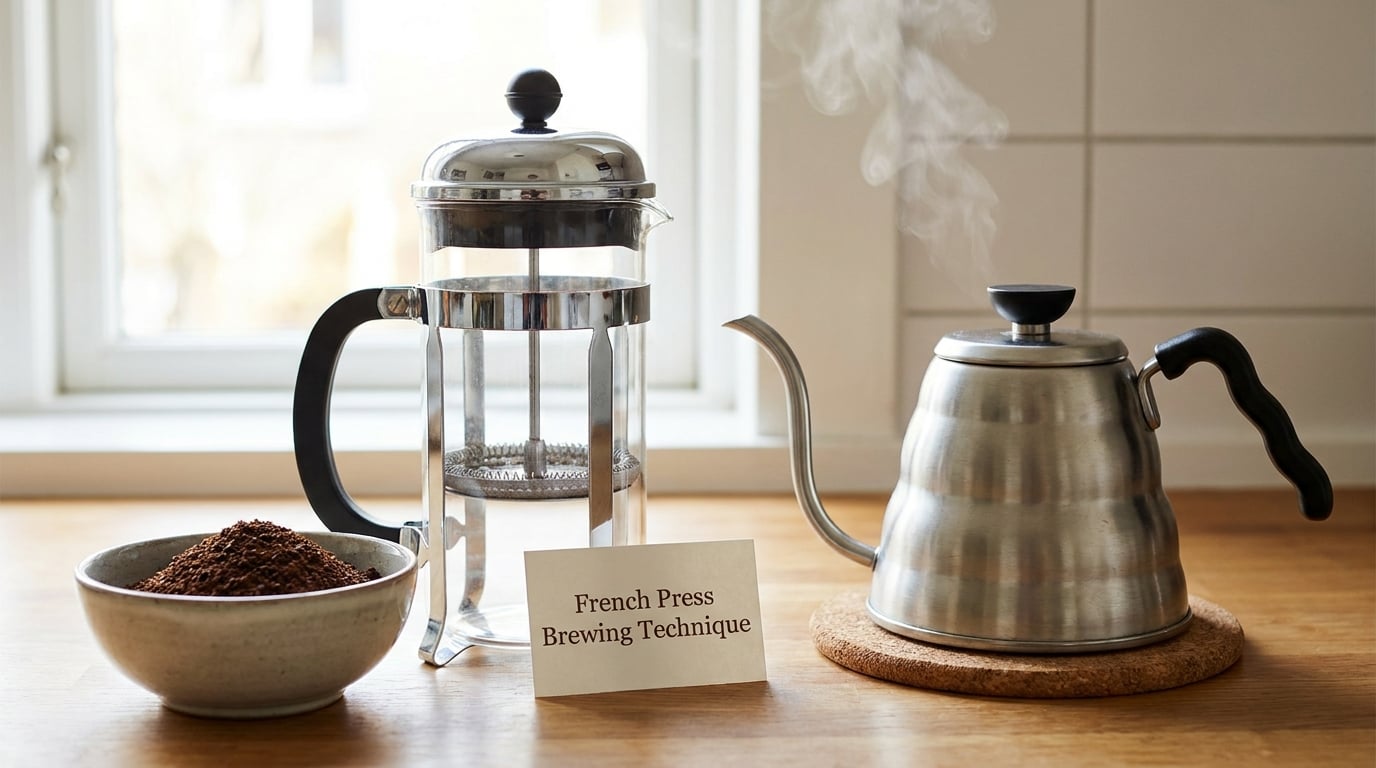
The French press rewards patience and punishes inattention at the wrong moment. That is a fair trade: three minutes of setup, four minutes of waiting, and a very forgiving cup.
- Coarsely grind 30 g of coffee for a 450 ml press. Coarse means the texture of sea salt. Too fine and the bed compacts, the press gets hard to push, and the cup turns muddy.
- Heat water to 195 to 205 °F and preheat the carafe if you have time. Very hot water against a light roast pulls bitterness; boiling water scorches the delicate notes.
- Add all the water at once, stir every layer, and start a timer. Stirring is what levels the bed and keeps fines in suspension instead of caking on the bottom.
- Steep for 4 minutes. Place a lid on top so the oils do not escape. Do not plunge early just because the timer looks long.
- Skim the foam off the top, then press the plunger down slowly and gently. Pressing hard churns the fines and adds silt to the cup.
- Decant immediately. Pour every drop into a mug or a server. Coffee resting on the bed keeps extracting, and that is where the harshness comes from.
To get a cleaner or less bitter cup, brew three and a half minutes instead of four, use three grams less coffee, and skip the plunge entirely by letting the bed settle and ladling the top liquid off. Many people who drink black do exactly this and never miss the sludge.
Which Should You Choose?
Choose based on how your mornings actually go. A method you have to fight is worse than a slightly less interesting cup, and the best brewer is the one that gets used on a Tuesday.
Choose a French press if
- You are new to brewing coffee and want a good cup on day one.
- You are making coffee for two or more people, or for a household that drinks all morning.
- You like a full, heavy body, or you drink coffee with milk and want the flavor to hold up in it.
- Your kitchen is small and counter space is precious. One carafe beats a cone, kettle, scale, and server.
- You plan to make cold brew or iced coffee. A coarse immersion in the fridge is the same idea at a larger scale, and the cold brew vs iced coffee difference explained guide breaks down which one suits you.
- You want a single cheap piece of gear with nothing to replace. The how to make cold brew coffee at home recipe is a natural next step once the press feels routine.
Choose pour over if
- You drink black coffee and want to taste origin, acidity, and florals in the cup.
- You enjoy a slow morning ritual and do not mind a few minutes of pouring.
- You buy specialty or single-origin beans and want to hear what the roaster meant.
- You care about the last two ounces in the cup, and thin, silted coffee bothers you.
- You want to learn a brewing skill that transfers to an espresso setup later.
- You drink one or two cups rather than a full pot, so the smaller batch suits you.
Frequently Asked Questions
Is pour over coffee healthier than French press coffee?
The difference is minor for most people. Paper filters hold back coffee oils including diterpenes, and research on the cholesterol link is mixed and not settled, so treat the health benefit as small. What is more real is how much sugar and milk you add. A French press cup invites a splash of cream, and a clear pour over often gets drunk black. If you care about the oils, filtered pour over is the simpler choice.
What are the downsides of using a French press?
Three things come up most. Sediment and grit settle at the bottom of the mug because the metal mesh passes fine particles. Coffee left sitting on the grounds after plunging keeps extracting and turns bitter. And there is less clarity, so the tasting notes on a light roast bag get blended together instead of separated. Serving smaller pots and decanting right away fixes the first two.
What are the disadvantages of pour-over coffee?
The trade is effort and gear. Pour over takes longer, asks for continuous pouring, and is far less forgiving when the grind or the pour is off. A bad pour often tastes sour and thin, which is how a lot of beginners give up on the method. You also spend on a cone, filters, and usually a kettle and scale. Buy a scale first, it fixes more cups than any other single item.
What makes the best coffee, pour over or French press?
Neither one makes better coffee on its own. Pour over gives you a cleaner, lighter cup where origin and acidity are easy to taste, and French press gives a heavier, rounder cup that carries through milk. Match the method to the bean and your habit. Full-bodied dark and chocolatey roasts suit the press, while light and fruity single origins show their detail best in pour over.
Is French press stronger than pour over?
Not in caffeine. Both methods land in a similar range of roughly 80 to 135 mg per 8 ounce cup, and a stronger cup is mostly a matter of more coffee per ounce of water. French press tastes stronger because the body, the oils, and the retained sediment coat your tongue. If you want more caffeine, use more coffee or less water, not a different brewer.
Can you use the same beans for a French press and pour over?
Yes, and you should, if you want to taste the difference fairly. Brew 22 g of the same bag both ways, one at a 1:16 pour over ratio and one at 1:15 in the press, and use the same water. Just remember the same bean wants a coarser grind and a shorter steep in the press, and a finer grind and a controlled pour for pour over.
The Bottom Line
Start where you already are. If you own a French press, learn the four-minute steep and decant it the moment the plunge is done, and buy a scale. If you have never brewed anything, the press gets you a good cup today, and a pour over cone is worth adding later if you want to chase the flavors in the bag.