
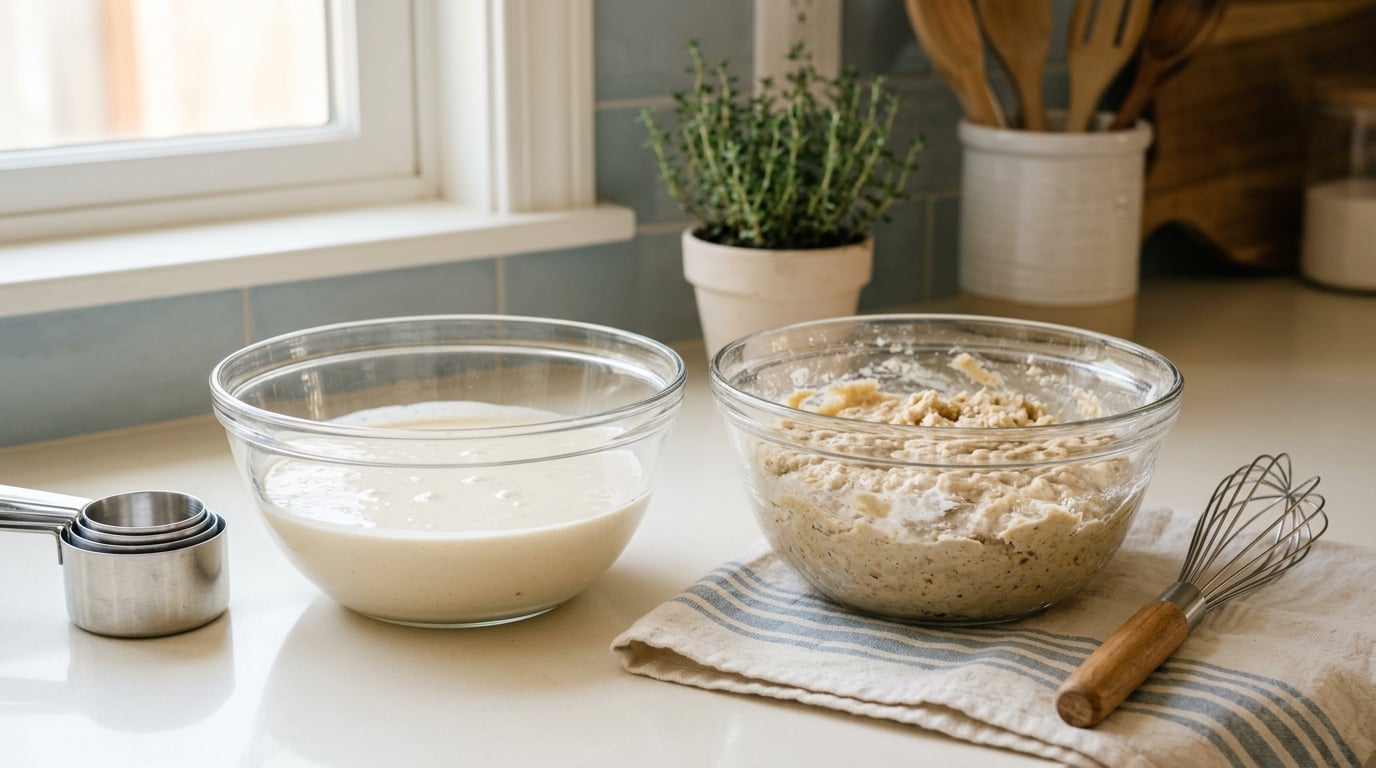
Why pancakes come out flat and dense is nearly always one of four things: the batter was mixed until it was smooth, which builds gluten and pushes the air out; the baking powder or soda has lost its punch; there is more flour than the liquid can wet; or the griddle never got properly hot. Fix the specific one and the next batch is a different pancake.
One thing worth saying early, because it changes everything after it: flat and dense are not the same complaint. Flat means no lift, which points at leavener, heat, and how much batter hits the pan. Dense means lift happened but the crumb is tight and heavy, which points at gluten and the flour-to-liquid ratio. Cook the same recipe wrong in two different ways and you get two different failures, and fixing one will not touch the other.
Table of Contents
- Why Pancakes Come Out Flat and Dense: the mechanism behind both symptoms
- How to Tell Whether Your Batter Is Too Dense, Too Wet, or Too Thin
- 8 Reasons Pancakes Come Out Flat and Dense
- How Each Problem Changes the Batter and Finished Pancake
- Why Pancakes Come Out Flat and Dense: How to Fix Each Cause
- How to stop overmixing the batter
- How to test and revive your leavening
- How to measure flour so the ratio stops lying
- How to rest the batter, and how long is long enough
- How hot the griddle should be, and how to know
- How to know when the pancake is ready to flip
- How to keep finished pancakes from going soggy
- How to get maximum lift when you want it
- A Reliable Fluffy Pancake Method for Beginners
- How to Adapt the Fixes to Buttermilk, Whole-Wheat, and High-Protein Pancakes
- Frequently Asked Questions
- What to Try First
Why Pancakes Come Out Flat and Dense: the mechanism behind both symptoms
Pancake lift comes from three places at once: carbon dioxide from the leavening agent, air beaten into the batter, and steam expanding in the oven-hot pan. Each source fills a slightly different kind of space, and each disappears for its own reason.
Gluten is the quiet culprit behind most dense pancakes. When flour is wetted and worked, two proteins, glutenin and gliadin, link into an elastic web. A little of that web is exactly what you want, because it catches the gas. Too much of it, and the web tightens around every pocket, squeezes the air and steam back out, and sets into a chewy crumb. People stir until the lumps disappear, assume smoothness means correctness, and hand overmixed batter without knowing it.
Leavener failure is the quiet culprit behind most flat ones. Baking powder releases its gas when it meets liquid and heat, baking soda when it meets an acid such as buttermilk. Both lose strength once the tin has been open for months, and a dead leavener makes a pancake that spreads, browns, and never rises no matter how long you wait for the bubbles.
And heat decides which of those symptoms you actually see. Batter poured onto a lukewarm pan spreads before it can set, so it cooks into a wide, thin disc with a thin layer of lift. Batter poured onto a screaming-hot pan sets the outside instantly, so you get a tall pancake with a raw seam in the middle. Same recipe, two different illnesses.
How to Tell Whether Your Batter Is Too Dense, Too Wet, or Too Thin
Diagnose before you change anything, because the fixes pull in opposite directions and guessing makes it worse. Lift a spoonful and let it fall back into the bowl, then look at what you see.
- Smooth, glossy, ribboning freely is overmixed batter. It pours like thin paint and has no visible lumps at all. This batter bakes dense, every time.
- Thick, slow, holds a mound that slowly slumps is the target for American diner-style stacks. The ribbon keeps its shape for a second before folding over.
- Streaky, with dry flour pockets in the surface means undermixed, which is usually fine. A few lumps are exactly what you want to see.
- Foamy and aerated, splattery when poured means you beat the wet ingredients too hard before adding the flour. That trapped air is not the same as good lift, and it collapses into flat patches.
- Runny, spreading across the whole pan in one second means too much liquid for the flour, or a pan that is not hot enough to set it. Either way the pancake goes wide and thin.
On the cooked side, a pancake that is round but squat and heavy smells of nothing wrong and eats like a damp towel. That is density, so look at mixing and ratio. A pancake that spreads into a ragged disc with a lace of bubbles that never set is flat, so look at leavener and heat. A pancake that is brown and crispy outside and pale and wet in the centre is a heat problem, and no amount of extra baking powder will touch it.
8 Reasons Pancakes Come Out Flat and Dense
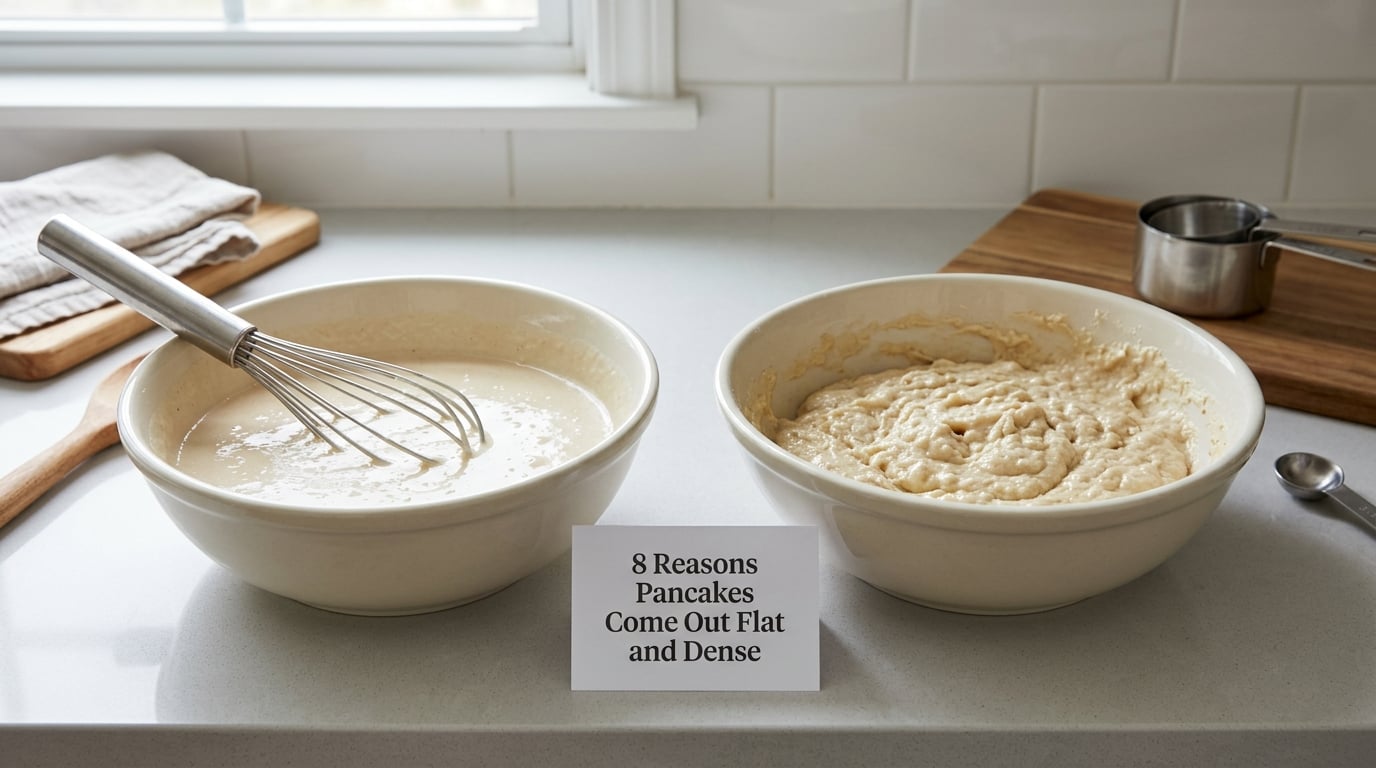
Here are the causes in the order they are easiest to check, starting with the ones that cost nothing to rule out and ending with the habit that quietly ruins an otherwise good stack.
- Overmixed batter. Stirring past the point of combined builds gluten, and the pancake bakes tight and chewy rather than tender.
- Leavener that has lost its strength. Old baking powder or baking soda releases little or no gas, so the pancake never rises.
- Too much flour for the liquid. A packed measuring cup, or one scooped straight from the bag, can add a quarter more flour than the recipe calls for and turn the batter to paste.
- A skipped rest. Unrested flour has not finished absorbing water, so the batter is thin, spread out, and thin-crumbed at once.
- A cool griddle. Batter spreads before the starch can set, which gives you a wide, thin pancake instead of a tall one.
- Flipping too early. Lifting a pancake before its bubbles have popped and held their shape tears the top and dumps the structure out onto the pan.
- Pressing down with the spatula. A push on a cooking pancake pushes out the steam and gas that were about to become its rise.
- Cold ingredients and too many eggs. Straight-from-the-fridge milk and butter keep the batter stiff for too long, and an extra egg adds protein where you wanted lift.
| Cause | Why it makes pancakes dense or flat | The fix |
|---|---|---|
| Overmixing | Glutenin and gliadin bond into an elastic web that squeezes out air and steam | 10 to 15 strokes with a fork, lumps staying in the bowl |
| Dead baking powder | No carbon dioxide released, so no lift to hold the crumb open | Test in hot water, replace the tin |
| Dead baking soda | Needs acid to activate, and a flat tin simply has nothing left to give | Vinegar test, then replace |
| Excess flour | Unabsorbed flour thickens the batter and leaves a heavy, dry crumb | Spoon and level, or weigh on a scale |
| No rest | Flour is not fully hydrated, so the batter is loose and spreads | 10 to 15 minutes before the first pour |
| Griddle too cool | Batter spreads before the surface sets, giving a wide thin disc | Medium-low, and a drop of water sizzles instantly |
| Flipped too soon | The top is still wet, so lifting tears the forming structure | Wait for bubbles to break and stay open |
| Pressed with a spatula | Pushes out the gas and steam that were still rising | Hands off until the flip |
How Each Problem Changes the Batter and Finished Pancake
The reason to separate these two families of causes is that their symptoms barely overlap. If you can tell which family you are in, you have already cut the list of suspects in half.
Weak lift changes the outline. Batter that will not rise spreads as soon as it hits the pan, so the finished pancake is wide, thin-rimmed, and pale in the middle of the top where the bubbles never set. The crumb inside is fine, sometimes even good, because there was no aggressive gluten to chew it up. That is the signature of a leavener problem or a griddle that is too cold, and adding flour to fix it makes the pancake worse.
Tight batter structure changes the texture, not the shape. These pancakes cook to a normal round shape with a decent dome, then feel heavy and slightly rubbery in the hand. The crumb is fine-grained rather than airy, and the pancake chews instead of tearing. That points at overmixing, excess flour, or too much egg, and no amount of extra baking powder changes it because the problem is structure, not gas.
Mixed signals are common, so here is the honest order I check things in. Shape first, because the outline of a pancake tells you the most in about one second: too wide means lift, right shape but too heavy means structure, browned outside and wet inside means heat. Then batter, then the tin, then the clock.
Why Pancakes Come Out Flat and Dense: How to Fix Each Cause
How to stop overmixing the batter
Combine the dry ingredients first, make a well, pour in the wet, and cut through the middle with a fork. Ten to fifteen strokes, then stop. Lumps are the sign you stopped at the right moment, and someone helping you is usually the reason the batter went smooth in the first place, so send them to set the table instead.
How to test and revive your leavening
Baking powder: put a spoonful in a cup of hot water. Active powder fizzes and bubbles hard, dead powder dissolves quietly. Baking soda: put a spoonful in a spoonful of vinegar or lemon juice. A good tin foams immediately, a tired one barely reacts. As a rule, baking powder past about six months after opening loses most of its punch. There is no way to bring a dead leavener back, so replace the tin and re-test the whole batch.
How to measure flour so the ratio stops lying
Flour packs down as it sits, and a heaped or shaken cup can carry 20 to 30 percent more than the recipe means. That extra flour is the single most common reason a careful cook gets a heavy pancake from a reliable recipe. Spoon it into the cup, level it with a knife, and tap the excess off. A scale is better still: about 125g for a cup of all-purpose flour, and you never have to think about it again.
How to rest the batter, and how long is long enough
Ten to fifteen minutes, not five. During the rest the flour finishes taking up water, so the batter thickens and spreads less; the gluten that did form relaxes and stops fighting you; and the leavener gets its start. All three changes push in the same direction, and a thicker rested batter holds a mound instead of running across the pan.
How hot the griddle should be, and how to know
Medium-low, and hotter than instinct suggests, because a griddle at medium reads cool once you have cooked a batch on it. A drop of water should sizzle and vanish in a couple of seconds. If it crawls and sits there, wait. If it scorches the first pancake in under a minute, lower the heat. Pour about 60ml, roughly a quarter cup, per pancake, and let it spread on its own for a second or two before you nudge it into shape.
How to know when the pancake is ready to flip
Watch the top, not the edge. The bubbles that break at the rim should pop, stay open, and not fill back in, and the edges should look set and slightly matte rather than wet and shiny. That is two to three minutes on the first side at medium-low. When you flip, use a wide spatula and slide it fully under, because a pancake lifted from one edge drags its own top layer along with it. A flip should be one motion. Two or three flips is what turns a good pancake into a hockey puck.
How to keep finished pancakes from going soggy
Stack them on a rack, not on a plate, and hold them in a low oven rather than under a lid. A lid traps steam, the crust softens, and the pancake starts to feel like the dense thing you were trying to avoid. Ten minutes in a 160F oven is plenty.
How to get maximum lift when you want it
Split the eggs, whip the whites to soft peaks, fold them through the batter at the very end, and use them within the hour. The whipped whites are the structure that holds the rest of the lift in place, and folding rather than stirring keeps that foam intact. This is the most-repeated fix on cooking forums, and it is the one most people have never tried.
A Reliable Fluffy Pancake Method for Beginners
Use this as your baseline, then change one thing at a time. The point is not the recipe, it is having a known-good result to compare against.
- Get everything to room temperature. Eggs, milk, and melted butter sitting out for 20 minutes make a noticeably more tender batter than the same ingredients straight from the fridge.
- Whisk the dry ingredients. Baking powder disperses evenly instead of arriving in one bitter pocket, and about 2 teaspoons of baking powder per 150g of flour is a solid ratio for thick American stacks.
- Add the wet, then mix in 10 to 15 strokes. Stop with lumps still visible. Level the top of the bowl and leave it alone.
- Rest 10 to 15 minutes. Set a timer. This is the free fix, and skipping it is the most common reason a good batter still spreads out flat.
- Heat the griddle to medium-low and confirm it. A drop of water sizzles and disappears in two seconds. Add a thin wipe of butter or oil.
- Pour about 60ml per pancake and resist shaping it. Let the batter decide the size. A round pancake is mostly a function of consistent portions, not of nudging the batter around the pan.
- Wait for the bubbles to pop and stay open. Two to three minutes. Then flip once, cook the second side for one to two minutes, and move it to a rack.
After a test batch, write down what happened rather than what you think should have happened. The first pancake is the useful one, because the griddle is still coming up to temperature and the batter is still setting into a good hydration. Judge the second and third.
How to Adapt the Fixes to Buttermilk, Whole-Wheat, and High-Protein Pancakes
Buttermilk and other acidic liquids. Acid is the whole point here, because baking soda needs it to fire. The usual trap is using baking powder and baking soda together, which pushes the pH too far and gives you a soapy, flat pancake that bakes up bitter. Pick one. If you swap buttermilk for plain milk, add a tablespoon of lemon juice or vinegar per cup and let it sit five minutes so the milk thickens slightly, and keep the baking powder. Also add 1 to 2 tablespoons of the buttermilk back in if the batter feels tight.
Whole wheat. Wheat bran and germ carry their own weight, so they drink more liquid than plain flour does and they make a heavier crumb that is hard to lift. Add 2 to 4 tablespoons of extra milk per cup of whole wheat flour, let the batter rest the full 15 minutes, and keep mixing short. A spoonful of white flour folded in at the end gives the crumb structure without undoing the nuttiness. Expect a slightly lower rise than white flour and stop treating that as failure.
Protein powder and high-protein blends. Protein powder is thirsty and it adds structure rather than lift, which is exactly backwards for a tall pancake. Follow the powder’s own liquid guidance and then add more, because most people underdo it. A scoop of powder plus 2 to 4 tablespoons of extra liquid per scoop is closer to right, and any scoop of fat-free powder makes a thin, fast-cooking pancake, so lower the griddle heat a notch.
Box mixes. These are formulated for speed, not height, and they land dry and flat for predictable reasons. Add 1/2 to 1 extra teaspoon of baking powder, use more liquid than the box calls for by a couple of tablespoons, and rest the batter. Rest is the part almost everybody skips, and box mix is exactly where it matters most. If a batch has already gone past saving, stir about a quarter cup of milk into what is left and make waffles instead.
Frequently Asked Questions
Why are my pancakes flat?
Flat pancakes almost always mean no lift. Check the leavener first, because old baking powder releases almost no gas. Then check the griddle: batter poured onto a cool pan spreads before it can set and cooks into a wide thin disc. Too much liquid in the batter causes the same shape. Bake a test spoonful in a hot oven to see whether the batter itself rises before you blame the pan.
Why are my pancakes dense and gummy?
Density comes from structure, not from heat. Overmixing is the usual reason, because working the batter develops gluten that squeezes out the air and steam and sets into a chewy crumb. Excess flour does the same thing by thickening the batter past what the liquid can carry. Mix in 10 to 15 strokes, keep some lumps, and measure your flour with a spoon and a knife instead of scooping.
Should pancake batter be smooth or slightly lumpy?
Slightly lumpy, every time. A perfectly smooth, glossy batter has been worked past the point where you want it, and that is the tell for overmixing. Stop mixing the moment the dry flour disappears into the wet and small lumps remain. They will hydrate during the 10 to 15 minute rest and disappear on their own, and the pancake will come out noticeably more tender.
How long should pancake batter rest before cooking?
Ten to 15 minutes at room temperature. During that window the flour finishes absorbing water so the batter thickens and spreads less, the gluten that formed relaxes, and the leavening gets its start. Five minutes is not really a rest. If you mix the batter the night before and cook it in the morning, the leavener will have spent itself and the pancakes will be flat and dense.
How hot should a pancake griddle be?
Medium-low, and fully preheated. A drop of water should sizzle hard and be gone within two seconds, which is a better test than any dial setting. Too cool and the batter spreads before the surface sets, giving a thin wide pancake. Too hot and the outside sets and browns before the middle cooks, leaving a raw seam. Cook two to three minutes on the first side at medium-low heat.
Can I make pancake batter ahead of time?
Mix it the night before, refrigerate it covered, and cook it in the morning, but expect a flatter pancake unless you add a little more leavening. Baking powder spends its potency during those hours, so a teaspoon extra per cup of flour usually covers it. Batter sitting out at room temperature for more than two hours should be discarded, especially if it contains milk or buttermilk.
What to Try First
If you only have time for four things, do them in this order, one batch at a time, because they cost nothing and each one rules out a whole family of causes.
- Test the baking powder in hot water. A tin that sits there quietly is the most common invisible cause, and it takes thirty seconds to check.
- Measure the flour properly. Spoon, level, or weigh it. A quarter more flour than the recipe means is enough to sink a good batter.
- Mix in ten to fifteen strokes and stop with lumps. Do not add a splash more liquid to smooth it out, because that trades a density problem for a flatness problem.
- Confirm the griddle is fully hot. The water test beats the dial every time.
Then make one batch, eat the second pancake rather than the first, and change exactly one variable before the next round. I still keep a note on my phone of the batch number, the rest time, and whether the griddle was at medium or medium-low, because pancakes are far more predictable once you stop treating them as a mood. Whatever you end up adjusting first in 2026, write it down too. The fourth failure is usually the one that finally explains the first three.