
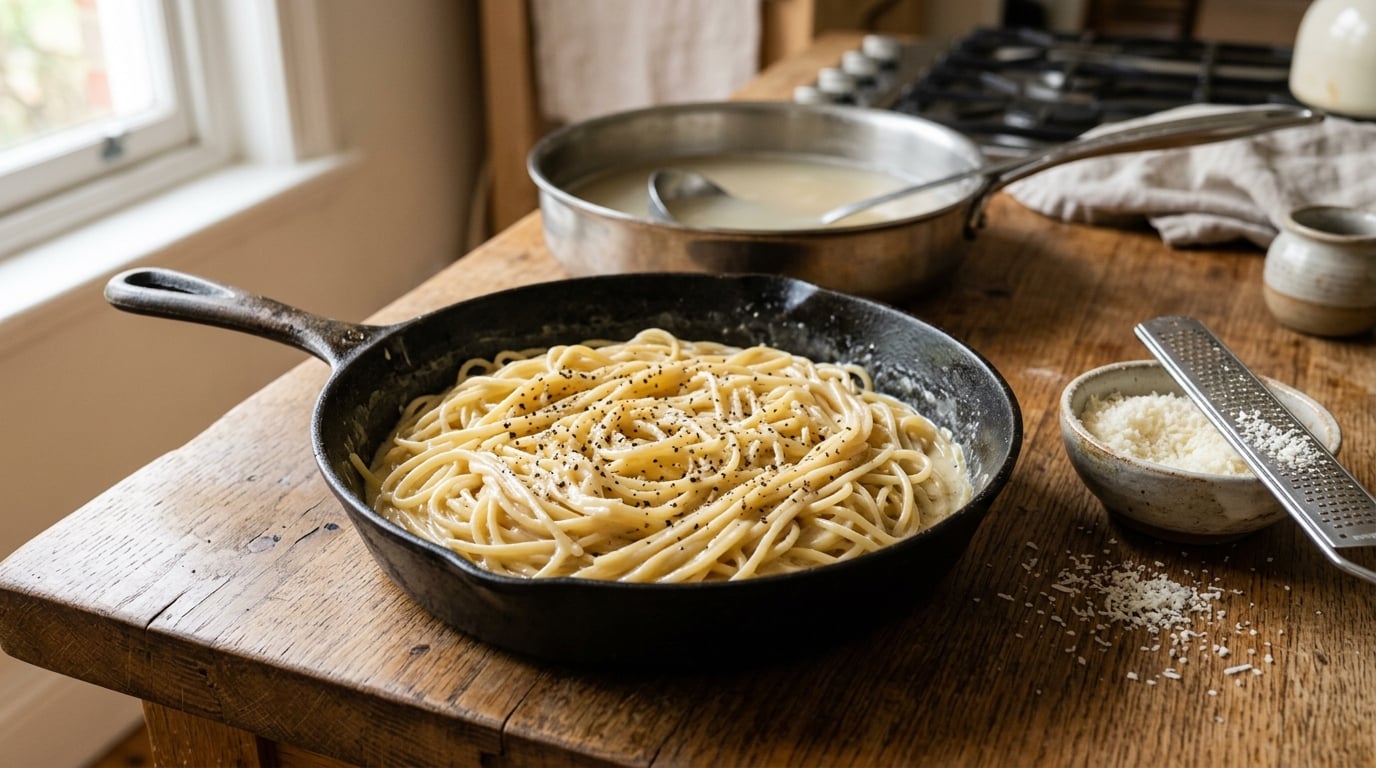
Cacio e pepe clumps for two reasons, and both are fixable: the pan gets hotter than the cheese can take (casein starts setting irreversibly around 65C / 149F), and the pasta water is too thin to hold the cheese in suspension. So learning how to make cacio e pepe without clumping is mostly about heat control rather than technique. The whole thing takes about 20 minutes and uses the same three ingredients you already had.
The fix I keep coming back to is called mantecatura: make the cheese into a loose paste with warm pasta water in a bowl first, then toss it with the pasta away from direct heat. That one change solves most of the rubbery-string failures people describe. Everything below is built around it, with the visual cues you need to know what right looks like at every stage.
Table of Contents
- What You Need
- How to Make Cacio e Pepe Without Clumping: Step-by-Step
- Common Mistakes
- Frequently Asked Questions
- How do I stop cacio e pepe from clumping every time?
- How do you unclump cacio e pepe sauce that already clumped?
- Why does the cheese clump when making cacio e pepe?
- What temperature should the pan be when I add the cheese?
- Can I use Parmesan instead of Pecorino, and is bagged grated cheese bad?
- How do I reheat cacio e pepe without ruining it?
What You Need
For two people, the ingredient list is famously short, but the tools matter more than most recipes admit.
- 100 g (about 3.5 oz) dried spaghetti or tonnarelli — bronze-die if you can find it. The rougher surface (trafilata al bronzo) gives the sauce something to grip.
- 100 g (about 3.5 oz) Pecorino Romano, aged, bought as a wedge. Parmigiano-Reggiano works too, and you can read more about both in how to build a cheese board for beginners.
- 1 teaspoon whole black peppercorns — or a coarse grind, not a fine one.
- A wide skillet or shallow saucepan — 28 cm / 11 inch is ideal. This is not the pot you would normally use for spaghetti.
- A fine rasp grater or microplane. A box grater works, but you will grate longer and the pieces are uneven.
- A medium bowl and a fork or whisk for the slurry, plus a heatproof spatula or a pair of tongs for tossing.
- A large serving bowl, warmed with hot water and dried. Cold bowls drop the temperature and stiffen the sauce on contact.
A kitchen thermometer is genuinely useful, but it is not required. Later in the article there is a way to judge the pan by behaviour instead of degrees.
How to Make Cacio e Pepe Without Clumping: Step-by-Step
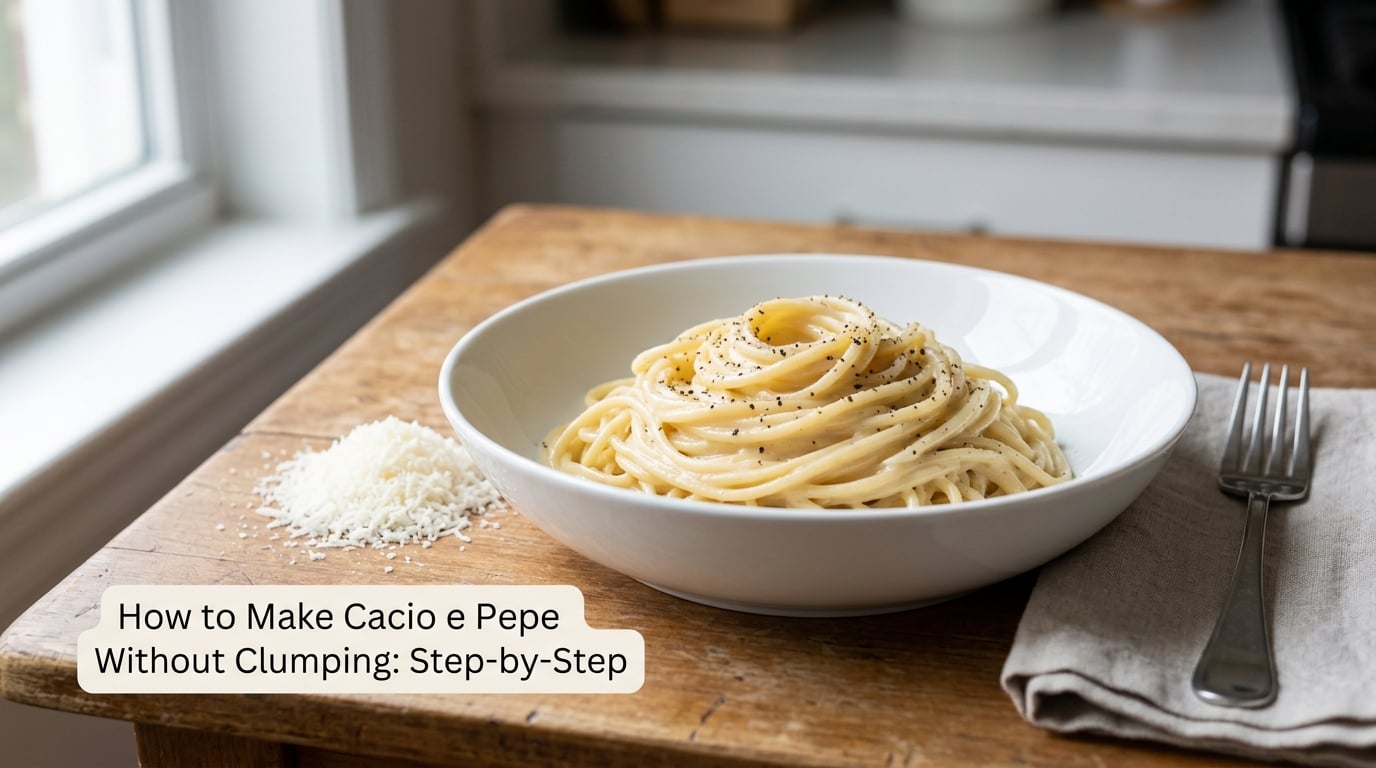
How to Make Cacio e Pepe Without Clumping: Start with the right cheese
The single most common failure is the bagged grated Pecorino from the shelf. Those bags contain anti-caking agents, and they are not something you want in an emulsion that has no other emulsifier. Buy a wedge and grate it yourself as finely as you can — the higher the surface area, the faster it dissolves into warm water without needing heat.
Age works against you here in a way most people do not expect. Young Pecorino has more moisture and melts more easily; very old Pecorino is drier, saltier and more prone to seizing into a mozzarella-like ball. If yours has failed you twice, move one step younger rather than upping the heat. If you have never built a board before, this beginner cheese board guide is a decent way to compare two wedges side by side.
Grate the cheese before you start the pasta, not during it. You want roughly 100 g of fine snow waiting at the counter.
Toast the black pepper without burning it
Put the peppercorns in a dry skillet over medium heat. They start to smell sweet and floral about 90 seconds in, and you should watch for the first wisp of smoke — that is your cue, not a colour change.
Crush them coarsely in a mortar or the flat of a knife. Fine powder tastes bitter and dusty; a coarse crack keeps the bite. One teaspoon for 100 g of pasta is about right, though the dish should taste gently peppery rather than sharp.
Cook the pasta and reserve the starchy water
Fill your wide skillet about a third full — roughly 1.5 litres / 6 cups — and salt it like you mean it, since Pecorino brings real salt of its own. Using less water than usual is a deliberate move: the ratio of starch to liquid is what holds the emulsion together, and a smaller pot of water concentrates it. It is the same idea behind restaurant-style mashed potatoes at home, where concentrated starchy water is doing the work rather than cream.
Cook the spaghetti until it is a full minute short of the packet time. Move the pasta to a bowl with tongs before draining, then scoop out at least a cup of the cloudy water and keep it near the stove. That cloudiness is the emulsifier; water that looks clear has already released most of its starch into the pot.
Make a loose cheese slurry
Put the grated Pecorino in a bowl and add 3 to 4 tablespoons of pasta water. Whisk or fork it until it looks like thick paint, then add another splash and keep going.
The test is simple: the slurry should pour in a slow ribbon, not sit in a stiff mound. If it clumps in the bowl, you have two options — add water a teaspoon at a time, or warm the bowl first by rinsing it in hot water and drying it. Never try to fix a stiff slurry with heat, because that is the problem you are already trying to avoid.
Combine the pasta, cheese, and pepper off direct heat
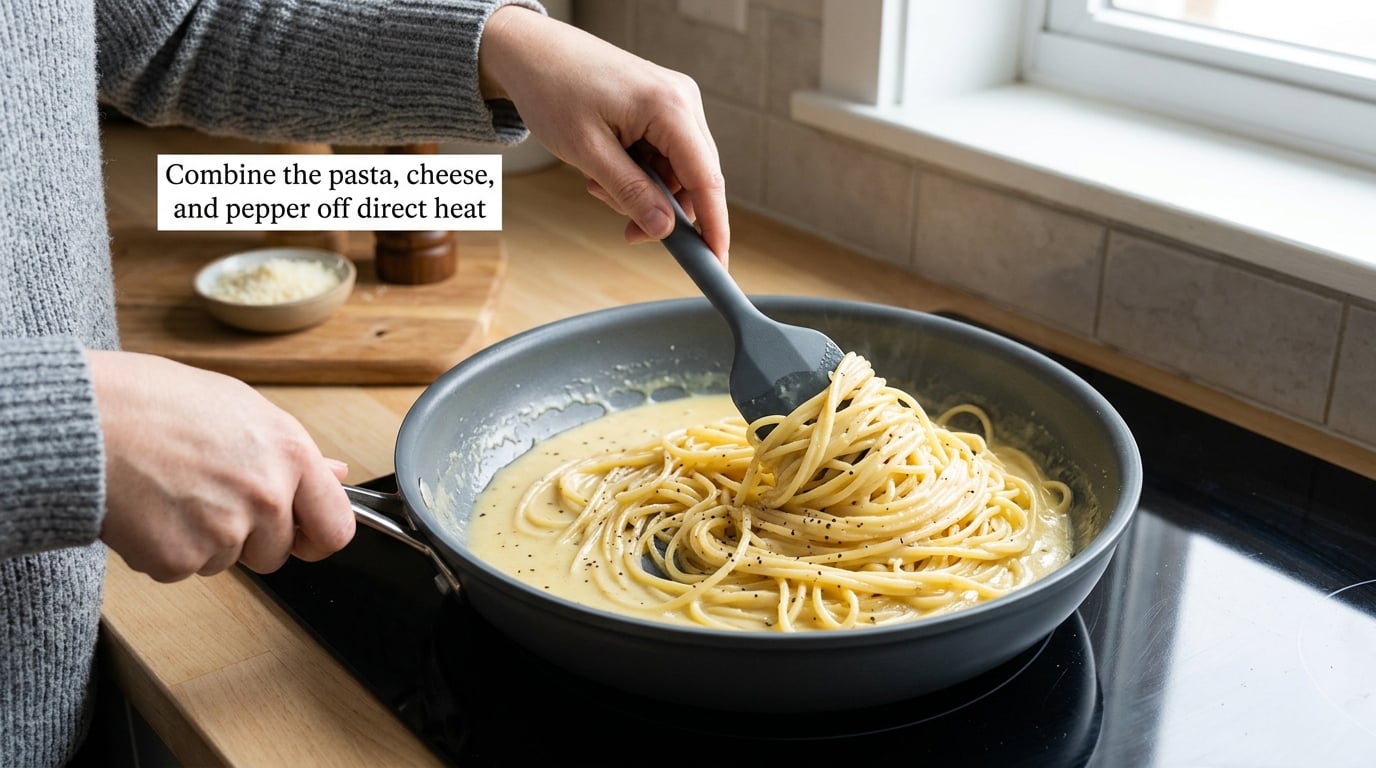
Take the pan completely off the burner and wait 20 to 30 seconds. Drop in a tablespoon of pasta water first and swirl it around — that alone drops the pan temperature fast enough to be safe. Add the pasta, then the slurry a third at a time, tossing hard with the spatula or tongs after every addition.
Keep tossing. If the pan looks dry, add another tablespoon of pasta water; if the sauce starts pooling instead of clinging, stop adding water and toss harder for a few seconds. You are looking for a sauce that coats each strand in a thin glossy film with no visible white streaks. The whole toss takes about a minute.
Plate into the warmed bowls immediately and eat it right away. If you want to judge the pan without a thermometer, sprinkle a few drops of water into the hot skillet: if it hisses and evaporates in a second, wait longer; if it sizzles lazily and leaves a bead, it is ready.
Common Mistakes
Almost every failure traces back to heat, starch or timing, and the fix is nearly always the same: get the pan off the burner, add water, and emulsify again. Here is the diagnostic table, then the two fixes people ask for most.
| What you see | What happened | What to do right now |
|---|---|---|
| Cheese fused into solid rubbery strings | Casein coagulated — the pan was over 65C / 149F | Not recoverable. Start over; use the slurry method next time. |
| Oily yellow sheen with the solids balled up | Fat separated out above about 57C / 135F before the starch could hold it | Off the heat, add a tablespoon of cold water, whisk hard with a fork. |
| Dry, grainy sauce that tightens as you eat | Not enough starch in the mix, or the bowl was too cold | Off heat, add warm pasta water a tablespoon at a time and toss until it flows. |
| Sauce slides straight off the pasta | Pasta drained too long, or the water was too diluted | Splash on a little reserved water and toss hard; use less water next time. |
| Whole dish tastes over-salted | Pecorino was heavily aged, or the water was salted twice | Serve with more pasta, or loosen with unsalted reserved water. |
| Grainy, slightly gluey texture but no clumps | Cheese sat too long on the heat before being stirred | Off heat, whisk vigorously and add water until glossy. |
How to rescue sauce that already clumped. It depends on how far it went, and this is the honest version. If the sauce has only separated — oily, with the solids loose and creamy — it is fully recoverable: pull the pan off the heat, add a tablespoon of cold water and whisk hard. The temperature drop lets the starch re-wrap the fat droplets and the emulsion comes back.
If it has already fused into solid rubbery strands, you are done with it. The casein has bonded to itself and no amount of water or whisking will undo that. Scraping it out of the pan and eating it anyway is a perfectly respectable consolation prize, but the sauce will not return to creamy.
The other big cause is the one people argue about online: is pasta water from a big pot too thin to emulsify anything? A home cook who reports on r/pasta that the water feels thin is usually boiling a large pot of unsalted water and skimming the pasta out. Concentrate it and the question goes away — less water, more boiling, more starch released, and a cloudy scoop rather than a clear one.
Frequently Asked Questions
How do I stop cacio e pepe from clumping every time?
Whisk your grated Pecorino into 3-4 tablespoons of warm pasta water in a bowl until it pours like thick paint, then take the pan completely off the heat before the pasta goes in. Toss constantly and add the slurry in three additions. Heat above 65C / 149F and thin, un-concentrated pasta water are the only two real reasons a three-ingredient sauce fails.
How do you unclump cacio e pepe sauce that already clumped?
It depends on the damage. If the sauce is oily with the solids still loose, take the pan off the heat, add a tablespoon of cold water and whisk hard with a fork — the emulsion usually comes back within a minute. If it has fused into solid rubbery strands, the casein has bonded irreversibly and no technique will restore it. Start over and use the slurry method next time.
Why does the cheese clump when making cacio e pepe?
Heat is the cause. Pecorino Romano is a low-moisture sheep’s milk cheese, and its casein proteins coagulate irreversibly above roughly 65C / 149F, fusing into rubbery strands. Its butterfat also separates above about 57C / 135F, which is the oily sheen you see beside the clumps. Nothing is added to this dish as an emulsifier, so temperature control is the whole technique.
What temperature should the pan be when I add the cheese?
Low enough that a drop of water evaporates lazily rather than hissing away — roughly 60C / 140F or below. If you own a thermometer, that is a much easier check. Either way, take the skillet off the burner entirely and add a tablespoon of pasta water first; the water cools the pan in seconds and you lose nothing by being conservative.
Can I use Parmesan instead of Pecorino, and is bagged grated cheese bad?
Parmigiano-Reggiano works well and many cooks prefer it — it is less salty and a little easier to emulsify, so use a little less and taste as you go. Bagged pre-grated Pecorino is the one to avoid: anti-caking agents are added to keep it flowing on the shelf, and they will not disperse into a starch emulsion. Grate your own from a wedge as finely as you can.
How do I reheat cacio e pepe without ruining it?
Reheating this sauce properly is genuinely difficult, and reheated cacio e pepe is usually disappointing. Warm the pasta itself in a dry pan first, then loosen the sauce with a fresh tablespoon of hot water and toss off the heat for a few seconds only. If it has already set, it will not come back to life — a fresh batch is faster than the rescue.
Next time, change one thing before you change anything else: make the cheese slurry in a bowl and keep the pan off the heat. That is the whole difference between a bowl of cheesy pasta and a bowl of rubbery strings.