
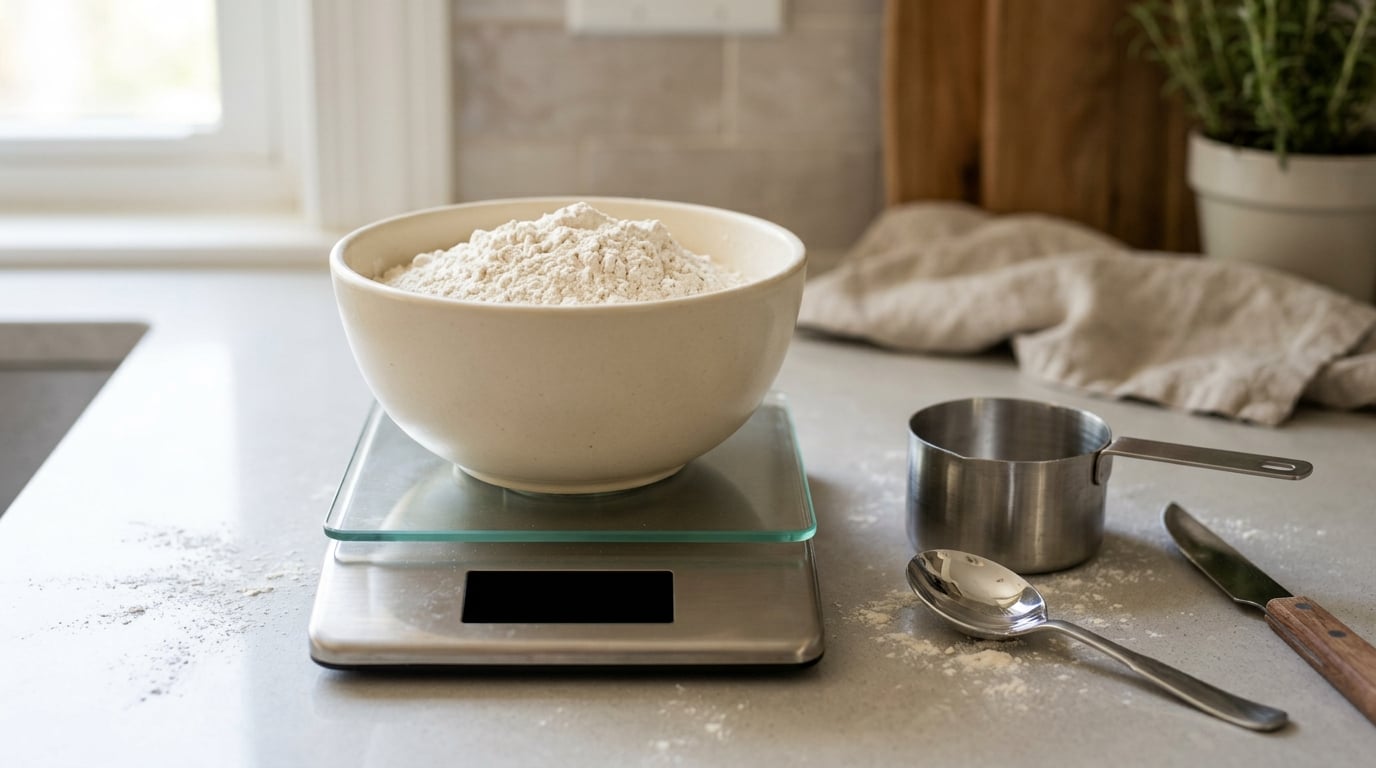
If you want to know how to measure flour correctly for baking, weigh it on a digital kitchen scale whenever you have one. If you are working from cups, fluff the flour, spoon it into a dry measuring cup, and level it with a straightedge, and never scoop straight out of the bag.
That is really the whole method. The difference between the two ways people measure flour is the difference between cookies that spread into thin wafers and cookies with a proper chew, or bread that rises cleanly and bread that comes out dense with a crumb too tight to slice.
On a recent batch of chocolate chip cookies I filled the cup the way I have filled it for years: plunged it into the bag, heaped it, shook it once. Two extra tablespoons of flour went into that dough. The cookies baked up cakey and spread until they touched on the tray. Measuring the flour properly the next weekend fixed it without changing anything else in the recipe.
What You Need
Weighing is the more accurate of the two methods, so if a scale is available, use it. Volume measures a space, and how much flour fits in that space changes with the flour type, how tightly it is packed, and how humid your kitchen is that morning. A weight on the scale does not care about any of that.
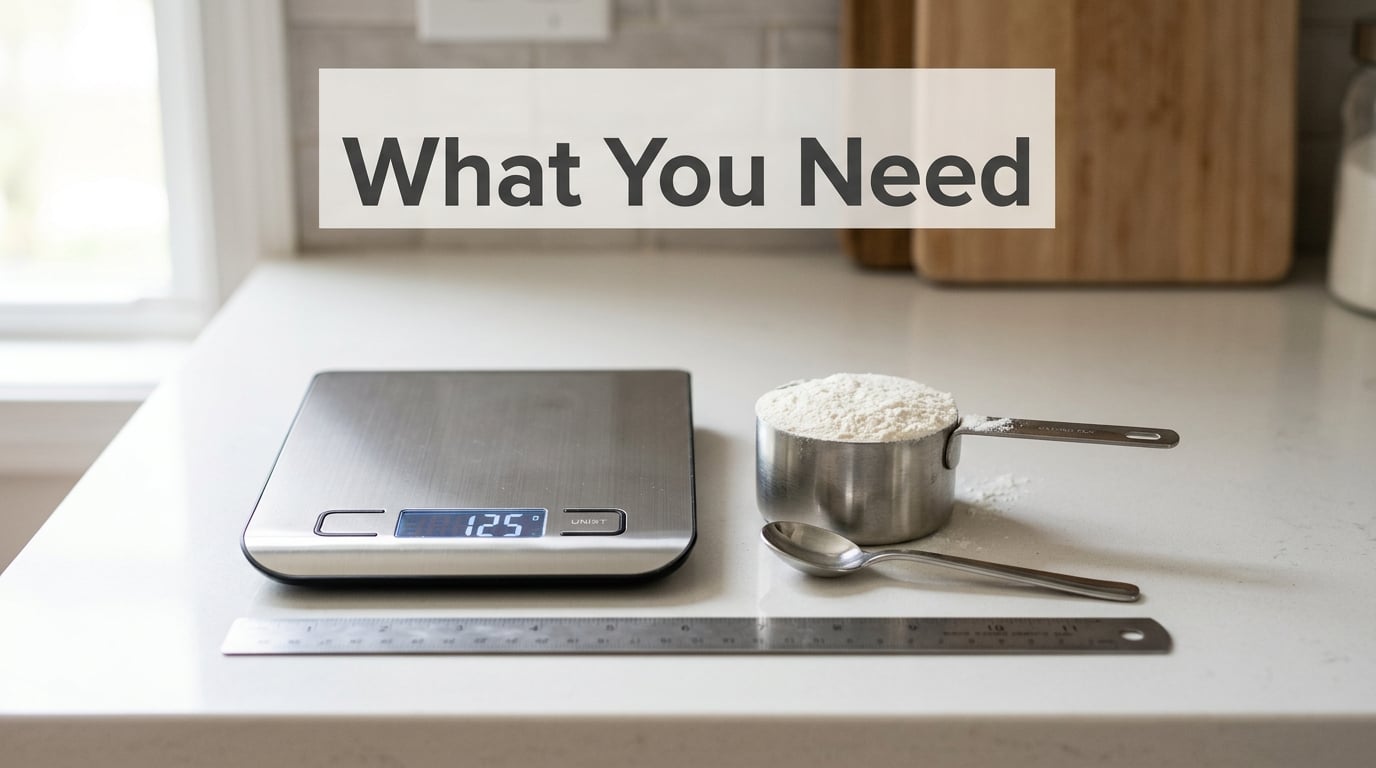
You do not need much beyond these five things:
- A digital kitchen scale that reads in grams and has a tare or zero button. For bread work, a model that reads to a single gram is worth the small step up, because a 1000 g dough rounded off to the nearest 10 g is a different dough.
- A dry measuring cup, 1 cup size, with a handle and a flat rim. Dry cups are straight-sided and filled to the top. Liquid cups taper and have a spout, and they are calibrated for water, so using one for flour is a silent error of roughly 20 percent.
- A tablespoon and a teaspoon, for the no-scale fallback and for the small quantities in things like frosting.
- A straightedge, such as a butter knife, a bench scraper, the back of a level tablespoon, or the rim of the measuring cup itself.
- Airtight storage, because flour that sits open on the counter compacts and picks up moisture, and both make it harder to measure.
For a sense of what you are aiming at, one cup of standard all-purpose flour should weigh about 120 to 125 grams, or 4.25 to 4.4 ounces. Write that number on the inside of a cabinet door and it does a lot of work for you later.
Step-by-Step
How to Weigh Flour for the Most Accurate Results
- Put the container on the scale first. Use a bowl you will mix in, if you can, so nothing has to be transferred. Set it down and let the reading settle.
- Press the tare or zero button. The display drops back to zero with the bowl still sitting there, so everything you add from now on is counted. On most scales tare and zero do the same thing; the button is often labeled with one name or the other.
- Add flour slowly until you hit the target weight. Spoon it in a little at a time and let the number catch up. A heaping tablespoon or two is a normal overshoot, and it is easy to correct for.
You know it worked when the dough or batter you mix next behaves the way the recipe described. If the target is 250 grams and you stop at 250 on the display, you are done, whatever the flour looks like in the bowl. Do not level, shake, or press the flour down to make the weight match a volume measurement, and leave it loose so air pockets are not counted as flour.
One more habit pays off: zero the scale between ingredients rather than only at the start. A sticky dough or a wet spatula on the bowl edge will otherwise skew everything that follows.
How to Measure Flour with a Cup
- Fluff the flour. If it came from a bag, turn it out and stir it with a spoon or a fork to break up any lumps and let air back through. Flour that has been sitting packed in a container needs this more than flour straight from the bag.
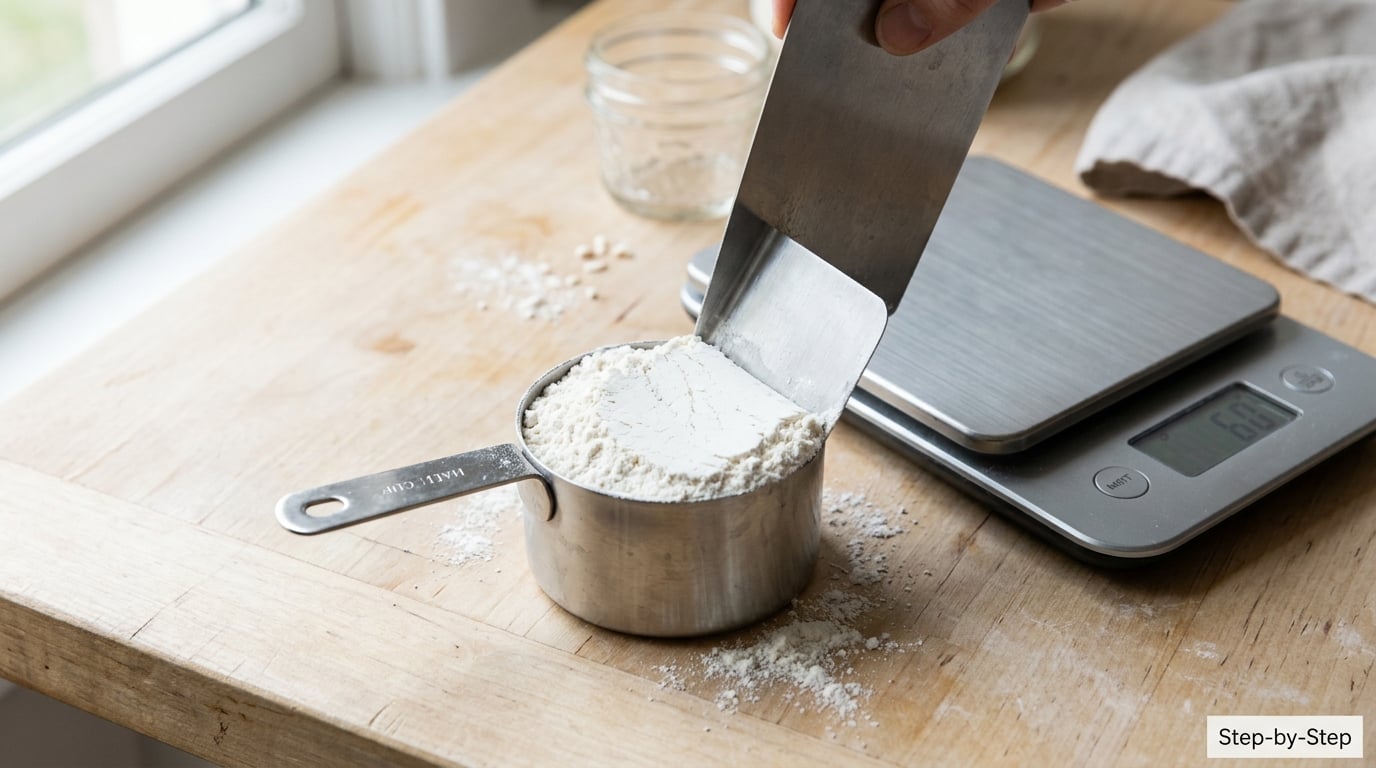
- Spoon it into the dry measuring cup. Heap the cup well past the top, dropping the flour in loosely. Tap the side of the cup once if a hollow pocket sits against the wall, but do not bang or shake it. Shaking is the same act as packing, just faster.
- Level it off. Rest the straightedge across the rim and slide it back and forth in one motion. Whatever falls off goes back in the bag.
That is the spoon-and-level method, and it is the standard for any recipe that says a cup of flour without asking you to pack it. A packed cup holds more flour than a level one, so the two are not interchangeable. The few recipes that genuinely want a packed measure say so explicitly, and brown sugar, cocoa, and shortening crumbs are the usual cases.
Once your cup is level, it is worth knowing what that level cup weighs. These are loose spoon-and-level weights for one US cup, which is 236 ml:
| Flour | Grams per cup | Ounces per cup |
|---|---|---|
| All-purpose | 120 to 125 g | 4.25 to 4.4 oz |
| Bread | about 127 g | about 4.5 oz |
| Whole wheat | about 120 g | about 4.25 oz |
| Cake | about 100 g | about 3.5 oz |
| Pastry | about 110 g | about 4 oz |
Two things catch people reading recipes from elsewhere. A US cup is 236 ml, while an Australian cup is 250 ml, so an Australian recipe measured with a US cup needs about 6 percent more flour. And check the order of words: a cup of sifted flour means sift, then measure, which gives a lighter and looser cup, while a cup of flour, sifted means measure, then sift, which gives a slightly heavier one.
How to Avoid Common Measurement Errors
- Scooping from the bag. Never plunge the measuring cup into the flour. A cup dipped straight in can pick up 30 to 50 percent more flour than a level cup, because the cup compresses the flour on its way down and drags a packed wall of it back up.
- Leaving the cup heaped. A mound above the rim means an unpredictable extra scoop in every direction.
- Using a liquid cup. The taper and the spout change the volume at the top, so a filled liquid cup of flour is not a cup of flour.
- Measuring a volume recipe by weight without converting first. If the recipe says 2 cups and you pour until the scale reads 250 grams, you have mixed two systems. Pick one, then stay in it.
- Skipping the scale on bread dough. Bread is the one place where a percent of error shows up in the finished loaf. Hydration is a ratio of water weight to flour weight, so 20 extra grams of flour quietly lowers the hydration and tightens the crumb.
Common Mistakes
Almost every baking failure blamed on the oven is a measuring failure. Here is what goes wrong and the correction for each.
- Flour scooped and swept. The fastest method and the least accurate one. Fix: add a tablespoon to a regular spoon, and level that.
- Skimping on leveling. A cup that looks close is often 10 to 15 percent over. Fix: sweep the excess off every single time, and use a straightedge rather than the curve of a spoon.
- Measuring into a dirty or damp cup. A trace of water or oil clings to the walls and adds weight you did not plan for. Fix: dry, cool cups every time.
- Weighing flour that is already in the batter. Once liquid is in the bowl, the reading is a mix, not flour. Fix: tare before each new ingredient.
- Ignoring the flour type. Cake flour and bread flour are not the same density. Fix: check the type in the recipe, and use the gram weight that matches it rather than assuming one cup fits all.
To check your own consistency, measure the same flour three days in a row and write down the weight. If the numbers move around by more than about 10 grams, humidity is getting into the flour, and the fix is to weigh rather than measure by volume that week. Bakers on r/Baking describe a scale as the one purchase that turned hit-or-miss baking into repeatable baking, and the r/KitchenConfidential thread on volume measurement is a good read for why.
If you truly have nothing but a tablespoon, about 15 grams of flour is one level tablespoon, so roughly seven of them gets you to 100 grams. It is an approximation, not a substitute, but it will save a recipe. That trick, credited to Betty Crocker, circulates on r/AskBaking as a reliable emergency measure.
And if you have already over-measured? In a batter, add a little extra liquid to bring it back toward the intended ratio rather than adding more flour. In a bread dough that is still mixing, add a splash of water along with the flour you need to correct. Once the dough is shaped, there is no fix, which is the argument for weighing from the start.
Frequently Asked Questions
Is 1 cup of flour the same as 1 cup of water?
No. Both fill the same 236 ml space, but they weigh very different amounts. A cup of water weighs about 236 grams, while a level cup of all-purpose flour weighs about 120 to 125 grams. That difference is why liquid and dry measuring cups are shaped differently, and why a recipe that lists a cup of milk and a cup of flour is not doubling up on volume.
What is the most accurate way to measure flour in cups?
The most accurate cup method is spoon-and-level. Fluff the flour, spoon it loosely into a dry measuring cup until it heaps, then sweep the top level with a straightedge. Do not shake, tap hard, or pack the cup, and do not dip the cup into the bag. Weighing the same flour on a scale is more accurate still, since a weight does not change with packing or humidity.
Do you measure flour before or after sifting?
Follow the wording. A cup of sifted flour means sift the flour first, then measure it, which gives a looser and slightly heavier cup. A cup of flour, sifted means measure the flour, then sift it over the bowl, which gives a slightly lighter cup. If you are weighing instead, sift first and weigh after, so the grams reflect what actually goes into the bowl.
Is 250g the same as 1 cup of flour?
Close, and not exact. A level cup of all-purpose flour is usually around 120 to 125 grams, so 250 grams is a little over two cups. Bread flour is heavier, around 127 grams a cup, and cake flour is much lighter at about 100 grams. If a recipe asks for 250 grams of flour, put the bowl on the scale and stop at 250 rather than trying to eyeball two cups.
How do I convert a recipe from cups to grams?
Find the cup weight for the exact flour the recipe uses, multiply by the number of cups, and add that many grams to the recipe. For example, 2 cups of all-purpose flour at 120 grams a cup becomes 240 grams. Do the same for the other dry ingredients, and for wet ingredients use weight when the recipe gives it, since a cup of milk or oil weighs more than a cup of flour.
How do I measure 100g of flour without a scale or measuring cups?
Use a level tablespoon as the unit. One level tablespoon of flour is about 15 grams, so seven level tablespoons gets you close to 100 grams. Keep the spoon level with the rim each time and keep the flour loose rather than tapped down. It will be a few grams off in either direction, which is fine for a casual batch but not for bread dough or pastry where the ratio matters.
Conclusion
Start here: put a bowl on your scale, press tare, and add flour until the number on the recipe appears. That is the whole method, and it takes about fifteen seconds per ingredient.
If you are working with cups instead, fluff the flour, spoon it in loosely, level it with a straightedge, and keep your hands out of the bag. Use a dry cup, never a liquid one, and check whether the recipe wants the flour sifted before measuring, after, or not at all.
Whichever way you measure, follow the flour type the recipe names. Bread dough in particular depends on the exact ratio of water to flour, so a scale earns its counter space there faster than anywhere else in the kitchen.