
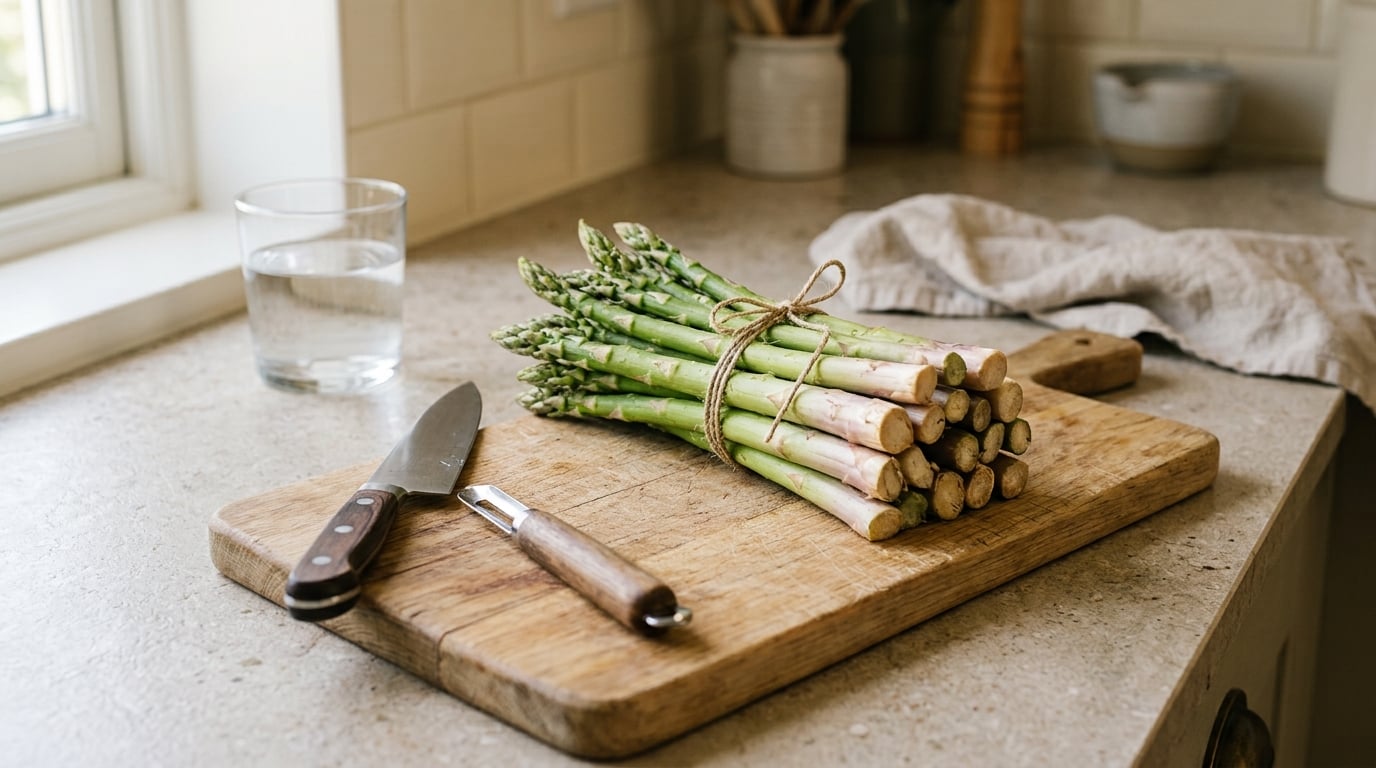
To trim and cook asparagus, wash the spears, then cut or snap off the pale woody bottom inch or two where the stalk stops being tender. From there, cook them fast and hot — roast, grill, sauté, or blanch — and match the method to the thickness of your spears. The whole job takes about 15 minutes.
Most people who dislike asparagus have eaten it with the woody end still attached, or let a skillet sit on low heat long enough to boil the spears in their own liquid. Both are easy to avoid.
Asparagus season runs roughly February through May on the West Coast and May into June in the East, and it is one of those vegetables that goes from perfect to mushy in under a minute once it hits a hot pan. That is why almost every reliable method below uses a number rather than the phrase “until tender.” A fat spear, meanwhile, behaves nothing like the skinny pencil-thin ones, so the thickness decides the cooking time far more than the variety does.
Table of Contents
- What You Need
- Step-by-Step
- Common Mistakes
- Tips for Choosing and Serving Asparagus
- Frequently Asked Questions
- How do you know which part of an asparagus spear to trim?
- Should asparagus be peeled before cooking?
- How long does it take to cook asparagus on the stove?
- What is the best way to tell when asparagus is cooked?
- How should asparagus be stored to stay fresh?
- Can cooked asparagus be reheated without becoming mushy?
- Conclusion
What You Need
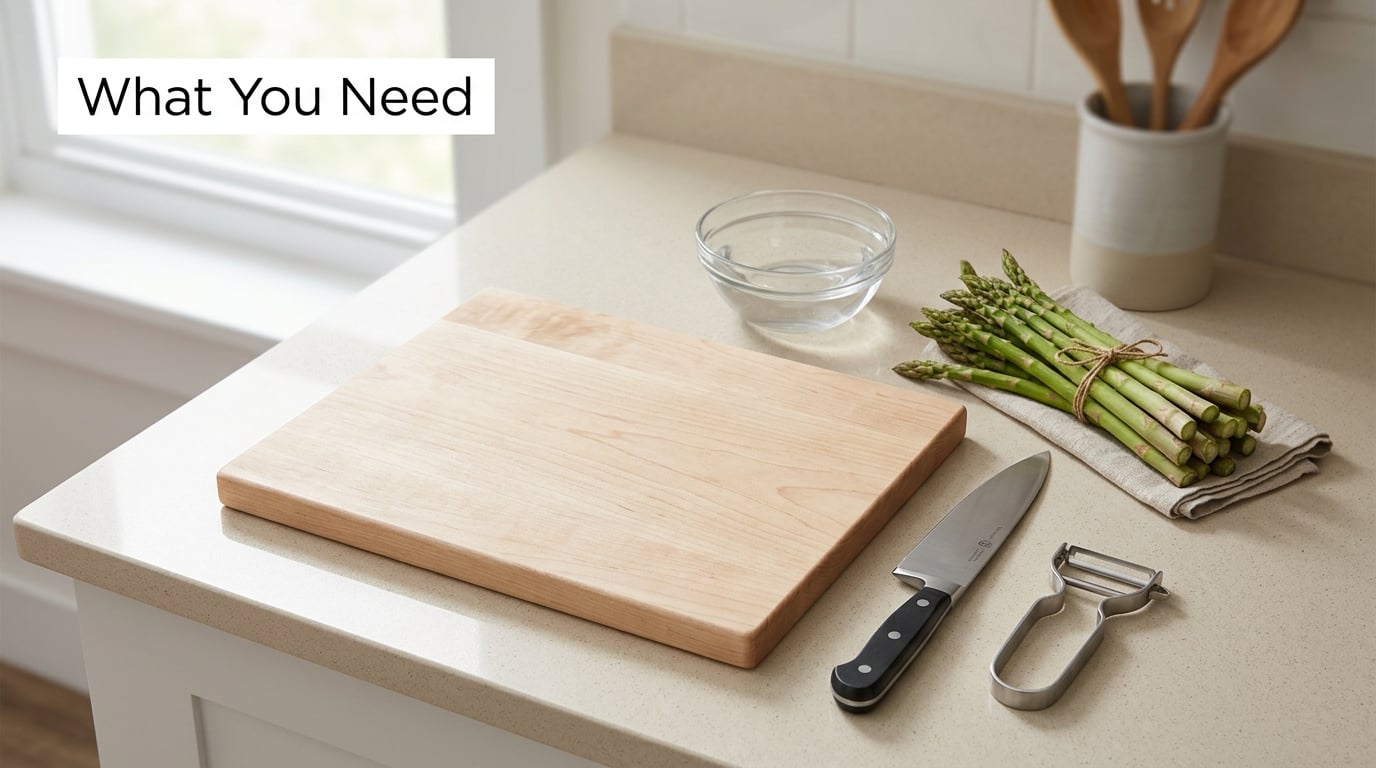
You need very little. A cutting board and one sharp knife do the actual work, and everything else on this list solves a specific problem that comes up later.
- A cutting board and a sharp knife. A dull blade crushes the stalk instead of cutting it, which is how you end up with a spear that bleeds moisture into the pan.
- A vegetable peeler. Only for fat spears, and only if you want the skin off.
- Kitchen shears. The fastest tool for snipping woody ends off a large bunch one-handed.
- Two clean kitchen towels. One for drying the washed spears, one for patting them dry after blanching.
- A wide bowl and an inch of cold water. This is the ice bath, and it is what keeps blanched asparagus bright green instead of turning olive.
- Cooking surfaces. A sheet pan for roasting, a wide skillet for sautéing, a pot with a steamer basket, a grill, or an air fryer.
Set the skillet or sheet pan heating before you start trimming. Asparagus does not wait politely, and the difference between a hot pan and a warming pan is the whole ballgame.
Step-by-Step
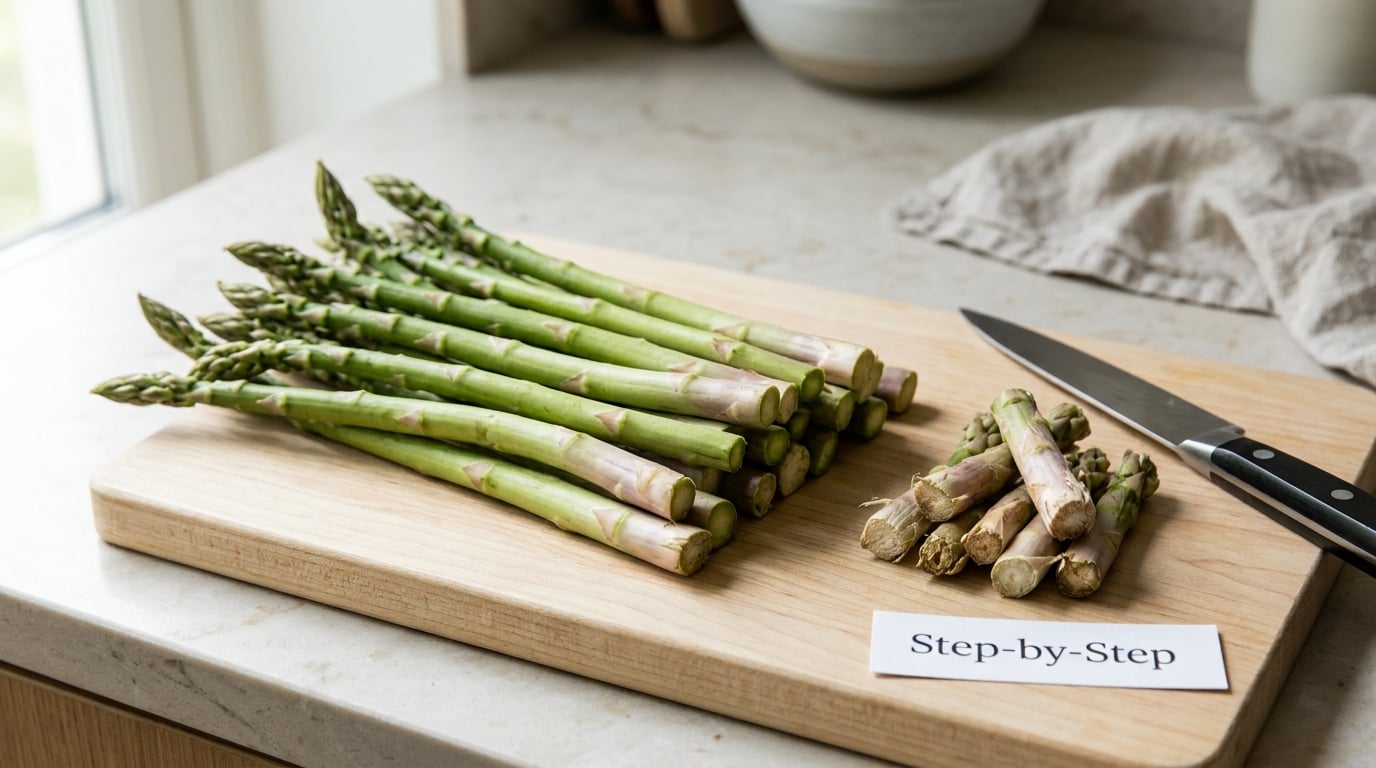
Trim first, always, then choose a method by girth. Here is the whole map in one place so you can see the timings next to each other.
- Roast. 425F (220C), 10 to 14 minutes. Best for thick and medium spears.
- Grill. Medium-high heat, 6 to 8 minutes, flip once. Best for medium and thick spears.
- Sauté. Medium-high heat, 2 to 5 minutes. Best for thin spears first, then medium.
- Blanch. Boiling salted water, 60 to 90 seconds, then ice. Best for thin spears and the brightest color.
- Steam. Over steaming hot water, 3 to 6 minutes. Works at any thickness with gentle heat.
- Air fryer. 370F (188C), 6 to 7 minutes. Best for thin and medium spears.
- Microwave. Full power, 90 seconds to 2 minutes. Thin spears only.
How to Trim Asparagus
The bottom of an asparagus spear is pale, fibrous, and will not soften no matter how long you cook it. Trim it off and the rest of the spear is edible from base to tip.
Step 1: Wash and dry. Hold the bunch by the tips and swish the cut ends under cold running water, or rinse the spears in a colander. Sand collects right where the spears join the ground, so scrub the bases with your fingers. Pat them dry with a towel — wet spears steam instead of sear.
Step 2: Snap off the woody end. Hold one spear at the middle and bend it gently. It snaps at the exact point where tender meets stringy, usually an inch to two inches up from the base. Do this to a few spears, note where they break, and then snap the rest of the bunch at about the same height. Snapping wastes the least, but the cut is ragged and the spears end up slightly different lengths.
Step 3: Or line the bunch up and cut. Lay the spears on the board with their conical tips all pointing the same way, and cut through the bottom inch or two in one stroke. This is faster than snapping and gives every spear the same flat, even cut, which matters if you want them all to finish at the same moment. The tradeoff is that you may cut away a couple of extra inches of perfectly good stalk.
Step 4: Peel the fat ones if you want to. If a spear is roughly as thick as a pencil or wider, take a vegetable peeler and shave two or three strips from the bottom third only. That takes the toughest skin off while leaving the tender center intact. Skip it on thin spears — there is nothing to peel.
Step 5: Make the lengths match. Trim the long stalks down so the whole bunch is roughly the same length, around 6 to 8 inches. Mixed lengths means the thin ones overcook before the thick ones finish, which is the single most common complaint about asparagus in home kitchens.
How to Cook Thin Asparagus
Thin spears, the pencil-thin kind, cook in a blink and need almost nothing. Think 2 to 4 minutes, high heat, and no crowding.
Sauté: Get a wide skillet hot with a tablespoon of olive oil and a smashed garlic clove. Lay the spears in a single layer and leave them alone for about 90 seconds before tossing. Thin spears are done in 2 to 3 minutes, medium ones in 4 to 5. Season with salt and a squeeze of lemon at the end, not the start.
Blanch: Drop the spears into heavily salted boiling water for 60 to 90 seconds, then straight into ice water for a minute to stop the cooking. This is the method that keeps the color brightest, and it is the best choice for thin spears you plan to serve cold in a salad or grain bowl.
Steam: Hold the spears above an inch of simmering water in a steamer basket, covered, for 3 to 4 minutes. They are ready when a knife slides into the thickest one with slight resistance.
Microwave: Place the spears in a microwave-safe dish with a tablespoon of water, cover loosely, and cook on full power for 90 seconds. Check, then add 30-second bursts. This is the fastest route and the least flavorful, so finish with olive oil, salt, and lemon.
How to Cook Thick Asparagus
Fat spears need more heat and more time, and a little surface tenderizing so the outside chars before the inside turns to paste. Give them 10 to 14 minutes rather than 5.
Roast: Heat the oven to 425F. Toss the trimmed spears with olive oil, salt, and pepper on a sheet pan, leaving about an inch of space between each one so the air can circulate and they crisp rather than steam. Roast 10 to 12 minutes for medium spears, 12 to 14 for fat ones. Shake the pan once at the halfway mark. If your oven runs cool, 400F for 15 minutes works too.
Grill: Set the grate to medium-high. Oil the spears rather than the grate, then grill 6 to 8 minutes, turning once, until the edges are lightly marked and the stalks bend without snapping. Thick spears take closer to the full 8 minutes.
Pan-char the fat ones: For a fat spear that worries you, brown it in a hot skillet first. Sear the stalks 1 to 2 minutes per side until colored, then add a splash of water, cover, and steam for 3 more minutes. You get a browned exterior and a tender center from the same pan.
Air fryer: This one has become a standard home method, and it works well. Set the air fryer to 370F, toss the spears with oil and salt, and cook for 6 to 7 minutes, shaking the basket at the 4-minute mark. Thick spears need another 2 minutes. Do not crowd the basket or the spears will pale and shrivel instead of crisping.
Steam or roast for the gentlest result: Steaming a fat spear for 5 to 6 minutes is the safest way to get it tender without char, and it is what to do if you plan to fold it into soup or risotto.
How to tell when asparagus is cooked
Skip the clock when you are unsure. Slide a knife tip into the thickest spear: it should meet slight resistance, not slide straight through. The color should be bright green, and lifting a spear with tongs should make it droop a little without collapsing.
Cut into the thickest spear and look at the center. It should be pale green, not translucent or beige. If you want a firmer bite for a salad, pull it a minute early.
Common Mistakes
Almost every bad batch of asparagus traces back to one of five habits. Each has a simple fix.
Cutting away too much stalk. The break point in a bunch is often 1 to 1.5 inches, and confident cutters take two or three. Snap one spear as a guide, measure that against the bunch, and cut the rest at the same place.
Crowding the pan or the sheet pan. Asparagus releases water the moment it hits heat, and spears touching each other cook in that water instead of browning. Cook in two batches rather than piling the pan. On a sheet pan, spacing matters more than oil.
Cooking it slowly. A medium simmer makes asparagus limp and grassy. Bring the pan to medium-high before the spears go in, and move them only once or twice. Let them sit undisturbed long enough to take on color.
Salting too early. Salt draws moisture out of the stalks, so seasoning at the start gives you a wet pan and steamed spears. Season after the color is there, right before you take the pan off the heat.
Mixing thicknesses in one batch. This is the mistake that ruins a dinner party plate. Sort the bunch into thin and fat piles after trimming and cook the fat spears first or in a separate pan. It takes an extra two minutes and it is the difference between everyone getting a good spear.
If a batch comes out soggy anyway, spread it on a warm plate and let it sit for two minutes; the surface dries and firms slightly. Shredded Parmesan and a squeeze of lemon do a lot to hide the disappointment.
Tips for Choosing and Serving Asparagus
Pick it fresh. Look for bright green spears with firm, smooth stalks and tips that are closed and compact, not splayed open. The cut ends should look moist, not dull and dry. Bend a spear gently in the store if you can — a good one snaps, a tired one just bends. Purple and white asparagus are worth trying once; they are milder and more tender than green.
Store it standing up. This is the answer to the question about why you put asparagus in water: the cut ends are still trying to drink. Stand the trimmed spears in a Mason jar or a narrow glass with an inch or two of cold water, loosely covered, in the fridge. That keeps them plump for up to a week, though the first three days are best. Change the water every other day if you keep them longer.
Cook it in bigger pieces if you are serving a crowd. Cut trimmed spears into 2 to 3 inch lengths and they all cook at the same rate, which is also why the shorter pieces work so well in pasta and stir-fries.
Finish it well. A squeeze of lemon and a shower of Parmesan are the classic endings. Chopped nuts, a little brown butter, or a spoonful of salsa verde also work. Olive oil and flaky salt are enough on their own.
Cook it raw if you want to. A vegetable peeler turns a thick spear into long, thin ribbons, which are good in salads or on a plate with cured meat and soft cheese. Raw asparagus does not need any trimming beyond peeling.
Know what to pair it with. It sits well next to a steak cooked in a cast iron skillet, alongside poached eggs, in a frittata, or folded through scrambled eggs in the last minute. As a side, it wants something rich and starchy; as a starter, keep the rest of the meal light.
Frequently Asked Questions
How do you know which part of an asparagus spear to trim?
The woody part is the pale, fibrous base. Snap one spear in the middle and it breaks at the exact line where tender becomes stringy, usually 1 to 1.5 inches up. Measure that against the rest of the bunch and trim the remainder at the same height. Whatever stays below the break will not soften, even after roasting.
Should asparagus be peeled before cooking?
Only thick spears need it. If a spear is about as thick as a pencil or wider, shave two or three strips from the bottom third with a vegetable peeler. Thin spears have nothing worth peeling and the skin is perfectly tender. If you are unsure, peel a small patch and press it — if it dents easily, leave it on.
How long does it take to cook asparagus on the stove?
Thin spears take 2 to 3 minutes in a hot skillet, medium spears 4 to 5. Steaming over simmering water takes 3 to 4 minutes for thin and 5 to 6 for fat. Blanching is fastest at 60 to 90 seconds, followed by an ice bath. Test with a knife rather than the clock — it should meet slight resistance.
What is the best way to tell when asparagus is cooked?
Slide a knife tip into the thickest spear. It should meet slight resistance instead of sliding straight through, and the cut center should be pale green rather than translucent. Lift a spear with tongs: it should droop a little without collapsing. Pull it a minute early if you want a firmer spear for a salad.
How should asparagus be stored to stay fresh?
Trim the ends, then stand the spears in a Mason jar or narrow glass with an inch or two of cold water and cover loosely. Refrigerate and use within three days for best texture, up to a week if you change the water every other day. A damp towel in the fridge crisps spears that have gone slightly limp.
Can cooked asparagus be reheated without becoming mushy?
Yes, if you reheat it fast and briefly. Skip the microwave, which reheats unevenly and waters the stalks down. A skillet over medium-high for 2 to 3 minutes with a drop of oil reheats roasted or grilled asparagus well, and a sheet pan at 425F for 5 minutes does the same. Season again with salt and lemon at the end.
Conclusion
Start by snapping one spear to find the natural break, then cut or snap the rest of the bunch at that same height so nothing woody goes in the pan. From there it is a question of thickness: thin spears need 2 to 3 minutes of fast, high heat, fat spears need 10 to 14 minutes in a 425F oven or a solid sear. Season at the end, sort by girth, and the vegetable most people think they dislike becomes the easiest thing on the plate.