
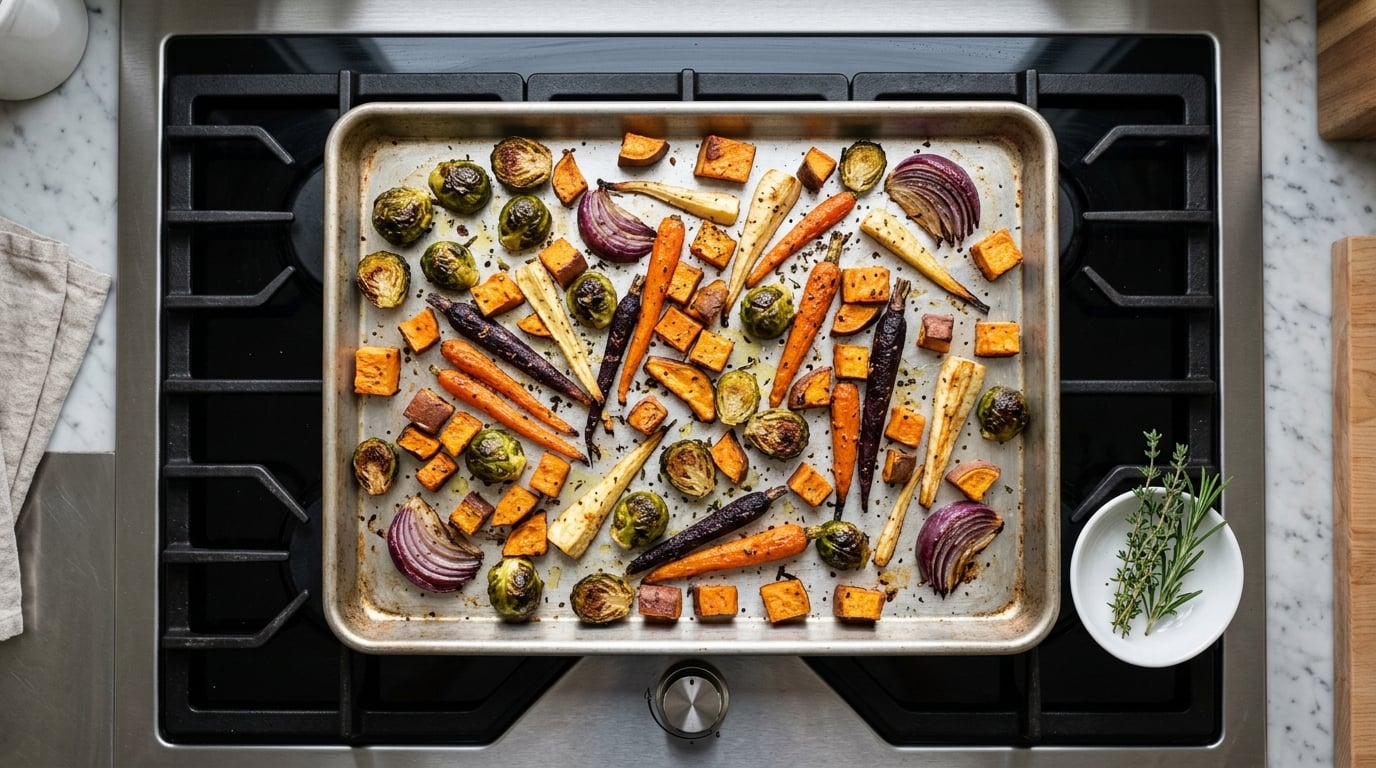
Roasted vegetables turn out soggy because the tray is cooking them in water, not heat. When vegetables sit wet, crowded or in a too-cool oven, the liquid they release pools underneath and steams them instead of browning them, and the flesh never dries out enough to crisp. Eight fixes solve it, and the first one costs you nothing.
Roasting is a dry-heat method: uncovered food, high oven heat, nothing to trap vapor. The moment a sheet pan behaves like a covered pot, the vegetables cook from the outside in and go limp. Everything below works in a normal home oven, with a fan optional.
Table of Contents
- What Makes Roasted Vegetables Turn Out Soggy?
- How Moisture Changes the Roasting Process
- The 8 Fixes for Crisp Roasted Vegetables
- 1. Pat the vegetables dry before they go in the pan
- 2. Roast hot enough for browning to start
- 3. Give every piece its own space in a single layer
- 4. Preheat the sheet pan with oil
- 5. Use a second tray instead of a deeper pile
- 6. Cook high-moisture vegetables at a lower temperature
- 7. Oil the vegetables lightly and evenly
- 8. Leave them uncovered and stop fussing
- How to Roast Vegetables for Maximum Browning
- Which Vegetables Are Most Likely to Turn Out Soggy?
- Roasted Vegetable Troubleshooting
- Frequently Asked Questions
- Conclusion
What Makes Roasted Vegetables Turn Out Soggy?
Four things cause it, and they usually arrive together. Excess moisture on the surface or inside the vegetables, an oven that is too cool to brown anything, a pan packed tight enough to trap steam, and a pan that is wet, cold or the wrong shape for the job. Each one alone is survivable. All four at once, and you are boiling vegetables on a baking sheet.
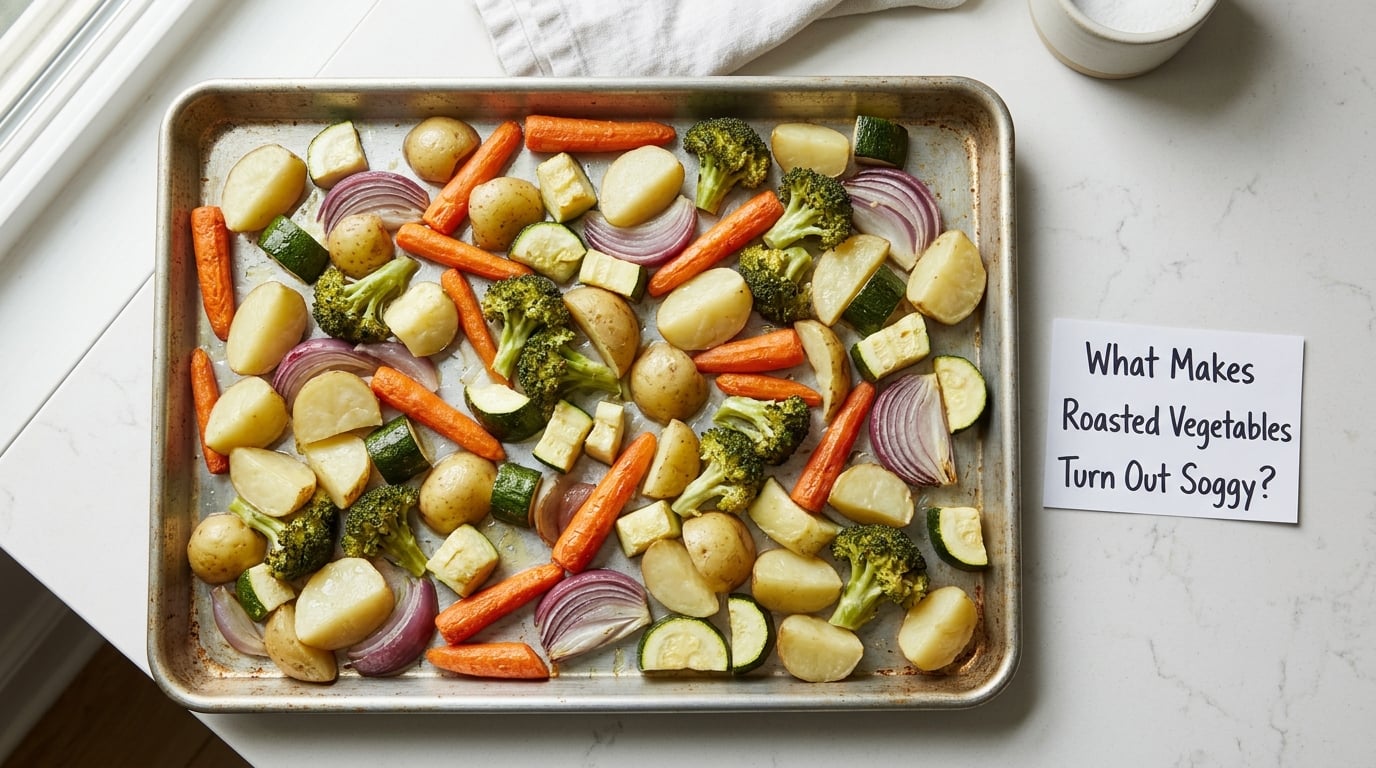
The confusing part is that the pan often looks busy and the vegetables look cooked. They have lost weight to evaporation and softened, but nothing has browned, so you get a limp, watery result with almost none of the flavor roasting is supposed to create.
Here is the diagnostic version: if the vegetables are pale and soft, it is temperature or crowding. If there is a shallow pool of cloudy liquid in the pan, it is released water sitting in the way. If the top is browned and the centers are still collapsing, the pieces are too thick or too crowded for the heat to reach the middle. If the edges are black and the middle is wet, the pan was too close to the element and the outside scorched before the inside finished.
One more cause deserves its own mention: overcooking. Once a vegetable passes the point where its cells collapse and release water, extra time cannot be recovered. It only makes things mushier, which is why saving a soggy tray with another ten minutes in the oven never works.
How Moisture Changes the Roasting Process
There are two kinds of water in the equation, and they behave differently. Surface moisture is the film you leave behind when you rinse produce, when frozen vegetables thaw, or when you cut vegetables and push the pieces around a wet board. Released water is the liquid that leaks out of the cells during cooking.
Surface moisture has to evaporate before browning can start, and evaporation costs energy. A wet piece of potato sitting in a 425°F oven spends the first several minutes boiling water off rather than browning. Pat it dry and the same piece starts coloring within minutes.
Released water is the more expensive problem. A cut vegetable is full of water held inside cell walls. Heat breaks those walls down and the water migrates out, which is why a cut vegetable softens and shrinks as it cooks. If that water can drain away or evaporate, the surface dries and browns. If it pools under the pieces, the bottom of the pan becomes a shallow bath of hot water, the temperature around the food drops to the boiling point of water, and browning stops. The vegetables finish tender, or worse than tender, and pale.
That is the whole mechanism behind why roasted vegetables turn out soggy: the oven never gets a dry surface to work on. Browning is a reaction between dry proteins and sugars at high temperature, and water above roughly 140°F pushes the food toward a simmer instead. A little browning is possible even with steam present, which is why the top of a crowded tray colors slightly and the bottom stays grey.
Practical takeaways from this: dry the outside of every piece, use a pan that has a rim and lets liquid pool away from the food, and never cover vegetables. Covering traps vapor and reproduces the steaming problem in miniature. A tent of foil over the first part of the cook is sometimes recommended for delicate vegetables, and it works for the opposite reason of what people think, which is that the foil buys time before the vegetables over-brown.
The 8 Fixes for Crisp Roasted Vegetables
How to keep roasted vegetables from getting soggy comes down to eight moves, in the order they matter. The first two solve most problems on their own.
1. Pat the vegetables dry before they go in the pan
Spread them on a towel or in a colander and blot the surfaces, or use a salad spinner. Do this after cutting, since cutting leaves fresh moisture on the exposed faces, and do it after thawing anything from the freezer. If you wash produce, wash it before you dry it and never put a rinsed piece straight into a hot pan.
2. Roast hot enough for browning to start
Most home ovens set to 350°F or 375°F will soften vegetables without ever browning them, which is a slow version of the same problem. Roast at 425°F to 450°F instead, with the pan in the oven once it is fully preheated. High heat and a short cook time are the combination that gives you a browned outside and a tender inside before the interior collapses.
3. Give every piece its own space in a single layer
Crowding is the cause people cite most often. Pieces touching each other exchange moisture, block the fan or convection air, and drop the temperature of the whole tray. If a single layer needs two trays, use two trays. Roasters love holding a large volume, and volume is the enemy of browning.
4. Preheat the sheet pan with oil
Put the empty pan in the hot oven with a thin film of oil and give it a few minutes, then add the vegetables. A hot pan starts searing the underside of the pieces immediately, and that first contact is where a lot of the browning and the best flavor come from. A cold pan soaks up heat instead, so the vegetables start cooking by slowly warming up in their own liquid. This trick gets recommended constantly in cooking forums and it is genuinely the cheapest upgrade available.
5. Use a second tray instead of a deeper pile
Roasting a mountain of vegetables is fine for a soup base, and it is exactly the method that produces soft results. When you want texture, spread everything out. Two sheet pans with breathing room beat one deep pan every time, and the total cook time barely changes because each piece is smaller and exposed.
6. Cook high-moisture vegetables at a lower temperature
Zucchini, tomato, eggplant, summer squash and mushrooms give off a surprising amount of water. Give them their own tray at 400°F to 425°F rather than 450°F, and add them later than dense roots if you are mixing a tray, since they cook in half the time. High heat on wet vegetables burns the thin edges before the centers soften.
7. Oil the vegetables lightly and evenly
A light coat speeds browning and reduces sticking, and that is the whole job. Pooled oil at the bottom of the pan adds nothing except a greasy surface under the food. A drizzle over the pieces and a toss with your hands, or a few sprays, does more than pouring oil straight into the pan.
8. Leave them uncovered and stop fussing
No foil, no lid, no stirring every few minutes. Constant disturbance keeps releasing moisture and resets the browning. One turn at the halfway mark is useful for thick pieces, and for everything else the best move is to leave the door shut and let the oven work.
How to Roast Vegetables for Maximum Browning
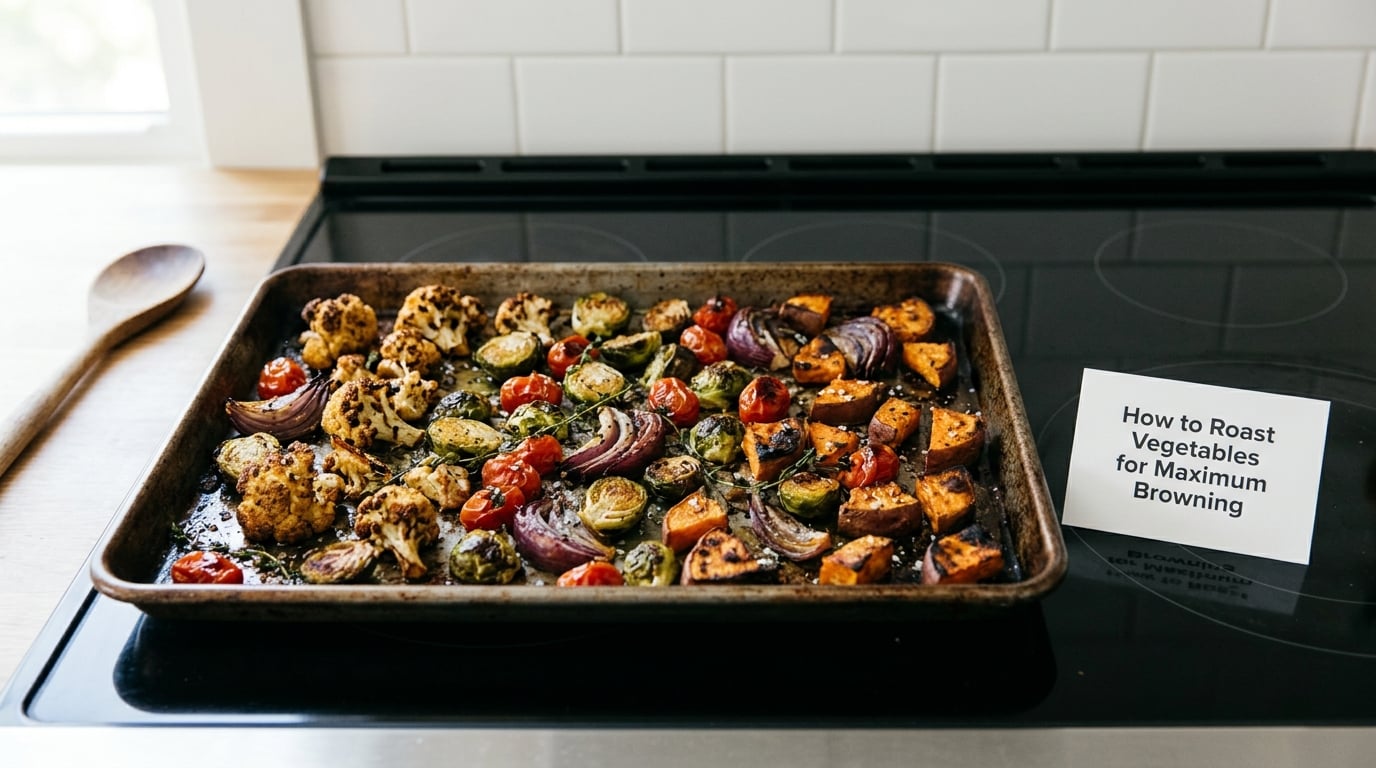
Here is the method I use, end to end, when I want browned edges rather than just cooked vegetables. It takes about 40 minutes for a full sheet pan of mixed vegetables and it scales by adding trays, not depth.
Heat the oven to 425°F with the fan on if your oven has one, and put the empty rimmed sheet pan inside to heat with it. While that happens, cut the vegetables to the same size, aim for about the same thickness so everything finishes together, and blot every surface dry.
Toss the pieces with a tablespoon or two of high smoke point oil, such as avocado, canola or grapeseed, plus salt and pepper. Olive oil works and tastes good, but it has a lower smoke point, so it is a better choice for vegetables that cook at 400°F than for a 450°F roast.
Pull the hot pan out, add the vegetables in one layer with a finger’s width between pieces, and spread any oil left in the bowl over the top. Back in the oven for 15 minutes, then turn the pieces with tongs. Continue until the edges are visibly colored and a knife slides into a thick piece with no resistance.
For more color, finish under the broiler for two to three minutes with the door cracked and the pan on the middle rack. Watch it, because broiler browning goes from golden to burnt in about fifteen seconds. When a vegetable is done, the cut face should show a dry, slightly translucent interior with a colored rim, not a wet pale center.
If you batch cook for meal prep, spread the finished vegetables on a rack rather than leaving them in the pan. Steam trapped between pieces and the sheet reheats them, so the second meal is softer than the first. Store them in a container that is not sealed airtight, and reheat on a hot sheet pan with a little oil, or in an oven rather than a microwave. If the vegetables are a side to poultry, bring the poultry to 165°F.
Which Vegetables Are Most Likely to Turn Out Soggy?
The water content of the vegetable decides most of your odds. Vegetables that are mostly water, and that have already been cut open, release liquid fast and have very little solid material left to firm up. Dense, starchy vegetables hold their shape and dry out as they cook, so they brown easily.
High moisture, high risk
Zucchini, yellow squash, cucumber, tomato, bell pepper, eggplant, mushrooms, onion and green beans. These need a lower temperature, their own space, and a shorter time. A zucchini cut into thick half-moons on a crowded tray is close to a guaranteed soft result.
Dense and forgiving
Potatoes, sweet potatoes, carrots, parsnips, beets, butternut squash and cauliflower hold up well. Cut them thick, give them a head start when mixing trays, and they will brown before they soften. Par-boiling dense roots for eight to ten minutes and draining them very well is a real fix for a mixed tray, because it moves the time they would have spent steaming in the oven into a pot of salted water.
Middle ground
Broccoli, Brussels sprouts, asparagus and peppers behave differently depending on the cut. Cut broccoli into flat-side-down florets rather than little round chunks and you get real browning, since the flat face can sear against the pan. Halve the Brussels sprouts lengthwise rather than quartering them for the same reason. Thin stems on asparagus roast faster than thick ones, so separate them by thickness or give the thick ones a head start.
Two more variables matter as much as the vegetable. Cut size sets surface area against volume, and small pieces dry out and brown but also burn faster. And density affects how fast heat travels inward, which is why a mixed tray should be built in groups by cooking time rather than by color.
Roasted Vegetable Troubleshooting
Match what came out of the oven to the cause, then fix it. Most trays have one dominant problem and a second contributing one.
- Soggy and pale, no color anywhere. The oven was too cool, or the pan was full and cold. Roast at 425°F to 450°F, in one layer, with the pan preheated and oiled.
- Cloudy liquid pooling in the pan. Water released by the vegetables had nowhere to go. Use a rimmed sheet pan, do not line it, and spread the pieces out.
- Browned on top, collapsing underneath. The pieces are too thick, or the tray is too crowded for heat to reach the center. Cut to a uniform size, halve large pieces, or use a second tray.
- Sticking and tearing as you lift it. Not enough oil, a wet surface, or a pan that was never heated. Coat lightly with oil, dry the pieces, and preheat the pan.
- Black edges, wet centers. The pan sat too close to the element, or high heat hit a wet vegetable. Move to the middle rack, drop to 400°F, and add wet vegetables later.
- Soft even after a full tray of time. Frozen vegetables roasted from frozen, or the tray was overloaded. Thaw on a towel and blot, spread across two trays, and extend time by five minutes.
- Limp, pale results in an air fryer. A crowded basket drops the temperature and traps vapor. Use a single layer, do not shake mid-cook, dry the pieces, and lower the temperature by 25°F.
Recovering an already soggy tray takes one move, not many. Put the vegetables and their liquid into a hot pan over medium-high heat and spread them out, then leave them until the liquid has boiled away and the pieces reheat and take on color. Ten minutes of that recovers a mediocre roast into a decent one. It will not make them crisp, because once the cells have collapsed they do not firm back up.
Frequently Asked Questions
How do I keep roasted vegetables from getting soggy?
Dry the pieces, roast at 425°F to 450°F, spread them in a single layer with space between them, and leave them uncovered. A light coat of oil speeds browning. Turn thick pieces once at the halfway mark, then stop opening the door.
Does parchment paper make roasted vegetables soggy?
Usually it is fine, and it makes cleanup easier. A few high-moisture vegetables, such as mushrooms and tomatoes, release enough water that a flat sheet holds the liquid under the food. A rimmed pan with no liner, or a silicone mat, lets moisture evaporate instead of sitting there.
Should I wash vegetables before roasting?
Yes, but dry them completely. Rinsing leaves a film of water that has to boil off before browning can start, and that costs you several minutes on every piece. Wash, then blot with a towel or spin them in a salad spinner, and keep the rinsing water away from the pan.
Can I fix a crowded pan while the vegetables are cooking?
Partly, and quickly. Move half the vegetables to a second hot pan, turn the convection fan on, and take the pans out five minutes early to let the moisture escape. The pieces already steamed will never crisp, but the second tray will finish properly, so you protect part of the batch.
Why are my frozen roasted vegetables always soft?
Frozen vegetables carry ice that becomes water, so they start the cook wet, and that water stays trapped when you crowd them. Thaw them in a colander on a towel, blot them well, roast them at 425°F on a single layer, and give them five extra minutes. Cooking from frozen works too, if the tray is roomy.
What is the secret to crispy roasted vegetables?
Dry surfaces, dry heat, and space. Moisture is what blocks browning, so remove it before cooking, keep the oven at 425°F or higher, and never crowd the pan. Everything else, including oil, seasoning and a hot sheet pan, helps, but those three do the work.
Conclusion
If your roasted vegetables keep turning out soggy, do one thing first: preheat a rimmed sheet pan with a little oil, dry the vegetables thoroughly after cutting them, spread them in a single layer with space between the pieces, and roast at 425°F or higher until the edges take on real color. Keep the pan uncovered and stop adjusting. That sequence gives the oven the dry surface it needs, and most soggy trays turn crisp the first time you try it.