
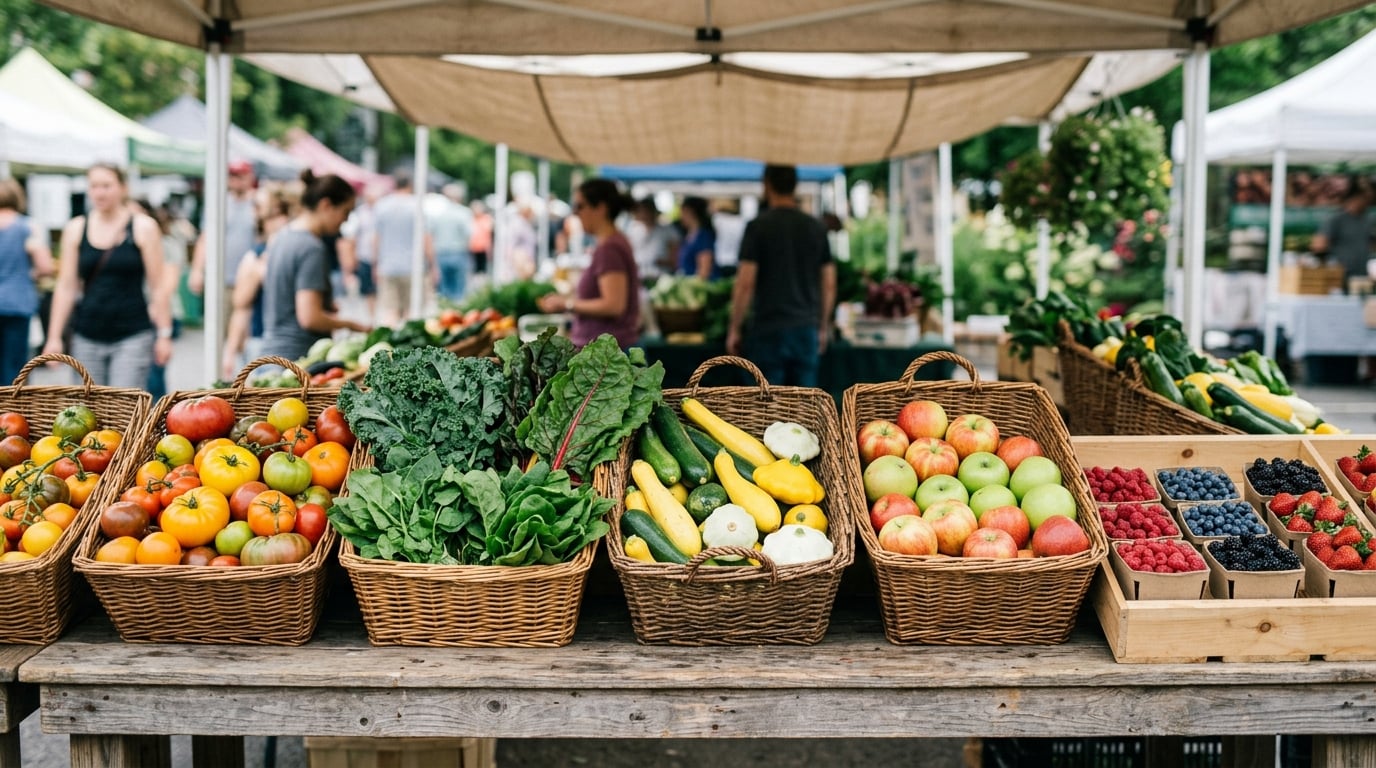
To tell if produce is in season, judge it by how it smells, looks and feels in your hand, not by the label. In-season produce has real aroma, deep even color, a firm but not rubbery texture, fresh stems, and a lower cost per pound than the same item in the dead of winter.
That answer is short on purpose. The harder part is that most people are really asking one of three different questions, and they are not the same question: is this in season, is this local, and is this fresh. A store can hand you any one of them without the other two.
Table of Contents
- How to Tell If Produce Is in Season
- Seasonal Produce Examples by Fruit and Vegetable
- How Can You Check Local Harvest Seasons?
- What Does the Label Tell You About Seasonal Produce?
- How Do You Store Produce After Buying It?
- Common Mistakes When Judging Produce
- Frequently Asked Questions
- Start With the Ones That Smell Good
How to Tell If Produce Is in Season
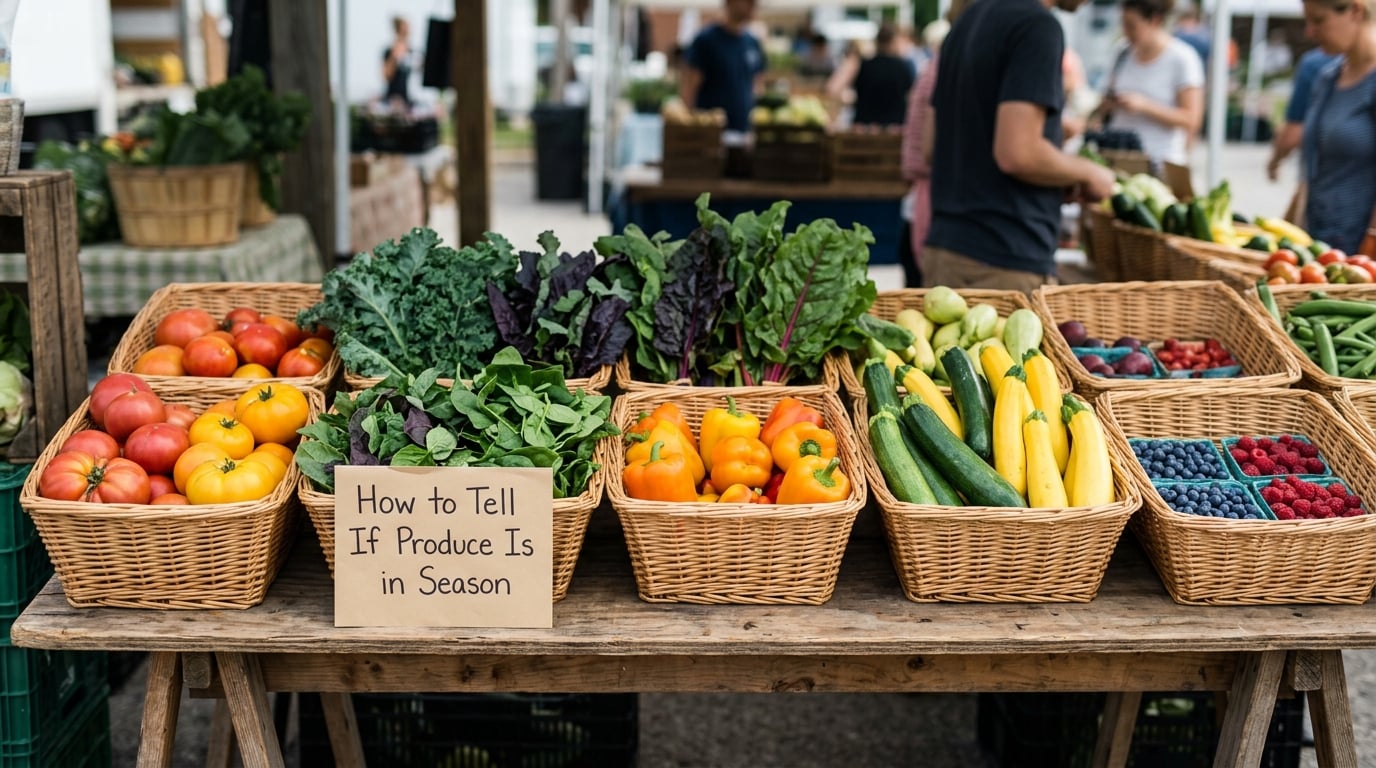
Produce is in season when it was picked at the peak of its natural growing cycle and is available in your region right now. Peak-season items are harvested ripe, travel a short distance, and reach you with flavor intact. Out-of-season items are picked green, held in controlled atmosphere, and ripened later or grown under lights in a greenhouse.
That single fact explains almost every signal shoppers notice. Fruit picked ripe softens fast, so it cannot be stored for weeks, which is why it shows up in season and disappears. Fruit picked green survives the trip and looks fine, which is why you can buy a tomato in February that looks like a tomato and tastes like a warm candle.
Here is the distinction that trips people up most often:
| Term | What it actually means | What it does not guarantee |
|---|---|---|
| In season | Harvested at the natural peak for that crop in your region | That it was grown nearby or that it is the best piece in the crate |
| Local | Grown within a defined distance, often under 100 or 200 miles | That it is in season, or even that the claim is accurate |
| Fresh | Recently harvested and still at good quality | That it came from a farm at all, or that it tastes like much |
Freshness is a measurement of hours. Season is a fact about the calendar. Local is a fact about distance. A bag of greens can be beautifully fresh in January, shipped from California, and out of season everywhere you are standing.
What Signs Show That Produce Is in Season?
Five signals do most of the work, and you can read all of them in the aisle without a phone.
- Smell. Put your nose near the stem end before anything else. Peak tomatoes smell like tomato leaves. Cantaloupe smells like melon at the blossom end. Peaches and pears have a floral perfume you can detect from arm’s length. If there is no aroma at all, nothing else matters much, because flavor compounds build alongside that scent.
- Color. In-season color is deep and even, not a uniform pale sticker color. A ripe tomato goes from green shoulders to a rich, slightly uneven red. Bell peppers in season show red, yellow and orange streaks on the same plant rather than one solid hue.
- Texture. Firm with a little give means ripe and recently picked. Rock hard means picked green. Soft spots and give with no fragrance mean it has been sitting. Buyers at wholesale markets check stem firmness on broccoli, cauliflower and celery, and a tender snap is the mark of a recent cut.
- Stems and leaves. Green caps on strawberries, crisp leaf edges on carrots and beets, and lively tops on beets and radishes all point to a recent harvest. Yellowing, rubbery, or dried stems are the oldest part of the item.
- Cost per pound. This is the fastest signal at home. When a crop is plentiful it drops in cost; when it is scarce and long-hauled it climbs. Shoppers in seasonal buying forums consistently notice the collapse in watermelon pricing during peak watermelon weeks, and the same pattern holds across most crops.
One more worth knowing, from buyers who work wholesale markets: rub the stem of a cluster tomato between your fingers and smell your hand. A green, fresh stem that gives back a sharp green tomato smell is a good sign. That single trick catches tomatoes that have been de-stemmed and re-flipped into a display tray.
How to Tell If Produce Is in Season in 30 Seconds
Run this routine in order and you will have an answer before you pick up your phone. It works on any produce aisle, from a supermarket to a roadside stand.
- Pick it up and weigh it in your hand. Produce picked at full ripeness holds more water and feels heavy for its size. A tomato that feels like a foam ball is underfilled.
- Smell the stem end. This takes two seconds and eliminates more bad picks than any other step.
- Press gently. You want slight give, not a soft patch. Test near the stem, not where the fruit sat on the shelf.
- Look for even color and a clean surface. Deep color, intact skin, no bruising or shriveling. A natural waxy sheen on apples or citrus is normal, a glossy plastic-looking coat is not.
- Check the stems and leaves. Green and firm, not yellow and limp.
- Look at the neighbors, not the sign. When one crate of peaches is pale and hard and the next is fragrant and giving, the whole display is a shipment problem, not a season problem. Buy the second crate.
- Check the per-pound cost against your memory of it. A crop at peak rarely needs a promotion, because supply is high.
| Check | Looks in season | Looks out of season |
|---|---|---|
| Aroma | Strong and sweet at the stem end | Little or no scent |
| Color | Deep, slightly uneven, fully colored | Flat and uniform, with green patches |
| Texture | Firm with slight give | Rock hard, or soft and collapsing |
| Stems and leaves | Green, crisp, fresh | Yellow, rubbery, dried |
| Skin | Intact, natural sheen, no bruising | Waxy, bruised, wrinkled |
| Cost per pound | Lower, no sign needed | Higher, usually featured |
| Shelf life | Shorter, use it this week | Long, keeps for weeks |
There is a flip side to this routine. Produce can be perfectly in season and still be a poor piece of fruit, because a season is a four-week window and quality moves around inside it. Whole communities of market shoppers say the same thing about their best sources: vendor and week matter as much as the crop calendar.
Seasonal Produce Examples by Fruit and Vegetable
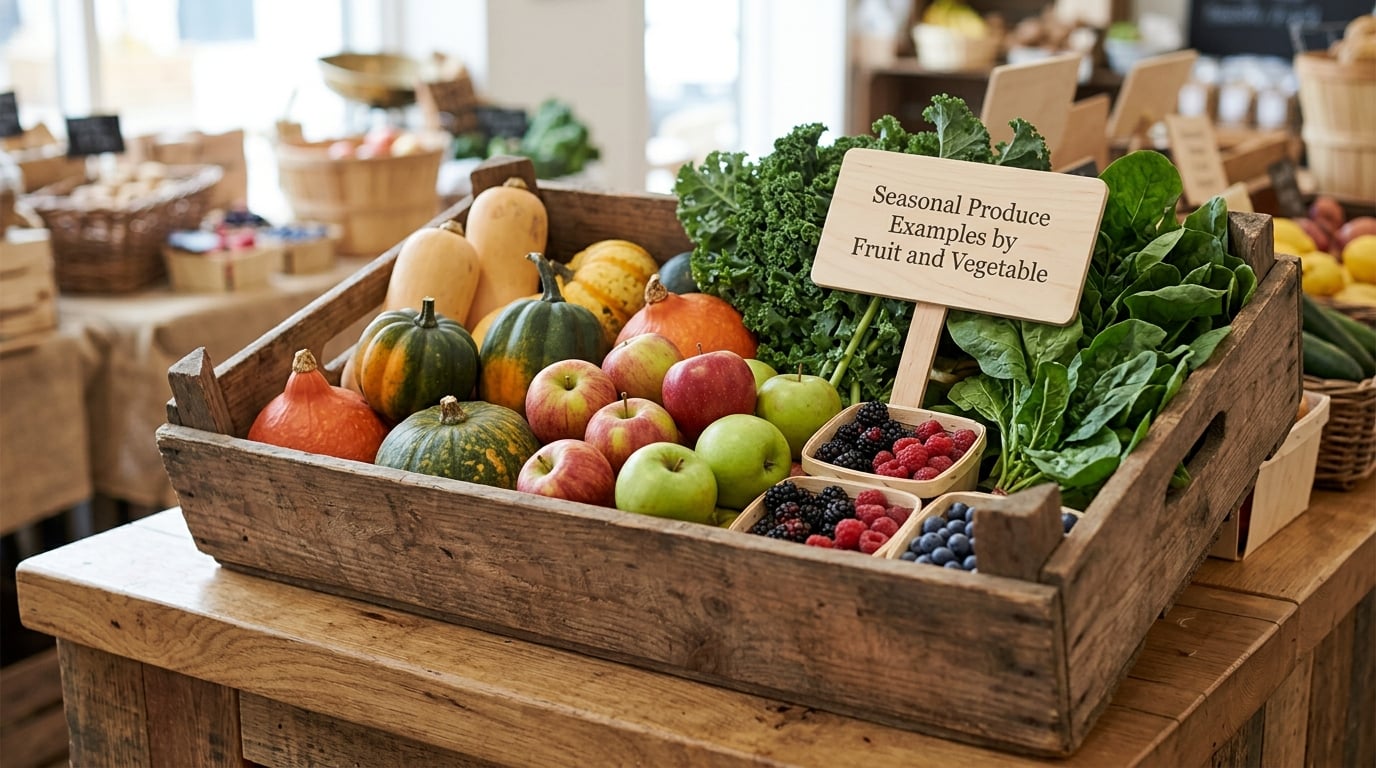
Crops announce their season differently, and once you know the tell for a category you can read an entire display faster.
| Produce | Peak months | Regional note | How to check it |
|---|---|---|---|
| Tomatoes | July to September | Texas and Florida peak weeks earlier than the Northeast | Smell the stem end, look for green shoulders turning deep red |
| Strawberries | April to July | Florida and California run winter and spring crops | Bright red with green caps, no white seeds, no bruising |
| Peaches and other stone fruit | July to September | Southern peaches start weeks earlier than northern ones | Fills the hand, gives at the seam, smells floral |
| Sweet corn | July to September | Sweetest in the South and Midwest; Northeast corn is later | Green husk, tight kernels, sweet smell through the tip |
| Asparagus | April to June | Short, sharp window that ends fast once temperatures rise | Sturdy snapped stems, tight tips, firm spears |
| Leafy greens | March to November | Virginia and North Carolina greens run well into fall | Crisp leaves, vivid color, no slimy spots at the core |
| Summer squash | June to September | Very productive in the South and Southwest | Skin is glossy and tender, feels heavy for length |
| Winter squash | September to December | Stores well, so quality stays good into winter | Hard shell, dry stem, heavy for its size |
| Apples | August to November | Washington, New York and Virginia lead the fall crop | Heavy, firm, fragrant, skin unblemished |
| Root vegetables | October to March | Sweet after frost; Southern roots run November to February | Firm shoulders, tops still green and flexible |
These are general windows for the United States. Your own region will shift them by weeks, sometimes months.
What Peak Tomatoes, Berries and Stone Fruit Look Like
A peak tomato varies in color. Deep shoulders, a darker core, and a slightly wrinkled area near the stem where flavor concentrates are all good signs. Uniformity is the warning sign, not the goal. Many of the best field-grown tomatoes simply do not match, which is why grocers who promise perfectly identical fruit are usually selling something picked green.
Berries fail differently. Strawberries should be bright red through the tip with green caps still attached, dry rather than shiny with condensation, and free of mold at the bottom. A berry that is uniformly pale red all over was likely picked early to survive transit. Blueberries should have a dusty bloom and firm skin; raspberries that hold their shape without weeping are the ones to take home.
Stone fruit announces itself with weight and aroma. A peach at peak fills your palm, yields slightly at the seam, and leaves a perfume on your hand after you pick it up. A plum that is hard and smells like nothing will soften on the counter but rarely gets sweeter, because sugar was made on the tree before it was picked.
What Peak Greens, Asparagus, Squash and Apples Look Like
Greens and brassicas are about water. A head of lettuce or a bunch of kale that feels heavy, crackles, and has upright leaves is freshly cut. Weight loss shows up as limp outer leaves, and the core of a head that has been sitting turns tan and slimy well before the outside looks bad.
Asparagus has one of the shortest seasons of any common vegetable, typically six to eight weeks in most regions. Bunches with firm, pale stems that snap rather than bend, and compact unopened tips, are the ones to buy. Once the tips open and the stems go tough, that window has shut for the year.
Squash splits into two families. Summer squash, zucchini and yellow crookneck, are picked immature, so the skin should be glossy, tender, and yield to a thumbnail. Winter squash, butternut, acorn and delicata, is picked fully mature with a hard shell and a dry corky stem, and it will sit in your pantry for months without refrigeration.
Apples come into their own in the fall. A good apple is heavy for its size, firm, fragrant at the stem, and free of bruises around the calyx. Because most fall apples store reasonably well, an apple in November can still be decent in January, which is why apples are one of the few crops where in-season and stored overlap heavily.
How Can You Check Local Harvest Seasons?
A national calendar is a starting point, not an answer. The reliable method is to find a source that names your growing region and check it against what the growers near you are actually pulling out of the ground this week.
Start with your USDA plant hardiness zone, which is a rough proxy for how long your growing season runs and how cold your winters get. Then use one or more of these sources:
- Regional extension services. County and state extension offices publish planting and harvest calendars tied to their own climate, and they are free.
- Individual farm websites. Smaller farms post what they are picking and often post a crop update by the week.
- Farmers market vendor boards. Most markets post a seasonal availability chart and name the farm growing each item.
- Harvest calendar apps and email lists. Several are built around your ZIP code rather than a national list, and subscribing takes under a minute.
Better still, ask the person standing behind the table. Market shoppers rate talking to the grower as the single most reliable freshness and seasonality signal there is, higher than any sticker or sign. Five questions get useful answers:
- What did you pick this week?
- What is coming in over the next two weeks?
- When does this crop start, and when does it end?
- Is this field-grown, greenhouse, or hydroponic?
- How far did this travel to get here?
Those answers tell you what the season actually looks like on this farm this year, which is the thing a printed calendar cannot do. Growers say it themselves: a warm spring can pull a crop forward by two weeks, and a wet June can end an asparagus season early.
What Does the Label Tell You About Seasonal Produce?
Labels confirm origin and farming method. They rarely confirm peak season, and reading one well saves you from a lot of guessing.
Most produce carries a small sticker with a PLU code, a number that identifies the item and the way it was grown. Conventionally grown items use a three-digit number, conventionally grown and approved organic uses a four-digit number starting with 9, and certified organic uses the word organic or the USDA organic seal. A PLU code is a product identifier, not a freshness or location claim, so two PLUs tell you nothing about when something was picked.
For imported produce, a country of origin statement appears on the shipping carton rather than the retail sticker. That is the one piece of printed information that genuinely helps you judge seasonality, because a crop listed as imported in March is by definition out of your local season.
Three claims come up constantly and are worth separating from seasonality:
- Grown in means the item was cultivated in the named country. It says nothing about when it was harvested.
- Packed for and shipped from refer to packing and distribution, which routinely happen far from the growing site. Treat these as logistics, not origin.
- Organic describes how it was grown, not when. Organic produce is routinely shipped long distances and stored in controlled atmosphere, so it is frequently out of season.
Greenhouse and hydroponic supply blurs the whole concept. Because light, heat and nutrients can be controlled, a grower can produce strawberries or tomatoes through the winter in a fixed location. That output is real and it is grown nearby, but the crop is not in season, because the season is defined by the plant’s natural cycle, not the calendar date on the box.
How Do You Store Produce After Buying It?
Peak-season produce has short shelf life by design, so storage is where the value of a good buy either survives or disappears. The basic rule: most vegetables want cold and humidity, most fruit wants cool and dry until you want to eat it, and ethylene-producing fruit speeds up the aging of everything nearby.
| Produce | Where to store | Realistic window | Key exception |
|---|---|---|---|
| Berries | Refrigerator, unwashed, in a single layer | 3 to 7 days | Rinse only right before eating, and dry them first |
| Leafy greens | Refrigerator in a bag with a dry towel | 7 to 10 days | Keep herbs like basil at room temperature in water, not refrigerated |
| Tomatoes | Counter, stem side down | 3 to 7 days | Never refrigerate, it flattens the flavor |
| Stone fruit | Counter until ripe, then refrigerator | 3 to 5 days | Refrigerate only after it gives to gentle pressure |
| Apples and pears | Refrigerator in the crisper | 2 to 8 weeks | Apples give off ethylene, so store them away from greens |
| Root vegetables | Refrigerator in a bag, tops removed | 2 to 4 weeks | Remove carrot and beet tops, they pull moisture from the root |
| Asparagus | Refrigerator, upright in a small amount of water | 2 to 4 days | Trim the ends an inch before storing |
| Winter squash | Cool, dry pantry or cellar | 2 to 6 months | Do not refrigerate, it softens the starch |
| Broccoli and cauliflower | Refrigerator, unwashed, loosely covered | 5 to 10 days | Yellowing florets mean it is past its best, not unsafe |
When a peak crop is genuinely cheap and abundant, buying extra is usually a good deal. Blanch and freeze greens, corn and beans; tomato sauce or roasted and frozen tomatoes; berries as jam or purée. Frozen produce is picked ripe and frozen, so it holds more flavor than most of what arrives in a winter aisle, and it is not a compromise at all.
For food safety, keep cold items at or below 40°F in the refrigerator, and use the cut produce within a few days. Pre-cut or peeled produce keeps about a week refrigerated, cut melon and cut leafy greens closer to 3 to 4 days.
Common Mistakes When Judging Produce
These assumptions cause more bad picks than any shortage of knowledge.
Assuming color equals ripeness. Uniform color is a shipping trait. Many in-season crops, especially heirloom tomatoes and peppers, ripen unevenly and will never look consistent. Judge color together with aroma and give, not alone.
Treating organic as seasonal. Organic describes a method, not a month. Organic produce travels the same distances in the same controlled-atmosphere rooms.
Believing in-season always costs less. It usually does at a supermarket, where supply drives cost. It often does not at a farmers market, where small plots, hand labor and no wholesale intermediary are priced in. Higher cost there buys you a harvest date, not a status.
Trusting a local claim you cannot verify. Signage, chalkboards and placards are marketing. The carton of origin, the vendor’s name, and a direct question to the grower are the parts you can rely on.
Wasting the whole crate on one soft piece. Soft spots are common in peak-season fruit and are a normal part of the batch, not a reason to reject everything nearby. Sort at home, eat the soft ones first, and refrigerate the rest unwashed.
Expecting the calendar to be exact. A harvest window is a range, not a date. Weather, a warm spring, a late frost, or a cold snap can move a crop in either direction by weeks, which is why asking the grower beats reading a chart.
Using the 3-3-3 rule for shopping decisions. The 3-3-3 guideline is about food safety, not seasonality. It points you toward produce that is safe to buy and store, and nothing more. Freshness rules and season rules are separate problems.
One last reassurance, since it comes up constantly in seasonal shopping discussions: produce that is out of season is not less safe. It is grown with the same oversight, stored and transported under the same standards. Out of season is a flavor, cost and distance question, not a health one.
Frequently Asked Questions
How do you know what produce is in season?
You know by looking for the signals that come with fruit picked ripe: strong aroma at the stem end, deep and even color, a firm texture with slight give, fresh green stems and leaves, and a lower cost per pound than out of season. A cross-check is the vendor, who can tell you what was picked this week and when the crop starts and ends.
How to tell if produce is NOT in season?
Out-of-season produce tends to be picked green and ripened later, so it shows flat, uniform color with green patches, little or no aroma, rock-hard or waxy texture, and yellow or dried stems. It also costs more per pound, because supply is short and it has traveled further. If it looks perfect and smells like nothing, that is the pattern.
What counts as fresh produce?
Fresh means recently harvested and still in good condition: heavy for its size, firm with a little give, brightly colored, with crisp stems and no bruising or soft spots. Freshness is measured in hours and days, while season is a fact about the growing calendar. Produce can be very fresh and completely out of season.
Which grocery store or chain has the best fresh produce?
No chain wins on average, because quality varies by produce manager, by warehouse and by the week. Turnover speed matters more than the banner name: a store that sells through a small truck quickly beats one holding a pallet for two weeks. Visit a farmers market for peak-season items and check discount grocers for seconds and canning-grade produce.
What produce is in season in North Carolina and Virginia?
In North Carolina, summer brings tomatoes, peaches, sweet corn, watermelons and green beans through July and August, with sweet potatoes, butternut squash, apples and leafy greens through the fall. Virginia runs close behind, adding apples, late tomatoes, kale and winter squash from September into November, with roots and storage crops carrying over into winter.
Is produce safe to eat right now?
Yes. Produce that is out of season is grown under the same food safety rules as produce that is in season, and cold storage and controlled atmosphere shipping are regulated practices. Out of season affects flavor, cost and distance traveled, not safety. Refrigerate cut or peeled produce at or below 40u0026deg;F and use it within a few days.
Start With the Ones That Smell Good
The fastest way to know if produce is in season is to stop at the display and use your nose. Fruit picked at peak ripeness carries aroma, and aroma is the one signal that cannot be faked by lighting, wax or a well-designed display.
After that, weigh the piece in your hand, press it gently near the stem, and check the stems and leaves. Once a week, ask the person selling it what was picked and what is coming. That habit, more than any calendar, is what puts you in season.
Last reviewed and updated in 2026. Seasonal windows shift by region and by year, so check your local extension service or market board when a crop is about to turn.