
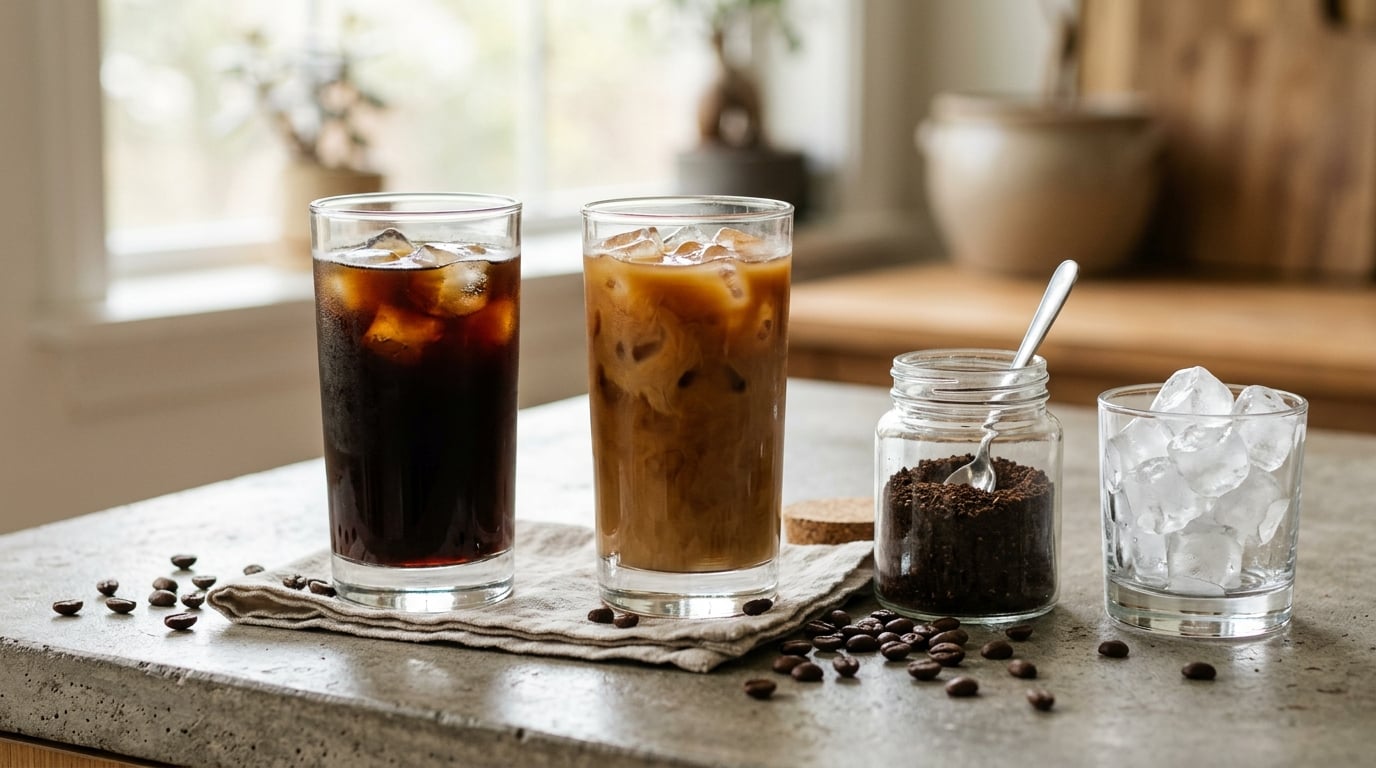
Cold brew is coffee steeped in cold or room-temperature water for 12 to 24 hours and never heated, while iced coffee is regular hot-brewed coffee, cooled down and poured over ice. That single difference, the temperature at which the water touches the grounds, decides everything else: flavor, acidity, caffeine per serving, and how long the drink keeps.
They look nearly identical in a glass, which is exactly why the two get mixed up. One was brewed cold. The other was brewed hot and chilled afterward. This guide covers the cold brew vs iced coffee difference explained method by method, so you can order the drink you actually wanted.
Table of Contents
Cold Brew vs Iced Coffee Difference Explained at a Glance

Short version: pick cold brew if you want a smooth, low-acid, fuller-bodied drink and do not mind paying a bit more or waiting. Pick iced coffee if you want the brighter, more acidic taste of the beans, a quicker and cheaper option, or a way to use up coffee you already brewed.
| Factor | Cold Brew | Iced Coffee |
|---|---|---|
| How it is brewed | Grounds steeped directly in cold or room-temperature water, never heated | Hot water at roughly 90 to 96 degrees Celsius, then chilled and poured over ice |
| Steep time | 12 to 24 hours, often overnight | 3 to 5 minutes as a hot brew, plus cooling time |
| Grind | Coarse, like raw sugar | Medium, matching the brew method |
| Flavor | Smooth, mellow, naturally sweet, low bitterness | Bright, sharp, aromatic, more acidity |
| Acidity | Low titratable acidity | Higher titratable acidity |
| Body | Full and creamy | Lighter, thinner mouthfeel |
| Caffeine per serving | Usually higher, because it is often served less diluted | Usually lower, especially as ice melts |
| Best for | Sensitive stomachs, dark roasts, batching, black drinking | Light roasts, tasting origin character, speed, leftover hot coffee |
Titratable acidity, in plain language, is simply how much sourness the drink has. It is the single most reliable flavor difference between the two methods.
How Cold Brew and Iced Coffee Are Made
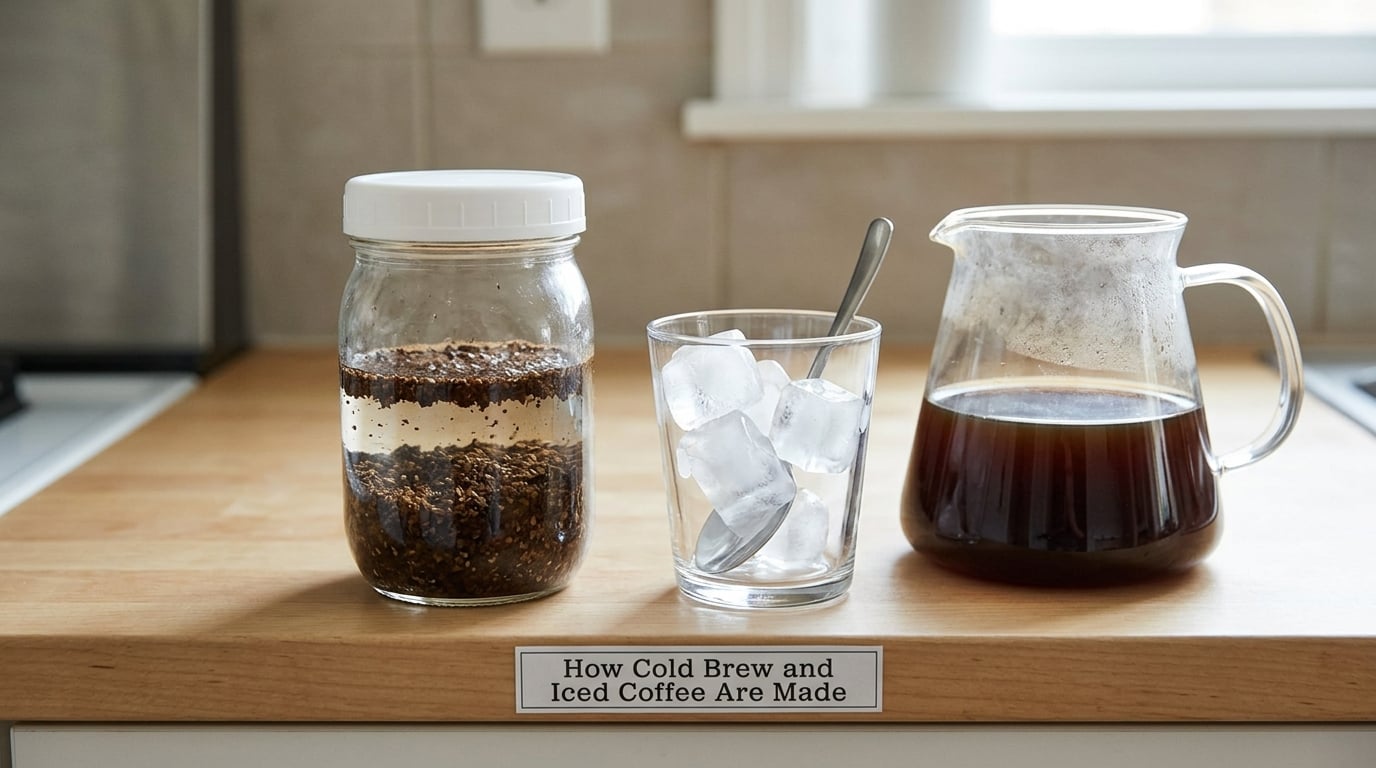
Cold brew: cold water, coarse grounds, and time
Cold brew coffee is made by putting coarse ground coffee in cold or room-temperature water and letting it sit. Most recipes use a 1:8 coffee-to-water ratio by weight, steep for 16 to 24 hours, then strain through a paper or mesh filter.
Because the water never gets hot, the grind can be coarse and the brew forgiving. Some people use a 1:15 ratio for a lighter result, or a 1:4 concentrate they dilute later with water or milk. One subtlety worth knowing: cold brew names the process, not the serving temperature. You can drink cold brew hot, and the reverse is not true of iced coffee.
Iced coffee: hot brew, fast chill, ice last
Iced coffee starts life as a normal hot brew, usually at 90 to 96 degrees Celsius for a few minutes. Then it gets cooled. The cooling method matters more than people expect: coffee chilled quickly over an ice bath keeps more aroma than coffee left to cool on a counter for two hours.
After that it is poured over fresh ice. The ice is part of the recipe, not just a serving detail, and it keeps diluting the drink while you drink it.
Why temperature is the whole story
Hot water extracts fast and pulls out acids and aromatic oils, which is why hot coffee smells so much like the roast. Cold water is patient, so it draws out sweetness and body while leaving more of the sharp acidic compounds behind in the grounds.
Getting the drink you ordered is not always a formality. Members of the Dunkin’ World Facebook group have described ordering cold brew and receiving something that tasted like ordinary iced coffee, and customers on r/starbucks have complained that iced coffee arrives pre-ground while cold brew is ground to order. The freshness gap people notice is usually a grinding gap.
Flavor and Acidity: Which Drink Tastes Smoother?
Cold brew is the smoother, sweeter drink
Cold brew tastes mellow and rounded, with a natural sweetness that most people describe as easier to drink black. It has more body, so it feels creamy rather than thin, and it is usually less bitter because the long cold steep does not over-extract the harsh compounds.
It also has less acidity. A 2018 study by Rao and Fuller published in Scientific Reports compared matched beans brewed hot and cold and found cold extraction produced roughly 67 percent lower titratable acidity. That is a big, measurable difference, and it is why people who find coffee upsets their stomach can often handle cold brew comfortably.
Iced coffee is brighter and closer to the bean
Iced coffee keeps the acidity and the aromatics that hot brewing pulls out quickly, so a good light roast still tastes like its origin: floral, citrusy, crisp. A pour-over iced coffee made with a scale and a gooseneck kettle can be more expressive than any cold brew.
Weakness: dilution. Iced coffee tastes sharp on the first sip and thin by the last as the ice melts. That is why good iced coffee is brewed stronger than the hot coffee you drink at a table, and why pour-over is usually served with less ice or a lighter hand with the cubes.
Which one is healthier?
Low acidity does not automatically mean healthier. Coffee’s organic acids are part of what makes the drink a meaningful source of antioxidants, and cold brew is usually taken with more sugar or cream to soften its strength. What is accurate: cold brew is gentler on digestion for many people, and caffeine content depends on the ratio and the serving size far more than on the method.
If you have reflux, a sensitive stomach, or a diagnosed condition, ask your doctor or a registered dietitian rather than switching drinks to treat it.
Caffeine and Strength: Which Has More?
Cold brew usually carries more caffeine per serving, but the reason is not what most people assume. It is not a magic effect of cold water extracting more caffeine. It is a ratio and dilution effect.
The ratio math explains most of it
Think in coffee-to-water ratios. A home cold brew at 1:8 is twice as concentrated as an iced coffee brewed at roughly 1:15. A 1:4 concentrate diluted with equal parts water still lands near 1:8.
On top of that, iced coffee spends the drink’s life melting. A 12 oz serving poured over ice may only be 6 or 7 oz of actual coffee by the time you reach the bottom, and the solids went with it.
| Serving | Typical caffeine |
|---|---|
| Strong cold brew, about 12 oz | Roughly 200 mg |
| Comparable iced coffee, about 12 oz | Roughly 120 mg |
| Home cold brew concentrate, 8 oz before dilution | Well over 200 mg |
Chain drinks vary widely, so treat any number on a menu as a rough guide rather than a promise. As a general reference, health guidelines for most healthy adults put a daily caffeine ceiling around 400 mg. Count the cold brew toward it, especially if you also drink tea, soda, or pre-workout mixes.
Price, Convenience, and At-Home Preparation
Neither drink has a fixed price, and both are shaped by the same few things: whether the shop batches a concentrate, whether they grind to order, and how large the drink is. Cold brew usually costs a little more because a 12 to 24 hour steep ties up equipment and beans. Iced coffee is generally the cheaper, faster option because it reuses the batch brew the shop already made for hot drinks.
Making cold brew at home
You need coarse grounds, filtered water, a jar or pitcher with a lid, and a strainer. Weigh one part coffee to eight parts water, stir, cover, and refrigerate 16 to 24 hours. Strain it, then serve it over ice as is or cut it with equal parts water or milk. A burr grinder gets you a consistent grind; a blade grinder leaves dust that turns the drink cloudy and bitter.
Made this way, cold brew keeps about a week refrigerated in a sealed container. Roasters are conservative and cap it at seven days, because flavor fades well before safety does.
Making iced coffee that does not taste watery
Brew it stronger than you would for a hot cup, roughly 50 to 100 mg of coffee per 8 oz of finished drink. Chill it fast in a covered vessel in the fridge or an ice bath, then add ice at the last moment. Large cubes melt slower than small ones, and serving it in a chilled glass buys you another few minutes.
Two more categories you will see on menus
Flash brew, also called Japanese iced pour-over, is brewed hot directly onto ice. It is the fastest of the three and keeps more origin character than cold brew. Nitro cold brew is cold brew pushed through nitrogen, which gives it a cascading, creamy texture with no dairy, and it is usually served without ice so the texture survives.
There is also iced Americano, which is espresso over ice and water. It is stronger per ounce than both drinks on this page, and it is the one to order when you want coffee flavor without any sweetness.
Which Should You Choose?
- Pick cold brew if your stomach objects to acidity, you drink coffee black and want it to taste sweet rather than sour, or you are brewing for a group and want one batch to last.
- Pick iced coffee if you love light roasts and want the beans to taste bright, you have hot coffee already brewed, or you want the cheapest fast option on the board.
- Pick flash brew if you care about origin character and can wait a few minutes for the pour.
- Pick nitro cold brew if you want cold brew’s body with a creamy texture and no ice dilution.
- Choose by caffeine, not by label. Ask for the ratio, or order a small cold brew with no ice if you want strength without the load.
- Choose by roast. Dark roasts are swallowed by the cold method’s sweetness; light roasts can taste thin brewed cold. Cold brew flatters chocolate and nutty notes, iced coffee flatters fruit and floral notes.
The fastest way to understand any of this is to taste both in the same week, side by side, from the same shop. That is the argument people on r/pourover make, and they are right.
Frequently Asked Questions
Is cold brew coffee the same as iced coffee?
No. Cold brew is steeped directly in cold or room-temperature water for 12 to 24 hours and never heated. Iced coffee is brewed with hot water, cooled, then poured over ice. Cold brew tends to taste smoother and less acidic, while iced coffee keeps more brightness and origin character from the beans.
Is cold brew higher in caffeine than iced coffee?
Usually yes, and the reason is dilution rather than extraction. A home cold brew at a 1:8 ratio is about twice as concentrated as iced coffee at 1:15, and iced coffee loses more strength as the ice melts. A strong 12 oz cold brew can carry roughly 200 mg of caffeine against about 120 mg for a comparable iced coffee.
Does cold brew taste stronger than iced coffee?
It tastes more intense but not necessarily more bitter. Cold water draws out sweetness and body while leaving sharp acids and heavy bitterness in the grounds, so the cup feels fuller and rounder. Iced coffee tastes brighter and thinner, and noticeably weaker by the last sip as the ice melts.
What are the downsides of cold brew?
The main drawbacks are practical. It usually costs more at a coffee shop, takes 12 to 24 hours to make at home, and the long steep can amplify bad beans instead of hiding them, so dull or stale coffee tastes dull. It also carries a lot of caffeine per serving, which matters if you are sensitive to it.
Is cold brew better for you than iced coffee?
For most people it is a matter of tolerance rather than nutrition. Cold brew’s low acidity makes it easier on sensitive stomachs, but lower acidity does not automatically mean healthier, since coffee’s organic acids carry antioxidants. Caffeine, sugar, and cream in the drink matter more to your intake than the brewing method.
What is the difference between Chick-fil-A’s cold brew and iced coffee?
The difference is the same one you find at any chain, and it comes down to preparation. Their cold brew is steeped cold for hours, while their iced coffee is a hot brew chilled and poured over ice, so it is brighter and more acidic. Chains rarely publish steep times, and some have been reported serving one in place of the other, so the taste test is the real check.
Conclusion
Cold brew and iced coffee are the same drink only if you never think about how they were made: one is brewed cold, the other is brewed hot and chilled. If you want smooth, sweet, low-acid coffee, order cold brew; if you want the bright, origin-forward taste of the beans, order iced coffee and ask for it brewed strong.
Start by ordering both in the same week from the same shop. You will settle the argument for yourself in about two minutes of tasting.