
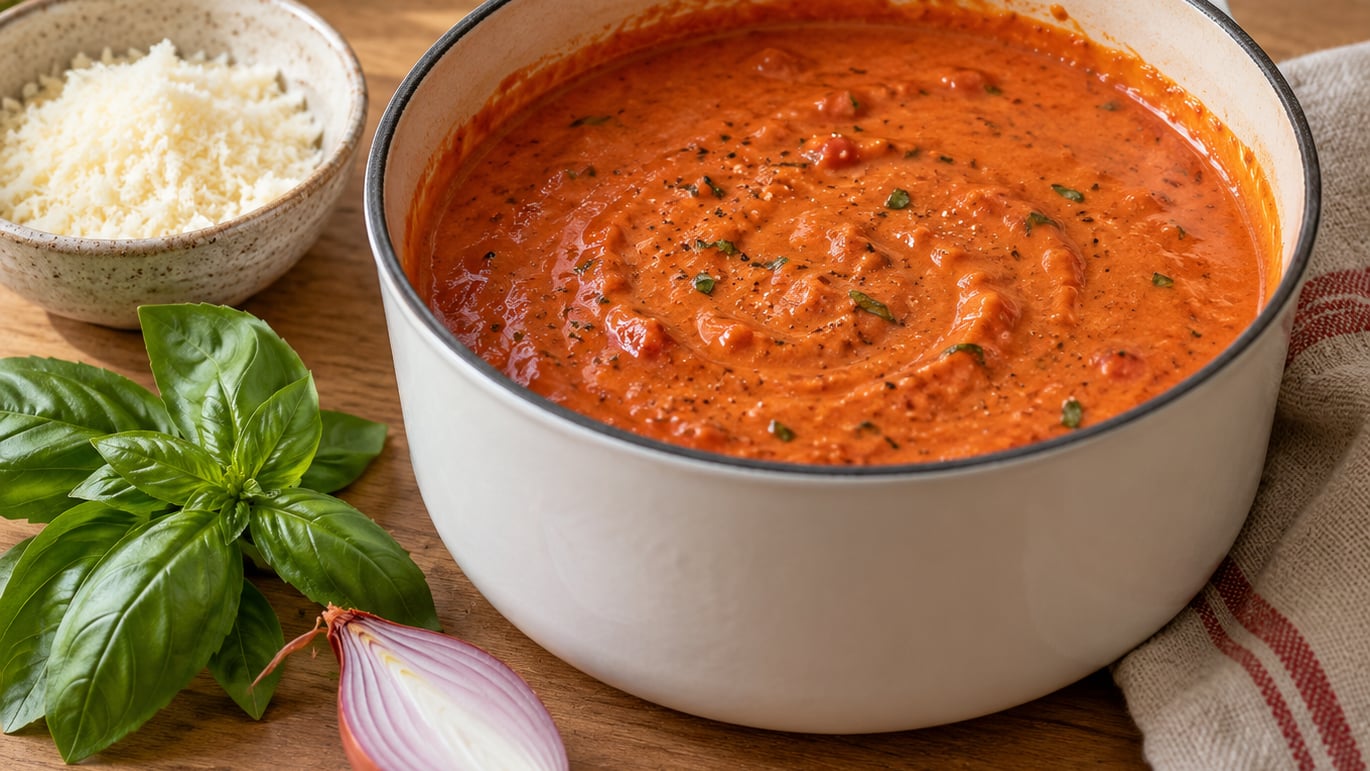
To make vodka sauce at home, simmer diced onion and garlic in olive oil, cook in crushed tomatoes with tomato paste, deglaze the pan with vodka until the raw spirit smell disappears, then finish the sauce off the heat with heavy cream and grated Parmesan until it turns glossy and silky. It is a 40-minute recipe, and most of that is unattended simmering.
Penne alla vodka is the sort of dish that looks like it needs a restaurant kitchen. It does not. What it actually needs is a wide saucepan, a wooden spoon you can whisk with, and the discipline to keep the heat low once dairy goes in. Get those three things right and the sauce does the work for you.
I have made this version more times than I can count, mostly on weeknights when the alternative is another jar of marinara. The version below was tested and rewritten in October 2026 to fix the two failures that show up most often: sauce that stays watery, and sauce that splits when the cream hits a hot pan.
If you are planning this for a group rather than for yourself, the timing and make-ahead notes at the end matter more than the recipe itself.
What You Need
The ingredient list is short and almost everything comes from a regular supermarket. Nothing in it is hard to find, and every item has a substitute that still produces a good sauce.
Equipment
- A wide, heavy saucepan or Dutch oven, ideally 4 quarts or larger. A wide base gives the tomato base room to reduce instead of stewing in its own liquid.
- A wooden spoon or silicone spatula for stirring, and a whisk for the last five minutes.
- A box grater and a microplane for the Parmesan. Pre-grated cheese from a tub will not melt properly and is the usual reason people complain about grainy sauce.
- A fine mesh strainer if you are using whole tomatoes and want to control the texture.
- Optional: an immersion blender. A blender works, but blending hot sauce in a countertop blender is a genuine steam-burn risk. Cool it for 10 to 15 minutes first, or blend in batches.
This is a stovetop recipe. No blender is required, and the sauce thickens on its own through reduction and emulsification rather than through pureeing.
Ingredients (serves 4)
- 1 tablespoon extra-virgin olive oil (15 ml)
- 1 medium shallot, finely diced, about 1/2 cup (75 g). A yellow onion works, peeled and diced.
- 3 garlic cloves, minced
- 1/2 teaspoon red pepper flakes, optional
- 2 tablespoons unsalted butter (30 g)
- 1/3 cup vodka (80 ml). Plain vodka only, not flavored.
- 1/4 cup tomato paste (60 g)
- 1 can (28 oz / 800 g) crushed tomatoes or tomato passata
- 3/4 cup heavy cream (180 ml)
- 1/2 cup finely grated Parmigiano Reggiano (50 g)
- Kosher salt and freshly ground black pepper, to taste
- Fresh basil leaves and 1/2 cup reserved pasta water, for finishing
You will also want 1 pound (450 g) of dried pasta, cooked al dente in well-salted water. Penne is the classic, but pasta shape matters more than most recipes admit, so there is a ranking near the end of the method.
Choosing the vodka
Any unflavored potato or grain vodka works. You are not looking for flavor, you are looking for the alcohol and the clean bite that cuts through tomato acid. That makes a mid-shelf bottle genuinely fine, and there is no reason to spend on a top-shelf one for this.
What to avoid is flavored vodka, vanilla or anything fruit-flavored, because the flavor survives the simmer and will fight the tomatoes. If you only own a big bottle of something floral or citrus, buy a cheap plain one for this sauce instead.
If you would rather leave alcohol out entirely, use the same amount of low-sodium broth or dry white wine in place of the vodka. The sauce still works, it just tastes slightly sweeter and less layered, since the vodka also does the job of cutting the acid.
Choosing the tomatoes
San Marzano crushed tomatoes are the upgrade worth making if you can find them at a normal price. Everything else, including standard crushed tomatoes or a passata, produces a very good sauce. Plain crushed tomatoes also let you crush them by hand for a slightly rougher texture, which is where a lot of the homemade character comes from.
Whole plum tomatoes work too, crushed by hand and strained, though that adds a few minutes. Avoid tomato sauce, which is already watered down, and avoid tomato paste as a substitute for the crushed tomatoes, since two tablespoons of paste will not replace 800 grams of tomatoes.
What to use instead of heavy cream
Half-and-half is the easiest swap and gives a lighter, less rich sauce. The trade-off is that lower-fat dairy is thinner, so add it a little more slowly and give the pan a minute longer to come back up to a simmer.
| Cream substitute | How it changes the sauce | Best for |
|---|---|---|
| Half-and-half | Lighter, less rich, slightly thinner | A weeknight version with half the dairy weight |
| Unsweetened evaporated milk | Rich and close to heavy cream, concentrates quickly | Pantry cooking with no cream in the house |
| Coconut cream | Smooth body with a faint coconut note that fades under Parmesan | Dairy-free cooking |
| Cashew cream, soaked and blended | Neutral, thick, creamy | Dairy-free cooking where texture matters most |
| Cold butter whisked into the tomato base | Rich but thinner, no dairy protein to split | A quick tomato-vodka sauce with no cream at all |
| Starch slurry, 1 cornstarch to 2 cold tablespoons of water | Glossy and thick on cooling, but loses the dairy richness | Last-resort thickening for a broken sauce |
Whichever option you pick, the rule is the same: add it over low heat and keep the sauce below a boil.
How to Make Vodka Sauce at Home: Step-by-Step
Read the whole method once before you start, because the order matters more than the quantities. Aromatics first, then tomato, then alcohol, and dairy last and gently. Move the cream in earlier and you will chase a split sauce all night.
1. Sauté the Aromatics
Warm 1 tablespoon of olive oil in the saucepan over medium heat, about 2 minutes, until the oil shimmers but does not smoke. Add the diced shallot and a pinch of salt, then cook for 5 to 6 minutes, stirring every minute or so, until the shallot looks translucent and collapses when you press it with the back of a spoon.
Add the minced garlic and the red pepper flakes, if using, and cook for 1 more minute. Stir constantly here. Garlic goes from pale to burnt in about 40 seconds once it hits a hot pan, and burnt garlic will follow you through the entire sauce. You are looking for the shallot to be soft with no white raw core and the garlic to smell sweet rather than sharp.
If you brown the shallot, start over. A dark fond at the bottom of the pan is the single most common reason a homemade vodka sauce tastes bitter.
2. Concentrate the Tomato Base
Stir in 2 tablespoons of butter and the tomato paste. Cook for a full 2 minutes, stirring, until the paste darkens from bright red to brick red and starts to stick slightly to the bottom of the pan. That sticking is the point, and it is what gives the finished sauce depth instead of just tomato flavor.
Pour in the crushed tomatoes or passata, add 1 teaspoon of salt if your tomatoes are unsalted, and bring the mixture to a simmer. Then lower the heat to medium-low, cover partially, and let it cook for 20 to 30 minutes, stirring every 5 minutes to keep the bottom from catching.
You are looking for a reduction cue: the sauce should drop roughly by a quarter to a third in volume, the bubbles should be smaller and slower, and a spatula drawn across the bottom should leave a clean line that fills in slowly. If liquid pools in the middle of the pan when you stir and stays there, it needs more time, not more heat. High heat here is how scorch happens, and scorched tomato base is unrecoverable.
If you are short on time, 10 minutes of simmering plus a tablespoon of tomato paste stirred in at the end gets you most of the way there. It just lacks the rounded sweetness of the full reduction.
3. Deglaze with Vodka
This is the step that makes it vodka sauce, and it does two jobs at once: it lifts the browned tomato residue off the bottom of the pan, which is where a good chunk of the flavor is sitting, and it balances the acidity of the tomatoes.
Turn the heat to medium and pour in 1/3 cup of vodka. Stand back, because it will flare up briefly and the steam is unpleasant. Stir and let it simmer for 3 to 5 minutes until the sharp smell of raw alcohol is gone and the liquid has reduced by roughly half. A wooden spoon dragged through the pan should leave a streak that stays visible for a second or two.
Smell is the only reliable test here. If you still catch a burn of rubbing alcohol, give it another minute. Under-reducing is the usual reason people say the sauce tastes like vodka, and it takes longer than most recipes admit because the smell lingers in the pan steam.
The acidity point is worth understanding, because it explains why plain tomato sauce never tastes quite right next to this one. Tomato acid is sharp on its own. Alcohol in the deglaze carries off some of that edge during the simmer, and what remains reads as brightness rather than sourness. It is the same reason wine works in a tomato sauce, and if you would rather not use alcohol, the how to make a pan sauce after searing meat guide covers the same deglaze technique with broth and wine.
4. Add Cream Without Splitting
Take the pan off the heat for a minute and warm the cream in a small separate pan or a heatproof bowl set in warm water. Slightly warmed cream and a slightly cooled tomato base are far less likely to shock each other into curdling. This is the whole trick.
Then set the saucepan back over the lowest heat, add a pinch of salt to the tomato base, and pour in about a third of the cream while whisking steadily. Whisk for a full minute until the mixture is fully uniform and no streaks remain. Add the rest in two more additions, whisking between each, and keep it barely moving.
Do not let it boil. Dairy proteins begin to break down and tighten into curds somewhere around 180°F, and a rolling boil is what produces the broken, watery skin you see in most split sauces. A sauce held at a low simmer will thicken naturally in 5 to 10 minutes.
You are looking for a finish that looks glossy and satin rather than matte, coats the back of a spoon, and pulls away slowly when you drag a finger through it. If it looks dull or thin, it is usually still too hot and the fat has not emulsified yet; give it two more minutes off the boil.
5. Finish the Sauce
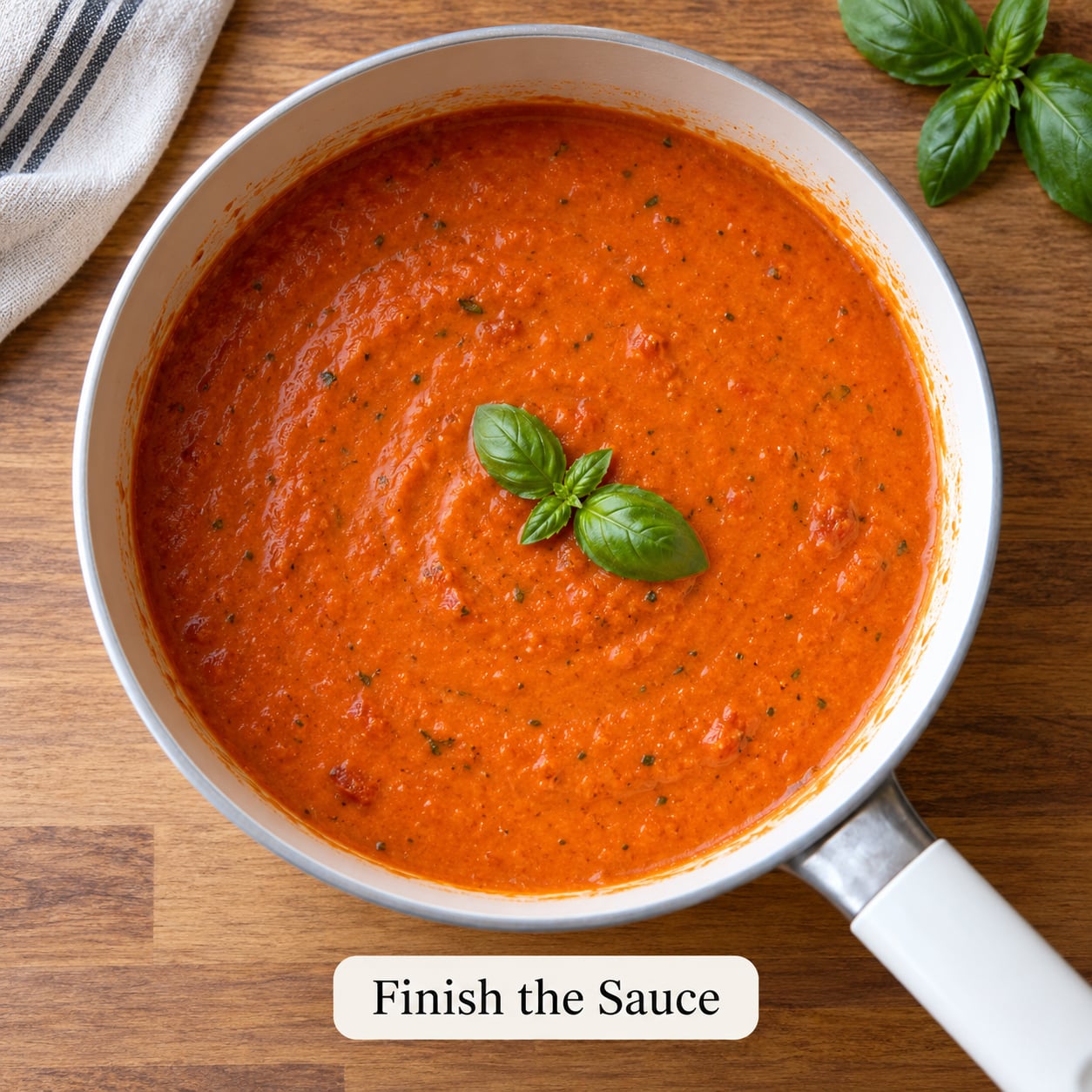
Kill the heat. Stir in the grated Parmesan in two additions, whisking until each addition melts completely, then swirl in the remaining tablespoon of butter for gloss and roundness. Taste and season with salt and plenty of freshly ground black pepper. Acid-heavy tomato bases usually want a second pinch of salt and nothing else, so taste before reaching for sugar.
The finished sauce should coat a spoon lightly and let it fall in a slow ribbon. If it is thicker than that, loosen it with a splash of reserved pasta water or a spoonful of warm cream. If it is thinner than you want, hold it over very low heat for a few more minutes, or stir in a tablespoon of tomato paste and simmer for 5.
Toss the drained pasta into the sauce with about 1/2 cup of the starchy pasta water and cook over medium heat for 1 to 2 minutes, stirring, until every noodle is coated and glossy. The starch in the pasta water is what makes the sauce cling instead of sliding off the bottom of the plate. This last minute matters more than any ingredient in the list.
On pasta shape, ranked by how well the sauce clings: penne first, then rigatoni and other large tubes, then cavatappi and other corkscrews, then ziti, and finally spaghetti. Thin strands have too little surface area and mostly arrive at the plate with sauce pooled underneath. Anything with ridges or a hollow core holds more sauce per bite, which is the whole point of the dish.
Finish with torn basil, extra Parmesan, and more black pepper than feels reasonable. If you are cooking for a group, make the sauce through step 4 before your guests arrive and hold it warm, then toss the pasta at the table. Scaling and make-ahead notes are below.
Common Mistakes
Nearly every bad vodka sauce I have seen comes down to one of six things. Here is what causes each and the fastest correction.
| Problem | What caused it | How to fix it |
|---|---|---|
| Sauce is too thin | Not enough reduction on the tomato base, or cream added to a cold pan and never brought back up to temperature | Simmer over low heat for 10 minutes with frequent stirring, or stir in 1 tablespoon of tomato paste and cook 5 more minutes |
| Sauce is too thick or gluey | Reduced too far, or too much cream and cheese for the batch size | Loosen with warm reserved pasta water, one tablespoon at a time, stirring over low heat |
| Sauce split or turned oily | Boiling after the cream went in, or cold cream added to a hot tomato base | Remove from the heat immediately, whisk in cold water or cold milk a tablespoon at a time, then whisk the sauce back over low heat. Starchy pasta water also brings a broken sauce back together |
| Grainy or gummy texture | Parmesan added at a rolling boil, or pre-grated cheese used | Take it off the heat and whisk in a further splash of warm cream. Prevention is grated Parmigiano Reggiano added off the heat in two additions |
| Sauce tastes too sharp | Under-reduced tomato acid, and not enough seasoning | Simmer 5 more minutes, then add a small pinch of salt. A tablespoon of unsalted butter melts in and rounds the edge |
| Sauce tastes like vodka | The deglaze was not given long enough to reduce | Keep it over low heat for another 3 to 5 minutes until the sharp smell is completely gone. Taste with a clean spoon, not the one you have been stirring with |
The prevention list is short, and it is worth memorizing because these four rules cover almost every failure. Warm the cream before it goes in. Keep the heat at a bare simmer once dairy is in the pan. Whisk constantly during the last two minutes rather than stirring. And use freshly grated cheese.
Reheating is where a perfect sauce most often gets ruined. Warm it in the saucepan over low heat with a splash of water or cream, stirring constantly, and give it a good whisker halfway through. Never microwave it and never let it come to a boil.
For storage, cool it quickly and refrigerate in a covered container within two hours. It keeps 3 to 4 days in the refrigerator. For longer, freeze it in a flat bag with the air pressed out, which makes it easy to break off in portions, for up to 2 to 3 months. Thaw in the refrigerator overnight and reheat slowly with a splash of liquid as above. Dairy sauces thicken noticeably after a freeze, so loosen before serving rather than during reheating.
Scaling up for a crowd is straightforward arithmetic, with one caveat: cook several smaller batches rather than one enormous one. Sautéing a mountain of shallot in a single crowded pan steams instead of browns, and that never translates well to a large pot. Double the recipe makes roughly 8 servings and about 1.5 quarts of sauce, which covers a table of six to eight generously.
If you are hosting, this sauce is a low-stress choice for exactly that reason, since almost all of it is simmering in the background. If you want to build out the rest of the night, how to plan a birthday dinner at home covers the timing so the pasta lands at the table hot.
Beyond pasta, the same sauce works as a pizza topping, folded into a pasta bake with mozzarella, served over roast chicken, or used as a dip for crusty bread. It is also worth knowing that vodka sauce is not the same dish as marinara or Alfredo. Marinara is tomato only, with no dairy, and Alfredo is dairy and butter with no tomato at all. Vodka sauce lives in the middle, which is why it goes off-balance when the tomato and cream are out of proportion.
For an alcohol-free version, swap the vodka for broth or dry white wine, use cashew or coconut cream for the dairy, and leave out the Parmesan or replace it with nutritional yeast added off the heat. The sauce will be a little looser and a little sweeter, and it needs a longer simmer to reduce to the same body.
Frequently Asked Questions
What kind of vodka is best for tomato vodka sauce?
Any plain, unflavored potato or grain vodka works, and a mid-shelf bottle is genuinely fine because the spirit is reduced away rather than tasted. Avoid flavored varieties like vanilla or citrus, which survive the simmer and clash with the tomato. If you would rather skip alcohol entirely, substitute low-sodium broth or dry white wine for the same volume and simmer a few minutes longer.
Can I make vodka sauce without heavy cream?
Yes. Half-and-half gives a lighter sauce, while unsweetened evaporated milk and cashew or coconut cream come closest to the richness of heavy cream without dairy protein. A cold butter whisked into the tomato base works too, and produces a thinner tomato-vodka sauce rather than a creamy one. Whatever you use, add it over low heat and keep it below a boil.
Why is my vodka sauce separating or turning oily?
Heat shock or a boil after the dairy went in is almost always the cause. Take the pan off the heat immediately, then whisk in cold water or cold milk a tablespoon at a time until the sauce comes back together. Warm it again over the lowest heat and whisk steadily. Starchy pasta water also rescues a split sauce, because the starch emulsifies the separated fat.
How thick should vodka sauce be before serving?
It should coat the back of a spoon lightly and fall off in a slow ribbon, thick enough to look satin rather than matte but loose enough to move in the pan. Loose it with warm reserved pasta water or a spoonful of warm cream. Tighten it with a simmer over low heat or a tablespoon of tomato paste cooked in for 5 minutes.
Can I leave vodka sauce in a saucepan overnight?
No. Cool it and move it into a covered container within two hours, then refrigerate. It keeps 3 to 4 days that way. For longer storage, freeze it flat with the air pressed out for up to 2 to 3 months and thaw it in the refrigerator overnight. Reheat slowly over low heat with a splash of water or cream, stirring, and never let it boil.
Is vodka sauce safe to eat when children are at the table?
A sauce simmered for 20 to 30 minutes after a deglaze will have cooked off most of its alcohol, but not all of it, and the amount left depends on the cooking time and how much vodka went in. For anyone avoiding alcohol entirely, including children, pregnant cooks and drivers, leave the vodka out and use broth or dry white wine instead. The sauce still tastes balanced and bright.
Conclusion
Three things decide whether this turns out. Reduce the tomato base until it darkens and holds a spatula track, cook the vodka down until the raw smell is completely gone, and treat the dairy as the thing that will break: warm it first, add it slowly, and keep the pan below a boil. Get those right and the rest is a 40-minute recipe with almost no technique left to hide behind.