
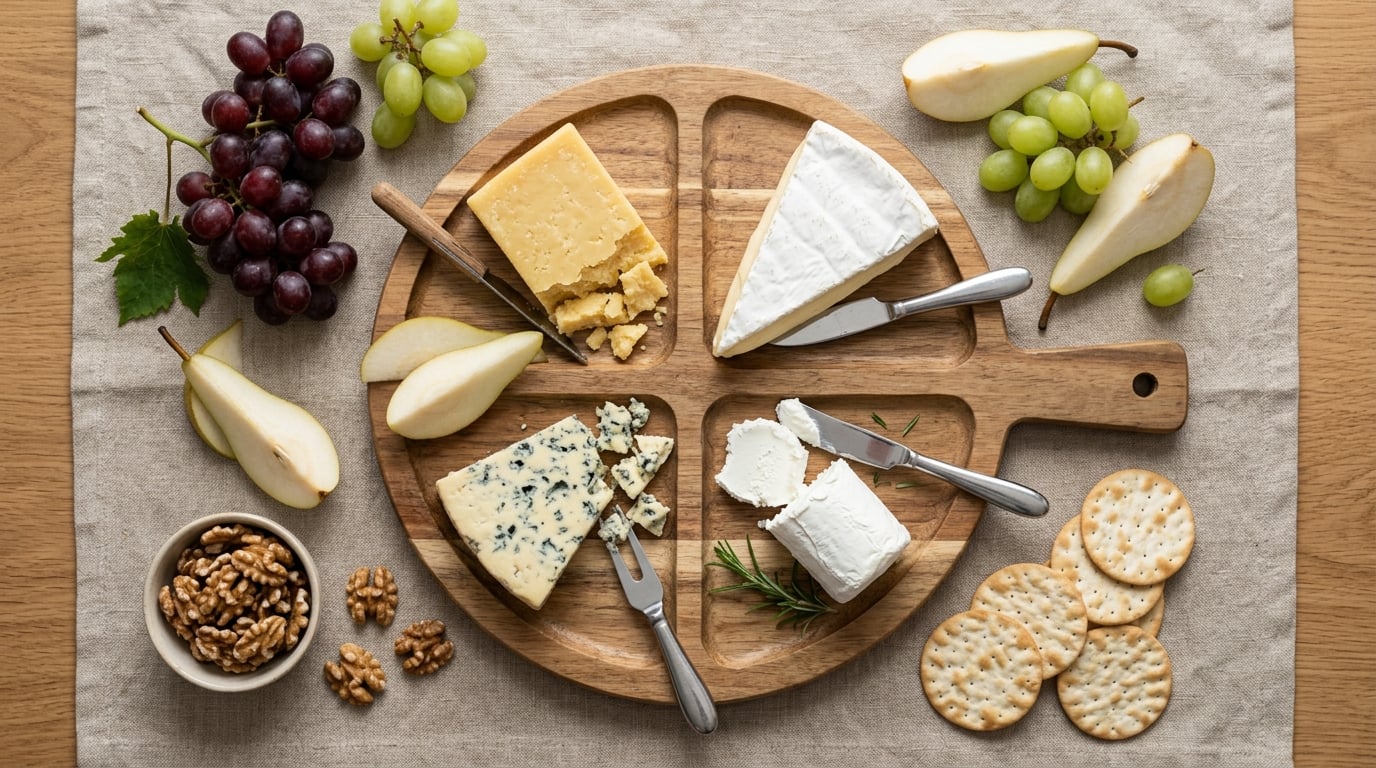
Cheeses go together on a board when they contrast, not when they match. If you are wondering what cheeses go together on a cheese board, build from five texture slots: a hard aged cheese, a semi-firm cheese, a soft-ripened cheese, a fresh or creamy cheese, and a blue or washed rind. Add one fruit, one nut, one cracker and one sweet or salty condiment to bridge them, and every guest gets a reason to try the next bite.
That framework is the whole answer. Names change, styles change, what you can buy changes with the season, but the shape of a good board does not.
The other half is how you taste. Put two cheeses on the same cracker, eat them one after the other, and the difference between them becomes obvious. That is how cheese people work, and it takes about four seconds. It also means a guest who dislikes one cheese has somewhere to go next, which is the real fix for the problem nobody admits to having: a crowd standing around the brie and ignoring the rest of the board.
A note before we go further. Some people do not like blue cheese or goat cheese, and nobody at your table has to eat either one. Build the board with an easy swap and nobody has to know about it.
Table of Contents
- How to Choose Complementary Cheeses
- Easy Cheese Pairings by Flavor
- Classic Cheese Board Combinations
- How Many Cheeses Do You Need for a Cheese Board?
- How to Arrange and Serve a Cheese Board
- Pairings to Avoid and How to Fix Them
- Frequently Asked Questions
- What are the best cheeses for a beginner cheese board?
- How many different cheeses should I put on a cheese board?
- Should all cheeses on a board be served at the same temperature?
- What crackers and fruit work best with a mixed cheese board?
- How do I keep cheeses separated on a serving board?
- What can I do with leftover cheese from a cheese board?
- Conclusion
How to Choose Complementary Cheeses
Complementary cheeses differ on three axes at the same time: texture, flavor intensity and milk type. Get all three right and the pair tastes deliberate. Miss any one and the board turns into a row of similar bites.
Texture is the biggest lever and the one beginners notice fastest. A crumbly aged cheese against a soft, bloomy-rinded one gives the mouth something to do. Two soft-ripened cheeses side by side just feel like the same cheese twice.
Intensity is the second lever. A pungent cheese needs a mild neighbor so you can still taste the mild one. Put a sharp washed rind next to a young mild cheddar and the cheddar disappears.
Milk type adds a finish most people can sense but not name. Cow milk tends to be buttery and long, sheep milk is nutty and salty, goat is grassy and tangy. Two cheeses from different milks register as different cheeses even when they share a texture, which is why a cow, sheep and goat board feels more varied than three cow-milk cheeses do.
Temperature matters more than most boards admit. Cold cheese mutes aroma and fat, so take the whole platter out of the fridge 45 minutes before guests arrive. A cheese straight from the fridge tastes flat next to the same cheese at room temperature.
How to Decide What Cheeses Go Together on a Cheese Board
Use this four-step process and you will have a balanced board on your counter in about ten minutes.
- Start with one familiar cheese. A mild cheddar, a gouda or a young Swiss. This is the anchor that keeps people eating while they work out the rest.
- Add one cheese with a completely different texture. If your anchor is firm and sliceable, make the second one soft and spreadable, or crumbly and hard. Contrast is the point.
- Add one bold or aged cheese. An aged cheddar, a long-aged hard cheese, a blue or a washed rind. One bold cheese is adventurous. Three bold cheeses is a dare.
- Add one milder or fresher option. A triple cream brie, a fresh goat cheese, a burrata or a ricotta. This is your escape hatch for the guest who does not want funk.
Then connect everything with three or four accompaniments. One fresh fruit, one toasted nut, one neutral cracker and one condiment such as honey, fig jam, whole-grain mustard or tapenade. Condiments do the heavy lifting on a board of unfamiliar cheeses: a smear of mustard or jam gives a guest somewhere to go with a cheese they cannot place.
Easy Cheese Pairings by Flavor
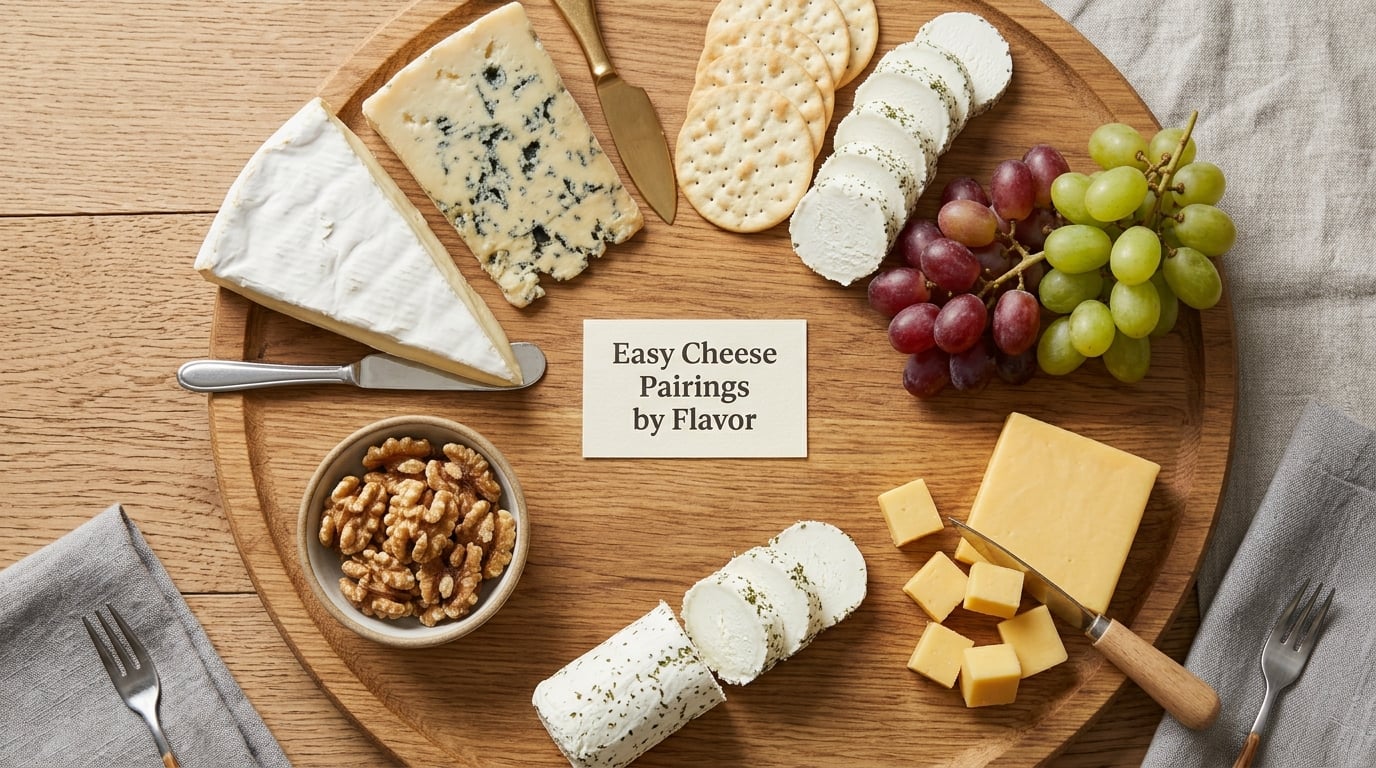
Here is where that framework turns into actual pairings, grouped by the flavor of the cheese that leads.
Creamy and mild cheeses. Triple cream brie, camembert, burrata and fresh goat cheese all share one weakness: on their own they are a little boring, so they need salt, acid or crunch. Triple cream brie is 75% butterfat and spreads like soft butter, so it takes a thin apple slice or a drizzle of hot honey better than anything heavy. Burrata wants tomatoes, basil and sea salt, or torn bread with olive oil. Fresh goat cheese is the most useful of the group because its tang cuts through fat, which makes it a good partner for a rich aged cheese next to it. Serve these close to room temperature so the fat actually registers.
Tangy and washed-rind cheeses. This group includes goat cheese with a washed or bloomy rind, Epoisses, Taleggio and washed-rind Brie. The flavors are savory, barnyard-adjacent and ammonia-sharp, which sounds alarming and is not. The trick is to pair them with something sweet and acidic rather than with more funk. Honeycomb, quince paste, cherry preserves and pickled shallots all work. Taleggio is the most forgiving of the lot and is genuinely good with a crisp apple and a glass of dry white. Serve these at room temperature too, since cold flattens the funk into something sour and unpleasant.
Sharp aged cheeses. Aged cheddar, Parmigiano Reggiano, aged Manchego, Gruyere and Pecorino belong here. Hard aged cheeses are crumbly, salty and nutty, and they are the anchor of most boards because they are familiar and easy to portion. They pair best with fruit that has some acidity, such as a ripe Bosc pear or a handful of dried figs, and with something bitter or herby to cut the salt: arugula, a little mustard seed, or a bitter green apple. Nutritionally, aged cheeses are also among the highest in calcium, which is a quiet bonus for anyone building a board as a snack rather than a meal.
Rich blue cheeses. Stilton, Gorgonzola, Roquefort and blue Brie all have the same structure: salt, cream and a sharp mold note. They are wonderful and they divide a room, so buy the smallest piece and pair it well. Honey, walnuts, a ripe pear and a dark, starchy cracker handle the salt. Coffee and dark chocolate work too, and a tawny port or a stout is the classic drink. If your group has one blue-phobe, this is the slot to fill with an aged goat cheese instead. Nobody will miss it.
| Cheese A | Cheese B | Why they work | Best drink |
|---|---|---|---|
| Aged cheddar | Brie or Camembert | Salty crumbly against soft bloomy rind, cow with cow but opposite textures | Light red wine or sparkling wine |
| Manchego | Fresh goat cheese | Nutty sheep-milk firmness against tangy grassy cream | Dry white wine or sparkling cider |
| Parmigiano Reggiano | Gorgonzola | Savory aged crunch balances salty blue cream | Tawny port or espresso |
| Camembert | Gruyere | Earthy washed rind next to nutty semi-firm cheese | Red Bordeaux or a light-bodied red |
| Burrata or ricotta | Pecorino | Milky mild freshness against salty hard sheep cheese | Sparkling wine or soda water with lemon |
| Smoked Gouda | Havarti or mild Brie | Smoke and a soft, mild, creamy finish that does not compete | Dry cider or chilled black lager |
| Stilton | Aged Gouda | Pungent blue and caramelized older Gouda, both firm enough to slice thin | Stout, tawny port or non-alcoholic cold brew |
Pick two or three rows from that table and you already have a board. Notice that almost every pair works because of contrast, not because the two cheeses share an origin or a style.
Classic Cheese Board Combinations
Four builds, each with a different purpose. Use them as written the first time, then swap in whatever you like.
The casual appetizer. Mild cheddar, a soft goat cheese, a wedge of Manchego and a small piece of Stilton. Add seed crackers, a few red grapes, Marcona almonds and a jar of fig jam. This one disappears in twenty minutes and works at any hour of the day. Served with cold beer or sparkling cider.
The wine-and-cheese evening. Brie, aged Gruyere, aged Manchego and a blue such as Stilton or Gorgonzola, plus a hard Parmigiano Reggiano if you want a fifth. Pair with a crisp white or a light red, and add sliced apple, Marcona almonds, whole-grain mustard and a baguette toasted with olive oil. The mustard is the piece most people skip and the piece that ties the whole board together.
The vegetarian gathering. Fresh goat cheese, a triple cream brie, a smoked Gouda, Halloumi and an aged Pecorino. Add Castelvetrano olives, dried apricots, roasted almonds, marinated artichoke hearts and a creamy herb dip. This board carries more weight as a meal, which matters if it is doing the job of dinner rather than a snack. Sparkling wine or a shrub over soda water both suit it.
The adventurous board. A washed-rind Epoisses, a goat cheese such as Valencay, a cave-aged Comte, an aged Crottin and a blue. Pair with honeycomb, aged balsamic, a spiced pear chutney and seeded crackers. Two things keep this one working: a mild cheese somewhere on the board, and a confident host who tastes the strong one first. If nobody goes near the washed rind, you have lost nothing, because the rest of the board is still good.
How Many Cheeses Do You Need for a Cheese Board?
Three to five cheeses is the right range for most home boards. Fewer than three and you have no contrast. More than six and guests taste in a daze, the strong cheeses crowd out the mild ones, and a lot of food goes uneaten.
The common rule of thumb is the 3-3-3: three cheeses minimum, three different textures, and about three ounces of cheese per guest. Some hosts add a fourth and a fifth cheese, which is fine, but the number of varieties matters less than the number of textures.
For quantities, work from portions rather than wedges:
- 2 to 4 guests: three cheeses, about 3 ounces per person, so roughly 9 ounces total. Buy a small piece of each.
- 5 to 8 guests: four cheeses, 3 ounces per person, roughly 24 ounces total. This is the most common size and the one that looks best on a board.
- 9 to 14 guests: five cheeses, 2 to 3 ounces per person, so about 30 ounces. Add one more accompaniment per person, because at that size people eat bread and fruit faster than cheese.
- 15 or more: two boards rather than one enormous one. A single crowded board slows down the line and guests stop trying things.
Count accompaniments separately. Fruit, crackers and nuts each need about a quarter of what the cheese does, so a 24-ounce cheese board wants roughly 6 ounces of fruit, a sleeve of crackers and a small bowl of nuts. Buying too much cheese is the most common mistake, and the leftovers are the least interesting part of hosting.
How to Arrange and Serve a Cheese Board
How to arrange and serve a cheese board is mostly about space, order and timing. A board that looks generous is usually under-filled in the middle and crowded at the edges, which is the opposite of what makes people reach for more.
Give each cheese its own space. Leave a couple of inches between piles so guests can lift a piece without disturbing the next variety. If cheeses touch, they merge visually and people assume the one underneath is the same as the one on top.
Order from mild to strong, left to right. Guests will naturally start at one end. Put the soft, mild cheese at the entrance and the blue or washed rind at the far end, and most people will sample in the right order without being told.
Portion before you serve. Cut wedges and blocks at the counter, not on the board. A hard cheese cut too thin disappears; cut 8 to 10 slices about a quarter inch thick, and if you are unsure how much that is, weigh the whole cheese before and after.
One utensil per cheese, and small ones. A hard cheese needs a proper knife, a soft cheese takes a small spreader. Sharing one knife between a mild and a strong cheese drags one flavor into the other, and guests notice even if they cannot name what is wrong. Label the cheeses if your group is unfamiliar with them; small cards or a folded napkin with the name written on it remove a lot of hesitation.
Temperature and timing. Take the cheese out of the fridge 45 minutes before serving. Keep crackers and cut fruit out until the last moment so they stay crisp. For food safety, treat the board as perishable food after two hours at room temperature, or one hour if the room is above 90 F, and put out the soft and washed-rind cheeses later rather than at the start of a long evening.
Pairings to Avoid and How to Fix Them
Five things go wrong on most home cheese boards. Each has a straightforward fix.
- Too many similar cheeses. Four semi-firm washed-rind cheeses look like abundance and taste like one cheese four times. Keep one per texture slot and swap the rest for something crumbly, creamy or hard.
- Everything at maximum strength. A board of only aged and blue cheeses intimidates half the guests, and the leftovers tell you who did not eat. Add one mild or fresh cheese and put it at the front of the board.
- No contrast in temperature. Cheese straight from the fridge tastes flat and dull. Give everything 45 minutes out.
- A crowded board. When cheeses touch and piles merge, guests sample one variety and move on. Space the piles out and use a larger board rather than stacking.
- Pairings that fight the cheese. Very sweet preserves with a pungent blue, or a heavy smoked cheese next to a delicate fresh goat cheese, makes both worse. Match intensity to intensity: sweet with strong, mild with mild.
A sixth one, less obvious: skipping the accompaniments entirely. Cheese on its own is a lot of salt and fat with nowhere to go, and a jar of mustard, a fruit preserve and a bowl of nuts are the cheapest way to make a board look generous.
Frequently Asked Questions
What are the best cheeses for a beginner cheese board?
Start with four: a mild cheddar, a soft goat cheese, a Brie or Camembert, and one aged hard cheese such as Parmigiano Reggiano or aged Manchego. Those four cover four different textures and three milk types, so the board already tastes varied. Add fruit, crackers and a nut, and skip the blue cheese until you are comfortable with it.
How many different cheeses should I put on a cheese board?
Three to five. Below three you lose the contrast that makes a board interesting, and above six guests taste in a daze and the strong cheeses crowd out the mild ones. The 3-3-3 rule is a good starting point: three cheeses minimum, three textures, about three ounces per guest. Scale the quantity with your guest list rather than adding more varieties.
Should all cheeses on a board be served at the same temperature?
Not quite. Take everything out of the refrigerator 45 minutes before serving, since cold suppresses aroma and fat. Beyond that, room temperature is right for soft-ripened, washed-rind and blue cheeses. Hard aged cheeses are fine slightly cooler, which means adding them at the last moment. Fresh cheeses like burrata and ricotta also do better cool than straight from the fridge.
What crackers and fruit work best with a mixed cheese board?
Choose neutral crackers: water crackers, rustic wheat crackers or a seeded variety that is not too sweet, so they do not fight the cheese. For fruit, go for balance: a ripe Bosc or Comice pear for hard and blue cheeses, green apple for creamy ones, grapes for crowd appeal and dried figs or apricots for aged cheese. Avoid very sweet fruit with a pungent blue.
How do I keep cheeses separated on a serving board?
Leave a couple of inches of empty board between each pile, and use a larger board rather than stacking more cheese in the same space. Serve soft or spreadable cheeses in small bowls, and give every cheese its own knife or spreader so one flavor is not dragged across the board. Small folded cards naming each cheese also reduce the chance that guests grab the first thing they see.
What can I do with leftover cheese from a cheese board?
Hard aged cheeses keep for weeks in the fridge and are good grated into pasta, folded into a frittata, scattered over roasted vegetables or stirred into risotto. Soft-ripened cheeses should be used within a few days, folded into pasta or spread on toast. Discard anything that smells ammonia-heavy, has darkened at the edges or has been at room temperature for more than two hours.
Conclusion
If you only remember one thing, remember the contrast. Pick cheeses that differ in texture, in strength and in milk type, rather than four versions of the same thing, and the question of what cheeses go together stops being hard.
Then add three or four accompaniments, arrange small portions with real space between the varieties, and take everything out of the fridge 45 minutes before anyone arrives. That is a board people eat well and remember, and it scales from three cheeses for a Tuesday to five for a full room.